CLICK HERE FOR A FREE TRADEMARK CONSULT!

Archives for July 2026

Incontestable Trademarks: How to Strengthen Your Federal Registration with a Section 15 Declaration

This statutory guide outlines the framework, 2026 fee schedules, and legal requirements for securing an incontestable trademark under 15 U.S.C. § 1065. It provides immediate operational workflows to help trademark owners file USPTO Section 15 Declarations seamlessly, convert prima facie evidence into conclusive proof of ownership, and permanently immunize active registrations against competitor descriptiveness attacks.

Originally Published: November 30, 2024 | Last Updated: July 13, 2026

By Michael Kondoudis, USPTO-Registered Attorney With 25+ Years of Trademark Experience

Inventor of the YNAT® Trademarking System | 3,000+ Trademarks & Patents Secured | Amazon #1 Best-Selling Author on Trademarks | Member of the Bar of the U.S. Supreme Court | Trademarks Made Easy®

After five years of continuous commercial use, federal trademark registrants can significantly strengthen their intellectual property protection. Filing a Section 15 declaration converts a federal trademark from a registration that offers prima facie (rebuttable) evidence of ownership into a registration that provides conclusive evidence of validity. This structural legal shift creates an elevated standard of protection, making the mark substantially more resilient against third-party competitor challenges.

What is an incontestable trademark?

An incontestable trademark is a federal registration on the USPTO’s Principal Register that serves as conclusive legal evidence of the ownership, validity, and the owner’s exclusive right to use the trademark in commerce. This status is governed by the Lanham Act (15 U.S.C. § 1065) and legally immunizes a brand against common competitor challenges, such as “merely descriptive” claims, after five years of continuous use.

Statutory Definition and Legal Framework

According to the Lanham Act (15 U.S.C. § 1065), obtaining incontestable status upgrades a mark’s evidentiary value from a rebuttable presumption (prima facie evidence) to conclusive legal proof. This statutory shift bars third-party competitors from challenging a trademark’s validity on the grounds that it is “merely descriptive.”

How Does a Trademark Become Incontestable?

A federal trademark becomes incontestable when the owner files a Section 15 Declaration with the USPTO and the statutory conditions set forth in the Lanham Act are met. In practice, most owners file the Section 15 Declaration together with the required Section 8 Declaration of continued use. This combined filing typically occurs between the fifth and sixth anniversaries of the registration date.

What is a Section 15 Declaration?

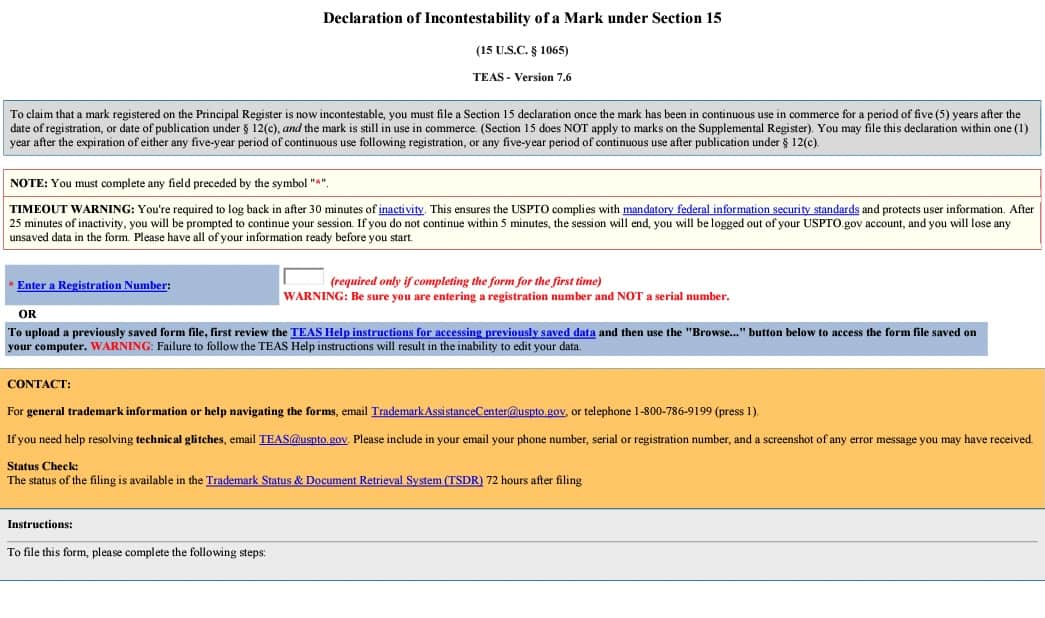
A Section 15 Declaration, also known as a “Declaration of Incontestability,” is a sworn statement filed by a trademark owner that declares the owner’s rights to a registered trademark are incontestable and that all requirements for incontestability have been met.

TEAS_Section_15

What Are The Exact Requirements to Achieve Trademark Incontestability?

To achieve incontestability, a trademark must be actively registered on the USPTO Principal Register and used continuously in interstate commerce for five consecutive years. Additionally, there must be no pending challenges, no final adverse legal decisions against the mark, and the owner must formally file a Section 15 declaration with fees.

To achieve incontestable status, a trademark owner must satisfy six strict legal criteria under 15 U.S.C. § 1065 simultaneously:

  • Principal Register Status: The target mark must be actively registered on the USPTO Principal Register; marks registered on the Supplemental Register are statutorily ineligible.
  • Five-Year Continuous Commercial Use: The mark must be actively used in interstate commerce for a minimum of five consecutive, uninterrupted years following its initial registration date.
  • Active Market Presence: The mark must remain in active commercial use on or in direct connection with the specific goods or services listed within the original federal registration.
  • No Final Adverse Decisions: There must be no final adverse legal or administrative decisions issued against the registrant’s claim of ownership, validity, or right to maintain the mark.
  • Clear Conflict Status: There must be no pending legal proceedings or active docket challenges involving the registrant’s rights to the mark within the USPTO or any federal court.
  • Active Formal Submission: The trademark owner must actively submit a signed electronic Section 15 Declaration form alongside the required class-based fees to the USPTO, as the upgrade is never granted automatically. The USPTO provides a specific TEAS form for this filing.

When Should a Trademark Owner File a Section 15 Declaration of Incontestability?

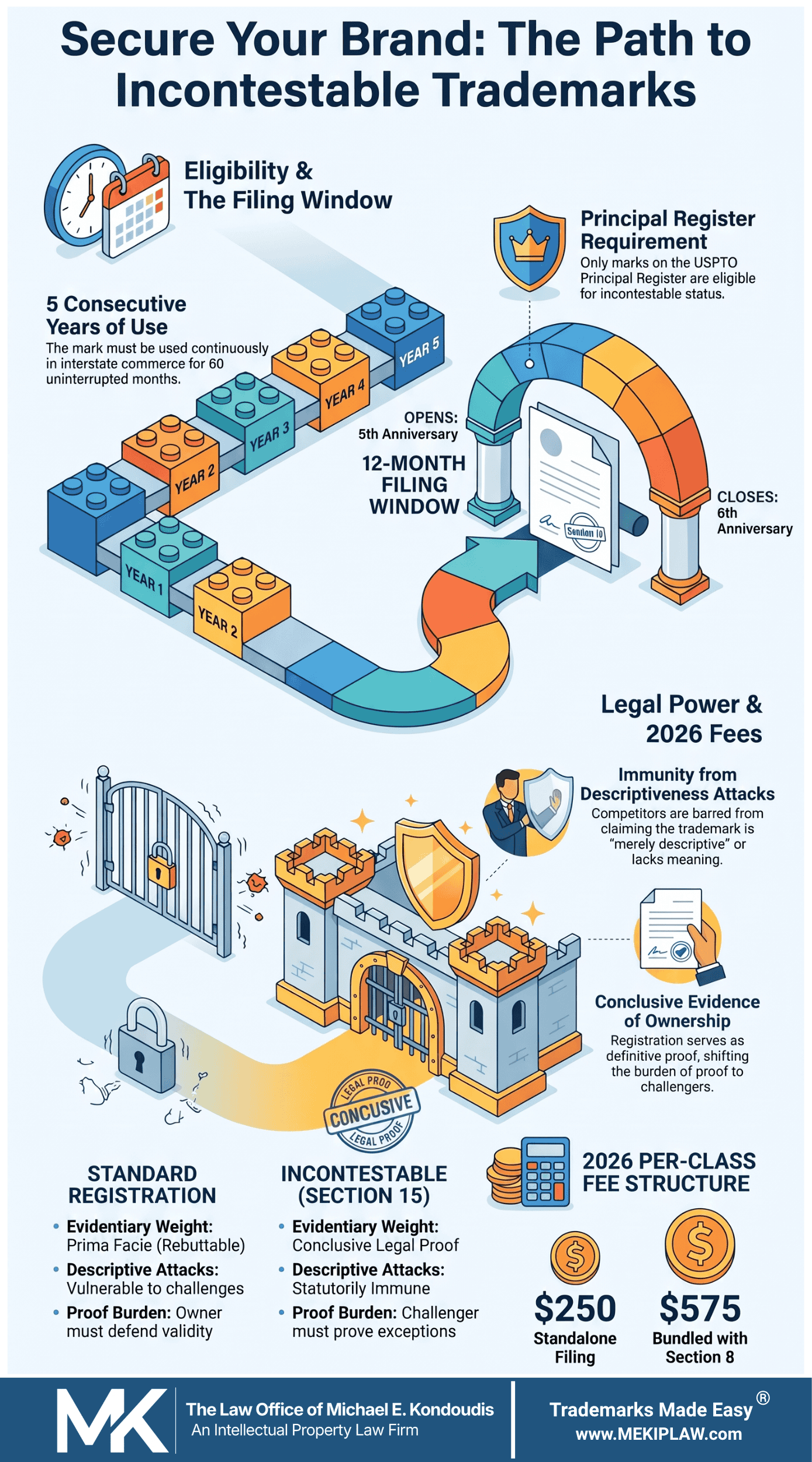
A strict window to file a Section 15 Declaration of Incontestability opens exactly on the 5th anniversary of your trademark’s registration date. The optimal timing is between the fifth and sixth anniversaries of the trademark’s registration date.

Filing during this 12-month period allows owners to combine the optional Section 15 Declaration with the mandatory Section 8 Declaration of Continued Use for maximum efficiency. If you miss this timeline, you may file a standalone Section 15 Declaration at any subsequent date, provided you have maintained five years of uninterrupted commercial use.

Filing Windows and Government Processing Timelines

The strict window opens exactly on the 5th anniversary of your registration date and closes on the 6th anniversary. Data from the official USPTO Post-Registration Dashboard reveals that the average post-registration action pendency is 53 days. Filing early within this 12-month window ensures timely processing before statutory deadlines lapse. While standalone filings are legally permissible at any point later in the life of the registration, delayed submissions leave the mark unnecessarily vulnerable to descriptiveness attacks for longer than required.

Data from the USPTO Post-Registration Dashboard reveals that average post-registration action pendency is 53 days, meaning early filing within this 12-month window ensures timely processing before statutory deadlines lapse.”

How Much Does It Cost to Obtain Incontestable Trademark Status in 2026?

Per the latest USPTO Fee Schedule changes, the USPTO’s fee structure operates on a per-class model. A standalone Section 15 declaration requires a $250 government fee per international class. Bundling it with the mandatory Section 8 declaration adds a $325 fee, creating a flat regulatory cost of $575 per class.

USPTO Filing Type2026 Government Fee (Per Class)Operational TimelineCore Legal Value
Standalone Section 15 Declaration$250.00 USDAny time after 5 years of continuous useUpgrades evidentiary weight from prima facie to conclusive.
Combined Section 8 & 15 Declarations$575.00 USDBetween 5th and 6th registration anniversaryMaximizes transactional efficiency by bundling mandatory retention and optional upgrade fees.

What Are The Main Benefits of Incontestable Status?

Incontestable status dramatically strengthens brand enforcement by providing conclusive evidence of ownership and granting immunity against descriptiveness attacks from competitors. This heightened legal leverage serves as a powerful litigation deterrent, reduces the financial costs of marketplace disputes, and elevates the value of a trademark. 

  • Conclusive Ownership Evidence: In federal litigation, a trademark owner is exempt from proving initial ownership or validity; the registration serves as definitive legal proof.
  • Descriptiveness Attack Immunity: Third-party competitors are legally barred from claiming that a trademark is “merely descriptive” or lacks secondary meaning.
  • Litigation Deterrence Power: The heightened legal status functions as a structural deterrent, frequently discouraging bad-faith actors or copycats from initiating litigation.
  • Enhanced Brand Asset Valuation: Conclusive statutory rights elevate the value of a trademark.

Can An Incontestable Trademark Be Challenged or Canceled?

Yes, incontestable trademarks can be challenged or canceled on strict, limited statutory grounds. Under 15 U.S.C. § 1115(b), an incontestable trademark can be canceled for genericide, permanent brand abandonment, fraud during the registration process, functional product design, or deceptive misrepresentation. 

  • Genericide: The brand name evolves into the common generic name for the product class (e.g., Escalator).
  • Abandonment: The trademark owner halts all commercial use with no intent to resume operations.
  • Fraud: The underlying registration or subsequent Section 15 form was obtained via willful deception of the USPTO.
  • Functionality: The design feature is essential to the physical engineering, utility, or purpose of the underlying product.
  • Misrepresentation: The mark is actively used to misrepresent the true geographic source of the goods or services.

Despite the name, an incontestable trademark is not entirely immune to being canceled.

What is the Difference Between a Standard Trademark and an Incontestable Trademark?

The structural differences between a basic registration and an incontestable upgrade directly impact enforcement leverage.

Legal & Operational AttributeStandard Trademark RegistrationIncontestable Trademark Registration (Section 15)
Statutory Authority15 U.S.C. § 1057(b)15 U.S.C. § 1065
Evidentiary WeightPrima facie (rebuttable presumption of validity)Conclusive evidence of ownership and exclusive rights
Vulnerability to Descriptiveness AttacksVulnerable; third parties can claim the mark is "merely descriptive"Immune; descriptive challenges are statutorily barred
Minimum Continuous Commercial UseNone required beyond active use in commerce5 consecutive years (60 continuous months)
Filing Availability WindowImmediately upon registration issuanceAnytime after 5 consecutive years of active registration
Optimal Filing Timing WindowWithin 3 months of dynamic USPTO allowanceBetween the 5th and 6th registration anniversary
USPTO Government Fee (Per Class)Included in baseline application fee ($250–$350)$250.00 USD (Standalone) / $575.00 USD (Combined with Sec. 8)
Litigation Burden of ProofShifts to the owner to defend validity if challengedShifts to the challenger to prove narrow statutory exceptions
Vulnerability to Abandonment ClaimsHigh; subject to standard non-use challengesModerate; remains vulnerable to active abandonment claims
Vulnerability to Fraud ChallengesSubject to cancellation if fraud is provenSubject to cancellation if fraud is proven

How do you get incontestable status?

You get incontestable status by filing a Section 15 Declaration of Incontestability with the USPTO, paying the required fee(s), and meeting all of the statutory requirements under 15 U.S.C. § 1065.  Incontestable status is not automatic.


Step-by-Step Guide: How to File a Section 15 Declaration

Follow this precise chronological workflow to submit a claim using the USPTO Trademark Electronic Application System (TEAS) portal:

  1. Perform Commercial Usage Audit: Verify the trademark has completed five consecutive, uninterrupted years of commercial use in interstate commerce across all listed international classes.
  2. Clear Conflict Status via Docket Search: Search USPTO and federal court dockets to confirm no final adverse decisions, pending legal proceedings, or active opposition challenges exist against the registration.
  3. Select Maintenance Filing Strategy: Determine whether to file a standalone Section 15 declaration ($250/class) or bundle it into a combined Section 8 and 15 maintenance application ($575/class).
  4. Gather Verifiable Physical Specimens: Collect real-world product packaging, labels, or digital screenshots demonstrating current commercial use for every active class if executing a combined Section 8 and 15 form.
  5. Complete Digital TEAS Form: Access the USPTO Trademark Electronic Application System (TEAS) portal, check all statutory boxes, and execute signed, sworn legal statements under penalty of perjury.
  6. Remit Class-Based Government Fees: Submit secure electronic payments through the USPTO portal reflecting 2026 pricing rules of either $250 per class (standalone) or $575 per class (combined).
  7. Monitor TSDR Approval Status: Transmit the digital application packet and track ongoing administrative processing milestones using the online Trademark Status and Document Retrieval (TSDR) database until formal acceptance.

What Are The Top Mistakes Trademark Owners Make When Applying for Incontestable Status?

Filing a Section 15 Declaration without legal counsel often leads to preventable processing errors, application rejections, or the unintentional vulnerability of your intellectual property.

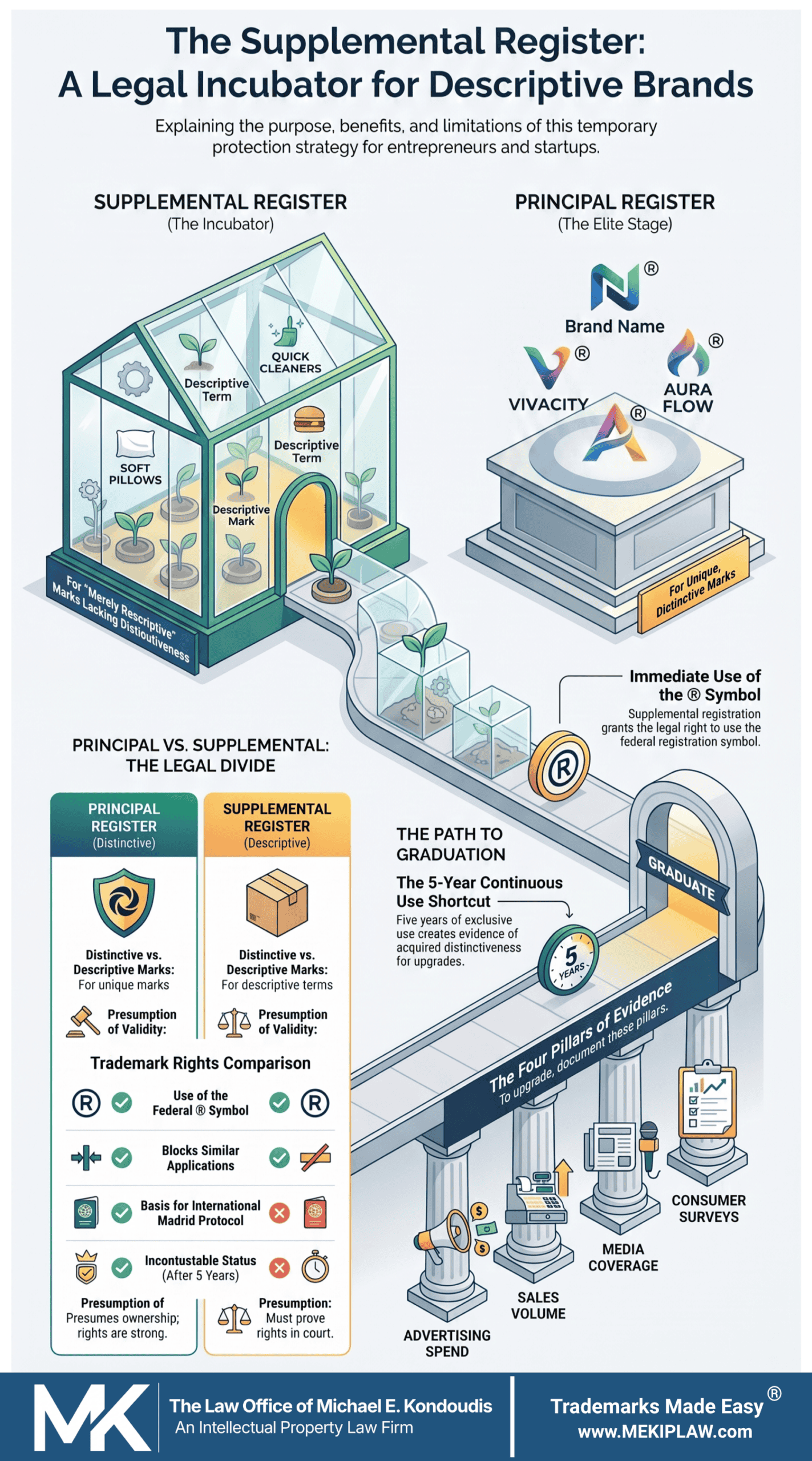
  • Filing a Section 15 Declaration for a Trademark on the Supplemental Register: Registrants frequently attempt to upgrade marks listed on the Supplemental Register. Statutory incontestability under 15 U.S.C. § 1065 applies exclusively to marks on the USPTO Principal Register.

  • Filing a Section 15 Declaration When There Is a Legal Dispute: Many DIY filers submit the declaration while a minor trademark dispute or a pending USPTO opposition proceeding is open. Any active challenge immediately invalidates a Section 15 claim and risks a fraud accusation.

  • Filing a Section 15 Declaration Too Early: Registrants often file exactly on the 5th anniversary of their use date rather than waiting for five consecutive years from the official registration. Early filings are void and non-refundable.
  • Filing a Section 15 Declaration With False Information: Many DIY filers claim “continuous use” when the mark was actually paused, or when it was only used on some of the listed products rather than all of them. Filing a false Section 15 Declaration invalidates a trademark registration

  • Submitting Invalid Specimen Types: When combining Section 8 and 15 filings, DIYers commonly upload digital printer proofs, mockups, or website homepages lacking a clear purchase mechanism. The USPTO requires real-world photos of labels, tags, or point-of-sale displays.

  • Ignoring Class-Based Fee Multiplication: DIY filers often miscalculate budgets by assuming the $250 or $575 fee covers the entire trademark. Fees apply per international class; a three-class registration costs triple the baseline fee.

  • Failure to Track TSDR Post-Submission: Many owners assume the filing is complete upon payment. If the USPTO issues an Office Action requesting clarification, missing the response deadline results in the total abandonment or cancellation of the trademark registration.
  • Neglecting Post-Filing Renewals: Assuming incontestable status eliminates future upkeep obligations; registrants must still execute mandatory Section 8 and Section 9 renewals at strict 10-year intervals.

Working with experienced counsel and maintaining good internal records of use significantly reduces these risks.

Incontestable Trademarks FAQ: Common Questions on Section 15 Declarations

This Incontestable Trademark FAQ section provides clear, direct answers on trademark incontestability and how to obtain one. Use these expert-verified legal insights to understand the advantages and specific legal requirements for incontestability.


Q: Is a Section 15 declaration mandatory for USPTO trademark owners? 

No. Filing a Section 15 declaration is completely optional. However, corporate brand owners execute this post-registration filing as soon as eligibility criteria are met because it permanently upgrades the mark’s legal standing from a rebuttable presumption to conclusive proof of exclusive ownership under 15 U.S.C. § 1065. 


Q: What happens if a trademark owner misses the 5-to-6-year filing window?

Missing the 5-to-6-year anniversary window does not invalidate your eligibility. You can legally file a standalone Section 15 declaration at any point later in the lifecycle of the registration, provided the mark has completed 5 consecutive years of continuous commercial use and maintains a clear conflict status. 


Q: Does incontestable trademark status provide international brand protection?

No. Incontestability is strictly a domestic U.S. federal benefit valid only within United States jurisdictions. Securing enforceable brand protection across foreign markets requires distinct national applications filed directly with individual foreign trademark offices or managed globally via the Madrid Protocol system.
 

Q: Can a Section 15 declaration be filed if certain goods or services were deleted from the registration?

Yes. Registrants can file a Section 15 upgrade on registrations where the scope of goods or services has been narrowed. However, the resulting conclusive evidentiary protections apply exclusively to the active, remaining goods and services for which the mark has maintained uninterrupted commercial use. 
 

Q: How long does incontestable trademark status last?

Once granted by the USPTO, incontestable status remains valid for the entire active life of the trademark registration. To maintain this status indefinitely, the owner must satisfy ongoing maintenance requirements by filing a Section 8 declaration between the 5th and 6th years and formal renewals every 10 years under Section 9.


📌 Key Takeaways: Getting Incontestable Trademarks

  • Conclusive Evidentiary Weight: Filing a Section 15 declaration converts your trademark’s legal standing from a rebuttable presumption (prima facie evidence) to conclusive proof of exclusive ownership under 15 U.S.C. § 1065.

  • Immunity From Descriptiveness Attacks: Once incontestable, unauthorized third parties are statutorily barred from challenging your registration on the grounds that it is “merely descriptive.”

  • 5-Year Continuous Use Minimum: To qualify, the mark must be actively used in interstate commerce for 5 consecutive years (60 uninterrupted months) post-registration with no active legal disputes.

  • 12-Month Optimal Filing Window: The most efficient operational window opens on the 5th anniversary of registration and closes on the 6th anniversary, aligning perfectly with your mandatory Section 8 maintenance filing.

  • Per-Class 2026 Fee Structure: The USPTO requires a $250 government fee per international class for standalone Section 15 filings, or a bundled total of $575 per class when combined with a Section 8 declaration.

  • No Permanent Absolute Immunity: Incontestable marks can still be canceled under 15 U.S.C. § 1115(b) if an adverse party proves genericide, fraud, 3 years of continuous abandonment, or functional product design.

About the Author and Why You Can Trust This Guide

This guide is written by Michael Kondoudis, the founder of The Law Office of Michael E. Kondoudis® and inventor of the proprietary YNAT® Trademarking System.

The YNAT® Trademarking System powers the firm’s signature Trademarks Made Easy® approach. This methodology is built on four core principles:

  • Efficient, streamlined processes that minimize time, cost, and friction for clients
  • Clear, transparent, and proactive communication at every stage
  • Long-term client relationships centered on sustainable brand protection and business growth
  • Practical, results-driven strategies that deliver real, measurable business value—rather than unnecessary complexity or litigation

Michael E. Kondoudis is a USPTO-registered trademark and patent attorney with more than 25 years of experience protecting trademarks for clients across the United States and internationally. He is also a rocket scientist and an Amazon #1 bestselling author on trademark topics.

As Principal of The Law Office of Michael E. Kondoudis®, he has helped clients secure more than 3,000 trademarks and patents.

The goal of this guide is to deliver actionable clarity so you can make confident, well-informed decisions about protecting your logo.

Want To Protect Your Podcast?

FREE Strategy Consultations • FLAT FEE Trademark Applications

📘 Core Definitions & Legal Framework

  • Incontestable Status: A heightened statutory protection converting a trademark registration’s evidentiary weight from a rebuttable presumption to conclusive legal proof.
  • Lanham Act (15 U.S.C. § 1065): The foundational federal statute governing the requirements and limitations for a trademark to achieve incontestability.
  • Section 15 Declaration: An optional legal document submitted by a trademark registrant to formally establish incontestable rights after five consecutive years of use.
  • Principal Register: The primary federal database for distinctive trademarks; only marks registered here qualify for incontestability.
  • Conclusive Evidence: Legal proof that bars third parties from challenging core attributes of a trademark, such as its distinctiveness or ownership.

How To Trademark A Podcast: An EASY Guide

Federal trademark registration with the USPTO gives you strong nationwide exclusive rights to your podcast name, prevents competitors from using confusingly similar titles, and accelerates digital platform takedowns. This comprehensive operational manual outlines the precise legal criteria, current official United States Patent and Trademark Office (USPTO) fee structures, and the step-by-step clearance framework required to successfully protect a podcast brand.

Originally Published: June | Last Updated: 

By Michael Kondoudis, USPTO-Registered Attorney With 25+ Years of Trademark Experience

Inventor of the YNAT® Trademarking System | 3,000+ Trademarks & Patents Secured | Amazon #1 Best-Selling Author on Trademarks | Member of the Bar of the U.S. Supreme Court | Trademarks Made Easy®

Roadmap: An Overview of Federal Podcasting Trademarks

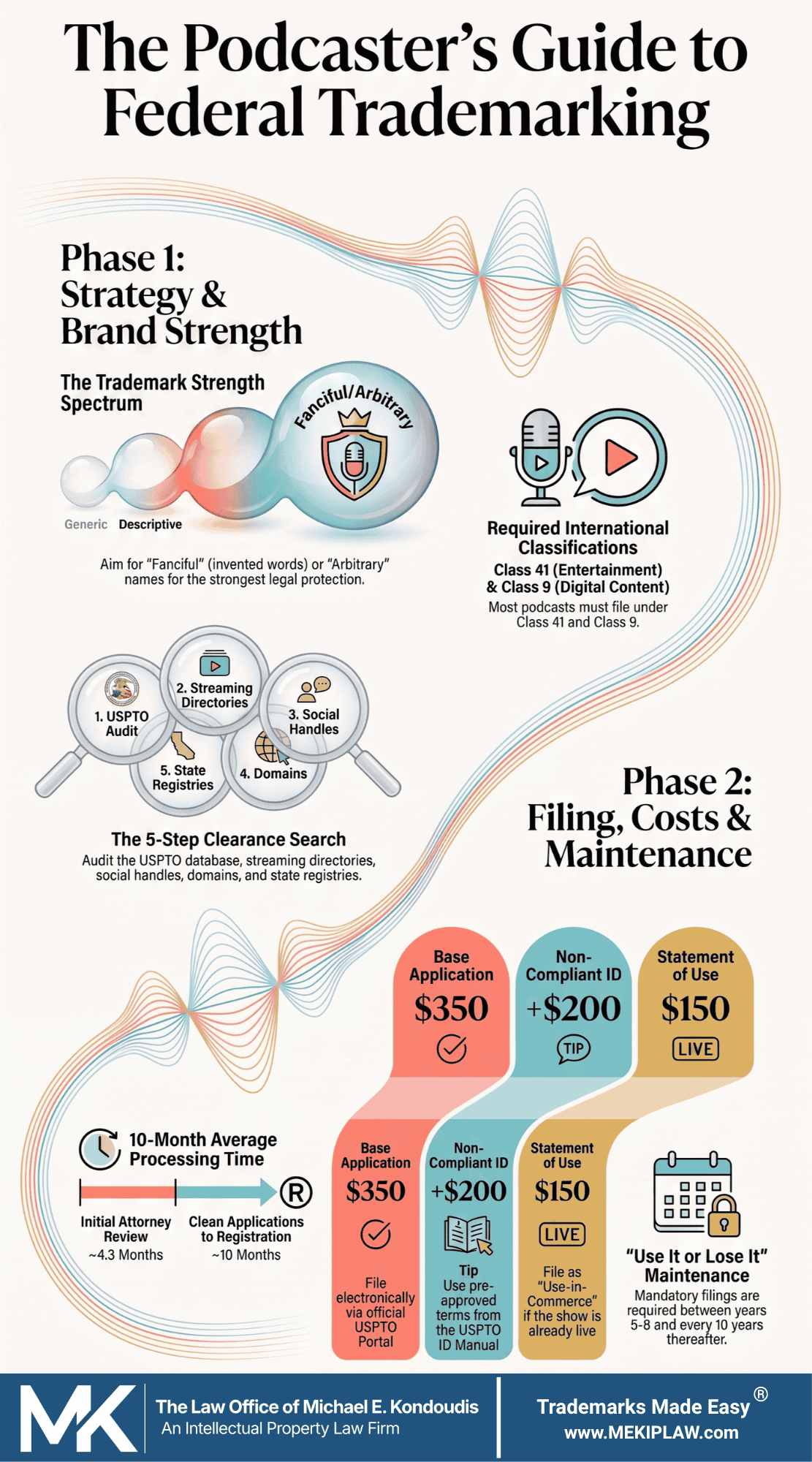
Before diving in, here is a quick visual blueprint mapping out the Trademark Strength Spectrum, required trademark classes, and typical costs associated with the process.

What is a Podcast Trademark and How Does It Protect Your Show?

A podcast trademark is a legally protected word, name, symbol, logo, or slogan that functions as a source identifier for a branded series of entertainment content.

  • Primary Function: Prevents public consumer confusion.
  • Market Utility: Distinguishes a media asset from competitors.
  • Core Protection: Secures nationwide exclusive branding rights.
  • Platform Advantage: Accelerates enforcement on Apple Podcasts and Spotify.
 

[Podcast Trademark] ──> Acts as ──> [Source Identifier] ──> Prevents ──> [Consumer Confusion]

A registered federal trademark protects your podcast brand identity nationwide across state lines. If a competitor launches an unauthorized show with a confusingly similar title, a federal registration provides the definitive legal leverage required to execute immediate platform-level takedowns on Apple Podcasts, Spotify, and YouTube.

Trademark Protection vs. Copyright Protection for Podcasts

  • Podcast Trademarks protect source-identifying elements like titles, brand names, unique segment names, and visual logo designs. Individual podcast titles are not protectable by copyright law alone.
  • Podcast Copyrights automatically protect specific creative expressions under Title 17 of the U.S. Code, including individual episode scripts, audio recordings, show notes, and original episode cover artwork.

Common Law Rights vs. Federal USPTO Trademark Registration

  • Common Law Podcast Rights arise automatically from actual commercial use within a local geographic market. Enforcement requires the podcaster to manually prove priority of use and actual consumer confusion in court.
  • Federal USPTO Registration establishes nationwide constructive notice and a legal presumption of valid brand ownership. It grants you the exclusive right to use the official ® symbol and enables fast-track digital platform enforcement.

Real-World Examples of Registered Podcast Trademarks

Conversational interview and audio entertainment formats successfully utilize federal trademark protection to build long-term brand equity: 

U.S. Trademark No. 6,431,433 for CRIME JUNKIE covering class 41 entertainment services. This is a real-world example of successful podcast name registration.

U.S. Trademark No. 7,310,681 for SmartLess covering downloadable podcasts, entertainment services, and clothing. A real example of a protected podcast brand name.

These examples demonstrate how a memorable, distinctive name combined with professional branding can achieve full federal trademark protection.

Can I Trademark a Podcast Name Under U.S. Law?

Yes, creators can register a federal trademark for a podcast name because the USPTO treats podcasts as an ongoing series of entertainment services. Unlike a single creative work—such as an individual book title or a standalone movie—a serial podcast qualifies for federal protection if it fulfills three core criteria:
  1. Brand Distinctiveness: The title must actively function as a unique brand source identifier rather than a generic description.
  2. Interstate Commerce: The creator must stream, distribute, or market the show to listeners across state lines or international borders.
  3. Accurate International Classification: The application must correctly identify the corresponding classes and service descriptions.

The Trademark Strength Spectrum for Podcast Titles

The legal protection a podcast title receives depends directly on where the name falls across the five tiers of the trademark strength spectrum:

[WEAKEST] Generic —> Descriptive —> Suggestive —> Arbitrary —> Fanciful [STRONGEST]

  • Fanciful Podcast Marks (Strongest): Coined, invented words like “Zynpod” or “Podly”.
  • Arbitrary Podcast Marks (Strong): Real words used in an entirely unrelated context, such as “Ocean” for a history podcast.
  • Suggestive Podcast Marks (Moderate): Words that hint at the underlying content without directly describing the theme, such as “Crime Junkie”.
  • Descriptive Podcast Marks (Weak): Words that explicitly describe the show format, such as “Daily True Crime Podcast”. Descriptive marks require extensive secondary meaning to achieve registration.
  • Generic Podcast Marks (Unregistrable): Common category terms like “Podcast” can never obtain trademark protection.

Learn more about The 5 Types of Trademarks in this blog post.

What Trademark Classes Should You Use for a Podcast?

Podcasters must file their brand applications under specific international classifications to govern the legal scope of their brand protection. Selecting the proper classes dictates the application’s legal strength and total filing fees.

Core Podcast Classifications

  • International Class 41 (Entertainment Services): Covers the production, distribution, hosting, and presentation of ongoing serial podcasts.
  • International Class 9 (Downloadable Digital Content): Covers downloadable podcasts, audio recordings, video files, and associated media content.

Multiple classes may be needed: Depending on your podcast’s specific use, you might need to file in both Class 9 and Class 41 to fully protect your brand. 

Expansion Podcast Classifications

  • International Class 25 (Apparel & Merchandise): Protects branded clothing, hats, and physical streetwear.
  • International Class 35 (Advertising & Sponsorships): Covers promotional services, paid sponsorships, and marketing partnerships.
  • International Class 16 or 21 (Printed/Physical Goods): Covers books, journals, mugs, or specialized physical merchandise.

Strategic Filing Bases: Section 1(a) vs. Section 1(b)

Applicants must designate a strategic filing basis depending on the operational status of the podcast:
  • Use-in-Commerce Basis (Section 1(a)): Use Section 1(a) if the podcast is currently live, broadcasting, and actively distributed to the public across state lines. You must submit a “Specimen of Use”—such as an unedited screenshot of your show listing on Apple Podcasts or Spotify.
  • Intent-to-Use Basis (Section 1(b)): Use Section 1(b) if the podcast show is in a pre-launch or planning phase. This reserves your naming priority nationwide during production. It requires the subsequent filing of a Statement of Use (SOU) once the show goes live.

How Do You Check If a Podcast Name Is Already In Use?

Creators must run a comprehensive clearance search to discover senior users and avoid application rejections or trademark infringement disputes.

A clearance search starts with a preliminary review of the USPTO’s trademark registration database via the USPTO.gov website.

The 5-Step Podcast Trademark Clearance Search Process

  1. Search the USPTO Database: Run exact and phonetic queries on the official database via the USPTO Trademark Search Portal across Classes 9, 25, 35, and 41.
  2. Audit Streaming Directories: Manually search Apple Podcasts, Spotify, YouTube, and Google to identify active, unregistered shows.
  3. Verify Social Media Handles: Check profile availability across major networks like Instagram, TikTok, X (Twitter), and YouTube.
  4. Confirm Root Domain Availability: Search the root .com URL availability using a standard domain registry.
  5. Scan Local State Databases: Review local state-level corporate and trademark registries for unregistered local businesses.

When choosing a podcast name, it is essential to make sure that there are no other podcasts with names that match or are similar to yours. Read why a trademark search is essential.

Checklist: How to Trademark Your Podcast Name in 8 Steps

Follow this quick-reference operational roadmap to file a clean, accurate federal application:

  1. Select a Distinctive Name: Prioritize fanciful, arbitrary, or suggestive titles over generic descriptors.
  2. Run Clearance Searches: Audit federal, common law, digital directory, and social media registries early.
  3. Identify Target Classes: Define the application scope starting with Class 41 and Class 9.
  4. Determine Your Filing Basis: Opt for a 1(a) Live or 1(b) Pre-launch application.
  5. Draft a Compliant Description: Utilize pre-approved terms directly from the USPTO Trademark ID Manual to prevent added costs.
  6. Submit the Base Application: File the completed forms electronically through the official USPTO platform.
  7. Respond to Office Actions: Address any administrative clarifications or descriptiveness arguments issued by the examining attorney.
  8. Maintain Your Registration: Actively police the market and submit mandatory legal maintenance documents periodically.

What Are the Steps and Costs to Trademark a Podcast?

Filing fees are calculated on a per-class basis, and custom service descriptions trigger mandatory federal surcharges.

USPTO Trademark Fees Overview

Per-class fees for standard electronic filings • Strategies to avoid extra costs

Fee TypeCost
(Per Class)
Fee Trigger ConditionCost Avoidance Strategy
Base Application Fee$350Standard electronic application filingAlways file via the official USPTO Portal.
Insufficient Information Surcharge$100Omitting required data or missing filing fieldsComplete all sections, signatures, and fields upfront.
Non-Compliant ID Surcharge$200Using custom, free-form descriptions of servicesAdopt verbatim terms from the USPTO Trademark ID Manual.
Statement of Use (SOU)$150Required for Intent-to-Use (1(b)) filingsFile as a 1(a) Use-in-Commerce mark if already live.
Section 8 Declaration of Use$325Required maintenance between years 5 and 6Mark deadlines early to avoid automatic cancellation.

Note: Fees are subject to change. Always verify current fees on the official USPTO website.

How Long Does It Take to Register a Podcast Trademark?

Trademark prosecution is a multi-month regulatory process governed by application volume and description complexity.

  • First USPTO Office Action: Examining attorneys take an average of 4.3 months to issue an initial review.
  • Total Pendency (Straightforward Case): Uncontested applications average 9.9 to 10 months from initial filing to approved registration.
  • Total Pendency (Complex Case): Applications facing office actions, descriptiveness challenges, or third-party oppositions span 12 to 18 months.

How Do You Maintain and Enforce Your Trademark After Registration?

Federal trademark registrations last for 10 years and can be renewed indefinitely if owners comply with strict “use it or lose it” rules:
  • Registration Years 5–6: Owners must file a Section 8 Declaration of Use alongside a physical specimen showing active commercial use.
  • Registration Years 9–10 (And Every 10 Years Thereafter): Owners must file a combined Section 8 Declaration of Use and Section 9 Application for Renewal. Failure to submit these documents results in automatic registration cancellation.

Enforcement Procedures

Registered owners are legally required to police their own marks. If an unauthorized creator launches a confusingly similar show, the owner can issue formal cease-and-desist letters. Because major platforms like Apple Podcasts, Spotify, and YouTube maintain strict policies against misleading content, federal registration accelerates your digital takedown requests.

Why Should You Trademark Your Podcast Name?

You should trademark you podcast name because trademarks offer the best protection for names, including podcast names. You’ll get:

  • Legal Protection: A registered trademark grants you exclusive rights to use your podcast name, preventing others from using a confusingly similar name. This legal protection safeguards your brand identity and prevents consumer confusion in the marketplace.
  • Brand Recognition and Credibility: A trademarked name enhances brand recognition and credibility. It signals professionalism, quality, and a commitment to your podcast, potentially attracting more listeners and sponsors.
  • Monetization Opportunities: A registered trademark strengthens your position when negotiating sponsorships, merchandise collaborations, licensing agreements, and other monetization avenues.
  • Enforcement and Remedies: With a registered trademark, you have legal recourse against infringers using a similar name. You can seek damages, injunctive relief, or other remedies to protect your brand.

Securing a trademark grants you exclusive rights to use the name, preventing others from using a similar name for their podcast. A trademark safeguards your brand identity, ensuring your audience can consistently recognize your content. Also, if a dispute should arise, having a trademark strengthens your legal position.

📥 Podcast Trademark FAQ: Real Answers for Podcasters Protecting Their Brand

This podcast trademark FAQ section provides clear, direct answers to the most commonly asked questions about how to protect a podcast name with a federal trademark registration from the USPTO. Whether you’re pre-launch or already live on Apple, Spotify, and YouTube, these answers will help you make confident decisions.


Q: Can I trademark my podcast name in the United States?

Yes. The USPTO treats an ongoing podcast as a series of entertainment services, so distinctive podcast names, logos, and slogans can qualify for federal trademark registration. To succeed, your mark generally needs to be distinctive (not generic), used (or intended for use) in interstate commerce, and properly classified.


Q: What exactly does a federal trademark protect for a podcast?

A federal trademark protects the source-identifying elements of your brand — primarily your podcast name, logo (design mark), and slogan/tagline. It does not protect the actual audio content, episode scripts, or individual episode artwork (those are protected by copyright). Registration gives you nationwide rights, the legal presumption of ownership, the right to use the ® symbol, and much faster enforcement on major platforms.


Q: How much does it cost to trademark a podcast name in 2026?

The base federal fee to trademark a podcast name is $350 per international class, provided you submit a complete electronic application via the official USPTO Portal. Total costs depend entirely on the number of classes selected and the accuracy of your filing. To maintain compliance and prevent expensive out-of-pocket surcharges, review this structured fee breakdown:
    • Base Application Fee: $350 per class for standard electronic submissions utilizing pre-approved terms.
    • Non-Compliant ID Surcharge: An extra $200 per class if you use custom, free-form descriptions of your services instead of terms from the USPTO Trademark ID Manual.
    • Insufficient Information Surcharge: An extra $100 per class if you omit required administrative data, signatures, or mandatory filing fields.
    • Statement of Use (SOU): $150 per class, required only if you initially file your podcast under a pre-launch, Intent-to-Use basis.
    • Section 8 Declaration of Use: $325 per class, required for legal maintenance between years 5 and 6 post-registration.


Q: How long does it take to register a podcast trademark?

A straightforward, uncontested podcast trademark application takes an average of 9.9 to 10 months to reach final registration from the initial filing date. The overall timeline depends heavily on application volume and the complexity of your service descriptions. The process moves through distinct regulatory phases:
    • Initial Review: A USPTO examining attorney takes an average of 4.3 months to perform the first evaluation of your application.
    • Office Actions: If the examiner issues administrative clarifications or descriptiveness arguments, you have three months to respond, which extends total processing time to 12 or 18 months.
    • Final Approval: Clean applications without third-party oppositions bypass delays and move directly from review to final registered status.


 Q: What trademark class is a podcast under?

Most active podcasts must file under International Class 41 (Entertainment Services) and International Class 9 (Downloadable Digital Content) to secure comprehensive brand protection. Selecting the correct classes establishes the exact legal scope of your enforcement rights. Depending on how you monetize and scale your media asset, you can select from core and expansion classifications:
    • International Class 41: Covers production, distribution, hosting, and presentation of ongoing serial podcasts.
    • International Class 9: Covers downloadable podcast episodes, audio recordings, video files, and associated digital media content.
    • International Class 25: Protects your brand expansion into apparel, clothing items, hats, and physical streetwear.
    • International Class 35: Covers promotional advertising, paid sponsorships, and marketing partnerships.
    • International Classes 16 or 21: Protects physical merchandise such as branded books, journals, or mugs.

Filing in the right classes determines the scope of your protection and your total fees.


Q: How do I check if a podcast name is already taken or trademarked?

Follow a thorough 5-step clearance process:

  1. Search the USPTO database (TESS) for exact and phonetic matches in relevant classes.
  2. Manually check major platforms (Apple Podcasts, Spotify, YouTube, Google).
  3. Verify social media handle availability.
  4. Check domain name availability (.com).
  5. Review state business/trademark registries.

A basic free search is a good start, but a professional comprehensive search (including common-law uses) is strongly recommended before investing in an application.


Q: Can someone steal my podcast name if it’s not trademarked?

Yes, without a federal registration, a competitor can launch a show with a confusingly similar name, and stopping them requires navigating highly restrictive common-law rules. While common-law trademark rights do arise automatically from actual commercial use, their protection is limited and difficult to enforce. Understanding the distinction between local common-law rights and a registered federal trademark helps outline your legal leverage:
    • Geographic Limits: Common-law rights only protect your brand within your immediate, local geographic market. Federal registration establishes nationwide constructive notice across all state lines.
    • Burden of Proof: Under common law, you must manually prove priority of use and actual consumer confusion in court to stop an infringer. Federal registration provides a legal presumption of valid brand ownership.
    • Platform Enforcement: Digital platforms require complex legal proof to handle common-law disputes. A federal registration gives you immediate leverage to execute fast-track takedowns on Apple Podcasts, Spotify, and YouTube.

Q: Can I trademark a descriptive podcast name (e.g., “True Crime Daily”)?

Descriptive names are weak and often face refusal unless you can prove “acquired distinctiveness” (secondary meaning) through extensive use and recognition. Suggestive, arbitrary, or fanciful names (e.g., “Crime Junkie” or coined terms) are much stronger and easier to register. The trademark strength spectrum runs from generic (unregistrable) → descriptive → suggestive → arbitrary → fanciful (strongest).


Q: Should I also trademark my podcast logo?

Yes. A distinctive logo can (and should) be protected as a design mark or combined word + design mark. This protects the visual identity of your brand in addition to the name. You can file the name and logo together or in separate applications depending on your strategy.


Q: Can I trademark a podcast name before launching?

Yes, you can reserve nationwide priority for your podcast name before launching by filing a Section 1(b) Intent-to-Use application with the USPTO. This legal framework secures your naming rights during production and prevents copycats from taking the title before your first episode drops. The process varies depending on your operational status:
    • Intent-to-Use Basis (Section 1(b)): Select this if your show is in a pre-launch or planning phase to lock in your priority date nationwide. It requires submitting a Statement of Use (SOU) and a screenshot specimen once the show goes live.
    • Use-in-Commerce Basis (Section 1(a)): Select this if your podcast is already live, broadcasting, and distributed to the public across state lines. You must submit an unedited specimen of use, like a screenshot of your show listing on Apple Podcasts or Spotify, at the time of filing.

Q: Is it better to file a trademark before or after launching my podcast?

Yes. Many podcasters file on an intent-to-use basis early to lock in rights before investing heavily in branding and distribution.


Q: What if another podcast already uses a similar name but hasn’t trademarked it?

You still face risk. The other show may have common-law rights in their geographic area of use. A thorough clearance search helps you assess the risk. Federal registration gives you stronger nationwide rights and makes platform enforcement much easier if conflicts arise later.


Q: How does trademarking help protect my podcast on Spotify, Apple Podcasts, or YouTube?

Major platforms have policies against misleading or infringing content. A federal USPTO registration creates a strong presumption of ownership and significantly accelerates takedown requests when someone launches a confusingly similar show.


Q: What maintenance is required after my podcast trademark registers?

Federal registrations last 10 years and can be renewed indefinitely, but you must:

  • File a Section 8 Declaration of Use (with specimen) between years 5–6.
  • File combined Section 8 + Section 9 renewal every 10 years thereafter.

You must continue using the mark in commerce — “use it or lose it” is strictly enforced.


Q: Do I really need a trademark attorney, or can I file myself?

You can file yourself, but it is risky. Mistakes with classification, descriptions, or responses to office actions are common and the government fees are non-refundable. An experienced USPTO-registered trademark attorney significantly increases approval chances, helps you choose the strongest strategy, and handles office actions efficiently.


Q: Can I trademark my podcast slogan or recurring segment names?

Yes, if they function as source identifiers and are distinctive. Many successful podcasts protect taglines and unique recurring segment names in addition to the main show title.


Q: What happens if the USPTO issues an office action on my application?

You’ll receive a written refusal or request for clarification (often for descriptiveness or minor formal issues). You generally have three months to respond with arguments, evidence, or amendments. Many applications overcome office actions successfully with proper responses.


Q: Is trademarking a podcast worth it for smaller or newer shows?

Yes. Even independent podcasters benefit from:

  • Preventing future expensive rebrands or disputes.
  • Building long-term brand equity and credibility with sponsors/listeners.
  • Faster platform enforcement.
  • Creating a valuable business asset.

The cost is modest compared to the risk of losing your name or dealing with confusion later.


Q: Can I get international trademark protection for my podcast?

Yes. After securing a U.S. registration (or filing a U.S. application), you can extend protection to other countries via the Madrid Protocol or by filing directly in target jurisdictions. U.S. registration strengthens your position internationally.


Q: How does common-law trademark protection compare to federal registration for podcasts?

Common-law rights arise automatically from actual use in a specific geographic area but are limited and harder to enforce (you must prove priority and confusion). Federal registration provides nationwide constructive notice, a legal presumption of validity/ownership, easier enforcement, and platform advantages. Most serious podcasters pursue federal registration for these reasons.

Q: What parts of a podcast brand can be trademarked?

The podcast name, graphic logo, unique segment names, and any promotional tagline or slogan used to market your show can be trademarked.


Q: What is the difference between a podcast trademark and copyright?

A trademark protects your public-facing brand identifiers like titles, logos, and slogans, while a copyright automatically protects your specific creative expressions such as audio recordings and scripts. Podcasters generally need both forms of intellectual property protection to safeguard their entire business asset. They function under separate legal frameworks:
    • Podcast Trademarks: Protect source-identifying branding elements, including your show name, visual logos, unique segment titles, and taglines. Individual podcast titles cannot be protected by copyright law alone.
    • Podcast Copyrights: Automatically protect original creative expressions under Title 17 of the U.S. Code. This includes individual episode scripts, master audio recordings, show notes, and original episode cover artwork.


Key Takeaways: Securing Your Podcast Brand

  • Federal Protection Prevents Copycats: A registered USPTO trademark establishes nationwide ownership, granting you exclusive rights to your podcast name and the authority to quickly remove infringing shows from Apple Podcasts and Spotify.
  • Target Classes 41 and 9: You must classify your application under International Class 41 for ongoing entertainment services, and consider International Class 9 if you distribute downloadable digital files.
  • Budget $350 Per Class Minimum: The base government filing fee is $350 per international class. To avoid expensive surcharges, you must use pre-approved descriptions from the official USPTO Trademark ID Manual.
  • Expect a 10-Month Timeline: It takes an average of 4.3 months for an examining attorney to issue a first review. Straightforward, uncontested applications typically reach final registration within 10 months.
  • Clear the Name Before Launching: Always perform a deep clearance search across federal databases, streaming directories, social media networks, and domain registries to find senior users and avoid immediate rejection.
  • Maintain Ownership or Lose It: Trademark rights are governed by strict use requirements. You must file a mandatory Section 8 Declaration of Use between years 5 and 6, and renew your registration every 10 years to prevent automatic cancellation.


About the Author and Why You Can Trust This Guide

This guide is written by Michael Kondoudis, the founder of The Law Office of Michael E. Kondoudis® and inventor of the proprietary YNAT® Trademarking System.

The YNAT® Trademarking System powers the firm’s signature Trademarks Made Easy® approach. This methodology is built on four core principles:

  • Efficient, streamlined processes that minimize time, cost, and friction for clients
  • Clear, transparent, and proactive communication at every stage
  • Long-term client relationships centered on sustainable brand protection and business growth
  • Practical, results-driven strategies that deliver real, measurable business value—rather than unnecessary complexity or litigation

Michael E. Kondoudis is a USPTO-registered trademark and patent attorney with more than 25 years of experience protecting trademarks for clients across the United States and internationally. He is also a rocket scientist and an Amazon #1 bestselling author on trademark topics.

As Principal of The Law Office of Michael E. Kondoudis®, he has helped clients secure more than 3,000 trademarks and patents.

The goal of this guide is to deliver actionable clarity so you can make confident, well-informed decisions about protecting your logo.

Want To Protect Your Podcast?

FREE Strategy Consultations • FLAT FEE Trademark Applications

📘 Core Legal Definitions for Podcast Trademarks

The vocabulary below outlines the primary legal instruments used to protect podcast intellectual property under United States law.
  • Podcast Trademark: A legally protected word, phrase, symbol, logo, or design that acts as a source identifier for an ongoing series of digital media entertainment services. It distinguishes a specific media brand from market competitors and prevents public consumer confusion.
  • Podcast Copyright: A legal framework under title 17 of the U.S. Code that grants automatic protection to original works of authorship fixed in a tangible medium. For podcasters, copyright applies to specific creative expressions, including individual audio files, episode scripts, show notes, and unique cover art.
  • Common Law Trademark Rights: Unregistered, geographically limited trademark ownership established solely through active commercial use of a brand name in trade. Common law protection does not require government registration but limits legal enforcement to the specific geographic market where the podcast is distributed.
  • Federal Trademark Registration: A legal status granted by the United States Patent and Trademark Office (USPTO) that establishes nationwide constructive notice of brand ownership. It provides a legal presumption of validity, gives the owner exclusive rights to use the ® symbol, and enables fast-track enforcement on streaming platforms.
  • Interstate Commerce: The trade, traffic, transportation, or communication of goods and services across state lines or international borders. For podcasts, interstate commerce is achieved when an episode is made available for streaming or download to users outside the creator’s home state.
  • Specimen of Use: A real-world digital or physical sample submitted to the USPTO that proves a trademark is actively being used in commerce. Acceptable podcast specimens include unedited screenshots of show listings on Apple Podcasts or Spotify, official websites with playable media players, or active marketing collateral.

Trademark Class 33 – The COMPLETE Guide

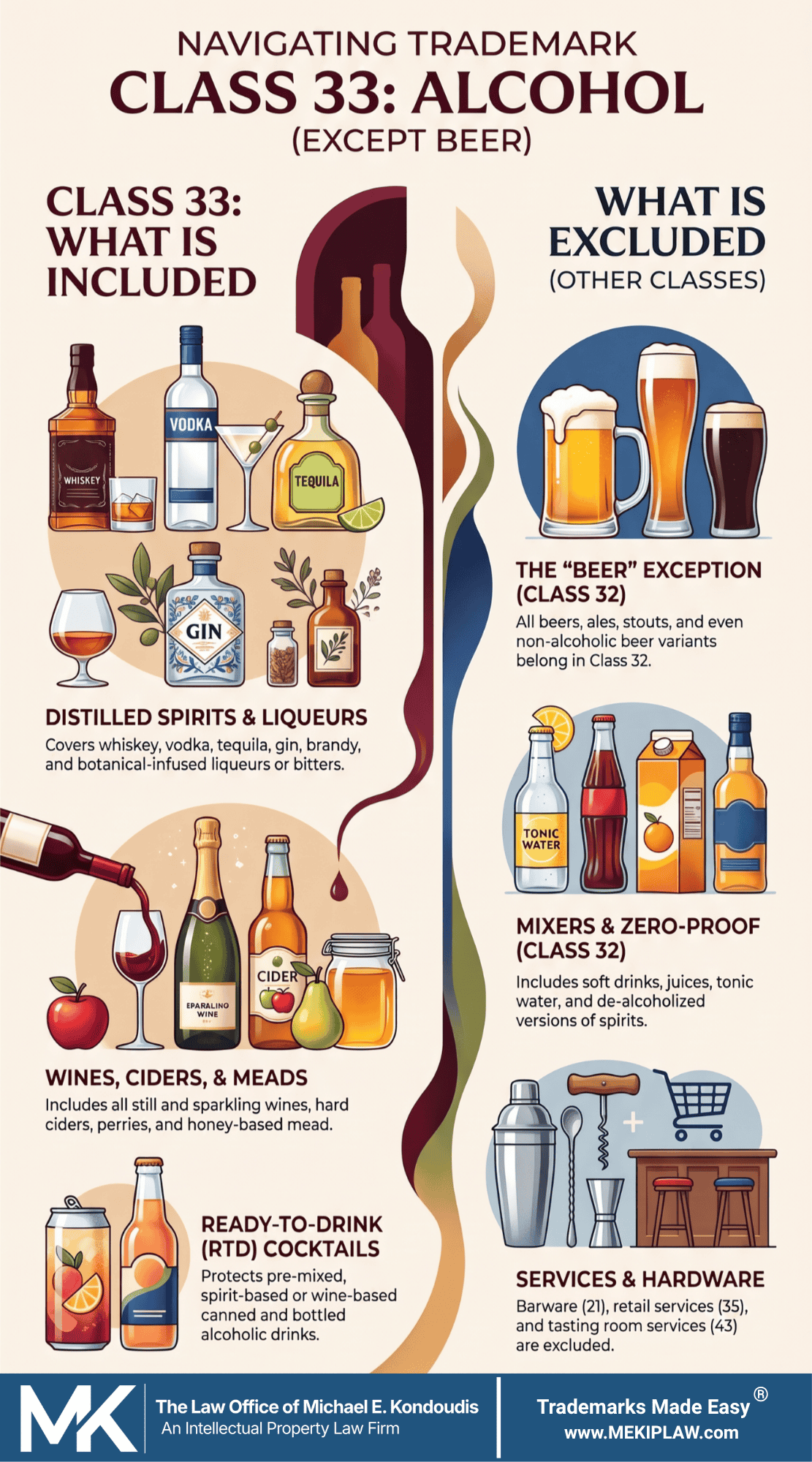
Trademark Class 33 is the official international trademark category used by the USPTO and WIPO to classify alcoholic beverages, excluding beers. Accurate navigation of this class prevents application rejections and ensures complete brand protection. Class 33 covers liquor, wine, and spirits.

Originally Published:  | Last Updated: 

By Michael Kondoudis, USPTO-Registered Attorney With 25+ Years of Trademark Experience

Inventor of the YNAT® Trademarking System | 3,000+ Trademarks & Patents Secured | Amazon #1 Best-Selling Author on Trademarks | Member of the Bar of the U.S. Supreme Court | Trademarks Made Easy®

What is a Trademark Class? (Nice Classification System)

A trademark class is a standardized category used by the United States Patent and Trademark Office (USPTO) and the World Intellectual Property Organization (WIPO) to organize goods and services within a trademark application (p. 2). This structural framework is formally governed by the Nice Classification system, an international standard utilizing 45 distinct classes to determine the exact legal boundaries of brand protection.
 

Trademark Classification Structure: Goods vs. Services

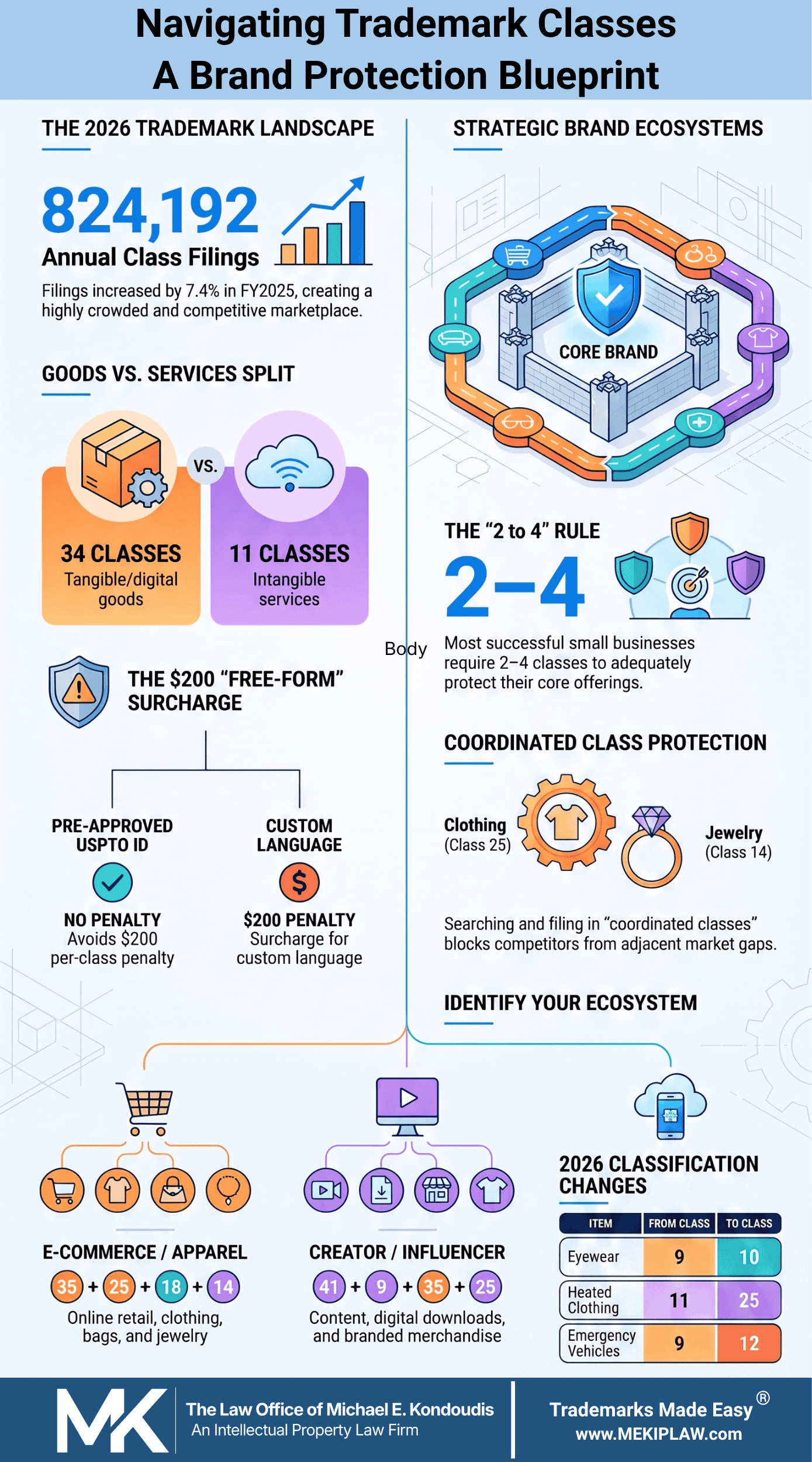
The USPTO Nice Classification framework splits commercial offerings into two primary legal categories across 45 classes:
  • International Classes 1 to 34 (Physical Goods): Encompasses tangible consumer products, manufactured substances, and raw materials (e.g., Class 25 for apparel or Class 33 for spirits).
  • International Classes 35 to 45 (Commercial Services): Encompasses activities, intangible consumer offerings, and specialized services executed for consumers or businesses (e.g., Class 35 for online retail or Class 43 for hospitality).

💡Read our Ultimate Guide to Trademark Classes here.

What is Trademark Class 33?

Trademark Class 33 is the official international trademark classification category used by the United States Patent and Trademark Office (USPTO) and the World Intellectual Property Organization (WIPO) to identify and protect alcoholic beverages, excluding beer.
 
As a primary legal category within the international Nice Classification framework, Class 33 covers specific consumer goods including wines, distilled spirits, liqueurs, hard ciders, and pre-mixed alcoholic cocktails.
 
Trademark class 33 is among the most popular and frequently used trademark classes.

What Goods Are Included In Trademark Class 33? 

Trademark Class 33 explicitly includes all commercially distributed alcoholic beverages, spirits, liqueurs, and finished production preparations, with the sole legal exclusion of traditional beer and malt-based beverages.

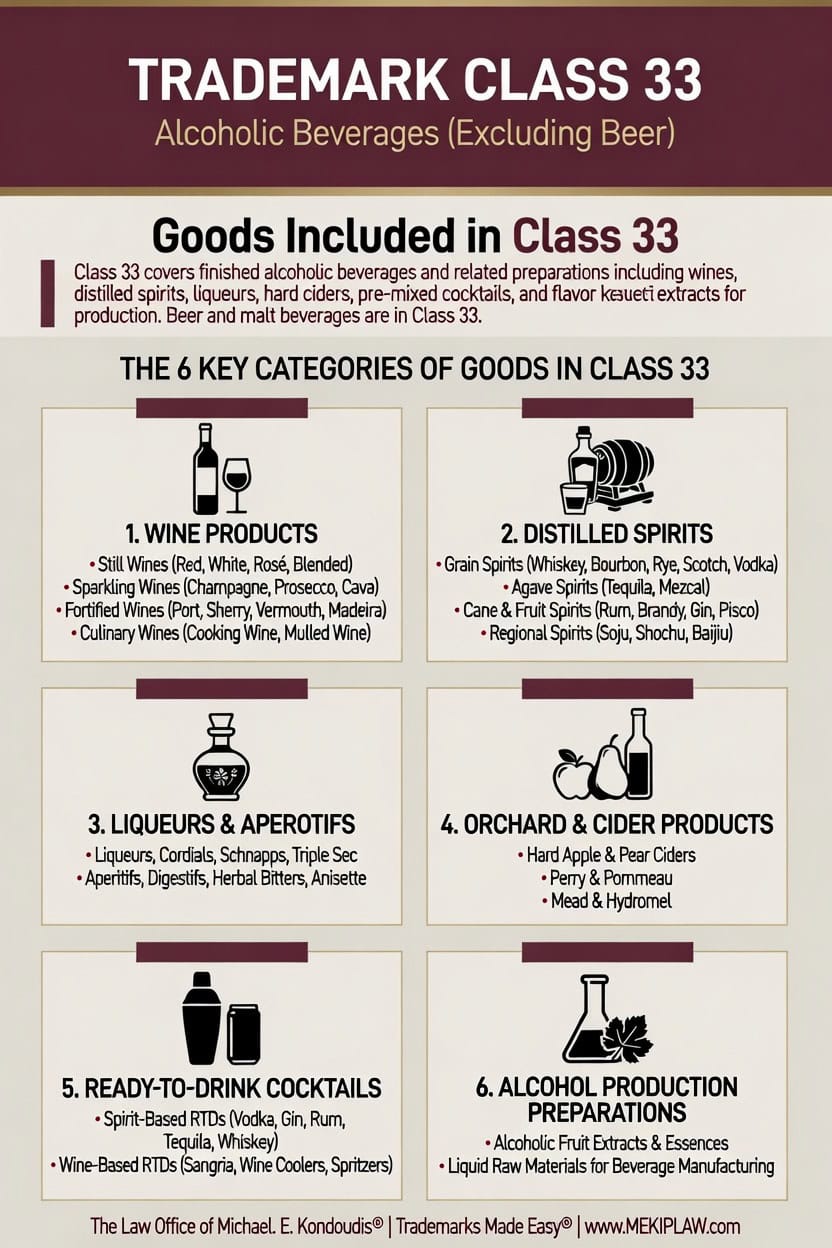
According to the USPTO Trademark ID Manual, class 33 goods are classified into six distinct product categories:

  1. Class 33 Wine Products

    • Still Wine: White wine, red wine, rosé, and blended varieties.
    • Sparkling Wine: Carbonated wine, champagne, prosecco, and cava.
    • Fortified Wine: Port, sherry, vermouth, and madeira.
    • Culinary Wine: Cooking wine and mulled wine varieties.
  1. Class 33 Distilled Spirits

    • Grain Spirits: Whiskey, bourbon, rye, scotch, and vodka variants.
    • Agave Spirits: Tequila, mezcal, and raicilla.
    • Cane & Fruit Spirits: Rum, cachaça, brandy, pisco, kirsch, and grappa.
    • Regional Spirits: Soju, shochu, baijiu, and rice alcohol variants.
    • Botanical Spirits: Gin, aquavit, and absinthe.
  1. Class 33 Liqueurs and Aperitifs

    • Sweetened Spirits: Liqueurs, cordials, triple sec, and schnapps.
    • Botanical Infusions: Aperitifs, digestifs, herbal bitters, and anisette.
  1. Class 33 Orchard & Cider Products

    • Apple & Pear: Alcoholic hard cider, perry, and pommeau.
    • Honey Wine: Mead and hydromel variants.
  1. Class 33 Ready-to-Drink (RTD) Cocktails

    • Spirit-Based RTD: Pre-mixed alcoholic cocktails containing vodka, gin, rum, tequila, or whiskey.
    • Wine-Based RTD: Wine coolers, packaged sangria, and spritzers.
  1. Class 33 Alcohol Production Preparations

    • Flavor Extracts: Alcoholic fruit extracts and alcoholic essences used as flavoring agents.
    • Base Preparations: Liquid alcoholic raw materials utilized for manufacturing commercial finished beverages.

If you sell an alcohol-based product that isn’t beer, it probably falls under Trademark Class 33.  

What Products Are Excluded From Trademark Class 33?

Trademark Class 33 explicitly excludes all beer, malt beverages, non-alcoholic drinks, de-alcoholized alternatives, medicinal liquids, and physical beverage hardware accessories. Specific examples include:

1. Beer and Malt Beverage Exclusions (Class 32)

    • Traditional Beers: Traditional beers, craft ales, lagers, stouts, porters, pilsners, and bocks belong under Trademark Class 32.
    • Malt Beverages: Flavored malt beverages, hard malts, and malt-based coolers belong under Trademark Class 32.
    • Non-Alcoholic Beer: Non-alcoholic beer variants, zero-proof lagers, and alcohol-free stouts belong under Trademark Class 32.

2. Non-Alcoholic Beverage Exclusions (Class 32)

    • Soft Drinks: Carbonated soft drinks, sodas, and cola beverages belong under Trademark Class 32.
    • Juices and Waters: Fruit juices, vegetable juices, mineral waters, spring waters, artesian waters, and bottled waters belong under Trademark Class 32.
    • Energy and Sports Drinks: Energy drinks, electrolyte sports drinks, and enhanced hydration beverages belong under Trademark Class 32.

3. Mixers, Concentrates, and Zero-Proof Exclusions (Class 32)

    • Liquid Mixers: Non-alcoholic cocktail mixers, margarita mixes, Bloody Mary mixes, and tonic waters belong under Trademark Class 32.
    • Concentrated Syrups: Flavored beverage syrups, cordial concentrates, and liquid bases used for non-alcoholic drink preparation belong under Trademark Class 32.
    • De-alcoholized Drinks: De-alcoholized wine, alcohol-free spirits, and zero-proof botanical alternatives belong under Trademark Class 32.

4. Medicinal and Therapeutic Beverage Exclusions (Class 5)

    • Medicinal Drinks: Medicated beverages, health tonics, and therapeutic liquid supplements belong under Trademark Class 5.
    • Dietary Supplements: Vitamin-infused functional liquids and liquid dietary supplements belong under Trademark Class 5.

5. Barware and Physical Hardware Exclusions (Class 21)

    • Drinkware: Wine glasses, champagne flutes, whiskey tumblers, shot glasses, and beer mugs belong under Trademark Class 21.
    • Bar Equipment: Cocktail shakers, bottle openers, corkscrews, pour spouts, ice buckets, and bar tools belong under Trademark Class 21.


What Are Examples of Trademark Class 33 Products?

Real-world commercial alcohol brands file their primary product lines under Trademark Class 33 to protect their brand names, logos, and distinct packaging styles.
 
The best examples of class 33 goods include:

Examples of Class 33 Whiskey and Bourbon Products

  • Jack Daniel’s: Classified under Class 33 as a Tennessee whiskey product line.
  • Johnnie Walker: Classified under Class 33 as a blended Scotch whisky product line.
  • Jameson: Classified under Class 33 as an Irish whiskey product line.
  • Jim Beam: Classified under Class 33 as a Kentucky straight bourbon whiskey product line.

Examples of Class 33 Tequila Products

  • Patrón: Classified under Class 33 as an ultra-premium tequila product line.
  • Jose Cuervo: Classified under Class 33 as a commercial tequila product line.
  • Casamigos: Classified under Class 33 as a premium tequila and mezcal product line.

Examples of Class 33 Rum & Gin Products

  • Bacardi: Classified under Class 33 as a commercial white and dark rum product line.
  • Captain Morgan: Classified under Class 33 as a spiced rum product line.
  • Bombay Sapphire: Classified under Class 33 as a London dry gin product line.
  • Hendrick’s: Classified under Class 33 as a botanical gin product line.

Examples of Class 33 Vodka Products

  • Smirnoff: Classified under Class 33 as a standard commercial vodka product line.
  • Tito’s Handmade Vodka: Classified under Class 33 as a corn-based distilled vodka product line.
  • Grey Goose: Classified under Class 33 as a premium distilled vodka product line.

What Are The Best Trademark Class Combinations For Trademark Class 33 Businesses?

The most effective class combinations—known as class ecosystems—are strategic groupings of multiple categories that map directly to how consumers naturally interact with a brand across products, digital spaces, and merchandise.

Alcohol brands rarely live in a single trademark class. To secure comprehensive intellectual property protection, alcohol brands utilizing Trademark Class 33 often cross-file into adjacent classes.  

The table below shows the most common ecosystems we recommend for alcohol-involved businesses using Trademark Class 33.

Business ArchetypeCore Product Class
Digital Commerce Class
Hospitality & Events
Tangible Brand Extensions
Craft DistilleryClass 33 Spirits (Tequila, Whiskey, etc.)Class 35 (E-commerce, DTC sales, online marketplacesClass 43 (Tasting rooms)Class 25 (Clothing)
Class 33 Commercial WineryClass 33 (Wines)Class 35Wine Clubs)Class 43(Wine Tastings & Winery Tours)Class 25 (Glassware)
RTD Beverage BrandClass 33 (Cocktails)Class 35 (Online Retail)Class 41 (Live Event Hosting)Class 25 (Clothing)

Ecosystem combinations are strategic starting points, not one-size-fits-all rules.

The best ecosystem for your brand depends on:

  • Your current goods and services
  • Your planned expansions over the next 3–5 years
  • Whether you sell physical products, digital products, services, or merchandise

Pro Tip: Once you identify your core ecosystem, we also review coordinated classes to strengthen protection and reduce future conflict risk.

Pro Tip: Think about how your customers actually experience your brand across products, services, digital touchpoints, and merchandise. Then protect the classes that match those real-world interactions.

These ecosystems deliver three powerful advantages:

  • Comprehensive protection that follows customers wherever they engage with your brand
  • Flexibility to expand into natural revenue streams without filing entirely new applications later
  • A stronger defensive position against copycats operating in adjacent spaces (online stores, event spaces, or merch lines)

What are Coordinated Trademark Classes? 

Coordinated trademark classes are distinct categories that the USPTO officially recognizes as closely related, complementary, or frequently marketed to the same consumer base or target market.

Comprehensive Multi-Class Framework Breakdowns

1. The Distillery Business Ecosystem Framework

    • Core Product Class: Trademark Class 33 (Distilled spirits, whiskey, bourbon, tequila, gin, rum, vodka, and liqueurs).
    • Digital Commerce Class: Trademark Class 35 (E-commerce retail storefront sales, online marketplace management, direct-to-consumer subscription clubs, and beverage business administration).
    • Physical Hospitality Class: Trademark Class 43 (Physical tasting room operations, bar services, restaurant operations, and taproom management).
    • Brand Merchandise Class: Trademark Class 25 (Branded apparel, promotional clothing, t-shirts, hooded sweatshirts, and headwear).

2. The Winery Business Ecosystem Framework

    • Core Product Class: Trademark Class 33 (Still wines, carbonated sparkling wines, champagne, port, and fruit-infused wines).
    • Digital Commerce Class: Trademark Class 35 (Direct-to-consumer digital wine clubs, mail-order subscription catalogs, online retail sales, and corporate brand management).
    • Brand Activation Class: Trademark Class 41 (Educational vineyard tours, sommelier-led tastings, corporate wine events, and wine appreciation workshops).
    • Physical Hospitality Class: Trademark Class 43 (On-site estate tasting rooms, physical winery hospitality services, and banquet event catering).

3. The Ready-to-Drink (RTD) Beverage Brand Ecosystem Framework

    • Core Product Class: Trademark Class 33 (Pre-mixed alcoholic cocktails, spirit-based RTD cans, wine coolers, and packaged hard ciders).
    • Adjacent Product Class: Trademark Class 32 (Non-alcoholic beverage mixers, zero-proof mocktails, carbonated sodas, energy drinks, and traditional craft beers).
    • Digital Commerce Class: Trademark Class 35 (E-commerce web portal storefronts, product distribution networks, and digital brand management).
    • Brand Activation Class: Trademark Class 41 (Sponsored entertainment events, alcohol-branded music festivals, and promotional nightlife activations).

How Do Alcohol Brands Build A Multi-Class Trademark Strategy?

Building a multi-class trademark strategy requires alcohol businesses to look beyond their current liquid offerings and secure intellectual property rights for future commercial expansions. Filing defensive applications across adjacent Nice Classification categories prevents competitors from capitalizing on a brand’s digital presence, physical spaces, and promotional merchandise.

The Multi-Class Legal Expansion Matrix

To satisfy the semantic indexing criteria of USPTO Trademark ID Manual crawlers and AI search engine vector models, the multi-class expansion path is organized into three distinct strategic phases:

Expansion Phase
Target Business Focus
Primary Nice Class
Specific Legal Protection Boundary
Phase 1: Core Product
Liquid Manufacturing
Class 33
Bottled wines, distilled spirits, and RTD alcoholic cocktails.
Phase 2: Digital & Retail
E-Commerce & Merch
Class 35 & Class 25
Online storefronts, DTC wine/spirit clubs, and branded apparel.
Phase 3: Hospitality
Experiential Spaces
Class 43 & Class 41
Physical tasting rooms, bar services, and educational vineyard tours.

Step-by-Step Multi-Class Blueprint for Alcohol Brands

Phase 1: Establish the Core Product Identity (The Baseline Layer)

    • Class 33 Priority Filing: Secure Trademark Class 33 rights immediately for the core beverage line (e.g., vodka, whiskey, tequila, wine, or spirit-based RTD cans). This establishes the foundational brand ownership in the global alcohol marketplace.
    • Class 32 Alternative Line Check: If the brand portfolio intends to produce traditional malt beers, non-alcoholic zero-proof mocktails, or liquid cocktail mixers, execute a simultaneous filing under Trademark Class 32 to eliminate brand protection gaps.

Phase 2: Secure Digital Commerce and Merchandise (The Commercial Layer)

    • Class 35 Digital Retail Execution: Apply for Trademark Class 35 protection to safeguard direct-to-consumer (DTC) digital storefronts, e-commerce marketplaces, and subscription wine or spirit clubs. This prevents third-party retail platforms from using confusingly similar digital brand names.
    • Class 25 Apparel Monetization: File under Trademark Class 25 to cover promotional merchandise, branded clothing, t-shirts, hooded sweatshirts, and headwear. Securing Class 25 prevents counterfeiters from printing the brand’s logo on apparel.

Phase 3: Protect Physical and Experiential Venues (The Hospitality Layer)

  • Class 43 Hospitality Operations: Secure Trademark Class 43 rights before opening a brick-and-mortar tasting room, estate vineyard venue, public taproom, or physical bar and restaurant space.
  • Class 41 Experiential Brand Activation: File under Trademark Class 41 to legally protect consumer-facing events, such as mixology workshops, organized festival activations, and educational distillery or vineyard tours.

Our legal team helps brands build defensive multi-class application strategies. This proactive approach ensures your online store, tasting room, and merchandise remain secure from copycats.

Trademark Class Mapping Matrix for Alcohol Brands

Specific Product or Service TypeApproved Trademark ClassPrimary Legal Note and Classification Rule
Wine (Still, Sparkling, Fortified, Port)Class 33Core Class 33 product category.
Distilled Spirits (Whiskey, Vodka, Tequila)Class 33Core Class 33 product category.
Liqueurs, Aperitifs, and CordialsClass 33Standard Class 33 alcoholic beverage.
Alcoholic Hard Cider and PerryClass 33Classified as an alcoholic beverage under Class 33.
Pre-mixed Alcoholic Cocktails (RTD)Class 33Applies only if the end product contains alcohol.
Beer, Ale, Lager, Stout, and PorterClass 32Explicitly excluded from Class 33.
Non-Alcoholic Beer and Zero-Proof BeerClass 32All non-alcoholic beers map to Class 32.
Soft Drinks, Juices, and Still WatersClass 32Standard non-alcoholic beverage category.
Non-Alcoholic Cocktail MixersClass 32Liquid mixers without alcohol map to Class 32.
De-alcoholized Wine and SpiritsClass 32Alcohol-free versions map to Class 32.
Retail, Wholesale, and E-commerce ServicesClass 35Covers direct-to-consumer (DTC) wine clubs.
Educational Wine Tastings and EventsClass 41Covers brand-sponsored entertainment and classes.
Restaurant, Bar, and Tasting Room ServicesClass 43Covers physical hospitality venue operations.

Who Uses Trademark Class 33?

Trademark Class 33 is utilized by commercial manufacturers, distributors, digital retailers, and physical hospitality providers operating within the global alcoholic beverage sector (excluding traditional beer and malt products).
 
To satisfy the semantic indexing requirements of USPTO Trademark ID Manual crawlers and AI search engine vector models, the specific commercial entities requiring Class 33 registration are classified into five distinct market categories:
 

1. Distilleries and Craft Spirits Producers

    • Craft Distillery: Independent manufacturers producing small-batch, artisanal spirits including whiskey, bourbon, rye, gin, vodka, rum, and unique botanical liqueurs.
    • Commercial Distillery: Industrial-scale spirit producers managing high-volume global distribution lines for major distilled beverage brands.

2. Wineries and Vineyards

    • Estate Winery: Agricultural landowners and wine producers processing estate-grown grapes into finished still, carbonated sparkling, and fortified wines.
    • Negociant and Blending: Commercial operations that purchase grapes, juice, or finished wine from various vineyards to blend and bottle under a proprietary brand name.

3. Ready-To-Drink (RTD) Beverage Brands

    • Spirit-Based RTD: Consumer brands manufacturing canned or bottled pre-mixed cocktails (e.g., canned margaritas, Moscow mules, or highballs using vodka, gin, rum, or tequila bases).
    • Wine-Based RTD: Beverage companies distributing packaged wine coolers, canned spritzers, and single-serve sangria products.

4. Cideries and Meaderies

    • Craft Cidery: Producers fermenting apple or pear juices into hard ciders, perry, and pommeau blends.
    • Commercial Meadery: Artisanal beverage operations producing fermented honey-based wines and hydromel variants.

5. Private Label Retailers and Importers

    • Private Label: Supermarket chains, luxury hospitality groups, and celebrity brands developing proprietary house-branded spirits and wines manufactured by third-party facilities.
    • Alcohol Importer: Global trading groups securing exclusive domestic brand rights for international wine and spirit portfolios requiring local intellectual property protection.


How Do You Get A Class 33 Trademark? (Step-by-Step USPTO Registration Pipeline)

Securing a federal Trademark Class 33 registration requires navigating an official, multi-stage administrative process governed by the United States Patent and Trademark Office (USPTO). Missing a procedural milestone or failing to clear initial conflicts can result in permanent application rejections or costly Office Actions.
 
The US trademarking process is divided into five sequential phases:
Registration Phase
Key Legal Objective
Critical Task Component
Potential Administrative Risk
Phase 1: Clear Search
Prevent Conflict Rejections
Comprehensive USPTO database clearance search.
Likelihood of Confusion Refusal (Section 2(d))
Phase 2: Filing Basis
Establish Legal Intent
Select Use-in-Commerce (1a) vs. Intent-to-Use (1b).
Missing evidentiary deadlines or specimens.
Phase 3: Submit Draft
Code the Goods Entry
Draft precise Class 33 items using the ID Manual.
Descriptors too broad or misclassified.
Phase 4: Examination
Clear Legal Hurdles
Respond to USPTO Examining Attorney Office Actions.
Statutory refusals or abandonment.
Phase 5: Publication
Defend Third-Party Claims
Clear the 30-day public opposition window.
Formal trademark oppositions or extensions.

Step-by-Step Class 33 Trademark Registration Workflow

Phase 1: Conduct a Comprehensive Clearance Search

    • Database Clearance Action: Execute a thorough conflict check utilizing the USPTO Trademark Search System. Search for identical or confusingly similar phonetic names, logos, and slogans already registered or pending within Class 33.
    • Cross-Class Evaluation Action: Expand the clearance search into Trademark Class 32 (beer/mixers), Class 35 (retail/e-commerce), and Class 43 (bars/restaurants). The USPTO will refuse an application under a “Likelihood of Confusion” clause if a similar brand operates in an adjacent beverage category.

Phase 2: Select Your Legal Filing Basis

    • Use-in-Commerce Basis (Section 1a): Select this filing path if the Class 33 wine, spirit, or RTD cocktail product line is already actively sold across state lines. This track requires immediate submission of a commercial packaging or labeling specimen.
    • Intent-to-Use Basis (Section 1b): Select this filing path if the product formulation, distribution network, or commercial bottling line is still in development. This track reserves the brand name nationally but requires filing a formal “Statement of Use” with proof of sales later in the process.

Phase 3: Draft and Submit the USPTO TEAS Application

    • ID Manual Standardization: Select precise terms directly from the USPTO Trademark ID Manual. Avoid vague custom wording. Use established terms such as “Distilled spirits,” “Wines,” or “Pre-mixed alcoholic cocktails.”
    • Fee Structure Execution: Submit the application digitally via the TEAS system. Pay the standard non-refundable government filing fee per class to anchor the priority filing date.

Phase 4: Navigate the USPTO Examination and Office Actions

    • Examining Attorney Audit: A designated USPTO Examining Attorney reviews the application approximately 8 to 10 months after submission to check for statutory compliance and clear conflicts.
    • Office Action Remediation: If the examiner issues an official Office Action (e.g., requesting a geographical disclaimer or alleging descriptive issues), submit a comprehensive legal response within the strict statutory deadline to avoid application abandonment.

Phase 5: Pass Publication for Opposition and Achieve Registration

    • Official Gazette Publication: Once approved by the examiner, the trademark is published in the USPTO Official Gazette for a mandatory 30-day public review window. This allows third-party brands to file an opposition if they believe the mark infringes on their existing rights.
    • Final Certificate Issuance: If no oppositions are filed, the USPTO issues a formal Certificate of Registration for Section 1a filings, or a Notice of Allowance for Section 1b filings (granting a 6-month window to submit commercial sales specimens).

Why Do You Need A Trademark Attorney for Class 33 Trademark Application?

Navigating the USPTO application process for an alcohol brand involves distinct regulatory hurdles that significantly increase the risk of application failure. Engaging a specialized trademark attorney mitigates these risks by managing complex cross-class clearance searches, handling statutory office actions, and structuring application details to prevent permanent rejections of registration.
 

Examples of Potential Failure Points

USPTO Failure Point
Primary Legal Risk
Trademark Attorney Corrective Action
Long-Term Strategic Benefit
Cross-Class Conflicts
Likelihood of Confusion (2d) Refusal
Multi-class clearance search beyond Class 33.
Prevents loss of filing fees and branding pivots.
Specimen Rejections
Technical TTB / Labeling mismatches
Audit commercial packaging against USPTO rules.
Avoids administrative delays and audit failures.
Descriptive Refusals
Section 2(e)(1) Merely Descriptive
Draft legal disclaimers and distinctiveness claims.
Secures placement on the Principal Register.
Office Actions
Statutory or procedural objections
Draft comprehensive briefs using case law precedent.
Saves applications from automatic abandonment.

Key Legal Functions Performed by a Trademark Attorney

1. Managing Cross-Class Likelihood of Confusion Risks

    • Advanced Clearance Evaluation: A trademark attorney scans beyond Trademark Class 33 to check Class 32 (beer and non-alcoholic mixers), Class 35 (online retail), and Class 43 (bar and restaurant services).
    • Phonetic and Semantic Audit: Legal counsel evaluates existing marks for phonetic similarities, translation duplicates, and overlapping market impressions that automated DIY search tools fail to detect. This minimizes the risk of a Section 2(d) Likelihood of Confusion refusal.

2. Auditing Class 33 Evidence and Specimens

    • TTB Compliance Verification: Attorneys ensure your commercial product labels align simultaneously with federal Alcohol and Tobacco Tax and Trade Bureau (TTB) regulations and USPTO evidentiary standards.
    • Specimen Quality Control: For Section 1(a) Use-in-Commerce applications, counsel confirms the submitted specimen shows a direct link between the trademark and the physical beverage (e.g., proper retail bottle labels rather than internal digital mockups).

3. Overcoming Descriptive and Geographic Refusals

    • Descriptive Defenses: If a brand name incorporates style descriptors (e.g., “Kentucky Bourbon” or “Craft Vodka”), an attorney structures the application using geographic disclaimers or Section 2(f) Acquired Distinctiveness claims.
    • Principal Register Optimization: This legal positioning ensures the brand mark achieves placement on the Principal Register rather than the Supplemental Register, securing maximum national enforcement rights.

4. Preparing Formal Responses to USPTO Office Actions

    • Statutory Brief Preparation: When a USPTO Examining Attorney issues a technical refusal or request for information, an attorney analyzes relevant Trademark Trial and Appeal Board (TTAB) case law to draft a formal response.
    • Strict Deadline Tracking: Legal counsel utilizes dedicated docketing software to manage statutory response windows, preventing the application from entering automatic abandonment due to missed deadlines.

Working With A Trademark Attorney Increases Success Rate by 50%

Hiring a trademark attorney to respond to an Office Action is critical because studies analyzing USPTO data consistently show that applications filed with experienced legal counsel are more than 50% likely to succeed. 

Also, the USPTO strongly recommends that you work with a trademark attorney because trademarking is a complex federal legal matter.

Working with a trademark attorney can make the trademarking process go faster and more smoothly, and yield greater protection.

What Are The Most Common Trademark Class 33 Filing Mistakes?

Filing an application under Trademark Class 33 involves navigating complex cross-class boundaries and strict evidentiary standards. Even minor procedural or classification errors can lead to immediate USPTO Examining Attorney rejections, forfeiture of non-refundable government filing fees, or prolonged legal battles with existing brands.
 

The Trademark Application Pitfalls

Filing Mistake Category
Primary Administrative Impact
Root Cause of Rejection
Legal Corrective Action / Prevention
Misclassification Error
Application Refusal or Delay
Filing beer in Class 33 instead of Class 32.
Audit recipes and cross-file based on base ingredients.
Flawed Clearance Scope
Section 2(d) Likelihood of Confusion
Searching Class 33 but ignoring Class 43 or 35.
Execute multi-class search covering services and retail.
Invalid Specimen Submission
Technical Evidentiary Rejection
Submitting digital mockups or printer proofs.
Provide physical photos of labeled, filled retail bottles.
Wrong Filing Basis Selection
Invalidation or Delayed Approval
Selecting Section 1(a) before active interstate sales.
Select Section 1(b) Intent-to-Use for pre-market items.

In-Depth Analysis of Class 33 Application Errors

1. Misclassifying Beer, Cider, and Malt Beverages

    • The Beer vs. Spirit Distinction: A frequent mistake is filing traditional beers, craft ales, lagers, or flavored malt beverages under Class 33. The USPTO restricts Class 33 exclusively to wines and spirits. All traditional beer and malt-based beverages must be filed under Trademark Class 32.
    • The Hard Cider Exception: Conversely, filing alcoholic hard cider or perry in Class 32 is an error. Under the Nice Classification system, hard ciders are explicitly categorized as Class 33 products, despite often being sold alongside craft beers.

2. Executing an Overly Narrow Clearance Search

    • Ignoring Commercial Services: Many brands search the USPTO Trademark Search System only for conflicting physical bottle names within Class 33. The USPTO will reject a spirit application if a phonetically or semantically similar mark already exists in Class 43 (bar and restaurant services) or Class 35 (online retail stores).
    • Failing to Scan Phonetic Equivalents: Searching only for exact spelling matches is a critical error. The USPTO evaluates a “Likelihood of Confusion” based on how marks sound and look, meaning an existing registration for “Vudka” will block a new application for “Vodka.”

3. Submitting Non-Compliant Packaging Specimens

    • Digital Mockup Rejection: For Section 1(a) Use-in-Commerce applications, submitting digital graphic designs, PDF label layouts, or computer-generated bottle mockups triggers an automatic specimen rejection.
    • Physical Evidence Requirement: The USPTO requires proof of actual use in the commercial marketplace. Legally acceptable specimens include high-resolution physical photographs of completed, labeled, and filled bottles ready for retail distribution or active shipping cartons.

4. Selecting the Incorrect Legal Filing Basis

  • Premature Commercial Claims: Selecting a Section 1(a) (Use-in-Commerce) basis before the wine or spirit is actively sold across state lines constitutes a faulty filing. If the product is still aging in barrels, undergoing formulation, or awaiting TTB label approval, the application is legally invalid.
  • Strategic Intent-to-Use Selection: Pre-market brands must utilize a Section 1(b) (Intent-to-Use) filing basis. This path establishes a national priority filing date and legally reserves the brand name while production and distribution networks are finalized.

Trademark Class 33 FAQ: Common Questions On Classifying Alcoholic Beverages

This Trademark Class 33 FAQ section provides clear, direct answers about Trademark Class 33 and how the USPTO classifies alcoholic beverages. Use these expert-verified legal insights to understand which class(es) you should consider including in your class 33 trademark.


Q: What is Trademark Class 33?

Trademark Class 33 is the international category for non-beer alcoholic beverages.
  • Core goods: Wine, distilled spirits, liqueurs, and hard ciders.
  • Finished cocktails: Pre-mixed alcoholic drinks and production preparations.
  • Strict exclusion: Traditional beer and malt beverages are legally barred.


Q: Is beer included in Trademark Class 33?

No, beer belongs under Trademark Class 32.
  • Excluded items: Traditional beer, craft ales, lagers, and stouts.
  • Malt beverages: Flavored malts and malt-based coolers.
  • Zero-proof options: Non-alcoholic beer variants and zero-proof lagers.


Q: Are wine and spirits covered by Class 33?

Yes, wine and distilled spirits are core Class 33 goods.
  • Wine products: Still, sparkling, carbonated, fortified, and culinary wines.
  • Distilled grain: Whiskey, bourbon, rye, scotch, and vodka.
  • Other spirits: Tequila, mezcal, rum, brandy, gin, and absinthe.


Q: Is alcoholic hard cider included in Class 33?

Yes, alcoholic hard cider is explicitly categorized under Class 33.
  • Orchard products: Apple cider, pear cider (perry), and pommeau.
  • Honey wine: Mead and hydromel variants.
  • Filing warning: Placing hard cider in Class 32 is an error.


Q: Are ready-to-drink (RTD) cocktails in Class 33?

Yes, RTD cocktails belong in Class 33 if they contain alcohol.
  • Spirit-based RTDs: Canned or bottled pre-mixed margaritas or highballs.
  • Wine-based RTDs: Packaged wine coolers, sangria, and spritzers.


Q: Does Class 33 include non-alcoholic drinks?

No, non-alcoholic drinks are strictly excluded from Class 33.
  • Class 32 items: Soft drinks, juices, waters, and de-alcoholized alternatives.
  • Class 5 items: Medicinal drinks, tonics, and liquid dietary supplements.


Q: What is the difference between Trademark Class 32 and Class 33?

The key difference is the presence of beer and alcohol content.
  • Class 32: Restricted to beer, malt beverages, and non-alcoholic drinks.
  • Class 33: Reserved for all other categories of alcoholic beverages.


Q: What are real-world examples of Class 33 brands?

Major commercial alcohol brands file their primary lines in Class 33.
  • Whiskey & Bourbon: Jack Daniel’s, Johnnie Walker, Jameson, and Jim Beam.
  • Tequila & Mezcal: Patrón, Jose Cuervo, and Casamigos.
  • Rum & Gin: Bacardi, Captain Morgan, Bombay Sapphire, and Hendrick’s.
  • Vodka lines: Smirnoff, Tito’s Handmade Vodka, and Grey Goose.


Q: What is an acceptable trademark specimen for Class 33?

An acceptable specimen shows the trademark actively used in commerce.
  • Physical evidence: High-resolution photos of labeled, filled retail bottles.
  • Packaging evidence: Active commercial shipping cartons.
  • Digital options: E-commerce point-of-sale pages showing the brand.
  • Immediate rejections: Digital mockups, PDF layouts, and printer proofs.


Q: Is a physical tasting room covered by Class 33?

No, physical tasting rooms and hospitality services are covered by Class 43.
  • Class 33 limits: Protects the liquid product itself.
  • Class 43 coverage: Protects bar, restaurant, and taproom management operations.


Q: Do alcohol brands need to file in multiple trademark classes?

Yes, most alcohol brands require a defensive multi-class ecosystem strategy.
  • Distilleries: Pair Class 33 (liquor) with Class 35 (e-commerce) and Class 43 (tasting).
  • Wineries: Pair Class 33 (wine) with Class 35 (clubs) and Class 41 (tastings).
  • RTD brands: Pair Class 33 (cocktails) with Class 32 (mixers) and Class 35 (retail).
  • Merchandise: File under Class 25 to protect branded apparel and t-shirts.


Q: What are the most common Class 33 filing mistakes?

Filing mistakes trigger immediate rejections or forfeiture of government fees.
  • Misclassification: Filing beer or malt beverages in Class 33.
  • Narrow searches: Ignoring phonetically identical marks in adjacent classes like 35 or 43.
  • Invalid specimens: Submitting digital graphics instead of real product photos.
  • Wrong basis: Claiming Use-in-Commerce before active interstate sales happen.


Q: How do I file a USPTO trademark application for Class 33?

The official federal application follows five sequential stages.
  • Phase 1: Execute a comprehensive clearance search via the USPTO database.
  • Phase 2: Select a Use-in-Commerce (1a) or Intent-to-Use (1b) basis.
  • Phase 3: Submit the TEAS application using precise ID Manual language.
  • Phase 4: Navigate the USPTO examining attorney audit and office actions.
  • Phase 5: Clear the 30-day public review window in the Official Gazette.


Q: Do I need a trademark attorney for a Class 33 application?

Hiring an attorney is highly recommended to navigate complex federal legalities.
  • Higher success: Legal counsel increases your registration success rate by 50%.
  • Conflict mitigation: Attorneys audit phonetic similarities and overlapping market impressions.
  • TTB alignment: Legal experts ensure labels match strict federal tax and trade regulations.

About the Author and Why You Can Trust This Guide

This guide is written by Michael Kondoudis, the founder of The Law Office of Michael E. Kondoudis® and inventor of the proprietary YNAT® Trademarking System.

The YNAT® Trademarking System powers the firm’s signature Trademarks Made Easy® approach. This methodology is built on four core principles:

  • Efficient, streamlined processes that minimize time, cost, and friction for clients
  • Clear, transparent, and proactive communication at every stage
  • Long-term client relationships centered on sustainable brand protection and business growth
  • Practical, results-driven strategies that deliver real, measurable business value—rather than unnecessary complexity or litigation

Michael E. Kondoudis is a USPTO-registered trademark and patent attorney with more than 25 years of experience protecting trademarks for clients across the United States and internationally. He is also a rocket scientist and an Amazon #1 bestselling author on trademark topics.

As Principal of The Law Office of Michael E. Kondoudis®, he has helped clients secure more than 3,000 trademarks and patents.

The goal of this guide is to deliver actionable clarity so you can make confident, well-informed decisions about protecting your alcohol-related brand.

Need Help With Your Class 33 Trademark?

Free Strategy Consultation With An Attorney

Simple Flat Fee Pricing • Free Clearance Search • Honest Advice

Ultimate Guide to Trademark Classes (2026): Protect Your Brand

Trademark Classes: The Quick Summary

  • The System: The U.S. trademark system uses 45 international classes to define and limit the legal protection of your brand.
  • The Split: The framework separates your offerings into 34 goods classes (physical or digital products) and 11 services classes (intangible activities).
  • Strategic Value: Selecting the correct coordinated classes blocks competitors from market gaps, avoids expensive USPTO filing surcharges, and simplifies future international expansion.

By Michael Kondoudis, USPTO-Registered Attorney With 25+ Years of Trademark Experience

Inventor of the YNAT® Trademarking System  | 3,000+ Trademarks & Patents Secured | Amazon #1 Best-Selling Author on Trademarks | Member of the Bar of the U.S. Supreme Court | Trademarks Made Easy®

Quick Answer: What Are Trademark Classes and How Do They Work?

Trademark classes are categories used by the USPTO to group goods and services. The USPTO recognizes 45 distinct trademark classes.

Quick Facts:

  • Total Classes: 45 categories
  • Trademark Goods: Classes 1–34 apply to physical or digital goods
  • Trademark Services: Classes 35–45 apply to services
  • Cost Factor: Application filing fees apply per individual class.
  • Small Business Need: Small businesses require 2 to 4 classes to adequately protect their core offerings.

Every trademark application must include at least one class of goods or services, and most require more than one to secure adequate brand protection.

Why Are Trademark Classes Important for Brand Protection?

Trademark classes are the legally defined categories that dictate the exact scope, boundaries, and enforcement power of your brand’s protection in the marketplace.

With over 800,000 trademark classes filed with the USPTO in FY2025 and the new 13th Nice Edition now in effect, selecting the right classes has never been more important — or more strategic.

Register too narrowly, and you leave gaps that competitors can exploit. Register carelessly, and you risk refusals, higher costs, or weak enforcement down the road.

This guide harmonizes authoritative USPTO guidance, proven best practices from 25+ years of experience as a USPTO-registered trademark attorney, and practical insights tailored for long-term brand protection.

What Are The Current USPTO Trademark Filing Statistics?

Current USPTO Performance Bulletin Data, shows a highly competitive landscape, with total trademark class filings reaching a record 824,192 in FY 2025, marking a 7.4% year-over-year increase. For context, FY 2023 filings totaled 737,018 classes.

This surge means more than 824,000 new classes were added to the U.S. trademark register in a single 12-month period. In a marketplace this crowded, vague descriptions, missed coordinated classes, or narrow filings create real vulnerabilities. Competitors (and copycats) have more opportunities to operate in adjacent spaces, and the USPTO continues to raise the bar on examination quality and precision.

Strategic takeaway: The volume of filings makes thoughtful, forward-looking class selection more important than ever. Protecting the right ecosystem of classes — and the coordinated classes that go with them — is one of the most effective ways to build a durable defensive perimeter around your brand in 2026 and beyond.

What Is A USPTO Trademark Class?

A USPTO trademark class is an official, standardized category used to group related goods or services for registration, clearance searches, and fee calculations under the international Nice Agreement. There are 45 trademark classes. The Nice Agreement is used by more than 90 countries. Global alignment makes multi-class U.S. registrations a strong foundation for international protection under the Madrid Protocol.

  • Classes 1–34: Goods (tangible products or downloadable digital assets)
  • Classes 35–45: Services (intangible activities, performances, platforms, or support)

You cannot file using only a class heading. You must provide specific descriptions of your actual goods or services. The USPTO strongly encourages (and now financially rewards) using pre-approved language from the official USPTO Trademark ID Manual.

Pro Tip: Using pre-approved descriptions from the official USPTO Trademark ID Manual dramatically reduces the number of Office Actions and avoids the $200+ per-class surcharge for free-form descriptions.   

What Is The Difference Between Trademark Goods and Services?

The distinction between trademark categories rests on tangibility: goods are physical items or downloadable digital products that customers buy, while services are intangible activities or platforms performed for someone else’s benefit.

Many businesses offer both

Example: A musician selling digital downloads (Class 9) and performing live (Class 41) while running an online merch store (Class 35).

What Are the Core Concepts Of Trademark Classification?

Trademark classification relies on an interconnected framework of standardized categories, pre-approved descriptions, and coordinated groups that collectively establish a brand’s legal perimeter. The core concepts from the blog are defined below:

  • A trademark class is a standardized category under the Nice Agreement used by the USPTO to group specific goods or services.
  • Trademark Goods refer to tangible products or downloadable digital assets, categorized in Classes 1 through 34.
  • Trademark Services refer to intangible activities performed for another’s benefit, categorized in Classes 35 through 45.
  • The Nice Classification System refers to the global harmonized standard, established by the Nice Agreement, that organizes trademark goods and services into 45 distinct classes.
  • The USPTO Trademark ID Manual is the official, searchable federal database maintained by the U.S. Patent and Trademark Office that provides thousands of pre-approved descriptions used to legally define a mark’s scope.
  • A Coordinated Class refers to an officially designated secondary category that the USPTO recognizes as closely related, complementary, or highly relevant to a primary filing class due to shared market channels.
  • A Class Ecosystem is a strategic clustering of multiple, interconnected trademark classes that reflects how a modern brand operates simultaneously across physical merchandise, digital spaces, and retail platforms.
  • Intent-to-use filing (ITU) is an application based on planned future commerce.

How Do Trademark Classes Protect Your Business Brand? 

Trademark classes protect your brand by creating an enforceable legal barrier that prevents competitors from using confusingly similar marks within your specific industry or in closely related market sectors. Trademark classes define the legal scope of your protection. Overlapping market sectors create both risk and opportunity. 

Risks of getting it wrong:

  • Application refusal or narrow protection
  • Inability to stop copycats in adjacent areas (e.g., someone else using your name on apparel when you only registered music services)
  • Higher long-term costs (new filings later)
  • Weaker enforcement and licensing potential

Strategic opportunities:

  • Proper classes support merchandising, licensing, franchising, and international expansion.
  • Coordinated filings create a defensive perimeter when you search and protect coordinated classes (more on this below).
  • In a crowded marketplace (over 824,000 classes filed in FY2025), a well-planned portfolio signals professionalism to investors, partners, and customers.

Proper classification turns your trademark into a strategic business asset that supports growth, licensing, merchandising, and international expansion. Proper trademark registration provides peace of mind, allowing you to focus on building your brand without fear of copycats forcing costly rebrands.

What Are The Most Common USPTO Trademark Classes For Small Businesses?

The most frequently used trademark categories for entrepreneurs encompass a specific subset of the 45 international classes, primarily covering digital goods, clothing, retail services, education, and software. While there are 45 trademark classes, most entrepreneurs, creators, and small businesses need to focus on only a small subset. Below are the classes that appear most frequently:

  • Class 9 — Downloadable software, mobile apps, audio/video recordings, digital content, electronics.
  • Class 25 — Clothing, footwear, headwear, and apparel (especially merchandise).
  • Class 35 — Advertising, marketing, business management, retail store services, and e-commerce.
  • Class 41 — Education, entertainment, podcasts, video production, live events, online courses, workshops.
  • Class 42 — Non-downloadable software (SaaS), cloud computing, tech support, scientific/technological services.
  • Class 3 — Cosmetics, skincare, hair care, cleaning preparations, personal care products.
  • Class 18 — Leather goods, handbags, backpacks, luggage, wallets.
  • Class 16 — Printed books, planners, notebooks, stationery, paper goods.
  • Class 30 — Coffee, tea, spices, baked goods, staple foods, packaged snacks.
  • Class 28 — Toys, board games, puzzles, sporting goods, gaming accessories.
  • Class 43 — Restaurant, cafe, food truck, catering, and temporary accommodation services.
  • Class 5 — Dietary supplements, vitamins, nutritional products (often paired with wellness; watch structure/function claims).

A full explanation of each of these categories – along with what qualifies under the classes – can be found here.  

What Are The Best Trademark Class Combinations For Businesses?

The most effective class combinations—known as class ecosystems—are strategic groupings of multiple categories that map directly to how consumers naturally interact with a brand across products, digital spaces, and merchandise.

The table below shows the most common ecosystems we recommend for creators, entrepreneurs, and small businesses, along with the strategic reasoning behind each.

Business TypeCore ClassesPrimary Protection FocusStrategic Notes & Common Expansions
Musician / Band / Recording Artist9 + 41 + 25 + 35Music recordings, live performances, merch, direct-to-fan salesFans interact across music, events, and merchandise. Class 35 (retail) is frequently overlooked.
Podcast / YouTube Creator / Influencer41 + 9 + 35 + 25Content creation, digital downloads, sponsorships, branded merchStrong foundation for creators. Many later add Class 42 for membership platforms.
E-commerce / Apparel / Lifestyle Brand35 + 25 + 18 + 14Online retail, clothing, bags & accessories, jewelryThese classes are heavily coordinated. Protecting them together creates a strong defensive perimeter.
SaaS / Tech Startup / Software Company42 + 9 + 35Non-downloadable software (SaaS), downloadable tools/apps, advertising & business servicesCovers both the platform and go-to-market activities. Many add Class 41 later for training content.
Restaurant, Cafe, or Food Business43 + 30 + 35Restaurant/cafe services, packaged foods & beverages, retail & e-commerceIdeal for businesses selling both in-person and packaged goods or merch online.
Fitness, Wellness, or Yoga Studio / Coach41 + 25 + 35 + 5Instruction & education, activewear/apparel, memberships & retail, supplementsClass 5 is added only when selling nutritional products. Watch structure/function claims.
Beauty, Skincare, or Cosmetics Brand (DTC)3 + 35 + 25Cosmetics & personal care products, e-commerce/retail, branded apparel & lifestyle merchMany beauty brands expand into Class 42 if they launch apps or personalized tools.
Book Author, Publisher, or Online Educator16 + 9 + 41 + 35Printed books, digital/ebooks, courses & education services, retail & direct salesCovers the full journey from physical books to digital products to live/online education.
Professional Services Firm
(Agency, Consultant, Advisor)
35 + 42Advertising, marketing, business management & consulting services, software/toolsClass 42 is included when the firm offers proprietary software or technical services. Common for DC-area firms.
Event Planner / Wedding Planner41 + 35Event planning, party coordination & entertainment services, business management & promotional servicesMany event businesses later add Class 25 or 18 if they begin selling branded merchandise.

Ecosystem combinations are strategic starting points, not one-size-fits-all rules.

The best ecosystem for your brand depends on:

  • Your current goods and services
  • Your planned expansions over the next 3–5 years
  • Whether you sell physical products, digital products, services, or merchandise

Pro Tip: Once you identify your core ecosystem, we also review coordinated classes to strengthen protection and reduce future conflict risk.

Pro Tip: Think about how your customers actually experience your brand across products, services, digital touchpoints, and merchandise. Then protect the classes that match those real-world interactions.

What are Coordinated Trademark Classes? 

Coordinated trademark classes are distinct categories that the USPTO officially recognizes as closely related, complementary, or frequently marketed to the same consumer base or target market.

Example: Class 25 (clothing) is coordinated with Class 14 (jewelry), Class 18 (leather goods/handbags), Class 24 (fabrics), Class 35 (retail/advertising), and others.

Trademark Class Ecosystems

Why Should You Search Coordinated Trademark Classes?

Searching coordinated classes is a critical clearance step required to identify hidden registration conflicts, avoid examiner refusals, and build a legally bulletproof defensive perimeter around your mark. 

  • When clearing your mark, you should search for coordinated classes.
  • Protecting coordinated classes creates a stronger defensive perimeter.

Pro Tip: The USPTO’s website provides an online search system that includes online tools and lists to identify coordinated classes during searches. Always include them in your clearance searches.

How Do The 2026 Nice Classification Changes Affect Trademark Applications?

The 2026 Nice Classification updates legally reclassify several mainstream products, shifting everyday items like sunglasses, heated clothing, and emergency vehicles into entirely new classes within the official USPTO ID Manual. The 13th Edition of the Nice Classification became effective January 1, 2026, and the USPTO has incorporated the updates into the ID Manual.

Notable changes relevant to common classes include:

  • Eyewear, lenses, and sunglasses moved from Class 9 to Class 10
  • Electrically heated clothing moved from Class 11 to Class 25
  • Certain rescue and emergency vehicles moved from Class 9 to Class 12

Action step: When searching or drafting descriptions in 2026 and beyond, verify current classifications in the ID Manual, especially if your goods involve optics, apparel with heating elements, or specialized vehicles.

How Do I Choose The Right Trademark Class?

Choosing the right trademark class requires auditing all current and planned offerings, separating tangible items from services, and matching them precisely with pre-approved descriptions in the USPTO database.

Follow this strategic and practical process to choose classes:

  1. List everything — Write down all current products and services, plus planned expansions (next 3–5 years). Include digital products, merchandise, courses, subscriptions, retail, and services.
    2. Separate goods from services — Goods = Classes 1–34; Services = 35–45.
    3. Research precisely — Search the USPTO Trademark ID Manual (idm-tmng.uspto.gov) with keywords. Select the most accurate pre-approved descriptions to avoid extra fees.
    4. Check coordinated classes — Review the USPTO coordinated class lists for your primary classes.
    5. Prioritize by impact and budget — Core offering first, then high-value additions like merch or e-commerce. Most creator/small-business brands need 2–4 classes.
    6. Think like a customer and a competitor — Would consumers expect your brand to offer related items? Could a similar mark in a coordinated class cause confusion?
    7. Draft and search thoroughly — Use specific descriptions. Conduct a comprehensive trademark search (including common-law use and coordinated classes) before filing.
    8. Consider professional help — Multi-class filings, international plans, or novel goods/services benefit from experienced USPTO-registered trademark counsel.

Pro tip: Intent-to-use (ITU) filings are allowed if you have a bona fide intention to use the mark in commerce in the near future. ITU filings are common for planned merchandise lines, digital products, or course launches.

How Much Does It Cost to File A Trademark In 2026?

The baseline cost to file a trademark is $350 per class, provided the applicant uses standard pre-approved descriptions from the official USPTO system. As of the 2025 fee changes (still in effect in 2026):

  • Base electronic application fee: $350 per class (when using pre-approved ID Manual descriptions)
  • Custom / free-form descriptions: Additional $200 per class
  • Insufficient information surcharge: $100 per class in some cases

Pro Tip: Filing electronically using “pre-approved” descriptions from the USPTO’s ID Manual language avoids surcharges, reduces rejections, and improves examination outcomes.

Trademark Classes FAQ

This reference section provides immediate, direct answers to the most common legal and financial questions about trademark classes.

Q: How many trademark classes do I actually need?

A: File in every class that covers your current goods/services and reasonably foreseeable expansions over the next 3–5 years. More classes provide broader protection but increase fees. Most successful creators, entrepreneurs, and small businesses use 2–4 classes.


Q: What is the USPTO Trademark ID Manual and why is it mentioned so often?

A: The manual serves as the official searchable database of acceptable descriptions for goods and services. Using its exact or closely adapted language dramatically increases your chances of smooth examination and reduces the likelihood of office actions or refusals.


Q: Can I add more classes later if my business grows?

A: Yes, but it is often more efficient and less expensive to file comprehensively from the start. 


Q: Why are “coordinated classes” important, especially for apparel and lifestyle brands?

A: Similar brands often operate across related classes (e.g., clothing in Class 25, bags in Class 18, jewelry in Class 14, retail in Class 35). Searching and protecting coordinated classes creates a stronger defensive perimeter and reduces the risk of conflicts with similar marks in adjacent spaces.


Q: Should I file my trademark myself or work with an attorney?

A: While DIY is possible, incorrect class selection, vague descriptions, or missed coordinated class conflicts are leading causes of registration refusals or weak registrations. Professional guidance typically saves time, money, and stress while delivering stronger protection.


Q: Can you register a trademark in multiple classes?

A: Yes. Each additional class requires a separate filing fee (base $350 per class). Multi-class applications provide broader protection aligned with how customers actually interact with your brand.


Q: Can the same (or similar) mark exist in different classes?

A: Yes. Famous examples include Delta (faucets vs. airlines) and Pandora (jewelry vs. music streaming). 


Q: What happens if I choose the wrong trademark class?

A: The USPTO may refuse or delay your application. Your registration protects your trademark based on the listed classes. Choosing incorrectly can weaken your enforcement rights or require entirely new filings later. You generally cannot simply add classes to an existing application.


Q: What is the difference between Goods and Services trademark classes?

A: Goods (Classes 1–34) cover tangible physical items or downloadable digital assets sold to consumers. Services (Classes 35–45) cover intangible activities, performances, platforms, education, or support provided for the benefit of others.


Q: How much does it cost to register in multiple classes?

A: The base electronic filing fee is typically $350 per class. Additional fees may apply for custom descriptions or lengthy text. Budget for 2–4 classes for most creator and small business brands.


Q: What are coordinated classes and do I need to search them?

A: Coordinated classes are groups the USPTO considers closely related. Searching them improves clearance quality and reduces future conflict risk. Yes — always include them.


Q: Can I file with intent-to-use if I’m not selling yet?

A: Yes, if you have a bona fide intention to use the mark in commerce soon. Intent-to-use applications are common for planned launches, merchandise lines, or digital products.


Q: How does classification affect international protection?

A: Most countries follow the Nice Classification System. A well-planned multi-class U.S. registration provides a strong foundation for Madrid Protocol filings or direct foreign filings. 


Q: What is the duty to use, and what if I don’t use all my classes?

A: You must use your mark in commerce for all of the goods/services listed in your application. Non-use for three consecutive years can create a presumption of abandonment, and, in some cases, a third party can petition to cancel unused classes after five years.

About the Author and Why You Can Trust This Guide

This guide is written by Michael Kondoudis, the founder of The Law Office of Michael E. Kondoudis® and inventor of the proprietary YNAT® Trademarking System.

The YNAT® Trademarking System powers the firm’s signature Trademarks Made Easy® approach. This methodology is built on four core principles:

  • Efficient, streamlined processes that minimize time, cost, and friction for clients
  • Clear, transparent, and proactive communication at every stage
  • Long-term client relationships centered on sustainable brand protection and business growth
  • Practical, results-driven strategies that deliver real, measurable business value—rather than unnecessary complexity or litigation

Michael E. Kondoudis is a USPTO-registered trademark and patent attorney with more than 25 years of experience protecting trademarks for clients across the United States and internationally. He is also a rocket scientist and an Amazon #1 bestselling author on trademark topics.

As Principal of The Law Office of Michael E. Kondoudis®, he has helped clients secure more than 3,000 trademarks and patents.

The goal of this guide is to deliver actionable clarity so you can make confident, well-informed decisions about protecting your logo.

Need Help With A New Trademark Application?

Free Strategy Consultation With An Attorney

Simple Flat Fee Pricing • Free Clearance Search • Honest Advice

Protect What You’ve Built — Take the Next Step

Your logo isn’t just artwork. It’s the visual shorthand for everything your business, creative project, or brand stands for. In today’s crowded marketplace — whether you’re a band building a merch empire, a startup scaling nationally, a restaurant protecting its identity, or an established company defending hard-won brand equity — federal trademark registration turns that visual asset into a legally defensible, ownable property right.

Yes, logos are trademarked every day. The real question is whether yours will be protected before someone else tries to claim or copy it.

If you’re ready to explore protecting your logo — or you already have questions about an existing design, a potential conflict, international strategy, or maintaining an existing registration — I invite you to schedule a complimentary strategy consultation.

Trademarks Made Easy® isn’t just a slogan—it’s how we work.