

BLUF: What Are Trademark Classes?
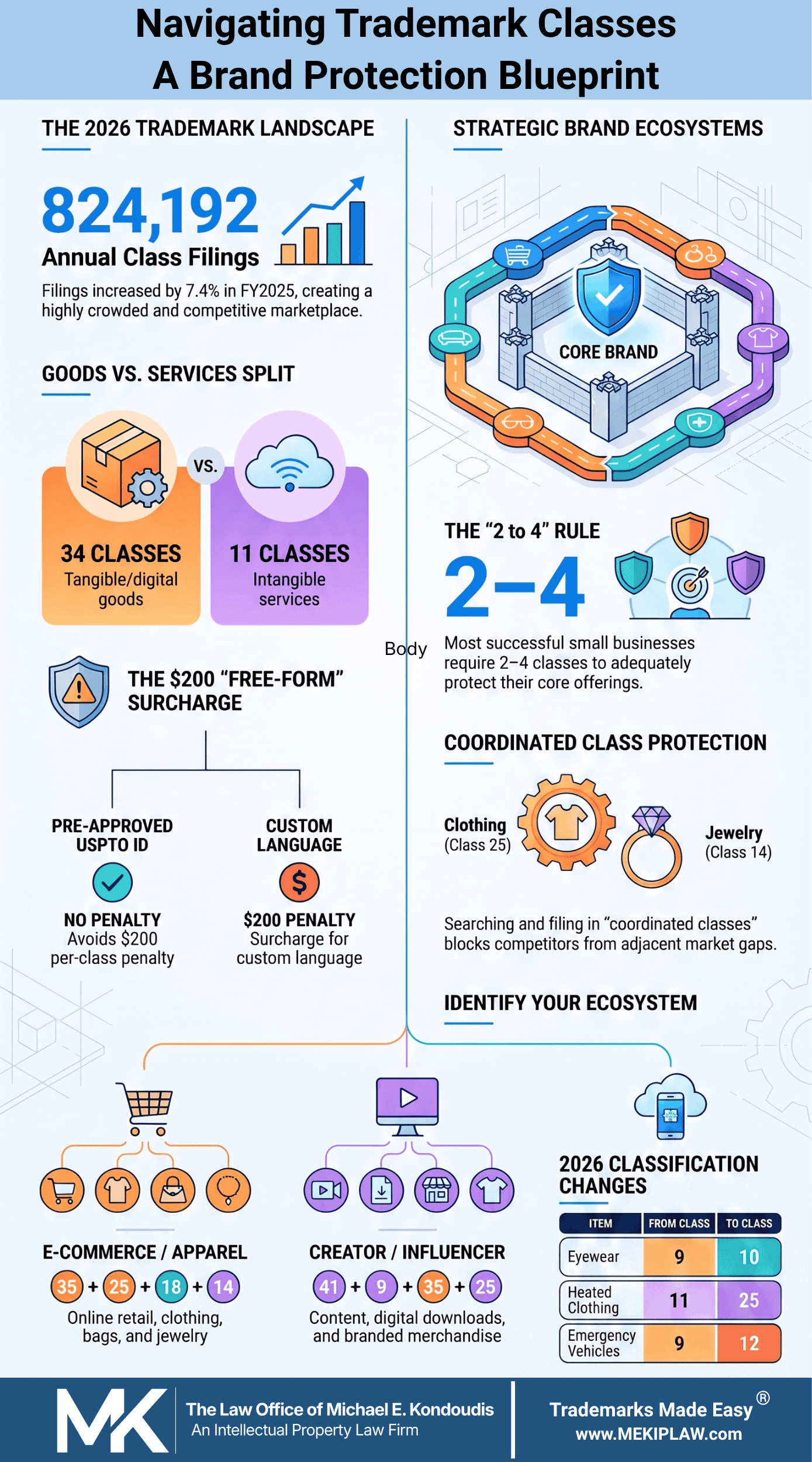
Trademark classes are the 45 standardized categories the USPTO uses to classify the goods and services covered by a federal trademark application. Classes 1–34 cover goods, while Classes 35–45 cover services. Choosing the correct trademark class is critical because the classes and identification of goods or services help define the scope of your application, determine filing fees, and affect the trademark clearance process. The USPTO base application fee is $350 per class, so applications covering multiple classes cost more. Applicants should also consider coordinated classes—closely related categories that may contain conflicting trademarks and should be reviewed during a comprehensive trademark search.
Updated 3 October, 2026 · Nice Classification, 13th edition (effective January 1, 2026)

By Michael E. Kondoudis, Trademark Attorney with 25+ years of Experience
USPTO-Registered·1,000+ Trademarks Searched and Filed·Bar: U.S. Supreme Court
TL;DR
The USPTO organizes trademark applications into 45 international classes—Classes 1–34 for goods and Classes 35–45 for services. The classes you need depend on the particular goods and services you offer or have a bona fide intent to offer. USPTO filing fees are generally assessed per class, and trademark clearance should consider related goods and services even when they fall in different classes. Start with the popular class guides:
🔑 Key Takeaways: USPTO Trademark Classes
The USPTO uses 45 international trademark classes to categorize goods and services. Classes 1–34 cover goods, while Classes 35–45 cover services.
A trademark class does not, by itself, define the scope of trademark rights. The specific goods and services identified in the application are critical, and trademarks in different classes can still conflict when their goods or services are sufficiently related.
Applicants should choose trademark classes based on the goods or services they currently provide or have a bona fide intent to provide. The USPTO Trademark ID Manual can be used to identify accepted descriptions and the appropriate international class.
The USPTO base application filing fee is $350 per class for qualifying applications under Sections 1 and 44. Additional fees may apply, including a $200-per-class fee for using the free-form text box instead of selecting an identification from the Trademark ID Manual.
A business may need more than one trademark class when its brand covers multiple types of goods or services. The correct number of classes depends on the business’s actual commercial activities and planned uses of the trademark—not a predetermined number of classes.
Trademark clearance searches should not be limited automatically to the applicant’s exact class. The USPTO’s coordinated-class system helps identify trademarks covering related goods or services in other classes that could present a likelihood-of-confusion issue.
The 2026 Nice Classification changes matter when selecting classes. The 13th edition of the Nice Classification became effective January 1, 2026, and reclassified certain goods, making current USPTO classification information particularly important when preparing a new application.
Every trademark application must identify at least one class of goods or services, and an application may include multiple classes when the mark is used—or there is a qualifying bona fide intent to use it—for goods or services falling in different classes.
Table of Contents (Clickable)
What Is a USPTO Trademark Class?
A USPTO trademark class is a standardized category used to organize the goods or services identified in a federal trademark application. The U.S. Patent and Trademark Office (USPTO)—the federal agency responsible for registering U.S. trademarks—uses trademark classes to organize goods and services in applications, assess filing fees, and help applicants search the federal trademark database for registered and pending marks.
According to the USPTO, all goods and services are organized into broad categories established by international agreement. Each category is assigned a number from 1 through 45, known as an international trademark class. Goods and services are not placed in the same class. See the USPTO’s guidance on goods, services, and trademark classes.
Importantly, a trademark class is primarily an administrative classification. Under 15 U.S.C. § 1112, classification exists for the convenience of USPTO administration and does not, by itself, limit or extend an applicant’s or registrant’s trademark rights.
What Are the Trademark Classes for Goods?
Trademark Classes 1 through 34 cover goods. Goods are products that customers purchase, including physical products and certain downloadable products.
Examples include:
Class 3 — cosmetics and cleaning preparations
Class 9 — electrical and scientific apparatus, including many downloadable software products
Class 14 — jewelry
Class 25 — clothing
Class 28 — toys and sporting goods
The USPTO identifies Classes 1–34 as the international classes for goods and provides an overview of the products generally covered by each class in its Goods and Services guidance.
The correct trademark class depends on the specific goods identified in the application, not simply on the applicant’s industry or general type of business.
What Are the Trademark Classes for Services?
Trademark Classes 35 through 45 cover services. Services are activities performed for the benefit of customers or other businesses rather than products sold to them.
Examples include:
Class 35 — advertising and business services
Class 36 — insurance and financial services
Class 41 — education and entertainment services
Class 42 — computer and scientific services
Class 43 — hotel and restaurant services
Class 45 — personal and legal services
The USPTO identifies Classes 35–45 as the international classes for services. Its Goods and Services guidance provides the general subject matter covered by each service class.
Why Does the Correct Trademark Class Matter?
The correct trademark class is important, but the class number alone does not define the scope of trademark protection. Federal law expressly provides that classification is for USPTO administrative convenience and does not itself limit or extend trademark rights. See 15 U.S.C. § 1112.
Instead, a trademark is connected to the specific goods or services with which it is used. As the USPTO explains in its guidance on trademark scope of protection, accurately identifying the goods and services associated with a mark helps define its scope of use and is important when evaluating potentially conflicting trademarks.
Trademark classes also affect filing costs. Most USPTO trademark fees are calculated on a per-class basis, so an application covering goods or services in multiple classes generally requires a separate filing fee for each class.
Explanatory Infographic About Trademark Classes
How Do The 2026 Nice Classification Changes Affect Trademark Applications?
The USPTO currently uses the Nice Classification, Thirteenth Edition, Version 2026 (NCL 13-2026). It became effective on January 1, 2026, and applies to U.S. trademark applications filed on or after that date.
The Nice Classification is the international system for classifying goods and services for trademark registration. The World Intellectual Property Organization (WIPO) maintains the Nice Classification, while the USPTO applies it to U.S. trademark applications.
The 2026 edition made several significant classification changes. According to the USPTO’s examination procedure manual, TMEP § 1401.16, notable changes include:
| Product Category | Old USPTO Class | New 2026 Class | What is Shifted? |
|---|---|---|---|
| Eyewear & Sunglasses | Class 9 | Class 10 | Moves all spectacles, contact lenses, and sunglasses to medical/assistive apparatus. |
| Electrically Heated Clothing | Class 11 | Class 25 | Migrates electrically heated clothing items into core clothing and apparel. |
| Specialized Vehicles | Class 9 | Class 12 | Select rescue and emergency vehicles migrate to land/air/water locomotion. |
Applicants should therefore use the current classification rules rather than relying on older trademark registrations or outdated class lists.
WIPO also publishes the official NCL(13-2026) revision materials, which identify additions, deletions, wording changes, and transfers between classes.
What Is the Difference Between Trademark Goods and Services?
Trademark goods are products sold to customers, while trademark services are activities performed for the benefit of others.
The USPTO explains that goods include products customers purchase, while services are activities performed for someone other than the applicant or its company. See the USPTO’s Goods and Services guidance.
Goods are classified in Classes 1–34, while services are classified in Classes 35–45.
Many businesses provide both goods and services and therefore may require more than one trademark class.
Example: A musician might offer downloadable music recordings in Class 9, live entertainment services in Class 41, branded clothing in Class 25, and online retail store services in Class 35.
Correctly distinguishing between goods and services matters because a federal trademark application must specifically identify what the applicant currently provides—or, for an intent-to-use application, has a bona fide intention to provide.
How Do Trademark Classes Affect the Scope of Trademark Protection?
Trademark classes organize goods and services, but they do not independently define the legal scope of trademark rights.
Under 15 U.S.C. § 1112, the USPTO’s classification system exists for administrative convenience and does not itself limit or extend an applicant’s or registrant’s rights.
Instead, trademark protection is connected to the goods and services identified with the mark. The USPTO, in its Trademark Scope of Protection guidance, explains that being specific about the goods or services associated with a trademark helps identify its scope of use.
This distinction is important because trademarks do not have to appear in the same international class to conflict. The central issue is whether the marks are sufficiently similar and the goods or services sufficiently related to create a likelihood of confusion. The USPTO’s guidance on the likelihood of confusion explains that it considers factors such as whether goods or services travel through similar trade channels, are used together, or are commonly advertised together.
Getting the identification and classification right can therefore help:
accurately define the goods and services covered by the application;
reduce classification and identification issues during examination;
support a more effective trademark clearance search;
align the application with the applicant’s actual commercial activities; and
reduce the need for additional applications as a business expands.
If the USPTO determines that an identification of goods or services is indefinite, inaccurate, or improperly classified, the issue may be raised in a USPTO Office Action requiring clarification or correction.
Proper classification is part of trademark strategy, but the specific identification of goods and services is generally more important than the class number itself. Also, proper classification is only one part of a federal trademark application. The proposed mark must also satisfy the substantive trademark requirements for federal registration.
The Complete List of All USPTO Trademark Classes for Goods (Classes 1-34)
USPTO Trademark Classes 1 through 34 cover goods. The class headings below follow the USPTO’s current Nice Classification, Thirteenth Edition, Version 2026.
A class heading describes the general subject matter associated with a class, but it should not be treated as a complete list of everything classified there. The USPTO advises applicants to consult the Nice explanatory notes, alphabetical list, and the USPTO Trademark ID Manual to determine the correct classification of a particular product.
USPTO Trademark Class 1 (Goods)
- Official Classification Heading: Chemicals for use in industry, science and photography, as well as in agriculture, horticulture and forestry; unprocessed artificial resins, unprocessed plastics; fire extinguishing and fire prevention compositions; tempering and soldering preparations; substances for tanning animal skins and hides; adhesives for use in industry; compost, manures, fertilizers; biological preparations for use in industry and science.
- Real-World Product Examples: Industrial chemicals, agricultural fertilizers, commercial adhesives, laboratory reagents.
USPTO Trademark Class 2 (Goods)
- Official Classification Heading: Paints, varnishes, lacquers; preservatives against rust and against deterioration of wood; colorants, dyes; inks for printing, marking and engraving; raw natural resins; metals in foil and powder form for use in painting, decorating, printing and art.
- Real-World Product Examples: House paint, wood stain, printing inks, industrial rust preventatives.
USPTO Trademark Class 3 (Goods)
- Official Classification Heading: Non-medicated cosmetics and toiletry preparations; non-medicated dentifrices; perfumes; bleaching preparations and other substances for laundry use; cleaning, polishing and abrasive preparations.
- Real-World Product Examples: Skincare products, cosmetics, perfume, hair shampoo, laundry detergent.
USPTO Trademark Class 4 (Goods)
- Official Classification Heading: Industrial oils and greases, wax; lubricants; dust absorbing, wetting and binding compositions; fuels and illuminants; candles and wicks for lighting.
- Real-World Product Examples: Motor oil, scented candles, petroleum fuels, industrial lubricants.
USPTO Trademark Class 5 (Goods)
- Official Classification Heading: Pharmaceuticals, medical and veterinary preparations; sanitary preparations for medical purposes; dietetic food and substances adapted for medical or veterinary purposes, food for babies; dietary supplements for human beings and animals; adhesive plasters, materials for dressings; material for filling teeth, dental wax; disinfectants; preparations for destroying vermin; fungicides, herbicides.
- Real-World Product Examples: Vitamins, dietary supplements, prescription medications, over-the-counter disinfectants.
USPTO Trademark Class 6 (Goods)
- Official Classification Heading: Common metals and their alloys, ores; metal materials for building and construction; transportable buildings of metal; non-electric cables and wires of common metal; small items of metal hardware; metal containers for storage or transport; safes.
- Real-World Product Examples: Metal hardware, structural building materials, commercial safes, metal storage containers.
USPTO Trademark Class 7 (Goods)
- Official Nice Classification Heading: Machines, machine tools, power-operated tools; motors and engines, except for land vehicles; machine coupling and transmission components, except for land vehicles; agricultural implements, other than hand-operated hand tools; incubators for eggs; automatic vending machines.
- Real-World Product Examples: Construction power tools, industrial manufacturing machines, non-vehicle motors.
USPTO Trademark Class 8 (Goods)
- Official Classification Heading: Hand-operated hand tools and implements; cutlery; side arms, except firearms; razors.
- Real-World Product Examples: Manual hand tools, kitchen knives, scissors, shaving razors.
USPTO Trademark Class 9 (Goods)
- Official Classification Heading: Scientific, research, navigation, surveying, photographic, cinematographic, audiovisual, optical, weighing, measuring, signalling, detecting, testing, inspecting, life-saving and teaching apparatus and instruments; apparatus and instruments for conducting, switching, transforming, accumulating, regulating or controlling the distribution or use of electricity; apparatus and instruments for recording, transmitting, reproducing or processing sound, images or data; recorded and downloadable multimedia files, computer software, blank digital or analogue recording and storage media; mechanisms for coin-operated apparatus; cash registers, calculating devices; computers and computer peripheral devices; diving suits, divers’ masks, ear plugs for divers, nose clips for divers, gloves for divers, breathing apparatus for underwater swimming; fire-extinguishing apparatus.
- Real-World Product Examples: Downloadable software, mobile applications, consumer electronics, digital audio/video recordings, personal computers.
- Note for 2026: Eyewear, lenses, and sunglasses have migrated out of Class 9 into Class 10.
USPTO Trademark Class 10 (Goods)
- Official Classification Heading: Surgical, medical, dental and veterinary apparatus and instruments; artificial limbs, eyes and teeth; spectacles, contact lenses and sunglasses; orthopaedic articles; suture materials; therapeutic and assistive devices adapted for persons with disabilities; massage apparatus; apparatus, devices and articles for nursing infants; sexual activity apparatus, devices and articles.
- Real-World Product Examples: Medical devices, orthopedic articles, surgical tools, spectacles, contact lenses, sunglasses.
- 2026 Revision Context: This class now explicitly includes consumer spectacles, contact lenses, and sunglasses.
USPTO Trademark Class 11 (Goods)
- Official Classification Heading: Apparatus and installations for lighting, heating, cooling, steam generating, cooking, drying, ventilating, water supply and sanitary purposes.
- Real-World Product Examples: Lighting fixtures, home heaters, air conditioners, kitchen cooking appliances.
- Note for 2026: Electrically heated clothing has migrated out of Class 11 into Class 25.
USPTO Trademark Class 12 (Goods)
- Official Classification Heading: Vehicles; apparatus for locomotion by land, air or water.
- Real-World Product Examples: Consumer cars, bicycles, commercial boats, aircraft, electric vehicles.
USPTO Trademark Class 13 (Goods)
- Official Classification Heading: Firearms; ammunition and projectiles; explosives; fireworks.
- Real-World Product Examples: Hunting firearms, defense ammunition, commercial fireworks.
USPTO Trademark Class 14 (Goods)
- Official Classification Heading: Precious metals and their alloys; jewelry, precious and semi-precious stones; horological and chronometric instruments.
- Real-World Product Examples: Fine jewelry, luxury watches, unmounted precious stones.
USPTO Trademark Class 15 (Goods)
- Official Classification Heading: Musical instruments; music stands and stands for musical instruments; conductors’ batons.
- Real-World Product Examples: Guitars, pianos, drums, orchestral music stands.
USPTO Trademark Class 16 (Goods)
- Official Classification Heading: Paper and cardboard; printed matter; bookbinding material; photographs; stationery and office requisites, except furniture; adhesives for stationery or household purposes; drawing materials and materials for artists; paintbrushes; instructional and teaching materials; plastic sheets, films and bags for wrapping and packaging; printers’ type, printing blocks.
- Real-World Product Examples: Printed books, paper notebooks, office stationery, physical instructional materials.
USPTO Trademark Class 17 (Goods)
- Official Classification Heading: Unprocessed and semi-processed rubber, gutta-percha, gum, asbestos, mica and substitutes for all these materials; plastics and resins in extruded form for use in manufacture; packing, stopping and insulating materials; flexible pipes, tubes and hoses, not of metal.
- Real-World Product Examples: Rubber manufacturing products, thermal insulating materials, flexible plastic tubing.
USPTO Trademark Class 18 (Goods)
- Official Classification Heading: Leather and imitations of leather; animal skins and hides; luggage and carrying bags; umbrellas and parasols; walking sticks; whips, harness and saddlery; collars, leashes and clothing for animals.
- Real-World Product Examples: Fashion handbags, travel backpacks, consumer luggage, leather wallets, pet leashes.
USPTO Trademark Class 19 (Goods)
- Official Classification Heading: Materials, not of metal, for building and construction; rigid pipes, not of metal, for building; asphalt, pitch, tar and bitumen; transportable buildings, not of metal; monuments, not of metal.
- Real-World Product Examples: Non-metal building materials, paving asphalt, concrete construction products.
USPTO Trademark Class 20 (Goods)
- Official Classification Heading: Furniture, mirrors, picture frames; containers, not of metal, for storage or transport; unworked or semi-worked bone, horn, whalebone or mother-of-pearl; shells; meerschaum; yellow amber.
- Real-World Product Examples: Home furniture, wall mirrors, wooden picture frames, non-metal storage containers.
USPTO Trademark Class 21 (Goods)
- Official Classification Heading: Household or kitchen utensils and containers; cookware and tableware, except forks, knives and spoons; combs and sponges; brushes, except paintbrushes; brush-making materials; articles for cleaning purposes; unworked or semi-worked glass, except building glass; glassware, porcelain and earthenware.
- Real-World Product Examples: Kitchen utensils, non-electric cookware, household glassware, porcelain dishware.
USPTO Trademark Class 22 (Goods)
- Official Classification Heading: Ropes and string; nets; tents and tarpaulins; awnings of textile or synthetic materials; sails; sacks for the transport and storage of materials in bulk; padding, cushioning and stuffing materials, except of paper, cardboard, rubber or plastics; raw fibrous textile materials and substitutes therefor.
- Real-World Product Examples: Camping tents, outdoor tarps, climbing ropes, bulk storage sacks.
USPTO Trademark Class 23 (Goods)
- Official Classification Heading: Yarns and threads for textile use.
- Real-World Product Examples: Textile yarns, commercial sewing threads.
USPTO Trademark Class 24 (Goods)
- Official Classification Heading: Textiles and substitutes for textiles; household linen; curtains of textile or plastic.
- Real-World Product Examples: Raw fabrics, bedroom bedding, bath towels, window curtains.
USPTO Trademark Class 25 (Goods)
- Official Classification Heading: Clothing, footwear, headwear.
- Real-World Product Examples: Brand apparel, shirts, pants, athletic shoes, hats, promotional merchandise clothing.
- 2026 Revision Context: This class now formally includes consumer-facing electrically heated clothing products.
USPTO Trademark Class 26 (Goods)
- Official Classification Heading: Lace and embroidery, and haberdashery ribbons and bows; buttons, hooks and eyes, pins and needles; artificial flowers; hair decorations; false hair.
- Real-World Product Examples: Clothing buttons, zippers, artificial decorative flowers, hair accessories.
USPTO Trademark Class 27 (Goods)
- Official Classification Heading: Carpets, rugs, mats and matting, linoleum and other materials for covering existing floors; wall hangings, not of textile.
- Real-World Product Examples: Floor carpets, area rugs, protective mats, linoleum floor coverings.
USPTO Trademark Class 28 (Goods)
- Official Classification Heading: Games, toys and playthings; video game apparatus; gymnastic and sporting articles; decorations for Christmas trees.
- Real-World Product Examples: Children’s toys, tabletop board games, consumer sporting goods, video game hardware.
USPTO Trademark Class 29 (Goods)
- Official Classification Heading: Meat, fish, poultry and game; meat extracts for culinary purposes; preserved, frozen, dried and cooked fruits, vegetables and seaweeds; jellies, jams, compotes; eggs; milk, cheese, butter, yogurt and other milk products; oils and fats for food.
- Real-World Product Examples: Packaged meats, dairy cheese and milk, preserved foods, cooking oils.
USPTO Trademark Class 30 (Goods)
- Official Classification Heading: Coffee, tea, cocoa and substitutes therefor; rice, pasta and noodles; tapioca and sago; flour and preparations made from cereals; bread, pastries and confectionery; chocolate; ice cream, sorbets and other edible ices; sugar, honey, treacle; yeast, baking-powder; salt, seasonings, spices, preserved herbs; vinegar, sauces and other condiments; ice (frozen water).
- Real-World Product Examples: Whole bean coffee, herbal tea, culinary spices, baked goods, condiment sauces, snack foods.
USPTO Trademark Class 31 (Goods)
- Official Classification Heading: Raw and unprocessed agricultural, aquacultural, horticultural and forestry products; raw and unprocessed grains and seeds; fresh fruits and vegetables, fresh herbs; natural plants and flowers; bulbs, seedlings and seeds for planting; live animals; foodstuffs and beverages for animals; malt.
- Real-World Product Examples: Fresh grocery produce, live house plants, agricultural seeds, commercial pet food, live animals.
USPTO Trademark Class 32 (Goods)
- Official Classification Heading: Beers; non-alcoholic beverages; mineral and aerated waters; fruit beverages and fruit juices; syrups and other preparations for making non-alcoholic beverages.
- Real-World Product Examples: Soft drinks, fruit juices, craft beer, bottled water.
USPTO Trademark Class 33 (Goods)
- Official Classification Heading: Alcoholic beverages, except beers; alcoholic preparations for making beverages.
- Real-World Product Examples: Wine, hard spirits, distilled liquor.
USPTO Trademark Class 34 (Goods)
- Official Classification Heading: Tobacco and tobacco substitutes; cigarettes and cigars; electronic cigarettes and oral vaporizers for smokers; smokers’ articles; matches.
- Real-World Product Examples: Cigarettes, premium cigars, e-cigarettes, vaporizers, smokers’ accessories.
The Complete List of All USPTO Trademark Classes for Services (Classes 35-45)
USPTO Trademark Classes 35 through 45 cover services. The official headings below are based on the current 2026 Nice Classification used by the USPTO.
The class heading is only a general guide. Applicants should identify their actual services with sufficient specificity and determine where those particular services are classified. The USPTO’s Trademark ID Manual contains searchable descriptions and classifications for thousands of goods and services.
USPTO Trademark Class 35 (Services)
- Official Classification Heading: Advertising; business management, organization and administration; office functions.
- Real-World Service Examples: Online retail store services, marketing agencies, business consulting, e-commerce store operations.
USPTO Trademark Class 36 (Services)
- Official Classification Heading: Financial, monetary and banking services; insurance services; real estate services.
- Real-World Service Examples: Commercial banking, insurance underwriting, real estate agencies, asset investment services.
USPTO Trademark Class 37 (Services)
- Official Classification Heading: Construction services; installation and repair services; mining extraction, oil and gas drilling.
- Real-World Service Examples: Building construction, home repair, equipment installation services.
USPTO Trademark Class 38 (Services)
- Official Classification Heading: Telecommunications services.
- Real-World Service Examples: Internet service providers (ISPs), cellular phone carriers, digital streaming platforms.
USPTO Trademark Class 39 (Services)
- Official Classification Heading: Transport; packaging and storage of goods; travel arrangement.
- Real-World Service Examples: Freight shipping, logistics coordination, travel agencies, delivery services.
USPTO Trademark Class 40 (Services)
- Official Classification Heading: Treatment of materials; recycling of waste and trash; air purification and treatment of water; printing services; food and drink preservation.
- Real-World Service Examples: Custom manufacturing, commercial printing, waste recycling, water treatment.
USPTO Trademark Class 41 (Services)
- Official Classification Heading: Education; providing of training; entertainment; sporting and cultural activities.
- Real-World Service Examples: Online courses, podcast production, live entertainment events, fitness gyms, live music performances.
USPTO Trademark Class 42 (Services)
- Official Classification Heading: Scientific and technological services and research and design relating thereto; industrial analysis, industrial research and industrial design services; quality control and authentication services; design and development of computer hardware and software.
- Real-World Service Examples: Software-as-a-Service (SaaS) platforms, custom software development, cloud computing services, IT technology consulting.
USPTO Trademark Class 43 (Services)
- Official Classification Heading: Services for providing food and drink; temporary accommodation.
- Real-World Service Examples: Dine-in restaurants, coffee shops, hotels, event catering, mobile food trucks.
USPTO Trademark Class 44 (Services)
- Official Classification Heading: Medical services; veterinary services; hygienic and beauty care for human beings or animals; agriculture, aquaculture, horticulture and forestry services.
- Real-World Service Examples: Medical clinics, wellness spas, veterinary services, hair and beauty salons.
USPTO Trademark Class 45 (Services)
- Official Classification Heading: Legal services; security services for the physical protection of tangible property and individuals; dating services, online social networking services; funerary services; babysitting.
- Real-World Service Examples: Law firms, private security services, online dating platforms, digital social networking applications.
What Are The Most Common USPTO Trademark Classes?
The most frequently used classes for founders, entrepreneurs, creators, and small businesses are:
- Class 9 — Downloadable software, mobile apps, audio/video recordings, digital content, electronics.
- Class 25 — Clothing, footwear, headwear, and apparel (especially merchandise).
- Class 35 — Advertising, marketing, business management, retail store services, and e-commerce.
- Class 41 — Education, entertainment, podcasts, video production, live events, online courses, workshops.
- Class 42 — Non-downloadable software (SaaS), cloud computing, tech support, scientific/technological services.
- Class 3 — Cosmetics, skincare, hair care, cleaning preparations, personal care products.
- Class 18 — Leather goods, handbags, backpacks, luggage, wallets.
- Class 16 — Printed books, planners, notebooks, stationery, paper goods.
- Class 30 — Coffee, tea, spices, baked goods, staple foods, packaged snacks.
- Class 28 — Toys, board games, puzzles, sporting goods, gaming accessories.
- Class 43 — Restaurant, cafe, food truck, catering, and temporary accommodation services.
- Class 5 — Dietary supplements, vitamins, nutritional products (often paired with wellness; watch structure/function claims).
These twelve classes account for the majority of filings by the businesses we serve.
What are the Best Multi-Class Combinations For Businesses?
The most effective class combinations—known as class ecosystems—are strategic groupings of multiple categories that map directly to how consumers naturally interact with a brand across products, digital spaces, and merchandise.
Musician, Recording Artists, or Band
- Recommended Classes: Class 9 + Class 41 + Class 25 + Class 35
- Filing Scope: Digital audio recordings (Class 9), live musical performances (Class 41), branded apparel merch (Class 25), and direct-to-fan online retail store services (Class 35)
- Strategic Note: Class 35 e-commerce store protection is frequently overlooked by independent musical artists.
For a complete walkthrough of the process, see our guide: How to Trademark a Band Name.
Podcaster, YouTube Creator, or Digital Influencer
- Recommended Classes: Class 41 + Class 9 + Class 35 + Class 25
- Filing Scope: Digital video entertainment content (Class 41), downloadable media files (Class 9), brand sponsorships (Class 35), and branded creator clothing (Class 25)
- Strategic Note: Expanding creators frequently add Class 42 later to protect proprietary digital membership platforms.
For a complete walkthrough of the process, see our guides: How to Trademark a Podcast and How to Trademark a YouTube Channel.
E-Commerce, Apparel, or Lifestyle Brand
- Recommended Classes: Class 35 + Class 25 + Class 18 + Class 14
- Filing Scope: Online retail store services (Class 35), brand clothing (Class 25), carrying bags and luggage (Class 18), and fashion jewelry (Class 14)
- Strategic Note: These classes may cover different aspects of an apparel or lifestyle business, including retail services, clothing, bags, and jewelry. Whether each class should be included depends on the goods and services actually offered or genuinely planned under the mark.
SaaS or Technology Startup
- Recommended Classes: Class 42 + Class 9 + Class 35
- Filing Scope: Cloud-hosted, non-downloadable platform software (Class 42), downloadable mobile phone applications (Class 9), and technology business services (Class 35)
- Strategic Note: This core startup combination comprehensively covers both the core software platform technology and your primary go-to-market commercial activities.
Restaurant, Cafe, or Commercial Food Business
- Recommended Classes: Class 43 + Class 30 + Class 35
- Filing Scope: Brick-and-mortar restaurant services (Class 43), branded packaged food products (Class 30), and retail store sales (Class 35)
- Strategic Note: This combination is ideal for modern food businesses that sell items both over the counter and via packaged grocery channels.
For a complete walkthrough of the process, see our guide: How to Trademark a Restaurant Name.
Fitness, Wellness, or Yoga Studio / Coach
- Recommended Classes: Class 41 + Class 25 + Class 35 + Class 5
- Filing Scope: Instruction and education (Class 41), activewear (Class 25), memberships and retail (Class 35), supplements (Class 5)
- Strategic Note: Class 5 should be added only when selling nutritional products; watch structure/function claims carefully.
Beauty, Skincare, or Cosmetics Brand (DTC)
- Recommended Classes: Class 3 + Class 35 + Class 25
- Filing Scope: Cosmetics and personal care products (Class 3), e-commerce/retail (Class 35), branded apparel and lifestyle merch (Class 25)
- Strategic Note: Many beauty brands later expand into Class 42 if they launch apps or personalized tools.
Book Author, Publisher, or Online Educator
- Recommended Classes: Class 16 + Class 9 + Class 41 + Class 35
- Filing Scope: Printed books (Class 16), digital/ebooks (Class 9), courses and education services (Class 41), retail and direct sales (Class 35)
- Strategic Note: Covers the full journey from physical books to digital products to live/online education.
Professional Services Firm (Agency, Consultant, Advisor)
- Recommended Classes: Class 35 + Class 42
- Filing Scope: Advertising, marketing, business management and consulting services (Class 35), software/tools (Class 42)
- Strategic Note: Class 42 is included when the firm offers proprietary software or technical services.
What Are Coordinated Trademark Classes and Why Should You Search Them?
Coordinated trademark classes are classes the USPTO search system identifies as potentially related to a particular class for trademark-search purposes. They can help applicants find marks covering goods or services that may be related even though they appear in different international classes.
For example, a search involving clothing in Class 25 may also require consideration of marks associated with related goods or services in other classes.
A trademark does not avoid a likelihood-of-confusion problem merely because the goods or services appear in different classes. The USPTO explains that the relevant inquiry is whether the marks are confusingly similar and whether the respective goods or services are related. See the USPTO’s guidance on likelihood of confusion.
The USPTO’s guidance on using coordinated classes in a federal trademark search explains how coordinated classes can help identify related goods and services during a clearance search.
However, coordinated classes are a search tool, not an exhaustive definition of related goods and services. The USPTO cautions that a coordinated-class search may not identify every potentially related good or service. Depending on the mark and marketplace, a comprehensive trademark search may need to extend beyond the classes identified as coordinated.
Practical rule: Use coordinated classes to expand a trademark search, but do not assume that searching only those classes will identify every potential conflict.

Not Sure Which Trademark Classes You Need?
Choosing the right trademark classes depends on the goods and services you offer, how you use your brand, and what you plan to protect through federal registration. Filing in the wrong classes—or overlooking an important class—can create problems that may require another application later.
Michael E. Kondoudis can help identify the appropriate USPTO classes, evaluate related goods and services, and develop a trademark filing strategy based on your business and brand.
Nationwide federal trademark representation · Flat-fee options available
How Do I Choose the Right Trademark Class? Step-by-Step
Choosing the correct trademark class begins with identifying the specific goods and services offered—or genuinely planned—under the trademark.
The USPTO requires an application to specify the particular goods or services associated with the mark. TMEP § 1402.01 explains that an identification should use understandable terminology and be specific, definite, clear, accurate, and concise.
Use this process:
List your current goods and services. Identify what customers actually buy from you and what services they hire you to perform.
Identify genuinely planned goods and services. Do not claim speculative products or services merely because you might offer them someday. For an intent-to-use application, 15 U.S.C. § 1051(b) requires a bona fide intention to use the trademark in commerce for the identified goods or services.
Search the USPTO Trademark ID Manual. Use the official Trademark ID Manual to locate accepted descriptions and determine the corresponding international class.
Review the current Nice Classification. For difficult classifications, consult the USPTO’s 2026 Nice Classification class headings and explanatory notes.
Identify related goods and services. Review the USPTO’s coordinated-class guidance as part of the clearance process, while recognizing that related goods and services can extend beyond coordinated classes.
Draft a precise identification. Describe the goods or services specifically enough to satisfy USPTO identification requirements. Avoid vague or unnecessarily broad terminology.
Conduct a comprehensive trademark search. Search not only identical marks in the same class but also similar marks associated with goods or services that could be considered related for likelihood-of-confusion purposes.
Determine which classes are commercially justified. File for the classes covering goods and services you use or have a supportable bona fide intent to use rather than selecting an arbitrary number of classes.
Pro Tip: Class selection and trademark clearance are related but distinct inquiries. Choosing the right class does not establish that a trademark is legally available for registration.
How Much Does It Cost to File A Trademark In 2026?
The USPTO base application filing fee is $350 per class for qualifying Section 1 and Section 44 applications. Because USPTO filing fees are generally calculated per class, the total government filing cost increases as additional classes are added. See the USPTO’s current Trademark Fee Schedule.
Current application-related fees include:
Base application filing fee: $350 per class
Insufficient information fee: $100 per class, when applicable
Free-form identification fee: $200 per class when the free-form text box is used instead of an identification from the Trademark ID Manual
Excess-character fee: $200 for each additional group of 1,000 characters beyond the first 1,000 in the free-form identification, per affected class
Amendment to Allege Use or Statement of Use: $150 per class for Section 1(b) applications
Extension of time to file a Statement of Use: $125 per class
Using an appropriate description from the USPTO’s Trademark ID Manual can avoid the $200-per-class free-form identification surcharge. The identification must still accurately describe the applicant’s actual goods or services.
Trademark Classes FAQ
This reference section provides immediate, direct answers to the most common legal and financial questions about trademark classes.
Q: How Many Trademark Classes Do I Actually Need?
There is no predetermined number of trademark classes that every business should file. An applicant should identify the classes that cover the goods and services it currently offers and, where appropriate, goods and services for which it has a bona fide intent to use the trademark.
The correct number depends on the business’s actual commercial activities and legitimate expansion plans. Each additional class generally increases USPTO filing fees. See the USPTO’s Goods and Services guidance.
Applicants should not add classes merely to expand the apparent breadth of an application. Each class should correspond to goods or services for which the mark is used or for which the applicant has the required bona fide intent to use the mark.
Q: What Is the USPTO Trademark ID Manual and Why Is It Important?
The USPTO Trademark ID Manual is the USPTO’s searchable database of acceptable identifications and classifications of goods and services.
Applicants can use the Trademark ID Manual to find descriptions that accurately identify their goods or services and determine the corresponding international class.
The TMEP explains that identifications must be sufficiently clear and specific to provide public notice, permit proper classification, and allow the USPTO to evaluate issues such as likelihood of confusion. See TMEP § 1402.01.
Using a suitable ID Manual entry also avoids the current USPTO surcharge for using the free-form identification field.
Q: Can I Add More Trademark Classes After Filing?
An applicant generally cannot broaden an application after filing by adding new goods or services outside the scope of the original identification. Under TMEP § 1402.06, an identification may generally be clarified or limited, but not broadened.
There is an important exception to the simplified statement that “classes can never be added.” In a Section 1 or Section 44 application, TMEP § 1403.02(c) permits an additional class when an item already identified in the original application is properly classified in a class that was not originally designated. The applicant must pay the applicable fee for the added class.
This does not permit an applicant to add genuinely new goods or services that fall outside the scope of the original identification. If a business later expands into new goods or services outside that scope, a new trademark application may be necessary.
Q: What Happens If I Choose the Wrong Trademark Class?
An incorrect class designation does not automatically mean an application must be abandoned. The consequences depend on the filing basis, the original identification, and whether a permissible correction can be made.
For Section 1 and Section 44 applications, the USPTO may permit classification corrections during examination when the goods or services were properly identified in the original application. The critical limitation is that the identification generally cannot be broadened after filing. See TMEP §§ 1402.06 and 1403.02.
For that reason, accurately identifying the goods and services at the time of filing is more important than simply selecting a class number.
Q: Can the Same or a Similar Trademark Exist in Different Trademark Classes?
Yes. Similar or even identical trademarks may coexist when the associated goods or services are sufficiently unrelated that consumers are unlikely to believe they come from the same source.
But different class numbers do not automatically eliminate a conflict. Under 15 U.S.C. § 1112, classification does not limit or extend trademark rights. The USPTO instead examines whether the marks and the associated goods or services create a likelihood of confusion.
That is why a trademark clearance search should consider related goods and services, not merely identical marks appearing in the applicant’s proposed class.
Q: Why Are Coordinated Trademark Classes Important?
Coordinated classes can help identify potentially related goods and services when conducting a federal trademark search.
The USPTO provides coordinated-class guidance to help searchers identify additional classes that may contain relevant marks.
However, coordinated classes are not exhaustive. A potential conflict can involve goods or services outside the listed coordinated classes if they are sufficiently related for likelihood-of-confusion purposes.
Q: Can I File an Intent-to-Use Trademark Application If I Am Not Selling Yet?
Yes. Section 1(b) of the Trademark Act permits an applicant with a bona fide intention to use a trademark in commerce to file before actual use begins.
The statutory basis is 15 U.S.C. § 1051(b). The applicant must have a bona fide intention to use the mark for the goods or services identified in the application.
Before registration generally can issue under Section 1(b), the applicant must establish qualifying use in commerce by filing an Amendment to Allege Use or Statement of Use and satisfying the applicable USPTO requirements.
Q: How Does Trademark Classification Affect International Protection?
The Nice Classification provides a common international framework for classifying trademark goods and services, but a U.S. registration does not automatically create trademark protection in other countries.
The Madrid System also uses the Nice Classification for international applications. WIPO’s Madrid System classification guidance explains how goods and services are classified in international trademark applications.
For a Madrid Protocol filing based on a U.S. application or registration, the goods and services claimed internationally cannot exceed the scope of the underlying U.S. basic application or registration.
Accurate identification and classification in the U.S. application can therefore be important when international expansion is anticipated.
Q: What Happens If I Stop Using My Trademark?
Trademark rights and registrations depend on continued qualifying use, subject to applicable legal requirements and exceptions.
Under the statutory definition of abandonment in 15 U.S.C. § 1127, a mark may be considered abandoned when its use has been discontinued with an intent not to resume use. Three consecutive years of nonuse constitute prima facie evidence of abandonment.
The three-year period does not automatically mean every registration is cancelled on the third anniversary of nonuse. Rather, the statute creates an evidentiary presumption of abandonment.
Applicants should therefore claim only goods and services for which the required use or bona fide intent can be supported.
Q: How Do I Find the Right Class in the USPTO Trademark ID Manual?
Start with the official USPTO Trademark ID Manual and search for the common commercial name of the particular product or service.
Review:
the identification wording;
the assigned international class;
any notes or limitations associated with the entry; and
whether the description accurately matches what the business actually offers.
The TMEP states that an identification should be specific, definite, clear, accurate, and concise. See TMEP § 1402.01.
Do not select an ID Manual description merely because it produces the class number you expected. The identification itself must accurately describe the applicant’s goods or services.
Q: What Are the Most Common Mistakes When Choosing Trademark Classes?
Common class-selection mistakes include:
choosing a class based only on a general class heading rather than the particular goods or services;
using an inaccurate or overly broad identification;
assuming different class numbers eliminate likelihood-of-confusion concerns;
failing to search for potentially conflicting marks covering related goods or services;
claiming speculative future goods or services without a supportable bona fide intent to use the mark; and
assuming that new goods or services can simply be added to the application after filing.
The USPTO’s Goods and Services guidance and TMEP Chapter 1400 provide the primary USPTO guidance on identification and classification.
Q: Do I Need to File in Coordinated Classes or Just Search Them?
A coordinated class is not a class that an applicant must automatically file in. Applicants should seek registration for classes covering goods or services they actually provide or have a bona fide intention to provide.
For searching, coordinated classes can be useful because they help identify potentially related goods and services. But the USPTO cautions that coordinated classes do not identify every possible relationship. See Using Coordinated Classes in Your Federal Trademark Search.
Accordingly, a clearance search should consider coordinated classes and other potentially related goods and services when appropriate.
What Are the Core Concepts of Trademark Classification?
Trademark classification relies on several related but distinct concepts:
Trademark Class: A standardized administrative category used by the USPTO to classify particular goods or services. Federal law provides that classification does not itself limit or extend trademark rights. See 15 U.S.C. § 1112.
Trademark Goods: Products sold to customers and classified principally in International Classes 1–34. See the USPTO’s Goods and Services guidance.
Trademark Services: Activities performed for the benefit of others and classified principally in International Classes 35–45.
Nice Classification: The international classification system for trademark goods and services maintained by WIPO. The USPTO currently applies the Nice Classification, Thirteenth Edition, Version 2026.
Identification of Goods and Services: The wording in an application that states the particular goods or services associated with the trademark. The identification—not merely the class number—is critical to defining the scope of the application. See TMEP § 1402.
USPTO Trademark ID Manual: The official searchable USPTO resource containing accepted identification wording and corresponding classifications. See the Trademark ID Manual.
Coordinated Classes: Classes identified by the USPTO search system as potentially related for search purposes. They are useful for trademark clearance but are not an exhaustive statement of all goods or services that may be legally related. See the USPTO’s Coordinated Classes guidance.
Likelihood of Confusion: The principal registration issue that can arise when marks are similar and their goods or services are related. Different class numbers do not necessarily prevent a conflict. See the USPTO’s Likelihood of Confusion guidance.
Intent-to-Use Application: A federal trademark application filed by an applicant with a bona fide intention to use the mark in commerce for the identified goods or services under 15 U.S.C. § 1051(b).
About the Author

Michael E. Kondoudis
U.S.-Licensed Trademark Attorney · USPTO-Registered Patent Attorney (Reg. No. 42,758) · Founder and Principal
Michael E. Kondoudis is the founder and principal of The Law Office of Michael E. Kondoudis®, a Washington, DC-based law firm focused on federal trademark matters. He helps businesses and entrepreneurs search, register, protect, and enforce trademarks before the United States Patent and Trademark Office. His practice includes trademark clearance, federal applications, USPTO prosecution, Office Action responses, registration, maintenance, and enforcement.
Learn more about Michael E. Kondoudis →Before You File a Federal Trademark Application
Before filing a federal trademark application, determine whether the mark is available, identify what should be protected, and select the correct filing strategy. These decisions can affect registrability, USPTO examination, and the scope of any resulting trademark rights.
Is Your Trademark Available?
A comprehensive clearance search can identify potentially conflicting federal, state, and common-law marks before you invest in filing or launching the brand.
What Should You Protect?
A name, phrase, logo, or other brand element may require a different filing format and protection strategy. In some cases, separate applications may be appropriate to protect different brand elements.
How Should You File Your App?
The owner, goods and services, trademark classes, filing basis, mark format, and specimen can affect USPTO examination and the scope of protection.
Ready to Protect Your Trademark?
Speak directly with Michael E. Kondoudis about trademark availability, what to protect, and the most practical federal filing strategy for your business.
Book a Free Strategy Call 20 minutes. No pressure. No obligation. For businesses and entrepreneurs planning to file within approximately 30 days · Flat-fee options available.Trademark Attorney-Client Privilege Disclaimer
Disclaimer: No Attorney-Client Relationship or Legal Advice
This content is for general informational and educational purposes only and does not constitute legal advice. Reading or interacting with it does not create an attorney-client relationship. A formal relationship is formed only through a signed engagement agreement. Reading, sharing, or interacting with this content does not create an attorney-client relationship.
Do not send confidential trademark concepts or brand names through comments, forms, or email on this site — unsolicited information is not privileged. Trademark rights depend on specific facts and jurisdiction. Past results do not guarantee future outcomes. Consult a licensed trademark attorney for advice on your situation.
Remember: I am an experienced trademark attorney. However, I am not your attorney.