

To trademark a podcast name, clear the name, lock the owner, map the real goods and services (usually Class 41; add Class 9 or 25 only if earned), choose Section 1(a) or 1(b), and file in USPTO Trademark Center. You protect the name as a source identifier — you do not “trademark the podcast itself.”
Originally Published: June | Last Updated:

By Michael E. Kondoudis, Trademark Attorney with 25+ years of Experience
USPTO-Registered·1,000+ Trademarks Searched and Filed·Bar: U.S. Supreme Court
TL;DR
A U.S. federal trademark registration from the USPTO protects your podcast name or logo nationwide, granting you exclusive branding rights and accelerating platform-level takedowns on Apple and Spotify.
Key Takeaways
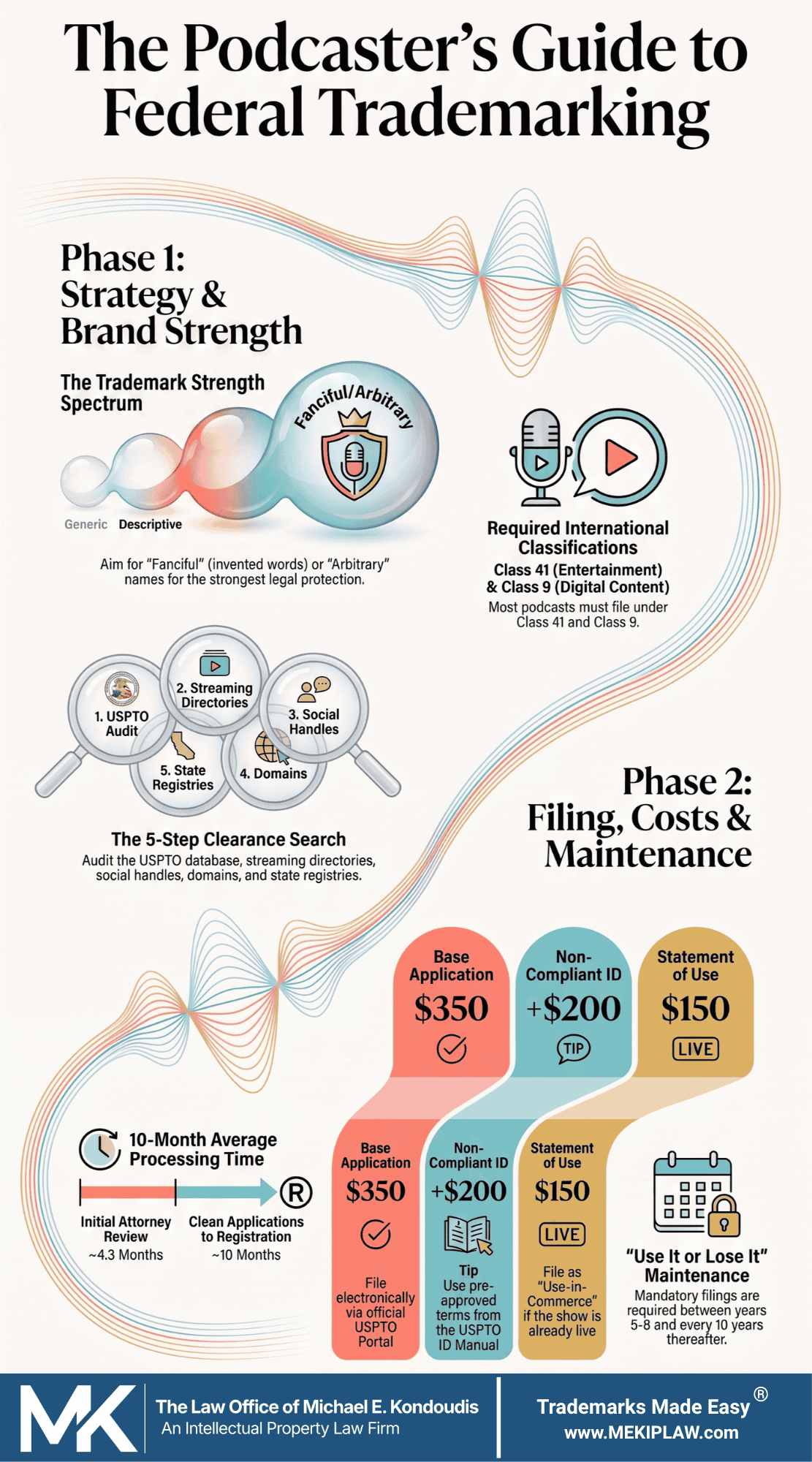
- Primary Classes: Applications for podcast trademarks often include Class 41 (Entertainment Services) and Class 9 (Downloadable Digital Content).
- Section 1(b) lets you file before launch if the intent is bona fide. Registration still waits on use.
- Trademark covers brands. Copyright covers episodes and recordings. Podcast names are not copyrightable.
- Base Cost: Base government filing fees are $350 per class when utilizing pre-approved descriptions from the USPTO ID Manual.
- Timeline: Initial evaluation by a USPTO examining attorney takes 4.3 months, with clean applications reaching final registration in 10 months.
What Does the Federal Podcast Trademark Process Look Like?
The federal podcast trademark process follows a clear sequence that includes evaluating trademark strength, selecting the correct classes, choosing a filing basis, and navigating USPTO examination. The visual roadmap below maps the Trademark Strength Spectrum, required classes, typical costs, and major decision points so you can see the entire path at a glance.
What is a Podcast Trademark and How Does It Protect Your Show?
A podcast trademark is a legally protected word, name, symbol, logo, or slogan that functions as a source identifier for a branded series of entertainment content.
- Primary Function: Prevents public consumer confusion.
- Market Utility: Distinguishes a media asset from competitors.
- Core Protection: Secures nationwide exclusive branding rights.
- Platform Advantage: Accelerates enforcement on Apple Podcasts and Spotify.
[Podcast Trademark] ──> Acts as ──> [Source Identifier] ──> Prevents ──> [Consumer Confusion]
A registered federal trademark protects your podcast brand identity nationwide across state lines. If a competitor launches an unauthorized show with a confusingly similar title, a federal registration provides the definitive legal leverage required to execute immediate platform-level takedowns on Apple Podcasts, Spotify, and YouTube.
Trademark Protection vs. Copyright Protection for Podcasts
- Podcast Trademarks protect source-identifying elements like titles, brand names, unique segment names, and visual logo designs. Individual podcast titles are not protectable by copyright law alone.
- Podcast Copyrights automatically protect specific creative expressions under Title 17 of the U.S. Code, including individual episode scripts, audio recordings, show notes, and original episode cover artwork.
What Is the Difference Between Common Law Rights and Federal Trademark Registration?
Common law rights arise automatically from actual commercial use but are limited to the geographic area where the podcast is known, while federal USPTO registration creates nationwide rights, a legal presumption of ownership, and the ability to use the ® symbol. Federal registration also makes platform enforcement on Apple Podcasts, Spotify, and YouTube significantly faster and more reliable.
- Common Law Podcast Rights arise automatically from actual commercial use within a local geographic market. Enforcement requires the podcaster to manually prove priority of use and actual consumer confusion in court.
- Federal USPTO Registration establishes nationwide constructive notice and a legal presumption of valid brand ownership. It grants you the exclusive right to use the official ® symbol and enables fast-track digital platform enforcement.
Understand exactly what the ® symbol means, when you can start using it, and the rules for TM and SM in our Guide to Trademark Symbols: How and When to Use ®, TM, and SM.
How Do You Trademark a Podcast Name?
You file a federal application that names the correct owner, lists the goods and services the name actually identifies, and shows use in U.S. commerce — or a bona fide intent to use. The USPTO examines the file for formalities and likelihood of confusion under Section 2(d) of the Lanham Act. If it survives examination and opposition, it registers.
Yes, a podcast name can function as a trademark or service mark. The test is source identification, not “is this a show title.”
| Step | What you do | Why it matters |
|---|---|---|
| 1. Choose a protectable name | Prefer fanciful, arbitrary, or suggestive wording | Descriptive and generic titles refuse or stall |
| 2. Clear the name | Federal + marketplace + common-law search | Confusion, not exact spelling, is the refusal |
| 3. Name the owner | Host, joint hosts, or LLC — in writing | Wrong applicant can void the filing |
| 4. Map classes | Class 41 core; 9 and 25 only if real | Rights follow the identification, not the medium |
| 5. Pick 1(a) or 1(b) | Use in commerce vs intent-to-use | Wrong basis = specimen or SOU problems |
| 6. File in Trademark Center | Owner, drawing, IDs, basis, fees | Filing starts a federal proceeding |
| 7. Specimen when required | Real use for 1(a); later SOU for 1(b) | Mockups fail |
| 8. Examination | Answer Office Actions by the deadline | Silence abandons the application |
| 9. Registration | Survive publication; use ® after issue | Nationwide constructive notice for claimed classes |
| 10. Maintain | Section 8 / 9 on time; watch the market | The USPTO does not police copycats |
What Are You Actually Registering?
The podcast is the show. The podcast name is the brand. The trademark is protection for that brand as a source identifier on specified goods and services.
| Asset | Usual protection | Not this |
|---|---|---|
| Podcast name | Trademark — standard-character mark | Copyright does not cover the title |
| Podcast logo | Trademark — special form; copyright may also cover the artwork | A restyled cover is not the same filing |
| Slogan / tagline | Trademark, if it identifies source | Decoration or a one-off episode title |
| Episodes, scripts, recordings | Copyright | Trademark |
What Are Real Examples of Registered Podcast Trademarks?
Successful podcast brands such as Crime Junkie and SmartLess have secured federal trademark registrations that protect their names across entertainment services and related goods. These real-world examples show how distinctive podcast titles can obtain nationwide protection and long-term brand equity.

U.S. Trademark No. 6,431,433 for CRIME JUNKIE covers class 41 entertainment services in the nature of podcasts (class 041) plus related downloadable content and apparel. The owner is an LLC, not a host’s personal name.

U.S. Trademark No. 7,310,681 for SmartLess covers downloadable content (Class 9), entertainment services (Class 41), and apparel (Class 25), among other classes.


These examples demonstrate how a memorable, distinctive name combined with professional branding can achieve full federal trademark protection.
Can I Trademark a Podcast Name Under U.S. Law?
- Brand Distinctiveness: The title must actively function as a unique brand source identifier rather than a generic description.
- Interstate Commerce: The creator must stream, distribute, or market the show to listeners across state lines or international borders.
- Accurate International Classification: The application must correctly identify the corresponding classes and service descriptions.
Where Does the Podcast Name Fall on the Trademark Strength Spectrum?
The legal protection a podcast title receives depends directly on where the name falls across the five tiers of the trademark strength spectrum:
[WEAKEST] Generic —> Descriptive —> Suggestive —> Arbitrary —> Fanciful [STRONGEST]
- Fanciful Podcast Marks (Strongest): Coined, invented words like “Zynpod” or “Podly”.
- Arbitrary Podcast Marks (Strong): Real words used in an entirely unrelated context, such as “Ocean” for a history podcast.
- Suggestive Podcast Marks (Moderate): Words that hint at the underlying content without directly describing the theme, such as “Crime Junkie”.
- Descriptive Podcast Marks (Weak): Words that explicitly describe the show format, such as “Daily True Crime Podcast”. Descriptive marks require extensive secondary meaning to achieve registration.
- Generic Podcast Marks (Unregistrable): Common category terms like “Podcast” can never obtain trademark protection.
| Rank | Category | Podcast example | Usual result |
|---|---|---|---|
| 1 — Dead | Generic | PODCAST, TRUE CRIME SHOW | Refusal. You cannot own the category. |
| 2 — Weak | Descriptive | THE MARKETING INTERVIEW PODCAST | Principal Register stall unless secondary meaning; Supplemental Register may be a fallback. |
| 3 — Moderate | Suggestive | CRIME JUNKIE | Often registrable if clear of conflicts. |
| 4 — Strong | Arbitrary | OCEAN for a history show | Inherently distinctive if not confusingly similar to a prior mark. |
| 5 — Strongest | Fanciful | A coined term with no prior meaning | Best inherent distinctiveness. Still must clear other users. |
Learn more about the 5 Types of Trademarks in this blog post.
How Do You Check If a Podcast Name Is Already In Use?
Creators must run a comprehensive clearance search to discover senior users and avoid application rejections or trademark infringement disputes.
A clearance search starts with a preliminary review of the USPTO’s trademark registration database via the USPTO.gov website.
The 5-Step Podcast Trademark Clearance Search Process
- Search the USPTO Database: Run exact and phonetic queries on the official database via the USPTO Trademark Search Portal across Classes 9, 25, 35, and 41.
- Audit Streaming Directories: Manually search Apple Podcasts, Spotify, YouTube, and Google to identify active, unregistered shows.
- Verify Social Media Handles: Check profile availability across major networks like Instagram, TikTok, X (Twitter), and YouTube.
- Confirm Root Domain Availability: Search the root
.comURL availability using a standard domain registry. - Scan Local State Databases: Review local state-level corporate and trademark registries for unregistered local businesses.

When choosing a podcast name, it is essential to make sure that there are no other podcasts with names that match or are similar to yours.
For a deep dive into trademark lookups, read our guide How to Do a Trademark Lookup: Complete USPTO Clearance Search Guide,
Who Should Own the Podcast Trademark?
The applicant must be the owner at filing: one host, hosts jointly, or — usually cleanest — an LLC the hosts own. Hosting the show does not automatically split the mark. Put ownership in a written agreement before anyone files. Wrong owner is hard to fix.
An LLC can own the registration. Forming the company is not a trademark.
| Owner | Use this when | Do not use this when |
|---|---|---|
| Individual host | One person runs and owns the show with no entity | An LLC already holds the contracts and revenue |
| LLC or corporation | The company owns the show and will license the name | The company does not yet exist |
| Network or studio | A written agreement assigns brand ownership to the network | The host still owns the name and the network is only a distributor |
| Joint hosts | Both control the brand and accept joint-ownership rules | One host will leave and take the name — use an entity plus a contract |
For a deeper dive into trademark ownership, read our guide to Who Owns a Trademark?
If your podcast includes your name, the special requirements for trademarking a personal name are explained in our guide, Can You Trademark Your Name?
What Trademark Classes Should You Use for a Podcast?
There is no universal “podcast class.” Protection follows the identification of services and goods listed in the application.
Core Podcast Classifications
- International Class 41 (Entertainment Services): Covers the production, distribution, hosting, and presentation of ongoing serial podcasts.
- International Class 9 (Downloadable Digital Content): Covers downloadable podcasts, audio recordings, video files, and associated media content.
Multiple classes may be needed: Depending on your podcast’s specific use, you might need to file in both Class 9 and Class 41 to fully protect your brand.
Expansion Podcast Classifications
- International Class 25 (Apparel & Merchandise): Protects branded clothing, hats, and physical streetwear.
- International Class 35 (Advertising & Sponsorships): Covers promotional services, paid sponsorships, and marketing partnerships.
- International Class 16 or 21 (Printed/Physical Goods): Covers books, journals, mugs, or specialized physical merchandise.
Should You File Under Section 1(a) or Section 1(b) for a Podcast Trademark?
You should file under Section 1(a) if your podcast is already live and distributing episodes across state lines, and under Section 1(b) if the show is still in the pre-launch or planning phase. Section 1(a) requires a specimen of use at filing, while Section 1(b) reserves nationwide priority and requires a Statement of Use only after the show launches.
- Use-in-Commerce Basis (Section 1(a)): Use Section 1(a) if the podcast is currently live, broadcasting, and actively distributed to the public across state lines. You must submit a “Specimen of Use”—such as an unedited screenshot of your show listing on Apple Podcasts or Spotify.
- Intent-to-Use Basis (Section 1(b)): Use Section 1(b) if the podcast show is in a pre-launch or planning phase. This reserves your naming priority nationwide during production. It requires the subsequent filing of a Statement of Use (SOU) once the show goes live.
| Issue | Section 1(a) | Section 1(b) |
|---|---|---|
| When | Show is live across state lines | Pre-launch or no qualifying use yet |
| Specimen at filing | Required | Later, with the Statement of Use |
| What you buy | A use-based file | A priority date now; not instant registration |
| Extra USPTO fee | None for use proof at filing | $150/class SOU; $125/class per six-month extension |
Should You Trademark the Name, the Logo, or Both?
File a standard-character application for the name first. File a special-form application for a distinctive logo if that artwork is a real brand asset. They are separate filings.
What Specimen Does the USPTO Accept for a Podcast?
A specimen shows the mark used in commerce with the claimed goods or services. Mockups are never acceptable specimens of use.
| Specimen | Class 41 | Notes |
|---|---|---|
| Live Apple Podcasts, Spotify, or YouTube show page | Usually yes | Mark visible; play or subscribe control visible; do not crop the chrome the examiner needs |
| Website with a working player | Usually yes | Coming-soon pages are not use |
| Cover-art file alone | Usually no | Artwork without a point of service is weak |
| Mockup or draft | No | Must be real commercial use |
What Are the 8 Steps to Trademark a Podcast Name?
The eight steps to trademark a podcast name are: select a distinctive name, run clearance searches, identify the correct classes, choose your filing basis, draft a compliant description, submit the application, respond to any office actions, and maintain the registration after it issues. Follow this operational checklist to file a clean, accurate federal application.
- Select a Distinctive Name: Prioritize fanciful, arbitrary, or suggestive titles over generic descriptors.
- Run Clearance Searches: Audit federal, common law, digital directory, and social media registries early.
- Identify Target Classes: Define the application scope starting with Class 41 and Class 9.
- Determine Your Filing Basis: Opt for a 1(a) Live or 1(b) Pre-launch application.
- Draft a Compliant Description: Utilize pre-approved terms directly from the USPTO Trademark ID Manual to prevent added costs.
- Submit the Base Application: File the completed forms electronically through the official USPTO platform.
- Respond to Office Actions: Address any administrative clarifications or descriptiveness arguments issued by the examining attorney.
- Maintain Your Registration: Actively police the market and submit mandatory legal maintenance documents periodically.
How Much Does It Cost to Trademark a Podcast Name in 2026?
The USPTO base fee is $350 per class for a complete electronic Section 1 or Section 44 application. Filing fees are calculated on a per-class basis, and custom service descriptions trigger mandatory federal surcharges. Fees are not refundable.
| Fee Type | Cost (Per Class) | Fee Trigger Condition | Cost Avoidance Strategy |
|---|---|---|---|
| Base Application Fee | $350 | Standard electronic application filing | Always file via the official USPTO Portal. |
| Insufficient Information Surcharge | $100 | Omitting required data or missing filing fields | Complete all sections, signatures, and fields upfront. |
| Non-Compliant ID Surcharge | $200 | Using custom, free-form descriptions of services | Adopt verbatim terms from the USPTO Trademark ID Manual. |
| Statement of Use (SOU) | $150 | Required for Intent-to-Use (1(b)) filings | File as a 1(a) Use-in-Commerce mark if already live. |
| Section 8 Declaration of Use | $325 | Required maintenance between years 5 and 6 | Mark deadlines early to avoid automatic cancellation. |
Note: Fees are subject to change. Always verify current fees on the official USPTO website.
How Long Does It Take to Register a Podcast Trademark?
Trademark prosecution is a multi-month regulatory process governed by application volume and description complexity. In 2026, the USPTO reports:
- First USPTO Office Action: Examining attorneys take an average of 4.3 months to issue an initial review.
- Total Pendency (Straightforward Case): Uncontested applications average 9.9 to 10 months from initial filing to approved registration.
- Total Pendency (Complex Case): Applications facing office actions, descriptiveness challenges, or third-party oppositions span 12 to 18 months.
Office Actions, Section 1(b) use proof, and oppositions add time. After a Notice of Allowance, a 1(b) applicant has six months to file a Statement of Use or a $125/class extension (up to 36 months total from the allowance date).
How Do You Maintain and Enforce Your Trademark After Registration?
- Registration Years 5–6: Owners must file a Section 8 Declaration of Use with a physical specimen showing active commercial use.
- Registration Years 9–10 (And Every 10 Years Thereafter): Owners must file a combined Section 8 Declaration of Use and Section 9 Application for Renewal. Failure to submit these documents results in automatic registration cancellation.
Enforcement Procedures
Registered owners are legally required to police their own marks. If an unauthorized creator launches a confusingly similar show, the owner can issue formal cease-and-desist letters. Because major platforms like Apple Podcasts, Spotify, and YouTube maintain strict policies against misleading content, federal registration accelerates your digital takedown requests.
What Are the Biggest Podcast Name Trademark Filing Mistakes?
- Exact-match-only search
- Skipping Apple Podcasts / Spotify / YouTube common-law uses
- Assuming a free domain or handle means the name is clear
- Filing in a host’s name when the LLC should own it — or the reverse
- Auto-adding Class 9 with no downloadable goods
- Mockup specimens
- Missing an Office Action deadline
- Treating registration as a word monopoly in every industry
- Waiting until the show has a real audience to check the name
- Assuming copyright covers the title
Why Should You Trademark Your Podcast Name?
You should trademark your podcast name because trademarks offer the best protection for names, including podcast names. You’ll get:
- Legal Protection: A registered trademark grants you exclusive rights to use your podcast name, preventing others from using a confusingly similar name. This legal protection safeguards your brand identity and prevents consumer confusion in the marketplace.
- Brand Recognition and Credibility: A trademarked name enhances brand recognition and credibility. It signals professionalism, quality, and a commitment to your podcast, potentially attracting more listeners and sponsors.
- Monetization Opportunities: A registered trademark strengthens your position when negotiating sponsorships, merchandise collaborations, licensing agreements, and other monetization avenues.
- Enforcement and Remedies: With a registered trademark, you have legal recourse against infringers using a similar name. You can seek damages, injunctive relief, or other remedies to protect your brand.
Securing a trademark grants you exclusive rights to use the name, preventing others from using a similar name for their podcast. A trademark safeguards your brand identity, ensuring your audience can consistently recognize your content. Also, if a dispute should arise, having a trademark strengthens your legal position.
📥 Podcast Trademark FAQ: Real Answers for Podcasters Protecting Their Brand
This podcast trademark FAQ section provides clear, direct answers to the most commonly asked questions about how to protect a podcast name with a federal trademark registration from the USPTO. Whether you’re pre-launch or already live on Apple, Spotify, and YouTube, these answers will help you make confident decisions.
Q: Can I trademark my podcast name in the United States?
Yes. The USPTO treats an ongoing podcast as a series of entertainment services, so distinctive podcast names, logos, and slogans can qualify for federal trademark registration. To succeed, your mark generally needs to be distinctive (not generic), used (or intended for use) in interstate commerce, and properly classified.
Q: What exactly does a federal trademark protect for a podcast?
A federal trademark protects the source-identifying elements of your brand — primarily your podcast name, logo (design mark), and slogan/tagline. It does not protect the actual audio content, episode scripts, or individual episode artwork (those are protected by copyright). Registration gives you nationwide rights, the legal presumption of ownership, the right to use the ® symbol, and much faster enforcement on major platforms.
Q: How much does it cost to trademark a podcast name in 2026?
- Base Application Fee: $350 per class for standard electronic submissions utilizing pre-approved terms.
- Non-Compliant ID Surcharge: An extra $200 per class if you use custom, free-form descriptions of your services instead of terms from the USPTO Trademark ID Manual.
- Insufficient Information Surcharge: An extra $100 per class if you omit required administrative data, signatures, or mandatory filing fields.
- Statement of Use (SOU): $150 per class, required only if you initially file your podcast under a pre-launch, Intent-to-Use basis.
- Section 8 Declaration of Use: $325 per class, required for legal maintenance between years 5 and 6 post-registration.
Q: How long does it take to register a podcast trademark?
- Initial Review: A USPTO examining attorney takes an average of 4.3 months to perform the first evaluation of your application.
- Office Actions: If the examiner issues administrative clarifications or descriptiveness arguments, you have three months to respond, which extends total processing time to 12 or 18 months.
- Final Approval: Clean applications without third-party oppositions bypass delays and move directly from review to final registered status.
Q: What trademark class is a podcast under?
- International Class 41: Covers production, distribution, hosting, and presentation of ongoing serial podcasts.
- International Class 9: Covers downloadable podcast episodes, audio recordings, video files, and associated digital media content.
- International Class 25: Protects your brand expansion into apparel, clothing items, hats, and physical streetwear.
- International Class 35: Covers promotional advertising, paid sponsorships, and marketing partnerships.
- International Classes 16 or 21: Protects physical merchandise such as branded books, journals, or mugs.
Filing in the right classes determines the scope of your protection and your total fees.
Q: How do I check if a podcast name is already taken or trademarked?
Follow a thorough 5-step clearance process:
- Search the USPTO database (TESS) for exact and phonetic matches in relevant classes.
- Manually check major platforms (Apple Podcasts, Spotify, YouTube, Google).
- Verify social media handle availability.
- Check domain name availability (.com).
- Review state business/trademark registries.
A basic free search is a good start, but a professional comprehensive search (including common-law uses) is strongly recommended before investing in an application.
Q: Can someone steal my podcast name if it’s not trademarked?
- Geographic Limits: Common-law rights only protect your brand within your immediate, local geographic market. Federal registration establishes nationwide constructive notice across all state lines.
- Burden of Proof: Under common law, you must manually prove priority of use and actual consumer confusion in court to stop an infringer. Federal registration provides a legal presumption of valid brand ownership.
- Platform Enforcement: Digital platforms require complex legal proof to handle common-law disputes. A federal registration gives you immediate leverage to execute fast-track takedowns on Apple Podcasts, Spotify, and YouTube.
Q: Can I trademark a descriptive podcast name (e.g., “True Crime Daily”)?
Descriptive names are weak and often face refusal unless you can prove “acquired distinctiveness” (secondary meaning) through extensive use and recognition. Suggestive, arbitrary, or fanciful names (e.g., “Crime Junkie” or coined terms) are much stronger and easier to register. The trademark strength spectrum runs from generic (unregistrable) → descriptive → suggestive → arbitrary → fanciful (strongest).
Q: Should I also trademark my podcast logo?
Yes. A distinctive logo can (and should) be protected as a design mark or combined word + design mark. This protects the visual identity of your brand in addition to the name. You can file the name and logo together or in separate applications depending on your strategy.
Q: Can I trademark a podcast name before launching?
- Intent-to-Use Basis (Section 1(b)): Select this if your show is in a pre-launch or planning phase to lock in your priority date nationwide. It requires submitting a Statement of Use (SOU) and a screenshot specimen once the show goes live.
- Use-in-Commerce Basis (Section 1(a)): Select this if your podcast is already live, broadcasting, and distributed to the public across state lines. You must submit an unedited specimen of use, like a screenshot of your show listing on Apple Podcasts or Spotify, at the time of filing.
Q: Is it better to file a trademark before or after launching my podcast?
Yes. Many podcasters file on an intent-to-use basis early to lock in rights before investing heavily in branding and distribution.
Q: What if another podcast already uses a similar name but hasn’t trademarked it?
You still face risk. The other show may have common-law rights in their geographic area of use. A thorough clearance search helps you assess the risk. Federal registration gives you stronger nationwide rights and makes platform enforcement much easier if conflicts arise later.
Q: How does trademarking help protect my podcast on Spotify, Apple Podcasts, or YouTube?
Major platforms have policies against misleading or infringing content. A federal USPTO registration creates a strong presumption of ownership and significantly accelerates takedown requests when someone launches a confusingly similar show.
Q: What maintenance is required after my podcast trademark registers?
Federal registrations last 10 years and can be renewed indefinitely, but you must:
- File a Section 8 Declaration of Use (with specimen) between years 5–6.
- File combined Section 8 + Section 9 renewal every 10 years thereafter.
You must continue using the mark in commerce — “use it or lose it” is strictly enforced.
Q: Do I really need a trademark attorney, or can I file myself?
You can file yourself, but it is risky. Mistakes with classification, descriptions, or responses to office actions are common and the government fees are non-refundable. An experienced USPTO-registered trademark attorney significantly increases approval chances, helps you choose the strongest strategy, and handles office actions efficiently.
Q: Can I trademark my podcast slogan or recurring segment names?
Yes, if they function as source identifiers and are distinctive. Many successful podcasts protect taglines and unique recurring segment names in addition to the main show title.
Q: What happens if the USPTO issues an office action on my application?
You’ll receive a written refusal or request for clarification (often for descriptiveness or minor formal issues). You generally have three months to respond with arguments, evidence, or amendments. Many applications overcome office actions successfully with proper responses.
Q: Is trademarking a podcast worth it for smaller or newer shows?
Yes. Even independent podcasters benefit from:
- Preventing future expensive rebrands or disputes.
- Building long-term brand equity and credibility with sponsors/listeners.
- Faster platform enforcement.
- Creating a valuable business asset.
The cost is modest compared to the risk of losing your name or dealing with confusion later.
Q: Can I get international trademark protection for my podcast?
Yes. After securing a U.S. registration (or filing a U.S. application), you can extend protection to other countries via the Madrid Protocol or by filing directly in target jurisdictions. U.S. registration strengthens your position internationally.
Q: How does common-law trademark protection compare to federal registration for podcasts?
Common-law rights arise automatically from actual use in a specific geographic area but are limited and harder to enforce (you must prove priority and confusion). Federal registration provides nationwide constructive notice, a legal presumption of validity/ownership, easier enforcement, and platform advantages. Most serious podcasters pursue federal registration for these reasons.
Q: What parts of a podcast brand can be trademarked?
Q: What is the difference between a podcast trademark and copyright?
- Podcast Trademarks: Protect source-identifying branding elements, including your show name, visual logos, unique segment titles, and taglines. Individual podcast titles cannot be protected by copyright law alone.
- Podcast Copyrights: Automatically protect original creative expressions under Title 17 of the U.S. Code. This includes individual episode scripts, master audio recordings, show notes, and original episode cover artwork.
Key Takeaways: Securing Your Podcast Brand
- Federal Protection Prevents Copycats: A registered USPTO trademark establishes nationwide ownership, granting you exclusive rights to your podcast name and the authority to quickly remove infringing shows from Apple Podcasts and Spotify.
- Target Classes 41 and 9: You must classify your application under International Class 41 for ongoing entertainment services, and consider International Class 9 if you distribute downloadable digital files.
- Budget $350 Per Class Minimum: The base government filing fee is $350 per international class. To avoid expensive surcharges, you must use pre-approved descriptions from the official USPTO Trademark ID Manual.
- Expect a 10-Month Timeline: It takes an average of 4.3 months for an examining attorney to issue a first review. Straightforward, uncontested applications typically reach final registration within 10 months.
- Clear the Name Before Launching: Always perform a deep clearance search across federal databases, streaming directories, social media networks, and domain registries to find senior users and avoid immediate rejection.
- Maintain Ownership or Lose It: Trademark rights are governed by strict use requirements. You must file a mandatory Section 8 Declaration of Use between years 5 and 6, and renew your registration every 10 years to prevent automatic cancellation.
About the Author and Why You Can Trust This Guide
About the Author and Trademark Expertise
The YNAT® Trademarking System and Core Principles
- Operational Efficiency — streamlined legal processes designed to minimize time, cost, and administrative friction.
- Proactive Communication — clear, transparent, and predictive client communication at every stage.
- Sustainable Growth — long-term client relationships centered on sustainable brand protection.
- Measurable Value — practical, results-driven strategies that deliver tangible business assets
87 ⭐⭐⭐⭐⭐ Reviews
Want To Protect Your Podcast?
FREE Strategy Consultations • FLAT FEE Trademark Applications

📘 Core Legal Definitions for Podcast Trademarks
- Podcast Trademark: A legally protected word, phrase, symbol, logo, or design that acts as a source identifier for an ongoing series of digital media entertainment services. It distinguishes a specific media brand from market competitors and prevents public consumer confusion.
- Podcast Copyright: A legal framework under title 17 of the U.S. Code that grants automatic protection to original works of authorship fixed in a tangible medium. For podcasters, copyright applies to specific creative expressions, including individual audio files, episode scripts, show notes, and unique cover art.
- Common Law Trademark Rights: Unregistered, geographically limited trademark ownership established solely through active commercial use of a brand name in trade. Common law protection does not require government registration but limits legal enforcement to the specific geographic market where the podcast is distributed.
- Federal Trademark Registration: A legal status granted by the United States Patent and Trademark Office (USPTO) that establishes nationwide constructive notice of brand ownership. It provides a legal presumption of validity, gives the owner exclusive rights to use the ® symbol, and enables fast-track enforcement on streaming platforms.
- Interstate Commerce: The trade, traffic, transportation, or communication of goods and services across state lines or international borders. For podcasts, interstate commerce is achieved when an episode is made available for streaming or download to users outside the creator’s home state.
- Specimen of Use: A real-world digital or physical sample submitted to the USPTO that proves a trademark is actively being used in commerce. Acceptable podcast specimens include unedited screenshots of show listings on Apple Podcasts or Spotify, official websites with playable media players, or active marketing collateral.
Trademark Attorney-Client Privilege Disclaimer
Disclaimer: No Attorney-Client Relationship or Legal Advice
This content is for general informational and educational purposes only and does not constitute legal advice. Reading or interacting with it does not create an attorney-client relationship. A formal relationship is formed only through a signed engagement agreement. Reading, sharing, or interacting with this content does not create an attorney-client relationship.
Do not send confidential trademark concepts or brand names through comments, forms, or email on this site — unsolicited information is not privileged. Trademark rights depend on specific facts and jurisdiction. Past results do not guarantee future outcomes. Consult a licensed trademark attorney for advice on your situation.
Remember: I am an experienced trademark attorney. However, I am not your attorney.