CLICK HERE FOR A FREE TRADEMARK CONSULT!

Incontestable Trademarks: How to Strengthen Your Federal Registration with a Section 15 Declaration

This statutory guide outlines the framework, 2026 fee schedules, and legal requirements for securing an incontestable trademark under 15 U.S.C. § 1065. It provides immediate operational workflows to help trademark owners file USPTO Section 15 Declarations seamlessly, convert prima facie evidence into conclusive proof of ownership, and permanently immunize active registrations against competitor descriptiveness attacks.

Originally Published: November 30, 2024 | Last Updated: July 13, 2026

By Michael Kondoudis, USPTO-Registered Attorney With 25+ Years of Trademark Experience

Inventor of the YNAT® Trademarking System | 3,000+ Trademarks & Patents Secured | Amazon #1 Best-Selling Author on Trademarks | Member of the Bar of the U.S. Supreme Court | Trademarks Made Easy®

After five years of continuous commercial use, federal trademark registrants can significantly strengthen their intellectual property protection. Filing a Section 15 declaration converts a federal trademark from a registration that offers prima facie (rebuttable) evidence of ownership into a registration that provides conclusive evidence of validity. This structural legal shift creates an elevated standard of protection, making the mark substantially more resilient against third-party competitor challenges.

What is an incontestable trademark?

An incontestable trademark is a federal registration on the USPTO’s Principal Register that serves as conclusive legal evidence of the ownership, validity, and the owner’s exclusive right to use the trademark in commerce. This status is governed by the Lanham Act (15 U.S.C. § 1065) and legally immunizes a brand against common competitor challenges, such as “merely descriptive” claims, after five years of continuous use.

Statutory Definition and Legal Framework

According to the Lanham Act (15 U.S.C. § 1065), obtaining incontestable status upgrades a mark’s evidentiary value from a rebuttable presumption (prima facie evidence) to conclusive legal proof. This statutory shift bars third-party competitors from challenging a trademark’s validity on the grounds that it is “merely descriptive.”

How Does a Trademark Become Incontestable?

A federal trademark becomes incontestable when the owner files a Section 15 Declaration with the USPTO and the statutory conditions set forth in the Lanham Act are met. In practice, most owners file the Section 15 Declaration together with the required Section 8 Declaration of continued use. This combined filing typically occurs between the fifth and sixth anniversaries of the registration date.

What is a Section 15 Declaration?

A Section 15 Declaration, also known as a “Declaration of Incontestability,” is a sworn statement filed by a trademark owner that declares the owner’s rights to a registered trademark are incontestable and that all requirements for incontestability have been met.

TEAS_Section_15

What Are The Exact Requirements to Achieve Trademark Incontestability?

To achieve incontestability, a trademark must be actively registered on the USPTO Principal Register and used continuously in interstate commerce for five consecutive years. Additionally, there must be no pending challenges, no final adverse legal decisions against the mark, and the owner must formally file a Section 15 declaration with fees.

To achieve incontestable status, a trademark owner must satisfy six strict legal criteria under 15 U.S.C. § 1065 simultaneously:

  • Principal Register Status: The target mark must be actively registered on the USPTO Principal Register; marks registered on the Supplemental Register are statutorily ineligible.
  • Five-Year Continuous Commercial Use: The mark must be actively used in interstate commerce for a minimum of five consecutive, uninterrupted years following its initial registration date.
  • Active Market Presence: The mark must remain in active commercial use on or in direct connection with the specific goods or services listed within the original federal registration.
  • No Final Adverse Decisions: There must be no final adverse legal or administrative decisions issued against the registrant’s claim of ownership, validity, or right to maintain the mark.
  • Clear Conflict Status: There must be no pending legal proceedings or active docket challenges involving the registrant’s rights to the mark within the USPTO or any federal court.
  • Active Formal Submission: The trademark owner must actively submit a signed electronic Section 15 Declaration form alongside the required class-based fees to the USPTO, as the upgrade is never granted automatically. The USPTO provides a specific TEAS form for this filing.

When Should a Trademark Owner File a Section 15 Declaration of Incontestability?

A strict window to file a Section 15 Declaration of Incontestability opens exactly on the 5th anniversary of your trademark’s registration date. The optimal timing is between the fifth and sixth anniversaries of the trademark’s registration date.

Filing during this 12-month period allows owners to combine the optional Section 15 Declaration with the mandatory Section 8 Declaration of Continued Use for maximum efficiency. If you miss this timeline, you may file a standalone Section 15 Declaration at any subsequent date, provided you have maintained five years of uninterrupted commercial use.

Filing Windows and Government Processing Timelines

The strict window opens exactly on the 5th anniversary of your registration date and closes on the 6th anniversary. Data from the official USPTO Post-Registration Dashboard reveals that the average post-registration action pendency is 53 days. Filing early within this 12-month window ensures timely processing before statutory deadlines lapse. While standalone filings are legally permissible at any point later in the life of the registration, delayed submissions leave the mark unnecessarily vulnerable to descriptiveness attacks for longer than required.

Data from the USPTO Post-Registration Dashboard reveals that average post-registration action pendency is 53 days, meaning early filing within this 12-month window ensures timely processing before statutory deadlines lapse.”

How Much Does It Cost to Obtain Incontestable Trademark Status in 2026?

Per the latest USPTO Fee Schedule changes, the USPTO’s fee structure operates on a per-class model. A standalone Section 15 declaration requires a $250 government fee per international class. Bundling it with the mandatory Section 8 declaration adds a $325 fee, creating a flat regulatory cost of $575 per class.

USPTO Filing Type2026 Government Fee (Per Class)Operational TimelineCore Legal Value
Standalone Section 15 Declaration$250.00 USDAny time after 5 years of continuous useUpgrades evidentiary weight from prima facie to conclusive.
Combined Section 8 & 15 Declarations$575.00 USDBetween 5th and 6th registration anniversaryMaximizes transactional efficiency by bundling mandatory retention and optional upgrade fees.

What Are The Main Benefits of Incontestable Status?

Incontestable status dramatically strengthens brand enforcement by providing conclusive evidence of ownership and granting immunity against descriptiveness attacks from competitors. This heightened legal leverage serves as a powerful litigation deterrent, reduces the financial costs of marketplace disputes, and elevates the value of a trademark. 

  • Conclusive Ownership Evidence: In federal litigation, a trademark owner is exempt from proving initial ownership or validity; the registration serves as definitive legal proof.
  • Descriptiveness Attack Immunity: Third-party competitors are legally barred from claiming that a trademark is “merely descriptive” or lacks secondary meaning.
  • Litigation Deterrence Power: The heightened legal status functions as a structural deterrent, frequently discouraging bad-faith actors or copycats from initiating litigation.
  • Enhanced Brand Asset Valuation: Conclusive statutory rights elevate the value of a trademark.

Can An Incontestable Trademark Be Challenged or Canceled?

Yes, incontestable trademarks can be challenged or canceled on strict, limited statutory grounds. Under 15 U.S.C. § 1115(b), an incontestable trademark can be canceled for genericide, permanent brand abandonment, fraud during the registration process, functional product design, or deceptive misrepresentation. 

  • Genericide: The brand name evolves into the common generic name for the product class (e.g., Escalator).
  • Abandonment: The trademark owner halts all commercial use with no intent to resume operations.
  • Fraud: The underlying registration or subsequent Section 15 form was obtained via willful deception of the USPTO.
  • Functionality: The design feature is essential to the physical engineering, utility, or purpose of the underlying product.
  • Misrepresentation: The mark is actively used to misrepresent the true geographic source of the goods or services.

Despite the name, an incontestable trademark is not entirely immune to being canceled.

What is the Difference Between a Standard Trademark and an Incontestable Trademark?

The structural differences between a basic registration and an incontestable upgrade directly impact enforcement leverage.

Legal & Operational AttributeStandard Trademark RegistrationIncontestable Trademark Registration (Section 15)
Statutory Authority15 U.S.C. § 1057(b)15 U.S.C. § 1065
Evidentiary WeightPrima facie (rebuttable presumption of validity)Conclusive evidence of ownership and exclusive rights
Vulnerability to Descriptiveness AttacksVulnerable; third parties can claim the mark is "merely descriptive"Immune; descriptive challenges are statutorily barred
Minimum Continuous Commercial UseNone required beyond active use in commerce5 consecutive years (60 continuous months)
Filing Availability WindowImmediately upon registration issuanceAnytime after 5 consecutive years of active registration
Optimal Filing Timing WindowWithin 3 months of dynamic USPTO allowanceBetween the 5th and 6th registration anniversary
USPTO Government Fee (Per Class)Included in baseline application fee ($250–$350)$250.00 USD (Standalone) / $575.00 USD (Combined with Sec. 8)
Litigation Burden of ProofShifts to the owner to defend validity if challengedShifts to the challenger to prove narrow statutory exceptions
Vulnerability to Abandonment ClaimsHigh; subject to standard non-use challengesModerate; remains vulnerable to active abandonment claims
Vulnerability to Fraud ChallengesSubject to cancellation if fraud is provenSubject to cancellation if fraud is proven

How do you get incontestable status?

You get incontestable status by filing a Section 15 Declaration of Incontestability with the USPTO, paying the required fee(s), and meeting all of the statutory requirements under 15 U.S.C. § 1065.  Incontestable status is not automatic.


Step-by-Step Guide: How to File a Section 15 Declaration

Follow this precise chronological workflow to submit a claim using the USPTO Trademark Electronic Application System (TEAS) portal:

  1. Perform Commercial Usage Audit: Verify the trademark has completed five consecutive, uninterrupted years of commercial use in interstate commerce across all listed international classes.
  2. Clear Conflict Status via Docket Search: Search USPTO and federal court dockets to confirm no final adverse decisions, pending legal proceedings, or active opposition challenges exist against the registration.
  3. Select Maintenance Filing Strategy: Determine whether to file a standalone Section 15 declaration ($250/class) or bundle it into a combined Section 8 and 15 maintenance application ($575/class).
  4. Gather Verifiable Physical Specimens: Collect real-world product packaging, labels, or digital screenshots demonstrating current commercial use for every active class if executing a combined Section 8 and 15 form.
  5. Complete Digital TEAS Form: Access the USPTO Trademark Electronic Application System (TEAS) portal, check all statutory boxes, and execute signed, sworn legal statements under penalty of perjury.
  6. Remit Class-Based Government Fees: Submit secure electronic payments through the USPTO portal reflecting 2026 pricing rules of either $250 per class (standalone) or $575 per class (combined).
  7. Monitor TSDR Approval Status: Transmit the digital application packet and track ongoing administrative processing milestones using the online Trademark Status and Document Retrieval (TSDR) database until formal acceptance.

What Are The Top Mistakes Trademark Owners Make When Applying for Incontestable Status?

Filing a Section 15 Declaration without legal counsel often leads to preventable processing errors, application rejections, or the unintentional vulnerability of your intellectual property.

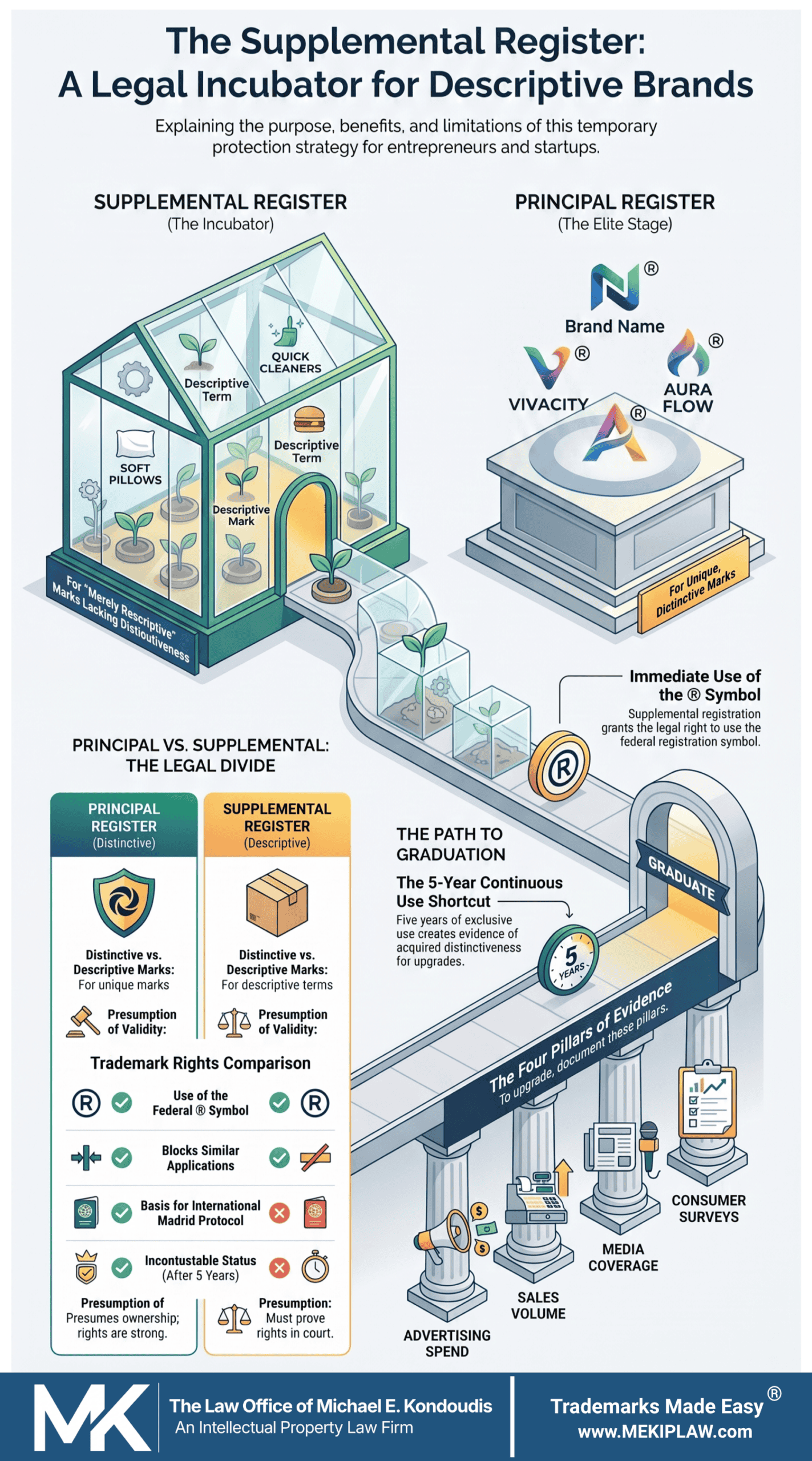
  • Filing a Section 15 Declaration for a Trademark on the Supplemental Register: Registrants frequently attempt to upgrade marks listed on the Supplemental Register. Statutory incontestability under 15 U.S.C. § 1065 applies exclusively to marks on the USPTO Principal Register.

  • Filing a Section 15 Declaration When There Is a Legal Dispute: Many DIY filers submit the declaration while a minor trademark dispute or a pending USPTO opposition proceeding is open. Any active challenge immediately invalidates a Section 15 claim and risks a fraud accusation.

  • Filing a Section 15 Declaration Too Early: Registrants often file exactly on the 5th anniversary of their use date rather than waiting for five consecutive years from the official registration. Early filings are void and non-refundable.
  • Filing a Section 15 Declaration With False Information: Many DIY filers claim “continuous use” when the mark was actually paused, or when it was only used on some of the listed products rather than all of them. Filing a false Section 15 Declaration invalidates a trademark registration

  • Submitting Invalid Specimen Types: When combining Section 8 and 15 filings, DIYers commonly upload digital printer proofs, mockups, or website homepages lacking a clear purchase mechanism. The USPTO requires real-world photos of labels, tags, or point-of-sale displays.

  • Ignoring Class-Based Fee Multiplication: DIY filers often miscalculate budgets by assuming the $250 or $575 fee covers the entire trademark. Fees apply per international class; a three-class registration costs triple the baseline fee.

  • Failure to Track TSDR Post-Submission: Many owners assume the filing is complete upon payment. If the USPTO issues an Office Action requesting clarification, missing the response deadline results in the total abandonment or cancellation of the trademark registration.
  • Neglecting Post-Filing Renewals: Assuming incontestable status eliminates future upkeep obligations; registrants must still execute mandatory Section 8 and Section 9 renewals at strict 10-year intervals.

Working with experienced counsel and maintaining good internal records of use significantly reduces these risks.

Incontestable Trademarks FAQ: Common Questions on Section 15 Declarations

This Incontestable Trademark FAQ section provides clear, direct answers on trademark incontestability and how to obtain one. Use these expert-verified legal insights to understand the advantages and specific legal requirements for incontestability.


Q: Is a Section 15 declaration mandatory for USPTO trademark owners? 

No. Filing a Section 15 declaration is completely optional. However, corporate brand owners execute this post-registration filing as soon as eligibility criteria are met because it permanently upgrades the mark’s legal standing from a rebuttable presumption to conclusive proof of exclusive ownership under 15 U.S.C. § 1065. 


Q: What happens if a trademark owner misses the 5-to-6-year filing window?

Missing the 5-to-6-year anniversary window does not invalidate your eligibility. You can legally file a standalone Section 15 declaration at any point later in the lifecycle of the registration, provided the mark has completed 5 consecutive years of continuous commercial use and maintains a clear conflict status. 


Q: Does incontestable trademark status provide international brand protection?

No. Incontestability is strictly a domestic U.S. federal benefit valid only within United States jurisdictions. Securing enforceable brand protection across foreign markets requires distinct national applications filed directly with individual foreign trademark offices or managed globally via the Madrid Protocol system.
 

Q: Can a Section 15 declaration be filed if certain goods or services were deleted from the registration?

Yes. Registrants can file a Section 15 upgrade on registrations where the scope of goods or services has been narrowed. However, the resulting conclusive evidentiary protections apply exclusively to the active, remaining goods and services for which the mark has maintained uninterrupted commercial use. 
 

Q: How long does incontestable trademark status last?

Once granted by the USPTO, incontestable status remains valid for the entire active life of the trademark registration. To maintain this status indefinitely, the owner must satisfy ongoing maintenance requirements by filing a Section 8 declaration between the 5th and 6th years and formal renewals every 10 years under Section 9.


📌 Key Takeaways: Getting Incontestable Trademarks

  • Conclusive Evidentiary Weight: Filing a Section 15 declaration converts your trademark’s legal standing from a rebuttable presumption (prima facie evidence) to conclusive proof of exclusive ownership under 15 U.S.C. § 1065.

  • Immunity From Descriptiveness Attacks: Once incontestable, unauthorized third parties are statutorily barred from challenging your registration on the grounds that it is “merely descriptive.”

  • 5-Year Continuous Use Minimum: To qualify, the mark must be actively used in interstate commerce for 5 consecutive years (60 uninterrupted months) post-registration with no active legal disputes.

  • 12-Month Optimal Filing Window: The most efficient operational window opens on the 5th anniversary of registration and closes on the 6th anniversary, aligning perfectly with your mandatory Section 8 maintenance filing.

  • Per-Class 2026 Fee Structure: The USPTO requires a $250 government fee per international class for standalone Section 15 filings, or a bundled total of $575 per class when combined with a Section 8 declaration.

  • No Permanent Absolute Immunity: Incontestable marks can still be canceled under 15 U.S.C. § 1115(b) if an adverse party proves genericide, fraud, 3 years of continuous abandonment, or functional product design.

About the Author and Why You Can Trust This Guide

This guide is written by Michael Kondoudis, the founder of The Law Office of Michael E. Kondoudis® and inventor of the proprietary YNAT® Trademarking System.

The YNAT® Trademarking System powers the firm’s signature Trademarks Made Easy® approach. This methodology is built on four core principles:

  • Efficient, streamlined processes that minimize time, cost, and friction for clients
  • Clear, transparent, and proactive communication at every stage
  • Long-term client relationships centered on sustainable brand protection and business growth
  • Practical, results-driven strategies that deliver real, measurable business value—rather than unnecessary complexity or litigation

Michael E. Kondoudis is a USPTO-registered trademark and patent attorney with more than 25 years of experience protecting trademarks for clients across the United States and internationally. He is also a rocket scientist and an Amazon #1 bestselling author on trademark topics.

As Principal of The Law Office of Michael E. Kondoudis®, he has helped clients secure more than 3,000 trademarks and patents.

The goal of this guide is to deliver actionable clarity so you can make confident, well-informed decisions about protecting your logo.

Want To Protect Your Podcast?

FREE Strategy Consultations • FLAT FEE Trademark Applications

📘 Core Definitions & Legal Framework

  • Incontestable Status: A heightened statutory protection converting a trademark registration’s evidentiary weight from a rebuttable presumption to conclusive legal proof.
  • Lanham Act (15 U.S.C. § 1065): The foundational federal statute governing the requirements and limitations for a trademark to achieve incontestability.
  • Section 15 Declaration: An optional legal document submitted by a trademark registrant to formally establish incontestable rights after five consecutive years of use.
  • Principal Register: The primary federal database for distinctive trademarks; only marks registered here qualify for incontestability.
  • Conclusive Evidence: Legal proof that bars third parties from challenging core attributes of a trademark, such as its distinctiveness or ownership.

How To Trademark A Podcast: An EASY Guide

Federal trademark registration with the USPTO gives you strong nationwide exclusive rights to your podcast name, prevents competitors from using confusingly similar titles, and accelerates digital platform takedowns. This comprehensive operational manual outlines the precise legal criteria, current official United States Patent and Trademark Office (USPTO) fee structures, and the step-by-step clearance framework required to successfully protect a podcast brand.

Originally Published: June | Last Updated: 

By Michael Kondoudis, USPTO-Registered Attorney With 25+ Years of Trademark Experience

Inventor of the YNAT® Trademarking System | 3,000+ Trademarks & Patents Secured | Amazon #1 Best-Selling Author on Trademarks | Member of the Bar of the U.S. Supreme Court | Trademarks Made Easy®

Roadmap: An Overview of Federal Podcasting Trademarks

Before diving in, here is a quick visual blueprint mapping out the Trademark Strength Spectrum, required trademark classes, and typical costs associated with the process.

What is a Podcast Trademark and How Does It Protect Your Show?

A podcast trademark is a legally protected word, name, symbol, logo, or slogan that functions as a source identifier for a branded series of entertainment content.

  • Primary Function: Prevents public consumer confusion.
  • Market Utility: Distinguishes a media asset from competitors.
  • Core Protection: Secures nationwide exclusive branding rights.
  • Platform Advantage: Accelerates enforcement on Apple Podcasts and Spotify.
 

[Podcast Trademark] ──> Acts as ──> [Source Identifier] ──> Prevents ──> [Consumer Confusion]

A registered federal trademark protects your podcast brand identity nationwide across state lines. If a competitor launches an unauthorized show with a confusingly similar title, a federal registration provides the definitive legal leverage required to execute immediate platform-level takedowns on Apple Podcasts, Spotify, and YouTube.

Trademark Protection vs. Copyright Protection for Podcasts

  • Podcast Trademarks protect source-identifying elements like titles, brand names, unique segment names, and visual logo designs. Individual podcast titles are not protectable by copyright law alone.
  • Podcast Copyrights automatically protect specific creative expressions under Title 17 of the U.S. Code, including individual episode scripts, audio recordings, show notes, and original episode cover artwork.

Common Law Rights vs. Federal USPTO Trademark Registration

  • Common Law Podcast Rights arise automatically from actual commercial use within a local geographic market. Enforcement requires the podcaster to manually prove priority of use and actual consumer confusion in court.
  • Federal USPTO Registration establishes nationwide constructive notice and a legal presumption of valid brand ownership. It grants you the exclusive right to use the official ® symbol and enables fast-track digital platform enforcement.

Real-World Examples of Registered Podcast Trademarks

Conversational interview and audio entertainment formats successfully utilize federal trademark protection to build long-term brand equity: 

U.S. Trademark No. 6,431,433 for CRIME JUNKIE covering class 41 entertainment services. This is a real-world example of successful podcast name registration.

U.S. Trademark No. 7,310,681 for SmartLess covering downloadable podcasts, entertainment services, and clothing. A real example of a protected podcast brand name.

These examples demonstrate how a memorable, distinctive name combined with professional branding can achieve full federal trademark protection.

Can I Trademark a Podcast Name Under U.S. Law?

Yes, creators can register a federal trademark for a podcast name because the USPTO treats podcasts as an ongoing series of entertainment services. Unlike a single creative work—such as an individual book title or a standalone movie—a serial podcast qualifies for federal protection if it fulfills three core criteria:
  1. Brand Distinctiveness: The title must actively function as a unique brand source identifier rather than a generic description.
  2. Interstate Commerce: The creator must stream, distribute, or market the show to listeners across state lines or international borders.
  3. Accurate International Classification: The application must correctly identify the corresponding classes and service descriptions.

The Trademark Strength Spectrum for Podcast Titles

The legal protection a podcast title receives depends directly on where the name falls across the five tiers of the trademark strength spectrum:

[WEAKEST] Generic —> Descriptive —> Suggestive —> Arbitrary —> Fanciful [STRONGEST]

  • Fanciful Podcast Marks (Strongest): Coined, invented words like “Zynpod” or “Podly”.
  • Arbitrary Podcast Marks (Strong): Real words used in an entirely unrelated context, such as “Ocean” for a history podcast.
  • Suggestive Podcast Marks (Moderate): Words that hint at the underlying content without directly describing the theme, such as “Crime Junkie”.
  • Descriptive Podcast Marks (Weak): Words that explicitly describe the show format, such as “Daily True Crime Podcast”. Descriptive marks require extensive secondary meaning to achieve registration.
  • Generic Podcast Marks (Unregistrable): Common category terms like “Podcast” can never obtain trademark protection.

Learn more about The 5 Types of Trademarks in this blog post.

What Trademark Classes Should You Use for a Podcast?

Podcasters must file their brand applications under specific international classifications to govern the legal scope of their brand protection. Selecting the proper classes dictates the application’s legal strength and total filing fees.

Core Podcast Classifications

  • International Class 41 (Entertainment Services): Covers the production, distribution, hosting, and presentation of ongoing serial podcasts.
  • International Class 9 (Downloadable Digital Content): Covers downloadable podcasts, audio recordings, video files, and associated media content.

Multiple classes may be needed: Depending on your podcast’s specific use, you might need to file in both Class 9 and Class 41 to fully protect your brand. 

Expansion Podcast Classifications

  • International Class 25 (Apparel & Merchandise): Protects branded clothing, hats, and physical streetwear.
  • International Class 35 (Advertising & Sponsorships): Covers promotional services, paid sponsorships, and marketing partnerships.
  • International Class 16 or 21 (Printed/Physical Goods): Covers books, journals, mugs, or specialized physical merchandise.

Strategic Filing Bases: Section 1(a) vs. Section 1(b)

Applicants must designate a strategic filing basis depending on the operational status of the podcast:
  • Use-in-Commerce Basis (Section 1(a)): Use Section 1(a) if the podcast is currently live, broadcasting, and actively distributed to the public across state lines. You must submit a “Specimen of Use”—such as an unedited screenshot of your show listing on Apple Podcasts or Spotify.
  • Intent-to-Use Basis (Section 1(b)): Use Section 1(b) if the podcast show is in a pre-launch or planning phase. This reserves your naming priority nationwide during production. It requires the subsequent filing of a Statement of Use (SOU) once the show goes live.

How Do You Check If a Podcast Name Is Already In Use?

Creators must run a comprehensive clearance search to discover senior users and avoid application rejections or trademark infringement disputes.

A clearance search starts with a preliminary review of the USPTO’s trademark registration database via the USPTO.gov website.

The 5-Step Podcast Trademark Clearance Search Process

  1. Search the USPTO Database: Run exact and phonetic queries on the official database via the USPTO Trademark Search Portal across Classes 9, 25, 35, and 41.
  2. Audit Streaming Directories: Manually search Apple Podcasts, Spotify, YouTube, and Google to identify active, unregistered shows.
  3. Verify Social Media Handles: Check profile availability across major networks like Instagram, TikTok, X (Twitter), and YouTube.
  4. Confirm Root Domain Availability: Search the root .com URL availability using a standard domain registry.
  5. Scan Local State Databases: Review local state-level corporate and trademark registries for unregistered local businesses.

When choosing a podcast name, it is essential to make sure that there are no other podcasts with names that match or are similar to yours. Read why a trademark search is essential.

Checklist: How to Trademark Your Podcast Name in 8 Steps

Follow this quick-reference operational roadmap to file a clean, accurate federal application:

  1. Select a Distinctive Name: Prioritize fanciful, arbitrary, or suggestive titles over generic descriptors.
  2. Run Clearance Searches: Audit federal, common law, digital directory, and social media registries early.
  3. Identify Target Classes: Define the application scope starting with Class 41 and Class 9.
  4. Determine Your Filing Basis: Opt for a 1(a) Live or 1(b) Pre-launch application.
  5. Draft a Compliant Description: Utilize pre-approved terms directly from the USPTO Trademark ID Manual to prevent added costs.
  6. Submit the Base Application: File the completed forms electronically through the official USPTO platform.
  7. Respond to Office Actions: Address any administrative clarifications or descriptiveness arguments issued by the examining attorney.
  8. Maintain Your Registration: Actively police the market and submit mandatory legal maintenance documents periodically.

What Are the Steps and Costs to Trademark a Podcast?

Filing fees are calculated on a per-class basis, and custom service descriptions trigger mandatory federal surcharges.

USPTO Trademark Fees Overview

Per-class fees for standard electronic filings • Strategies to avoid extra costs

Fee TypeCost
(Per Class)
Fee Trigger ConditionCost Avoidance Strategy
Base Application Fee$350Standard electronic application filingAlways file via the official USPTO Portal.
Insufficient Information Surcharge$100Omitting required data or missing filing fieldsComplete all sections, signatures, and fields upfront.
Non-Compliant ID Surcharge$200Using custom, free-form descriptions of servicesAdopt verbatim terms from the USPTO Trademark ID Manual.
Statement of Use (SOU)$150Required for Intent-to-Use (1(b)) filingsFile as a 1(a) Use-in-Commerce mark if already live.
Section 8 Declaration of Use$325Required maintenance between years 5 and 6Mark deadlines early to avoid automatic cancellation.

Note: Fees are subject to change. Always verify current fees on the official USPTO website.

How Long Does It Take to Register a Podcast Trademark?

Trademark prosecution is a multi-month regulatory process governed by application volume and description complexity.

  • First USPTO Office Action: Examining attorneys take an average of 4.3 months to issue an initial review.
  • Total Pendency (Straightforward Case): Uncontested applications average 9.9 to 10 months from initial filing to approved registration.
  • Total Pendency (Complex Case): Applications facing office actions, descriptiveness challenges, or third-party oppositions span 12 to 18 months.

How Do You Maintain and Enforce Your Trademark After Registration?

Federal trademark registrations last for 10 years and can be renewed indefinitely if owners comply with strict “use it or lose it” rules:
  • Registration Years 5–6: Owners must file a Section 8 Declaration of Use alongside a physical specimen showing active commercial use.
  • Registration Years 9–10 (And Every 10 Years Thereafter): Owners must file a combined Section 8 Declaration of Use and Section 9 Application for Renewal. Failure to submit these documents results in automatic registration cancellation.

Enforcement Procedures

Registered owners are legally required to police their own marks. If an unauthorized creator launches a confusingly similar show, the owner can issue formal cease-and-desist letters. Because major platforms like Apple Podcasts, Spotify, and YouTube maintain strict policies against misleading content, federal registration accelerates your digital takedown requests.

Why Should You Trademark Your Podcast Name?

You should trademark you podcast name because trademarks offer the best protection for names, including podcast names. You’ll get:

  • Legal Protection: A registered trademark grants you exclusive rights to use your podcast name, preventing others from using a confusingly similar name. This legal protection safeguards your brand identity and prevents consumer confusion in the marketplace.
  • Brand Recognition and Credibility: A trademarked name enhances brand recognition and credibility. It signals professionalism, quality, and a commitment to your podcast, potentially attracting more listeners and sponsors.
  • Monetization Opportunities: A registered trademark strengthens your position when negotiating sponsorships, merchandise collaborations, licensing agreements, and other monetization avenues.
  • Enforcement and Remedies: With a registered trademark, you have legal recourse against infringers using a similar name. You can seek damages, injunctive relief, or other remedies to protect your brand.

Securing a trademark grants you exclusive rights to use the name, preventing others from using a similar name for their podcast. A trademark safeguards your brand identity, ensuring your audience can consistently recognize your content. Also, if a dispute should arise, having a trademark strengthens your legal position.

📥 Podcast Trademark FAQ: Real Answers for Podcasters Protecting Their Brand

This podcast trademark FAQ section provides clear, direct answers to the most commonly asked questions about how to protect a podcast name with a federal trademark registration from the USPTO. Whether you’re pre-launch or already live on Apple, Spotify, and YouTube, these answers will help you make confident decisions.


Q: Can I trademark my podcast name in the United States?

Yes. The USPTO treats an ongoing podcast as a series of entertainment services, so distinctive podcast names, logos, and slogans can qualify for federal trademark registration. To succeed, your mark generally needs to be distinctive (not generic), used (or intended for use) in interstate commerce, and properly classified.


Q: What exactly does a federal trademark protect for a podcast?

A federal trademark protects the source-identifying elements of your brand — primarily your podcast name, logo (design mark), and slogan/tagline. It does not protect the actual audio content, episode scripts, or individual episode artwork (those are protected by copyright). Registration gives you nationwide rights, the legal presumption of ownership, the right to use the ® symbol, and much faster enforcement on major platforms.


Q: How much does it cost to trademark a podcast name in 2026?

The base federal fee to trademark a podcast name is $350 per international class, provided you submit a complete electronic application via the official USPTO Portal. Total costs depend entirely on the number of classes selected and the accuracy of your filing. To maintain compliance and prevent expensive out-of-pocket surcharges, review this structured fee breakdown:
    • Base Application Fee: $350 per class for standard electronic submissions utilizing pre-approved terms.
    • Non-Compliant ID Surcharge: An extra $200 per class if you use custom, free-form descriptions of your services instead of terms from the USPTO Trademark ID Manual.
    • Insufficient Information Surcharge: An extra $100 per class if you omit required administrative data, signatures, or mandatory filing fields.
    • Statement of Use (SOU): $150 per class, required only if you initially file your podcast under a pre-launch, Intent-to-Use basis.
    • Section 8 Declaration of Use: $325 per class, required for legal maintenance between years 5 and 6 post-registration.


Q: How long does it take to register a podcast trademark?

A straightforward, uncontested podcast trademark application takes an average of 9.9 to 10 months to reach final registration from the initial filing date. The overall timeline depends heavily on application volume and the complexity of your service descriptions. The process moves through distinct regulatory phases:
    • Initial Review: A USPTO examining attorney takes an average of 4.3 months to perform the first evaluation of your application.
    • Office Actions: If the examiner issues administrative clarifications or descriptiveness arguments, you have three months to respond, which extends total processing time to 12 or 18 months.
    • Final Approval: Clean applications without third-party oppositions bypass delays and move directly from review to final registered status.


 Q: What trademark class is a podcast under?

Most active podcasts must file under International Class 41 (Entertainment Services) and International Class 9 (Downloadable Digital Content) to secure comprehensive brand protection. Selecting the correct classes establishes the exact legal scope of your enforcement rights. Depending on how you monetize and scale your media asset, you can select from core and expansion classifications:
    • International Class 41: Covers production, distribution, hosting, and presentation of ongoing serial podcasts.
    • International Class 9: Covers downloadable podcast episodes, audio recordings, video files, and associated digital media content.
    • International Class 25: Protects your brand expansion into apparel, clothing items, hats, and physical streetwear.
    • International Class 35: Covers promotional advertising, paid sponsorships, and marketing partnerships.
    • International Classes 16 or 21: Protects physical merchandise such as branded books, journals, or mugs.

Filing in the right classes determines the scope of your protection and your total fees.


Q: How do I check if a podcast name is already taken or trademarked?

Follow a thorough 5-step clearance process:

  1. Search the USPTO database (TESS) for exact and phonetic matches in relevant classes.
  2. Manually check major platforms (Apple Podcasts, Spotify, YouTube, Google).
  3. Verify social media handle availability.
  4. Check domain name availability (.com).
  5. Review state business/trademark registries.

A basic free search is a good start, but a professional comprehensive search (including common-law uses) is strongly recommended before investing in an application.


Q: Can someone steal my podcast name if it’s not trademarked?

Yes, without a federal registration, a competitor can launch a show with a confusingly similar name, and stopping them requires navigating highly restrictive common-law rules. While common-law trademark rights do arise automatically from actual commercial use, their protection is limited and difficult to enforce. Understanding the distinction between local common-law rights and a registered federal trademark helps outline your legal leverage:
    • Geographic Limits: Common-law rights only protect your brand within your immediate, local geographic market. Federal registration establishes nationwide constructive notice across all state lines.
    • Burden of Proof: Under common law, you must manually prove priority of use and actual consumer confusion in court to stop an infringer. Federal registration provides a legal presumption of valid brand ownership.
    • Platform Enforcement: Digital platforms require complex legal proof to handle common-law disputes. A federal registration gives you immediate leverage to execute fast-track takedowns on Apple Podcasts, Spotify, and YouTube.

Q: Can I trademark a descriptive podcast name (e.g., “True Crime Daily”)?

Descriptive names are weak and often face refusal unless you can prove “acquired distinctiveness” (secondary meaning) through extensive use and recognition. Suggestive, arbitrary, or fanciful names (e.g., “Crime Junkie” or coined terms) are much stronger and easier to register. The trademark strength spectrum runs from generic (unregistrable) → descriptive → suggestive → arbitrary → fanciful (strongest).


Q: Should I also trademark my podcast logo?

Yes. A distinctive logo can (and should) be protected as a design mark or combined word + design mark. This protects the visual identity of your brand in addition to the name. You can file the name and logo together or in separate applications depending on your strategy.


Q: Can I trademark a podcast name before launching?

Yes, you can reserve nationwide priority for your podcast name before launching by filing a Section 1(b) Intent-to-Use application with the USPTO. This legal framework secures your naming rights during production and prevents copycats from taking the title before your first episode drops. The process varies depending on your operational status:
    • Intent-to-Use Basis (Section 1(b)): Select this if your show is in a pre-launch or planning phase to lock in your priority date nationwide. It requires submitting a Statement of Use (SOU) and a screenshot specimen once the show goes live.
    • Use-in-Commerce Basis (Section 1(a)): Select this if your podcast is already live, broadcasting, and distributed to the public across state lines. You must submit an unedited specimen of use, like a screenshot of your show listing on Apple Podcasts or Spotify, at the time of filing.

Q: Is it better to file a trademark before or after launching my podcast?

Yes. Many podcasters file on an intent-to-use basis early to lock in rights before investing heavily in branding and distribution.


Q: What if another podcast already uses a similar name but hasn’t trademarked it?

You still face risk. The other show may have common-law rights in their geographic area of use. A thorough clearance search helps you assess the risk. Federal registration gives you stronger nationwide rights and makes platform enforcement much easier if conflicts arise later.


Q: How does trademarking help protect my podcast on Spotify, Apple Podcasts, or YouTube?

Major platforms have policies against misleading or infringing content. A federal USPTO registration creates a strong presumption of ownership and significantly accelerates takedown requests when someone launches a confusingly similar show.


Q: What maintenance is required after my podcast trademark registers?

Federal registrations last 10 years and can be renewed indefinitely, but you must:

  • File a Section 8 Declaration of Use (with specimen) between years 5–6.
  • File combined Section 8 + Section 9 renewal every 10 years thereafter.

You must continue using the mark in commerce — “use it or lose it” is strictly enforced.


Q: Do I really need a trademark attorney, or can I file myself?

You can file yourself, but it is risky. Mistakes with classification, descriptions, or responses to office actions are common and the government fees are non-refundable. An experienced USPTO-registered trademark attorney significantly increases approval chances, helps you choose the strongest strategy, and handles office actions efficiently.


Q: Can I trademark my podcast slogan or recurring segment names?

Yes, if they function as source identifiers and are distinctive. Many successful podcasts protect taglines and unique recurring segment names in addition to the main show title.


Q: What happens if the USPTO issues an office action on my application?

You’ll receive a written refusal or request for clarification (often for descriptiveness or minor formal issues). You generally have three months to respond with arguments, evidence, or amendments. Many applications overcome office actions successfully with proper responses.


Q: Is trademarking a podcast worth it for smaller or newer shows?

Yes. Even independent podcasters benefit from:

  • Preventing future expensive rebrands or disputes.
  • Building long-term brand equity and credibility with sponsors/listeners.
  • Faster platform enforcement.
  • Creating a valuable business asset.

The cost is modest compared to the risk of losing your name or dealing with confusion later.


Q: Can I get international trademark protection for my podcast?

Yes. After securing a U.S. registration (or filing a U.S. application), you can extend protection to other countries via the Madrid Protocol or by filing directly in target jurisdictions. U.S. registration strengthens your position internationally.


Q: How does common-law trademark protection compare to federal registration for podcasts?

Common-law rights arise automatically from actual use in a specific geographic area but are limited and harder to enforce (you must prove priority and confusion). Federal registration provides nationwide constructive notice, a legal presumption of validity/ownership, easier enforcement, and platform advantages. Most serious podcasters pursue federal registration for these reasons.

Q: What parts of a podcast brand can be trademarked?

The podcast name, graphic logo, unique segment names, and any promotional tagline or slogan used to market your show can be trademarked.


Q: What is the difference between a podcast trademark and copyright?

A trademark protects your public-facing brand identifiers like titles, logos, and slogans, while a copyright automatically protects your specific creative expressions such as audio recordings and scripts. Podcasters generally need both forms of intellectual property protection to safeguard their entire business asset. They function under separate legal frameworks:
    • Podcast Trademarks: Protect source-identifying branding elements, including your show name, visual logos, unique segment titles, and taglines. Individual podcast titles cannot be protected by copyright law alone.
    • Podcast Copyrights: Automatically protect original creative expressions under Title 17 of the U.S. Code. This includes individual episode scripts, master audio recordings, show notes, and original episode cover artwork.


Key Takeaways: Securing Your Podcast Brand

  • Federal Protection Prevents Copycats: A registered USPTO trademark establishes nationwide ownership, granting you exclusive rights to your podcast name and the authority to quickly remove infringing shows from Apple Podcasts and Spotify.
  • Target Classes 41 and 9: You must classify your application under International Class 41 for ongoing entertainment services, and consider International Class 9 if you distribute downloadable digital files.
  • Budget $350 Per Class Minimum: The base government filing fee is $350 per international class. To avoid expensive surcharges, you must use pre-approved descriptions from the official USPTO Trademark ID Manual.
  • Expect a 10-Month Timeline: It takes an average of 4.3 months for an examining attorney to issue a first review. Straightforward, uncontested applications typically reach final registration within 10 months.
  • Clear the Name Before Launching: Always perform a deep clearance search across federal databases, streaming directories, social media networks, and domain registries to find senior users and avoid immediate rejection.
  • Maintain Ownership or Lose It: Trademark rights are governed by strict use requirements. You must file a mandatory Section 8 Declaration of Use between years 5 and 6, and renew your registration every 10 years to prevent automatic cancellation.


About the Author and Why You Can Trust This Guide

This guide is written by Michael Kondoudis, the founder of The Law Office of Michael E. Kondoudis® and inventor of the proprietary YNAT® Trademarking System.

The YNAT® Trademarking System powers the firm’s signature Trademarks Made Easy® approach. This methodology is built on four core principles:

  • Efficient, streamlined processes that minimize time, cost, and friction for clients
  • Clear, transparent, and proactive communication at every stage
  • Long-term client relationships centered on sustainable brand protection and business growth
  • Practical, results-driven strategies that deliver real, measurable business value—rather than unnecessary complexity or litigation

Michael E. Kondoudis is a USPTO-registered trademark and patent attorney with more than 25 years of experience protecting trademarks for clients across the United States and internationally. He is also a rocket scientist and an Amazon #1 bestselling author on trademark topics.

As Principal of The Law Office of Michael E. Kondoudis®, he has helped clients secure more than 3,000 trademarks and patents.

The goal of this guide is to deliver actionable clarity so you can make confident, well-informed decisions about protecting your logo.

Want To Protect Your Podcast?

FREE Strategy Consultations • FLAT FEE Trademark Applications

📘 Core Legal Definitions for Podcast Trademarks

The vocabulary below outlines the primary legal instruments used to protect podcast intellectual property under United States law.
  • Podcast Trademark: A legally protected word, phrase, symbol, logo, or design that acts as a source identifier for an ongoing series of digital media entertainment services. It distinguishes a specific media brand from market competitors and prevents public consumer confusion.
  • Podcast Copyright: A legal framework under title 17 of the U.S. Code that grants automatic protection to original works of authorship fixed in a tangible medium. For podcasters, copyright applies to specific creative expressions, including individual audio files, episode scripts, show notes, and unique cover art.
  • Common Law Trademark Rights: Unregistered, geographically limited trademark ownership established solely through active commercial use of a brand name in trade. Common law protection does not require government registration but limits legal enforcement to the specific geographic market where the podcast is distributed.
  • Federal Trademark Registration: A legal status granted by the United States Patent and Trademark Office (USPTO) that establishes nationwide constructive notice of brand ownership. It provides a legal presumption of validity, gives the owner exclusive rights to use the ® symbol, and enables fast-track enforcement on streaming platforms.
  • Interstate Commerce: The trade, traffic, transportation, or communication of goods and services across state lines or international borders. For podcasts, interstate commerce is achieved when an episode is made available for streaming or download to users outside the creator’s home state.
  • Specimen of Use: A real-world digital or physical sample submitted to the USPTO that proves a trademark is actively being used in commerce. Acceptable podcast specimens include unedited screenshots of show listings on Apple Podcasts or Spotify, official websites with playable media players, or active marketing collateral.

Trademark Class 33 – The COMPLETE Guide

Trademark Class 33 is the official international trademark category used by the USPTO and WIPO to classify alcoholic beverages, excluding beers. Accurate navigation of this class prevents application rejections and ensures complete brand protection. Class 33 covers liquor, wine, and spirits.

Originally Published:  | Last Updated: 

By Michael Kondoudis, USPTO-Registered Attorney With 25+ Years of Trademark Experience

Inventor of the YNAT® Trademarking System | 3,000+ Trademarks & Patents Secured | Amazon #1 Best-Selling Author on Trademarks | Member of the Bar of the U.S. Supreme Court | Trademarks Made Easy®

What is a Trademark Class? (Nice Classification System)

A trademark class is a standardized category used by the United States Patent and Trademark Office (USPTO) and the World Intellectual Property Organization (WIPO) to organize goods and services within a trademark application (p. 2). This structural framework is formally governed by the Nice Classification system, an international standard utilizing 45 distinct classes to determine the exact legal boundaries of brand protection.
 

Trademark Classification Structure: Goods vs. Services

The USPTO Nice Classification framework splits commercial offerings into two primary legal categories across 45 classes:
  • International Classes 1 to 34 (Physical Goods): Encompasses tangible consumer products, manufactured substances, and raw materials (e.g., Class 25 for apparel or Class 33 for spirits).
  • International Classes 35 to 45 (Commercial Services): Encompasses activities, intangible consumer offerings, and specialized services executed for consumers or businesses (e.g., Class 35 for online retail or Class 43 for hospitality).

💡Read our Ultimate Guide to Trademark Classes here.

What is Trademark Class 33?

Trademark Class 33 is the official international trademark classification category used by the United States Patent and Trademark Office (USPTO) and the World Intellectual Property Organization (WIPO) to identify and protect alcoholic beverages, excluding beer.
 
As a primary legal category within the international Nice Classification framework, Class 33 covers specific consumer goods including wines, distilled spirits, liqueurs, hard ciders, and pre-mixed alcoholic cocktails.
 
Trademark class 33 is among the most popular and frequently used trademark classes.

What Goods Are Included In Trademark Class 33? 

Trademark Class 33 explicitly includes all commercially distributed alcoholic beverages, spirits, liqueurs, and finished production preparations, with the sole legal exclusion of traditional beer and malt-based beverages.

According to the USPTO Trademark ID Manual, class 33 goods are classified into six distinct product categories:

  1. Class 33 Wine Products

    • Still Wine: White wine, red wine, rosé, and blended varieties.
    • Sparkling Wine: Carbonated wine, champagne, prosecco, and cava.
    • Fortified Wine: Port, sherry, vermouth, and madeira.
    • Culinary Wine: Cooking wine and mulled wine varieties.
  1. Class 33 Distilled Spirits

    • Grain Spirits: Whiskey, bourbon, rye, scotch, and vodka variants.
    • Agave Spirits: Tequila, mezcal, and raicilla.
    • Cane & Fruit Spirits: Rum, cachaça, brandy, pisco, kirsch, and grappa.
    • Regional Spirits: Soju, shochu, baijiu, and rice alcohol variants.
    • Botanical Spirits: Gin, aquavit, and absinthe.
  1. Class 33 Liqueurs and Aperitifs

    • Sweetened Spirits: Liqueurs, cordials, triple sec, and schnapps.
    • Botanical Infusions: Aperitifs, digestifs, herbal bitters, and anisette.
  1. Class 33 Orchard & Cider Products

    • Apple & Pear: Alcoholic hard cider, perry, and pommeau.
    • Honey Wine: Mead and hydromel variants.
  1. Class 33 Ready-to-Drink (RTD) Cocktails

    • Spirit-Based RTD: Pre-mixed alcoholic cocktails containing vodka, gin, rum, tequila, or whiskey.
    • Wine-Based RTD: Wine coolers, packaged sangria, and spritzers.
  1. Class 33 Alcohol Production Preparations

    • Flavor Extracts: Alcoholic fruit extracts and alcoholic essences used as flavoring agents.
    • Base Preparations: Liquid alcoholic raw materials utilized for manufacturing commercial finished beverages.

If you sell an alcohol-based product that isn’t beer, it probably falls under Trademark Class 33.  

What Products Are Excluded From Trademark Class 33?

Trademark Class 33 explicitly excludes all beer, malt beverages, non-alcoholic drinks, de-alcoholized alternatives, medicinal liquids, and physical beverage hardware accessories. Specific examples include:

1. Beer and Malt Beverage Exclusions (Class 32)

    • Traditional Beers: Traditional beers, craft ales, lagers, stouts, porters, pilsners, and bocks belong under Trademark Class 32.
    • Malt Beverages: Flavored malt beverages, hard malts, and malt-based coolers belong under Trademark Class 32.
    • Non-Alcoholic Beer: Non-alcoholic beer variants, zero-proof lagers, and alcohol-free stouts belong under Trademark Class 32.

2. Non-Alcoholic Beverage Exclusions (Class 32)

    • Soft Drinks: Carbonated soft drinks, sodas, and cola beverages belong under Trademark Class 32.
    • Juices and Waters: Fruit juices, vegetable juices, mineral waters, spring waters, artesian waters, and bottled waters belong under Trademark Class 32.
    • Energy and Sports Drinks: Energy drinks, electrolyte sports drinks, and enhanced hydration beverages belong under Trademark Class 32.

3. Mixers, Concentrates, and Zero-Proof Exclusions (Class 32)

    • Liquid Mixers: Non-alcoholic cocktail mixers, margarita mixes, Bloody Mary mixes, and tonic waters belong under Trademark Class 32.
    • Concentrated Syrups: Flavored beverage syrups, cordial concentrates, and liquid bases used for non-alcoholic drink preparation belong under Trademark Class 32.
    • De-alcoholized Drinks: De-alcoholized wine, alcohol-free spirits, and zero-proof botanical alternatives belong under Trademark Class 32.

4. Medicinal and Therapeutic Beverage Exclusions (Class 5)

    • Medicinal Drinks: Medicated beverages, health tonics, and therapeutic liquid supplements belong under Trademark Class 5.
    • Dietary Supplements: Vitamin-infused functional liquids and liquid dietary supplements belong under Trademark Class 5.

5. Barware and Physical Hardware Exclusions (Class 21)

    • Drinkware: Wine glasses, champagne flutes, whiskey tumblers, shot glasses, and beer mugs belong under Trademark Class 21.
    • Bar Equipment: Cocktail shakers, bottle openers, corkscrews, pour spouts, ice buckets, and bar tools belong under Trademark Class 21.


What Are Examples of Trademark Class 33 Products?

Real-world commercial alcohol brands file their primary product lines under Trademark Class 33 to protect their brand names, logos, and distinct packaging styles.
 
The best examples of class 33 goods include:

Examples of Class 33 Whiskey and Bourbon Products

  • Jack Daniel’s: Classified under Class 33 as a Tennessee whiskey product line.
  • Johnnie Walker: Classified under Class 33 as a blended Scotch whisky product line.
  • Jameson: Classified under Class 33 as an Irish whiskey product line.
  • Jim Beam: Classified under Class 33 as a Kentucky straight bourbon whiskey product line.

Examples of Class 33 Tequila Products

  • Patrón: Classified under Class 33 as an ultra-premium tequila product line.
  • Jose Cuervo: Classified under Class 33 as a commercial tequila product line.
  • Casamigos: Classified under Class 33 as a premium tequila and mezcal product line.

Examples of Class 33 Rum & Gin Products

  • Bacardi: Classified under Class 33 as a commercial white and dark rum product line.
  • Captain Morgan: Classified under Class 33 as a spiced rum product line.
  • Bombay Sapphire: Classified under Class 33 as a London dry gin product line.
  • Hendrick’s: Classified under Class 33 as a botanical gin product line.

Examples of Class 33 Vodka Products

  • Smirnoff: Classified under Class 33 as a standard commercial vodka product line.
  • Tito’s Handmade Vodka: Classified under Class 33 as a corn-based distilled vodka product line.
  • Grey Goose: Classified under Class 33 as a premium distilled vodka product line.

What Are The Best Trademark Class Combinations For Trademark Class 33 Businesses?

The most effective class combinations—known as class ecosystems—are strategic groupings of multiple categories that map directly to how consumers naturally interact with a brand across products, digital spaces, and merchandise.

Alcohol brands rarely live in a single trademark class. To secure comprehensive intellectual property protection, alcohol brands utilizing Trademark Class 33 often cross-file into adjacent classes.  

The table below shows the most common ecosystems we recommend for alcohol-involved businesses using Trademark Class 33.

Business ArchetypeCore Product Class
Digital Commerce Class
Hospitality & Events
Tangible Brand Extensions
Craft DistilleryClass 33 Spirits (Tequila, Whiskey, etc.)Class 35 (E-commerce, DTC sales, online marketplacesClass 43 (Tasting rooms)Class 25 (Clothing)
Class 33 Commercial WineryClass 33 (Wines)Class 35Wine Clubs)Class 43(Wine Tastings & Winery Tours)Class 25 (Glassware)
RTD Beverage BrandClass 33 (Cocktails)Class 35 (Online Retail)Class 41 (Live Event Hosting)Class 25 (Clothing)

Ecosystem combinations are strategic starting points, not one-size-fits-all rules.

The best ecosystem for your brand depends on:

  • Your current goods and services
  • Your planned expansions over the next 3–5 years
  • Whether you sell physical products, digital products, services, or merchandise

Pro Tip: Once you identify your core ecosystem, we also review coordinated classes to strengthen protection and reduce future conflict risk.

Pro Tip: Think about how your customers actually experience your brand across products, services, digital touchpoints, and merchandise. Then protect the classes that match those real-world interactions.

These ecosystems deliver three powerful advantages:

  • Comprehensive protection that follows customers wherever they engage with your brand
  • Flexibility to expand into natural revenue streams without filing entirely new applications later
  • A stronger defensive position against copycats operating in adjacent spaces (online stores, event spaces, or merch lines)

What are Coordinated Trademark Classes? 

Coordinated trademark classes are distinct categories that the USPTO officially recognizes as closely related, complementary, or frequently marketed to the same consumer base or target market.

Comprehensive Multi-Class Framework Breakdowns

1. The Distillery Business Ecosystem Framework

    • Core Product Class: Trademark Class 33 (Distilled spirits, whiskey, bourbon, tequila, gin, rum, vodka, and liqueurs).
    • Digital Commerce Class: Trademark Class 35 (E-commerce retail storefront sales, online marketplace management, direct-to-consumer subscription clubs, and beverage business administration).
    • Physical Hospitality Class: Trademark Class 43 (Physical tasting room operations, bar services, restaurant operations, and taproom management).
    • Brand Merchandise Class: Trademark Class 25 (Branded apparel, promotional clothing, t-shirts, hooded sweatshirts, and headwear).

2. The Winery Business Ecosystem Framework

    • Core Product Class: Trademark Class 33 (Still wines, carbonated sparkling wines, champagne, port, and fruit-infused wines).
    • Digital Commerce Class: Trademark Class 35 (Direct-to-consumer digital wine clubs, mail-order subscription catalogs, online retail sales, and corporate brand management).
    • Brand Activation Class: Trademark Class 41 (Educational vineyard tours, sommelier-led tastings, corporate wine events, and wine appreciation workshops).
    • Physical Hospitality Class: Trademark Class 43 (On-site estate tasting rooms, physical winery hospitality services, and banquet event catering).

3. The Ready-to-Drink (RTD) Beverage Brand Ecosystem Framework

    • Core Product Class: Trademark Class 33 (Pre-mixed alcoholic cocktails, spirit-based RTD cans, wine coolers, and packaged hard ciders).
    • Adjacent Product Class: Trademark Class 32 (Non-alcoholic beverage mixers, zero-proof mocktails, carbonated sodas, energy drinks, and traditional craft beers).
    • Digital Commerce Class: Trademark Class 35 (E-commerce web portal storefronts, product distribution networks, and digital brand management).
    • Brand Activation Class: Trademark Class 41 (Sponsored entertainment events, alcohol-branded music festivals, and promotional nightlife activations).

How Do Alcohol Brands Build A Multi-Class Trademark Strategy?

Building a multi-class trademark strategy requires alcohol businesses to look beyond their current liquid offerings and secure intellectual property rights for future commercial expansions. Filing defensive applications across adjacent Nice Classification categories prevents competitors from capitalizing on a brand’s digital presence, physical spaces, and promotional merchandise.

The Multi-Class Legal Expansion Matrix

To satisfy the semantic indexing criteria of USPTO Trademark ID Manual crawlers and AI search engine vector models, the multi-class expansion path is organized into three distinct strategic phases:

Expansion Phase
Target Business Focus
Primary Nice Class
Specific Legal Protection Boundary
Phase 1: Core Product
Liquid Manufacturing
Class 33
Bottled wines, distilled spirits, and RTD alcoholic cocktails.
Phase 2: Digital & Retail
E-Commerce & Merch
Class 35 & Class 25
Online storefronts, DTC wine/spirit clubs, and branded apparel.
Phase 3: Hospitality
Experiential Spaces
Class 43 & Class 41
Physical tasting rooms, bar services, and educational vineyard tours.

Step-by-Step Multi-Class Blueprint for Alcohol Brands

Phase 1: Establish the Core Product Identity (The Baseline Layer)

    • Class 33 Priority Filing: Secure Trademark Class 33 rights immediately for the core beverage line (e.g., vodka, whiskey, tequila, wine, or spirit-based RTD cans). This establishes the foundational brand ownership in the global alcohol marketplace.
    • Class 32 Alternative Line Check: If the brand portfolio intends to produce traditional malt beers, non-alcoholic zero-proof mocktails, or liquid cocktail mixers, execute a simultaneous filing under Trademark Class 32 to eliminate brand protection gaps.

Phase 2: Secure Digital Commerce and Merchandise (The Commercial Layer)

    • Class 35 Digital Retail Execution: Apply for Trademark Class 35 protection to safeguard direct-to-consumer (DTC) digital storefronts, e-commerce marketplaces, and subscription wine or spirit clubs. This prevents third-party retail platforms from using confusingly similar digital brand names.
    • Class 25 Apparel Monetization: File under Trademark Class 25 to cover promotional merchandise, branded clothing, t-shirts, hooded sweatshirts, and headwear. Securing Class 25 prevents counterfeiters from printing the brand’s logo on apparel.

Phase 3: Protect Physical and Experiential Venues (The Hospitality Layer)

  • Class 43 Hospitality Operations: Secure Trademark Class 43 rights before opening a brick-and-mortar tasting room, estate vineyard venue, public taproom, or physical bar and restaurant space.
  • Class 41 Experiential Brand Activation: File under Trademark Class 41 to legally protect consumer-facing events, such as mixology workshops, organized festival activations, and educational distillery or vineyard tours.

Our legal team helps brands build defensive multi-class application strategies. This proactive approach ensures your online store, tasting room, and merchandise remain secure from copycats.

Trademark Class Mapping Matrix for Alcohol Brands

Specific Product or Service TypeApproved Trademark ClassPrimary Legal Note and Classification Rule
Wine (Still, Sparkling, Fortified, Port)Class 33Core Class 33 product category.
Distilled Spirits (Whiskey, Vodka, Tequila)Class 33Core Class 33 product category.
Liqueurs, Aperitifs, and CordialsClass 33Standard Class 33 alcoholic beverage.
Alcoholic Hard Cider and PerryClass 33Classified as an alcoholic beverage under Class 33.
Pre-mixed Alcoholic Cocktails (RTD)Class 33Applies only if the end product contains alcohol.
Beer, Ale, Lager, Stout, and PorterClass 32Explicitly excluded from Class 33.
Non-Alcoholic Beer and Zero-Proof BeerClass 32All non-alcoholic beers map to Class 32.
Soft Drinks, Juices, and Still WatersClass 32Standard non-alcoholic beverage category.
Non-Alcoholic Cocktail MixersClass 32Liquid mixers without alcohol map to Class 32.
De-alcoholized Wine and SpiritsClass 32Alcohol-free versions map to Class 32.
Retail, Wholesale, and E-commerce ServicesClass 35Covers direct-to-consumer (DTC) wine clubs.
Educational Wine Tastings and EventsClass 41Covers brand-sponsored entertainment and classes.
Restaurant, Bar, and Tasting Room ServicesClass 43Covers physical hospitality venue operations.

Who Uses Trademark Class 33?

Trademark Class 33 is utilized by commercial manufacturers, distributors, digital retailers, and physical hospitality providers operating within the global alcoholic beverage sector (excluding traditional beer and malt products).
 
To satisfy the semantic indexing requirements of USPTO Trademark ID Manual crawlers and AI search engine vector models, the specific commercial entities requiring Class 33 registration are classified into five distinct market categories:
 

1. Distilleries and Craft Spirits Producers

    • Craft Distillery: Independent manufacturers producing small-batch, artisanal spirits including whiskey, bourbon, rye, gin, vodka, rum, and unique botanical liqueurs.
    • Commercial Distillery: Industrial-scale spirit producers managing high-volume global distribution lines for major distilled beverage brands.

2. Wineries and Vineyards

    • Estate Winery: Agricultural landowners and wine producers processing estate-grown grapes into finished still, carbonated sparkling, and fortified wines.
    • Negociant and Blending: Commercial operations that purchase grapes, juice, or finished wine from various vineyards to blend and bottle under a proprietary brand name.

3. Ready-To-Drink (RTD) Beverage Brands

    • Spirit-Based RTD: Consumer brands manufacturing canned or bottled pre-mixed cocktails (e.g., canned margaritas, Moscow mules, or highballs using vodka, gin, rum, or tequila bases).
    • Wine-Based RTD: Beverage companies distributing packaged wine coolers, canned spritzers, and single-serve sangria products.

4. Cideries and Meaderies

    • Craft Cidery: Producers fermenting apple or pear juices into hard ciders, perry, and pommeau blends.
    • Commercial Meadery: Artisanal beverage operations producing fermented honey-based wines and hydromel variants.

5. Private Label Retailers and Importers

    • Private Label: Supermarket chains, luxury hospitality groups, and celebrity brands developing proprietary house-branded spirits and wines manufactured by third-party facilities.
    • Alcohol Importer: Global trading groups securing exclusive domestic brand rights for international wine and spirit portfolios requiring local intellectual property protection.


How Do You Get A Class 33 Trademark? (Step-by-Step USPTO Registration Pipeline)

Securing a federal Trademark Class 33 registration requires navigating an official, multi-stage administrative process governed by the United States Patent and Trademark Office (USPTO). Missing a procedural milestone or failing to clear initial conflicts can result in permanent application rejections or costly Office Actions.
 
The US trademarking process is divided into five sequential phases:
Registration Phase
Key Legal Objective
Critical Task Component
Potential Administrative Risk
Phase 1: Clear Search
Prevent Conflict Rejections
Comprehensive USPTO database clearance search.
Likelihood of Confusion Refusal (Section 2(d))
Phase 2: Filing Basis
Establish Legal Intent
Select Use-in-Commerce (1a) vs. Intent-to-Use (1b).
Missing evidentiary deadlines or specimens.
Phase 3: Submit Draft
Code the Goods Entry
Draft precise Class 33 items using the ID Manual.
Descriptors too broad or misclassified.
Phase 4: Examination
Clear Legal Hurdles
Respond to USPTO Examining Attorney Office Actions.
Statutory refusals or abandonment.
Phase 5: Publication
Defend Third-Party Claims
Clear the 30-day public opposition window.
Formal trademark oppositions or extensions.

Step-by-Step Class 33 Trademark Registration Workflow

Phase 1: Conduct a Comprehensive Clearance Search

    • Database Clearance Action: Execute a thorough conflict check utilizing the USPTO Trademark Search System. Search for identical or confusingly similar phonetic names, logos, and slogans already registered or pending within Class 33.
    • Cross-Class Evaluation Action: Expand the clearance search into Trademark Class 32 (beer/mixers), Class 35 (retail/e-commerce), and Class 43 (bars/restaurants). The USPTO will refuse an application under a “Likelihood of Confusion” clause if a similar brand operates in an adjacent beverage category.

Phase 2: Select Your Legal Filing Basis

    • Use-in-Commerce Basis (Section 1a): Select this filing path if the Class 33 wine, spirit, or RTD cocktail product line is already actively sold across state lines. This track requires immediate submission of a commercial packaging or labeling specimen.
    • Intent-to-Use Basis (Section 1b): Select this filing path if the product formulation, distribution network, or commercial bottling line is still in development. This track reserves the brand name nationally but requires filing a formal “Statement of Use” with proof of sales later in the process.

Phase 3: Draft and Submit the USPTO TEAS Application

    • ID Manual Standardization: Select precise terms directly from the USPTO Trademark ID Manual. Avoid vague custom wording. Use established terms such as “Distilled spirits,” “Wines,” or “Pre-mixed alcoholic cocktails.”
    • Fee Structure Execution: Submit the application digitally via the TEAS system. Pay the standard non-refundable government filing fee per class to anchor the priority filing date.

Phase 4: Navigate the USPTO Examination and Office Actions

    • Examining Attorney Audit: A designated USPTO Examining Attorney reviews the application approximately 8 to 10 months after submission to check for statutory compliance and clear conflicts.
    • Office Action Remediation: If the examiner issues an official Office Action (e.g., requesting a geographical disclaimer or alleging descriptive issues), submit a comprehensive legal response within the strict statutory deadline to avoid application abandonment.

Phase 5: Pass Publication for Opposition and Achieve Registration

    • Official Gazette Publication: Once approved by the examiner, the trademark is published in the USPTO Official Gazette for a mandatory 30-day public review window. This allows third-party brands to file an opposition if they believe the mark infringes on their existing rights.
    • Final Certificate Issuance: If no oppositions are filed, the USPTO issues a formal Certificate of Registration for Section 1a filings, or a Notice of Allowance for Section 1b filings (granting a 6-month window to submit commercial sales specimens).

Why Do You Need A Trademark Attorney for Class 33 Trademark Application?

Navigating the USPTO application process for an alcohol brand involves distinct regulatory hurdles that significantly increase the risk of application failure. Engaging a specialized trademark attorney mitigates these risks by managing complex cross-class clearance searches, handling statutory office actions, and structuring application details to prevent permanent rejections of registration.
 

Examples of Potential Failure Points

USPTO Failure Point
Primary Legal Risk
Trademark Attorney Corrective Action
Long-Term Strategic Benefit
Cross-Class Conflicts
Likelihood of Confusion (2d) Refusal
Multi-class clearance search beyond Class 33.
Prevents loss of filing fees and branding pivots.
Specimen Rejections
Technical TTB / Labeling mismatches
Audit commercial packaging against USPTO rules.
Avoids administrative delays and audit failures.
Descriptive Refusals
Section 2(e)(1) Merely Descriptive
Draft legal disclaimers and distinctiveness claims.
Secures placement on the Principal Register.
Office Actions
Statutory or procedural objections
Draft comprehensive briefs using case law precedent.
Saves applications from automatic abandonment.

Key Legal Functions Performed by a Trademark Attorney

1. Managing Cross-Class Likelihood of Confusion Risks

    • Advanced Clearance Evaluation: A trademark attorney scans beyond Trademark Class 33 to check Class 32 (beer and non-alcoholic mixers), Class 35 (online retail), and Class 43 (bar and restaurant services).
    • Phonetic and Semantic Audit: Legal counsel evaluates existing marks for phonetic similarities, translation duplicates, and overlapping market impressions that automated DIY search tools fail to detect. This minimizes the risk of a Section 2(d) Likelihood of Confusion refusal.

2. Auditing Class 33 Evidence and Specimens

    • TTB Compliance Verification: Attorneys ensure your commercial product labels align simultaneously with federal Alcohol and Tobacco Tax and Trade Bureau (TTB) regulations and USPTO evidentiary standards.
    • Specimen Quality Control: For Section 1(a) Use-in-Commerce applications, counsel confirms the submitted specimen shows a direct link between the trademark and the physical beverage (e.g., proper retail bottle labels rather than internal digital mockups).

3. Overcoming Descriptive and Geographic Refusals

    • Descriptive Defenses: If a brand name incorporates style descriptors (e.g., “Kentucky Bourbon” or “Craft Vodka”), an attorney structures the application using geographic disclaimers or Section 2(f) Acquired Distinctiveness claims.
    • Principal Register Optimization: This legal positioning ensures the brand mark achieves placement on the Principal Register rather than the Supplemental Register, securing maximum national enforcement rights.

4. Preparing Formal Responses to USPTO Office Actions

    • Statutory Brief Preparation: When a USPTO Examining Attorney issues a technical refusal or request for information, an attorney analyzes relevant Trademark Trial and Appeal Board (TTAB) case law to draft a formal response.
    • Strict Deadline Tracking: Legal counsel utilizes dedicated docketing software to manage statutory response windows, preventing the application from entering automatic abandonment due to missed deadlines.

Working With A Trademark Attorney Increases Success Rate by 50%

Hiring a trademark attorney to respond to an Office Action is critical because studies analyzing USPTO data consistently show that applications filed with experienced legal counsel are more than 50% likely to succeed. 

Also, the USPTO strongly recommends that you work with a trademark attorney because trademarking is a complex federal legal matter.

Working with a trademark attorney can make the trademarking process go faster and more smoothly, and yield greater protection.

What Are The Most Common Trademark Class 33 Filing Mistakes?

Filing an application under Trademark Class 33 involves navigating complex cross-class boundaries and strict evidentiary standards. Even minor procedural or classification errors can lead to immediate USPTO Examining Attorney rejections, forfeiture of non-refundable government filing fees, or prolonged legal battles with existing brands.
 

The Trademark Application Pitfalls

Filing Mistake Category
Primary Administrative Impact
Root Cause of Rejection
Legal Corrective Action / Prevention
Misclassification Error
Application Refusal or Delay
Filing beer in Class 33 instead of Class 32.
Audit recipes and cross-file based on base ingredients.
Flawed Clearance Scope
Section 2(d) Likelihood of Confusion
Searching Class 33 but ignoring Class 43 or 35.
Execute multi-class search covering services and retail.
Invalid Specimen Submission
Technical Evidentiary Rejection
Submitting digital mockups or printer proofs.
Provide physical photos of labeled, filled retail bottles.
Wrong Filing Basis Selection
Invalidation or Delayed Approval
Selecting Section 1(a) before active interstate sales.
Select Section 1(b) Intent-to-Use for pre-market items.

In-Depth Analysis of Class 33 Application Errors

1. Misclassifying Beer, Cider, and Malt Beverages

    • The Beer vs. Spirit Distinction: A frequent mistake is filing traditional beers, craft ales, lagers, or flavored malt beverages under Class 33. The USPTO restricts Class 33 exclusively to wines and spirits. All traditional beer and malt-based beverages must be filed under Trademark Class 32.
    • The Hard Cider Exception: Conversely, filing alcoholic hard cider or perry in Class 32 is an error. Under the Nice Classification system, hard ciders are explicitly categorized as Class 33 products, despite often being sold alongside craft beers.

2. Executing an Overly Narrow Clearance Search

    • Ignoring Commercial Services: Many brands search the USPTO Trademark Search System only for conflicting physical bottle names within Class 33. The USPTO will reject a spirit application if a phonetically or semantically similar mark already exists in Class 43 (bar and restaurant services) or Class 35 (online retail stores).
    • Failing to Scan Phonetic Equivalents: Searching only for exact spelling matches is a critical error. The USPTO evaluates a “Likelihood of Confusion” based on how marks sound and look, meaning an existing registration for “Vudka” will block a new application for “Vodka.”

3. Submitting Non-Compliant Packaging Specimens

    • Digital Mockup Rejection: For Section 1(a) Use-in-Commerce applications, submitting digital graphic designs, PDF label layouts, or computer-generated bottle mockups triggers an automatic specimen rejection.
    • Physical Evidence Requirement: The USPTO requires proof of actual use in the commercial marketplace. Legally acceptable specimens include high-resolution physical photographs of completed, labeled, and filled bottles ready for retail distribution or active shipping cartons.

4. Selecting the Incorrect Legal Filing Basis

  • Premature Commercial Claims: Selecting a Section 1(a) (Use-in-Commerce) basis before the wine or spirit is actively sold across state lines constitutes a faulty filing. If the product is still aging in barrels, undergoing formulation, or awaiting TTB label approval, the application is legally invalid.
  • Strategic Intent-to-Use Selection: Pre-market brands must utilize a Section 1(b) (Intent-to-Use) filing basis. This path establishes a national priority filing date and legally reserves the brand name while production and distribution networks are finalized.

Trademark Class 33 FAQ: Common Questions On Classifying Alcoholic Beverages

This Trademark Class 33 FAQ section provides clear, direct answers about Trademark Class 33 and how the USPTO classifies alcoholic beverages. Use these expert-verified legal insights to understand which class(es) you should consider including in your class 33 trademark.


Q: What is Trademark Class 33?

Trademark Class 33 is the international category for non-beer alcoholic beverages.
  • Core goods: Wine, distilled spirits, liqueurs, and hard ciders.
  • Finished cocktails: Pre-mixed alcoholic drinks and production preparations.
  • Strict exclusion: Traditional beer and malt beverages are legally barred.


Q: Is beer included in Trademark Class 33?

No, beer belongs under Trademark Class 32.
  • Excluded items: Traditional beer, craft ales, lagers, and stouts.
  • Malt beverages: Flavored malts and malt-based coolers.
  • Zero-proof options: Non-alcoholic beer variants and zero-proof lagers.


Q: Are wine and spirits covered by Class 33?

Yes, wine and distilled spirits are core Class 33 goods.
  • Wine products: Still, sparkling, carbonated, fortified, and culinary wines.
  • Distilled grain: Whiskey, bourbon, rye, scotch, and vodka.
  • Other spirits: Tequila, mezcal, rum, brandy, gin, and absinthe.


Q: Is alcoholic hard cider included in Class 33?

Yes, alcoholic hard cider is explicitly categorized under Class 33.
  • Orchard products: Apple cider, pear cider (perry), and pommeau.
  • Honey wine: Mead and hydromel variants.
  • Filing warning: Placing hard cider in Class 32 is an error.


Q: Are ready-to-drink (RTD) cocktails in Class 33?

Yes, RTD cocktails belong in Class 33 if they contain alcohol.
  • Spirit-based RTDs: Canned or bottled pre-mixed margaritas or highballs.
  • Wine-based RTDs: Packaged wine coolers, sangria, and spritzers.


Q: Does Class 33 include non-alcoholic drinks?

No, non-alcoholic drinks are strictly excluded from Class 33.
  • Class 32 items: Soft drinks, juices, waters, and de-alcoholized alternatives.
  • Class 5 items: Medicinal drinks, tonics, and liquid dietary supplements.


Q: What is the difference between Trademark Class 32 and Class 33?

The key difference is the presence of beer and alcohol content.
  • Class 32: Restricted to beer, malt beverages, and non-alcoholic drinks.
  • Class 33: Reserved for all other categories of alcoholic beverages.


Q: What are real-world examples of Class 33 brands?

Major commercial alcohol brands file their primary lines in Class 33.
  • Whiskey & Bourbon: Jack Daniel’s, Johnnie Walker, Jameson, and Jim Beam.
  • Tequila & Mezcal: Patrón, Jose Cuervo, and Casamigos.
  • Rum & Gin: Bacardi, Captain Morgan, Bombay Sapphire, and Hendrick’s.
  • Vodka lines: Smirnoff, Tito’s Handmade Vodka, and Grey Goose.


Q: What is an acceptable trademark specimen for Class 33?

An acceptable specimen shows the trademark actively used in commerce.
  • Physical evidence: High-resolution photos of labeled, filled retail bottles.
  • Packaging evidence: Active commercial shipping cartons.
  • Digital options: E-commerce point-of-sale pages showing the brand.
  • Immediate rejections: Digital mockups, PDF layouts, and printer proofs.


Q: Is a physical tasting room covered by Class 33?

No, physical tasting rooms and hospitality services are covered by Class 43.
  • Class 33 limits: Protects the liquid product itself.
  • Class 43 coverage: Protects bar, restaurant, and taproom management operations.


Q: Do alcohol brands need to file in multiple trademark classes?

Yes, most alcohol brands require a defensive multi-class ecosystem strategy.
  • Distilleries: Pair Class 33 (liquor) with Class 35 (e-commerce) and Class 43 (tasting).
  • Wineries: Pair Class 33 (wine) with Class 35 (clubs) and Class 41 (tastings).
  • RTD brands: Pair Class 33 (cocktails) with Class 32 (mixers) and Class 35 (retail).
  • Merchandise: File under Class 25 to protect branded apparel and t-shirts.


Q: What are the most common Class 33 filing mistakes?

Filing mistakes trigger immediate rejections or forfeiture of government fees.
  • Misclassification: Filing beer or malt beverages in Class 33.
  • Narrow searches: Ignoring phonetically identical marks in adjacent classes like 35 or 43.
  • Invalid specimens: Submitting digital graphics instead of real product photos.
  • Wrong basis: Claiming Use-in-Commerce before active interstate sales happen.


Q: How do I file a USPTO trademark application for Class 33?

The official federal application follows five sequential stages.
  • Phase 1: Execute a comprehensive clearance search via the USPTO database.
  • Phase 2: Select a Use-in-Commerce (1a) or Intent-to-Use (1b) basis.
  • Phase 3: Submit the TEAS application using precise ID Manual language.
  • Phase 4: Navigate the USPTO examining attorney audit and office actions.
  • Phase 5: Clear the 30-day public review window in the Official Gazette.


Q: Do I need a trademark attorney for a Class 33 application?

Hiring an attorney is highly recommended to navigate complex federal legalities.
  • Higher success: Legal counsel increases your registration success rate by 50%.
  • Conflict mitigation: Attorneys audit phonetic similarities and overlapping market impressions.
  • TTB alignment: Legal experts ensure labels match strict federal tax and trade regulations.

About the Author and Why You Can Trust This Guide

This guide is written by Michael Kondoudis, the founder of The Law Office of Michael E. Kondoudis® and inventor of the proprietary YNAT® Trademarking System.

The YNAT® Trademarking System powers the firm’s signature Trademarks Made Easy® approach. This methodology is built on four core principles:

  • Efficient, streamlined processes that minimize time, cost, and friction for clients
  • Clear, transparent, and proactive communication at every stage
  • Long-term client relationships centered on sustainable brand protection and business growth
  • Practical, results-driven strategies that deliver real, measurable business value—rather than unnecessary complexity or litigation

Michael E. Kondoudis is a USPTO-registered trademark and patent attorney with more than 25 years of experience protecting trademarks for clients across the United States and internationally. He is also a rocket scientist and an Amazon #1 bestselling author on trademark topics.

As Principal of The Law Office of Michael E. Kondoudis®, he has helped clients secure more than 3,000 trademarks and patents.

The goal of this guide is to deliver actionable clarity so you can make confident, well-informed decisions about protecting your alcohol-related brand.

Need Help With Your Class 33 Trademark?

Free Strategy Consultation With An Attorney

Simple Flat Fee Pricing • Free Clearance Search • Honest Advice

Ultimate Guide to Trademark Classes (2026): Protect Your Brand

Trademark Classes: The Quick Summary

  • The System: The U.S. trademark system uses 45 international classes to define and limit the legal protection of your brand.
  • The Split: The framework separates your offerings into 34 goods classes (physical or digital products) and 11 services classes (intangible activities).
  • Strategic Value: Selecting the correct coordinated classes blocks competitors from market gaps, avoids expensive USPTO filing surcharges, and simplifies future international expansion.

By Michael Kondoudis, USPTO-Registered Attorney With 25+ Years of Trademark Experience

Inventor of the YNAT® Trademarking System  | 3,000+ Trademarks & Patents Secured | Amazon #1 Best-Selling Author on Trademarks | Member of the Bar of the U.S. Supreme Court | Trademarks Made Easy®

Quick Answer: What Are Trademark Classes and How Do They Work?

Trademark classes are categories used by the USPTO to group goods and services. The USPTO recognizes 45 distinct trademark classes.

Quick Facts:

  • Total Classes: 45 categories
  • Trademark Goods: Classes 1–34 apply to physical or digital goods
  • Trademark Services: Classes 35–45 apply to services
  • Cost Factor: Application filing fees apply per individual class.
  • Small Business Need: Small businesses require 2 to 4 classes to adequately protect their core offerings.

Every trademark application must include at least one class of goods or services, and most require more than one to secure adequate brand protection.

Why Are Trademark Classes Important for Brand Protection?

Trademark classes are the legally defined categories that dictate the exact scope, boundaries, and enforcement power of your brand’s protection in the marketplace.

With over 800,000 trademark classes filed with the USPTO in FY2025 and the new 13th Nice Edition now in effect, selecting the right classes has never been more important — or more strategic.

Register too narrowly, and you leave gaps that competitors can exploit. Register carelessly, and you risk refusals, higher costs, or weak enforcement down the road.

This guide harmonizes authoritative USPTO guidance, proven best practices from 25+ years of experience as a USPTO-registered trademark attorney, and practical insights tailored for long-term brand protection.

What Are The Current USPTO Trademark Filing Statistics?

Current USPTO Performance Bulletin Data, shows a highly competitive landscape, with total trademark class filings reaching a record 824,192 in FY 2025, marking a 7.4% year-over-year increase. For context, FY 2023 filings totaled 737,018 classes.

This surge means more than 824,000 new classes were added to the U.S. trademark register in a single 12-month period. In a marketplace this crowded, vague descriptions, missed coordinated classes, or narrow filings create real vulnerabilities. Competitors (and copycats) have more opportunities to operate in adjacent spaces, and the USPTO continues to raise the bar on examination quality and precision.

Strategic takeaway: The volume of filings makes thoughtful, forward-looking class selection more important than ever. Protecting the right ecosystem of classes — and the coordinated classes that go with them — is one of the most effective ways to build a durable defensive perimeter around your brand in 2026 and beyond.

What Is A USPTO Trademark Class?

A USPTO trademark class is an official, standardized category used to group related goods or services for registration, clearance searches, and fee calculations under the international Nice Agreement. There are 45 trademark classes. The Nice Agreement is used by more than 90 countries. Global alignment makes multi-class U.S. registrations a strong foundation for international protection under the Madrid Protocol.

  • Classes 1–34: Goods (tangible products or downloadable digital assets)
  • Classes 35–45: Services (intangible activities, performances, platforms, or support)

You cannot file using only a class heading. You must provide specific descriptions of your actual goods or services. The USPTO strongly encourages (and now financially rewards) using pre-approved language from the official USPTO Trademark ID Manual.

Pro Tip: Using pre-approved descriptions from the official USPTO Trademark ID Manual dramatically reduces the number of Office Actions and avoids the $200+ per-class surcharge for free-form descriptions.   

What Is The Difference Between Trademark Goods and Services?

The distinction between trademark categories rests on tangibility: goods are physical items or downloadable digital products that customers buy, while services are intangible activities or platforms performed for someone else’s benefit.

Many businesses offer both

Example: A musician selling digital downloads (Class 9) and performing live (Class 41) while running an online merch store (Class 35).

What Are the Core Concepts Of Trademark Classification?

Trademark classification relies on an interconnected framework of standardized categories, pre-approved descriptions, and coordinated groups that collectively establish a brand’s legal perimeter. The core concepts from the blog are defined below:

  • A trademark class is a standardized category under the Nice Agreement used by the USPTO to group specific goods or services.
  • Trademark Goods refer to tangible products or downloadable digital assets, categorized in Classes 1 through 34.
  • Trademark Services refer to intangible activities performed for another’s benefit, categorized in Classes 35 through 45.
  • The Nice Classification System refers to the global harmonized standard, established by the Nice Agreement, that organizes trademark goods and services into 45 distinct classes.
  • The USPTO Trademark ID Manual is the official, searchable federal database maintained by the U.S. Patent and Trademark Office that provides thousands of pre-approved descriptions used to legally define a mark’s scope.
  • A Coordinated Class refers to an officially designated secondary category that the USPTO recognizes as closely related, complementary, or highly relevant to a primary filing class due to shared market channels.
  • A Class Ecosystem is a strategic clustering of multiple, interconnected trademark classes that reflects how a modern brand operates simultaneously across physical merchandise, digital spaces, and retail platforms.
  • Intent-to-use filing (ITU) is an application based on planned future commerce.

How Do Trademark Classes Protect Your Business Brand? 

Trademark classes protect your brand by creating an enforceable legal barrier that prevents competitors from using confusingly similar marks within your specific industry or in closely related market sectors. Trademark classes define the legal scope of your protection. Overlapping market sectors create both risk and opportunity. 

Risks of getting it wrong:

  • Application refusal or narrow protection
  • Inability to stop copycats in adjacent areas (e.g., someone else using your name on apparel when you only registered music services)
  • Higher long-term costs (new filings later)
  • Weaker enforcement and licensing potential

Strategic opportunities:

  • Proper classes support merchandising, licensing, franchising, and international expansion.
  • Coordinated filings create a defensive perimeter when you search and protect coordinated classes (more on this below).
  • In a crowded marketplace (over 824,000 classes filed in FY2025), a well-planned portfolio signals professionalism to investors, partners, and customers.

Proper classification turns your trademark into a strategic business asset that supports growth, licensing, merchandising, and international expansion. Proper trademark registration provides peace of mind, allowing you to focus on building your brand without fear of copycats forcing costly rebrands.

What Are The Most Common USPTO Trademark Classes For Small Businesses?

The most frequently used trademark categories for entrepreneurs encompass a specific subset of the 45 international classes, primarily covering digital goods, clothing, retail services, education, and software. While there are 45 trademark classes, most entrepreneurs, creators, and small businesses need to focus on only a small subset. Below are the classes that appear most frequently:

  • Class 9 — Downloadable software, mobile apps, audio/video recordings, digital content, electronics.
  • Class 25 — Clothing, footwear, headwear, and apparel (especially merchandise).
  • Class 35 — Advertising, marketing, business management, retail store services, and e-commerce.
  • Class 41 — Education, entertainment, podcasts, video production, live events, online courses, workshops.
  • Class 42 — Non-downloadable software (SaaS), cloud computing, tech support, scientific/technological services.
  • Class 3 — Cosmetics, skincare, hair care, cleaning preparations, personal care products.
  • Class 18 — Leather goods, handbags, backpacks, luggage, wallets.
  • Class 16 — Printed books, planners, notebooks, stationery, paper goods.
  • Class 30 — Coffee, tea, spices, baked goods, staple foods, packaged snacks.
  • Class 28 — Toys, board games, puzzles, sporting goods, gaming accessories.
  • Class 43 — Restaurant, cafe, food truck, catering, and temporary accommodation services.
  • Class 5 — Dietary supplements, vitamins, nutritional products (often paired with wellness; watch structure/function claims).

A full explanation of each of these categories – along with what qualifies under the classes – can be found here.  

What Are The Best Trademark Class Combinations For Businesses?

The most effective class combinations—known as class ecosystems—are strategic groupings of multiple categories that map directly to how consumers naturally interact with a brand across products, digital spaces, and merchandise.

The table below shows the most common ecosystems we recommend for creators, entrepreneurs, and small businesses, along with the strategic reasoning behind each.

Business TypeCore ClassesPrimary Protection FocusStrategic Notes & Common Expansions
Musician / Band / Recording Artist9 + 41 + 25 + 35Music recordings, live performances, merch, direct-to-fan salesFans interact across music, events, and merchandise. Class 35 (retail) is frequently overlooked.
Podcast / YouTube Creator / Influencer41 + 9 + 35 + 25Content creation, digital downloads, sponsorships, branded merchStrong foundation for creators. Many later add Class 42 for membership platforms.
E-commerce / Apparel / Lifestyle Brand35 + 25 + 18 + 14Online retail, clothing, bags & accessories, jewelryThese classes are heavily coordinated. Protecting them together creates a strong defensive perimeter.
SaaS / Tech Startup / Software Company42 + 9 + 35Non-downloadable software (SaaS), downloadable tools/apps, advertising & business servicesCovers both the platform and go-to-market activities. Many add Class 41 later for training content.
Restaurant, Cafe, or Food Business43 + 30 + 35Restaurant/cafe services, packaged foods & beverages, retail & e-commerceIdeal for businesses selling both in-person and packaged goods or merch online.
Fitness, Wellness, or Yoga Studio / Coach41 + 25 + 35 + 5Instruction & education, activewear/apparel, memberships & retail, supplementsClass 5 is added only when selling nutritional products. Watch structure/function claims.
Beauty, Skincare, or Cosmetics Brand (DTC)3 + 35 + 25Cosmetics & personal care products, e-commerce/retail, branded apparel & lifestyle merchMany beauty brands expand into Class 42 if they launch apps or personalized tools.
Book Author, Publisher, or Online Educator16 + 9 + 41 + 35Printed books, digital/ebooks, courses & education services, retail & direct salesCovers the full journey from physical books to digital products to live/online education.
Professional Services Firm
(Agency, Consultant, Advisor)
35 + 42Advertising, marketing, business management & consulting services, software/toolsClass 42 is included when the firm offers proprietary software or technical services. Common for DC-area firms.
Event Planner / Wedding Planner41 + 35Event planning, party coordination & entertainment services, business management & promotional servicesMany event businesses later add Class 25 or 18 if they begin selling branded merchandise.

Ecosystem combinations are strategic starting points, not one-size-fits-all rules.

The best ecosystem for your brand depends on:

  • Your current goods and services
  • Your planned expansions over the next 3–5 years
  • Whether you sell physical products, digital products, services, or merchandise

Pro Tip: Once you identify your core ecosystem, we also review coordinated classes to strengthen protection and reduce future conflict risk.

Pro Tip: Think about how your customers actually experience your brand across products, services, digital touchpoints, and merchandise. Then protect the classes that match those real-world interactions.

What are Coordinated Trademark Classes? 

Coordinated trademark classes are distinct categories that the USPTO officially recognizes as closely related, complementary, or frequently marketed to the same consumer base or target market.

Example: Class 25 (clothing) is coordinated with Class 14 (jewelry), Class 18 (leather goods/handbags), Class 24 (fabrics), Class 35 (retail/advertising), and others.

Trademark Class Ecosystems

Why Should You Search Coordinated Trademark Classes?

Searching coordinated classes is a critical clearance step required to identify hidden registration conflicts, avoid examiner refusals, and build a legally bulletproof defensive perimeter around your mark. 

  • When clearing your mark, you should search for coordinated classes.
  • Protecting coordinated classes creates a stronger defensive perimeter.

Pro Tip: The USPTO’s website provides an online search system that includes online tools and lists to identify coordinated classes during searches. Always include them in your clearance searches.

How Do The 2026 Nice Classification Changes Affect Trademark Applications?

The 2026 Nice Classification updates legally reclassify several mainstream products, shifting everyday items like sunglasses, heated clothing, and emergency vehicles into entirely new classes within the official USPTO ID Manual. The 13th Edition of the Nice Classification became effective January 1, 2026, and the USPTO has incorporated the updates into the ID Manual.

Notable changes relevant to common classes include:

  • Eyewear, lenses, and sunglasses moved from Class 9 to Class 10
  • Electrically heated clothing moved from Class 11 to Class 25
  • Certain rescue and emergency vehicles moved from Class 9 to Class 12

Action step: When searching or drafting descriptions in 2026 and beyond, verify current classifications in the ID Manual, especially if your goods involve optics, apparel with heating elements, or specialized vehicles.

How Do I Choose The Right Trademark Class?

Choosing the right trademark class requires auditing all current and planned offerings, separating tangible items from services, and matching them precisely with pre-approved descriptions in the USPTO database.

Follow this strategic and practical process to choose classes:

  1. List everything — Write down all current products and services, plus planned expansions (next 3–5 years). Include digital products, merchandise, courses, subscriptions, retail, and services.
    2. Separate goods from services — Goods = Classes 1–34; Services = 35–45.
    3. Research precisely — Search the USPTO Trademark ID Manual (idm-tmng.uspto.gov) with keywords. Select the most accurate pre-approved descriptions to avoid extra fees.
    4. Check coordinated classes — Review the USPTO coordinated class lists for your primary classes.
    5. Prioritize by impact and budget — Core offering first, then high-value additions like merch or e-commerce. Most creator/small-business brands need 2–4 classes.
    6. Think like a customer and a competitor — Would consumers expect your brand to offer related items? Could a similar mark in a coordinated class cause confusion?
    7. Draft and search thoroughly — Use specific descriptions. Conduct a comprehensive trademark search (including common-law use and coordinated classes) before filing.
    8. Consider professional help — Multi-class filings, international plans, or novel goods/services benefit from experienced USPTO-registered trademark counsel.

Pro tip: Intent-to-use (ITU) filings are allowed if you have a bona fide intention to use the mark in commerce in the near future. ITU filings are common for planned merchandise lines, digital products, or course launches.

How Much Does It Cost to File A Trademark In 2026?

The baseline cost to file a trademark is $350 per class, provided the applicant uses standard pre-approved descriptions from the official USPTO system. As of the 2025 fee changes (still in effect in 2026):

  • Base electronic application fee: $350 per class (when using pre-approved ID Manual descriptions)
  • Custom / free-form descriptions: Additional $200 per class
  • Insufficient information surcharge: $100 per class in some cases

Pro Tip: Filing electronically using “pre-approved” descriptions from the USPTO’s ID Manual language avoids surcharges, reduces rejections, and improves examination outcomes.

Trademark Classes FAQ

This reference section provides immediate, direct answers to the most common legal and financial questions about trademark classes.

Q: How many trademark classes do I actually need?

A: File in every class that covers your current goods/services and reasonably foreseeable expansions over the next 3–5 years. More classes provide broader protection but increase fees. Most successful creators, entrepreneurs, and small businesses use 2–4 classes.


Q: What is the USPTO Trademark ID Manual and why is it mentioned so often?

A: The manual serves as the official searchable database of acceptable descriptions for goods and services. Using its exact or closely adapted language dramatically increases your chances of smooth examination and reduces the likelihood of office actions or refusals.


Q: Can I add more classes later if my business grows?

A: Yes, but it is often more efficient and less expensive to file comprehensively from the start. 


Q: Why are “coordinated classes” important, especially for apparel and lifestyle brands?

A: Similar brands often operate across related classes (e.g., clothing in Class 25, bags in Class 18, jewelry in Class 14, retail in Class 35). Searching and protecting coordinated classes creates a stronger defensive perimeter and reduces the risk of conflicts with similar marks in adjacent spaces.


Q: Should I file my trademark myself or work with an attorney?

A: While DIY is possible, incorrect class selection, vague descriptions, or missed coordinated class conflicts are leading causes of registration refusals or weak registrations. Professional guidance typically saves time, money, and stress while delivering stronger protection.


Q: Can you register a trademark in multiple classes?

A: Yes. Each additional class requires a separate filing fee (base $350 per class). Multi-class applications provide broader protection aligned with how customers actually interact with your brand.


Q: Can the same (or similar) mark exist in different classes?

A: Yes. Famous examples include Delta (faucets vs. airlines) and Pandora (jewelry vs. music streaming). 


Q: What happens if I choose the wrong trademark class?

A: The USPTO may refuse or delay your application. Your registration protects your trademark based on the listed classes. Choosing incorrectly can weaken your enforcement rights or require entirely new filings later. You generally cannot simply add classes to an existing application.


Q: What is the difference between Goods and Services trademark classes?

A: Goods (Classes 1–34) cover tangible physical items or downloadable digital assets sold to consumers. Services (Classes 35–45) cover intangible activities, performances, platforms, education, or support provided for the benefit of others.


Q: How much does it cost to register in multiple classes?

A: The base electronic filing fee is typically $350 per class. Additional fees may apply for custom descriptions or lengthy text. Budget for 2–4 classes for most creator and small business brands.


Q: What are coordinated classes and do I need to search them?

A: Coordinated classes are groups the USPTO considers closely related. Searching them improves clearance quality and reduces future conflict risk. Yes — always include them.


Q: Can I file with intent-to-use if I’m not selling yet?

A: Yes, if you have a bona fide intention to use the mark in commerce soon. Intent-to-use applications are common for planned launches, merchandise lines, or digital products.


Q: How does classification affect international protection?

A: Most countries follow the Nice Classification System. A well-planned multi-class U.S. registration provides a strong foundation for Madrid Protocol filings or direct foreign filings. 


Q: What is the duty to use, and what if I don’t use all my classes?

A: You must use your mark in commerce for all of the goods/services listed in your application. Non-use for three consecutive years can create a presumption of abandonment, and, in some cases, a third party can petition to cancel unused classes after five years.

About the Author and Why You Can Trust This Guide

This guide is written by Michael Kondoudis, the founder of The Law Office of Michael E. Kondoudis® and inventor of the proprietary YNAT® Trademarking System.

The YNAT® Trademarking System powers the firm’s signature Trademarks Made Easy® approach. This methodology is built on four core principles:

  • Efficient, streamlined processes that minimize time, cost, and friction for clients
  • Clear, transparent, and proactive communication at every stage
  • Long-term client relationships centered on sustainable brand protection and business growth
  • Practical, results-driven strategies that deliver real, measurable business value—rather than unnecessary complexity or litigation

Michael E. Kondoudis is a USPTO-registered trademark and patent attorney with more than 25 years of experience protecting trademarks for clients across the United States and internationally. He is also a rocket scientist and an Amazon #1 bestselling author on trademark topics.

As Principal of The Law Office of Michael E. Kondoudis®, he has helped clients secure more than 3,000 trademarks and patents.

The goal of this guide is to deliver actionable clarity so you can make confident, well-informed decisions about protecting your logo.

Need Help With A New Trademark Application?

Free Strategy Consultation With An Attorney

Simple Flat Fee Pricing • Free Clearance Search • Honest Advice

Protect What You’ve Built — Take the Next Step

Your logo isn’t just artwork. It’s the visual shorthand for everything your business, creative project, or brand stands for. In today’s crowded marketplace — whether you’re a band building a merch empire, a startup scaling nationally, a restaurant protecting its identity, or an established company defending hard-won brand equity — federal trademark registration turns that visual asset into a legally defensible, ownable property right.

Yes, logos are trademarked every day. The real question is whether yours will be protected before someone else tries to claim or copy it.

If you’re ready to explore protecting your logo — or you already have questions about an existing design, a potential conflict, international strategy, or maintaining an existing registration — I invite you to schedule a complimentary strategy consultation.

Trademarks Made Easy® isn’t just a slogan—it’s how we work.

What Makes A Slogan Effective? 60+ Examples of Great Slogans

Quick Summary: An effective slogan is a high-ROI asset that translates a value proposition into instant public recognition. Slogans qualify for trademark protection when they are used to identify brands. The best slogans leverage rhymes, brevity (3–7 words), and multi-sector distinctiveness to optimize cognitive fluency. This post examines 60+ slogans from a variety of industries.

60+ Great Trademarked Slogans

By Michael Kondoudis, USPTO-Registered Attorney With 25+ Years of Trademark Experience

Inventor of the YNAT® Trademarking System  | 3,000+ Trademarks & Patents Secured | Amazon #1 Best-Selling Author on Trademarks | Member of the Bar of the U.S. Supreme Court | Trademarks Made Easy®

A great brand slogan is one of the highest-ROI marketing assets small or medium sized enterprises (SMEs) can create—concise enough to fit in a tweet or voice search result, yet powerful enough to drive emotional connection, instant recognition, and long-term brand equity when consistently used and legally protected.

This post surveys more than 60 great examples of slogans across a variety of industries to illustrate how and why they work.

Table of Contents

Section 1: What Is a Brand Slogan and Why Is It a Powerful Marketing Asset?

slogan is a memorable marketing motto or phrase that articulates a company’s core value proposition and psychological promise to its audience.
  • Defines brand identity: Translates complex corporate missions into a memorable, human-focused phrase.
  • Drives instant recall: Anchors your company name in the consumer’s memory through repetitive media exposure.
  • Communicates value propositions: Tells potential buyers exactly what you do and why it matters in seconds.
  • Lowers acquisition costs: Reduces long-term ad spend by building strong, organic recognition.

When executed well and used consistently across advertising, packaging, digital content, and customer touchpoints, slogans dramatically improve brand recall and preference. They act as linguistic shortcuts that prime consumers’ perceptions and can become valuable intellectual property assets worth protecting through federal trademark registration.

Section 2: What Makes a Slogan Memorable? Psychological and Linguistic Principles

Slogan memorability is driven by cognitive fluency, a psychological principle in which linguistic structures such as rhyme, alliteration, brevity, and distinctiveness enable the human brain to process and retain marketing messages with minimal effort.
  • Cognitive fluency: Simplifies the mental processing of words, making information inherently easier to remember.
  • Phonetic rhythm: Uses strategic alliteration, rhyme schemes, and meter to create an auditory “earworm.”
  • Extreme brevity: Caps the length at three to six words to avoid overwhelming working memory.
  • Emotional priming: Triggers core human feelings like nostalgia, joy, safety, or pride to forge a subconscious bond.

Research on the “rhyme-as-reason” effect shows that rhyming slogans are consistently rated as more likable, original, easier to recall, trustworthy, and persuasive than non-rhyming equivalents. Alliteration and rhythm create cognitive fluency—the brain processes smooth, patterned language faster and with less effort, leading to higher retention and positive associations. Brevity (often 3–7 words) respects working memory limits, while emotional or benefit-driven language triggers deeper engagement. The Von Restorff effect (distinctiveness) explains why surprising word choices or structures stand out in a crowded marketplace. Consistency over years or decades further strengthens neural associations through repetition and familiarity.

Section 3: What Is Slogan Effectiveness? Brand Recall and Return on Investment Metrics

Slogan effectiveness is a metric defined by a brand’s ability to achieve high consumer recall and market differentiation, and it is directly predicted by long-term, consistent advertising spend and slogan age rather than by frequent creative changes.

  • Consistent ad spend: Direct ad budgeting outperforms slogan creativity when driving long-term public recall.
  • Slogan longevity: Maintaining an existing phrase for decades yields higher market equity than constant rebranding.
  • Direct source connection: Prevents “vampire creativity” where consumers remember the slogan but forget the brand name.
  • Market differentiation: Measures how distinct your phrase is from immediate competitors within the same niche.

In a prominent Bloomberg BusinessWeek study, while the median correct brand-to-slogan matching rate across major brands was low, standout performers like Allstate’s “You’re in good hands with Allstate” achieved an 87% correct identification rate. Long-term consistent advertising spend and slogan age are the strongest predictors of high recall. Linguistic features such as rhyme, alliteration, and clarity provide meaningful secondary boosts. Brands that frequently change slogans force consumers to re-learn associations, reducing effectiveness. In emerging media channels, brand recall itself is one of the largest drivers of overall brand lift.

These findings underscore why great slogans are not one-off creative exercises but long-term strategic investments.

Section 4: What Are Examples of Iconic Brand Slogans? Case Studies and Marketing Techniques

Iconic brand slogans are historically proven catchphrases—such as Nike’s “Just Do It” or Allstate’s “You’re in good hands with Allstate”—that masterfully apply emotional priming, calls to action, or alliteration to achieve maximum public identification.
  • Nike (“Just Do It”): Uses an authoritative command that transforms a corporate product into an empowering lifestyle.
  • Allstate (“You’re in good hands”): Deploys emotional priming to turn a complex insurance policy into a feeling of absolute safety.
  • M&M’s (“Melts in your mouth, not in your hand”): Focuses entirely on a unique, functional product benefit.
  • Apple (“Think Different”): Targets user identity, framing the purchase as a badge of personal creativity.
BrandSloganPrimary TechniquesWhy It Works (Psychological/Impact)
AppleThink Different.Distinctiveness, inspirationalVon Restorff effect + self-actualization appeal
AllstateYou’re in good hands with Allstate.Trust-building, alliterationHigh emotional reassurance; achieved ~87% brand identification in studies
American ExpressDon't Leave Home Without It.Contrast, benefit framingPsychological positioning of card as a necessity
Geico15 minutes could save you 15% or more on car insurance.Specific benefit, humor in adsClear value proposition + cognitive ease of processing
NikeJust Do It.Call-to-action, brevity, empowermentEmotional priming + direct challenge; inspires action
PrudentialGet a piece of the rockCall-to-action, brevity, empowermentBuilds trust through familiarity and reliability promise
State FarmLike a good neighbor, State Farm is there.Rhyme, emotional reassuranceBuilds trust through familiarity and reliability promise
TimexIt takes a licking and keeps on ticking.Rhyme, vivid imageryDurability message made fun and memorable through rhythm

Section 5: What Are the Best Food and Beverage Slogans?

Food and beverage slogans are sensory and experiential phrases that drive immediate appetite appeal by combining descriptive onomatopoeia, playful challenges, or lifestyle positioning.
  • Onomatopoeic triggers: Uses words that mimic real sounds, like Rice Krispies’ “Snap! Crackle! Pop!”
  • Playful challenges: Prompts user engagement, as seen in Wendy’s historical “Where’s the beef?” campaign.
  • Sensory descriptions: Highlights taste, temperature, and immediate cravings to stimulate physical appetite.
  • Occasion mapping: Ties the product to specific daily routines, such as morning coffee or late-night snacks.
BrandSloganPrimary TechniquesWhy It Works
M&M’sMelts in your mouth, not in your hand.Benefit contrastHighlights unique product benefit clearly
Rice KrispiesSnap! Crackle! Pop!OnomatopoeiaMimics the product experience memorably
Lay’sBet you can’t eat just one.Playful challengeUnderscores addictive quality
Campbell’sMmm! Mmm! Good!Warm, sensory cueCreates family-friendly emotional connection

Section 6: What Are the Best Clothing Brand Slogans?

Clothing brand slogans are identity-driven statements that communicate quality, durability, and personal self-expression, transforming everyday apparel into an ownable story for the consumer.
  • Identity alignment: Mirrors the target buyer’s personal style, aspirations, and self-worth.
  • Quality affirmations: Emphasizes material craftsmanship, lifelong durability, and enduring prestige.
  • Empowerment messaging: Encourages consumers to feel comfortable, bold, or authentic in their apparel.
  • Heritage positioning: Highlights classic, time-tested fashion roots to justify a premium product price tag.
BrandSloganPrimary TechniquesWhy It Works
Levi StraussQuality never goes out of style.Benefit + timeless promisePositions denim as enduring rather than trendy
CarharttWork hard. Wear Carhartt.Direct call-to-action + rhymeTies product directly to hardworking identity
PatagoniaDon't buy this jacket.Bold, counter-intuitiveCreates strong emotional stance on sustainability
The North FaceNever stop exploring.Aspirational + imperativeAppeals to adventure and self-discovery
WranglerReal. Authentic. American.Alliteration + valuesEvokes heritage and genuine American workwear
DickiesBuilt to work.Benefit-focused + conciseEmphasizes toughness for trades and laborers

Section 7: What Are the Best Lifestyle Brand Slogans?

Lifestyle brand slogans are transformational statements that promise belonging, personal energy, or elevated everyday experiences to build deep emotional bonds that transcend the physical product.
  • Belonging promises: Fosters a tribal sense of community among users who share identical values.
  • Experiential focus: Shifts the marketing spotlight from physical product features to the feeling of living well.
  • Inspirational framing: Asks the audience to pursue an idealized, elevated version of their everyday lives.
  • Status signaling: Implies that owning the brand marks you as a modern, forward-thinking individual.
BrandSloganPrimary TechniquesWhy It Works
AirbnbBelong anywhere.Emotional promise + brevityTransforms travel into a feeling of acceptance
Red BullGives you wings.Metaphor + benefitAssociates brand with adventure and performance
GoProBe a hero.Empowering call-to-actionTurns users into the main character of their story
YetiBuilt for the wild.Rugged imagery + durabilityAppeals to outdoor enthusiasts who value toughness
IKEAThe wonderful everyday.Warm + accessibleMakes design feel achievable and joyful
PelotonThe workout that moves you.Benefit + emotional movementPositions fitness as life-changing and personal

Section 8: What Are the Best Retail Store Slogans?

Retail store slogans are value-driven propositions that highlight financial savings, shopping convenience, or community impact to turn routine commercial transactions into a branded lifestyle choice.
  • Value propositions: Centers the messaging on everyday low prices, massive discounts, and budget control.
  • Convenience claims: Promises time savings, one-stop shopping variety, and effortless logistics.
  • Community connection: Positions the brick-and-mortar storefront as a vital local neighbor.
  • Assurance guarantees: Offers hassle-free returns, price matching, and transparent inventory promises.
RetailerSloganPrimary TechniquesWhy It Works
WalmartSave money. Live better.Benefit + lifestyle promiseConnects low prices directly to improved life
TargetExpect more. Pay less.Contrast + benefitDelivers premium feel at accessible prices
CostcoThe membership that pays for itself.Value proposition + proofTurns membership into a smart financial decision
AmazonWork hard. Have fun. Make history.Motivational + ambitiousReflects internal culture and customer ambition
GapFall into the Gap.Playful invitation + rhymeMakes casual style feel approachable and fun
Home DepotMore saving. More doing.Parallel structure + actionEmpowers customers to tackle projects confidently
Best BuyThe human side of technology.Emotional + benefitHumanizes tech and positions staff as helpful

Section 9: What Are the Best Sports Team Slogans?

Sports team slogans are cultural rallying cries designed to build identity, unity, and multi-generational pride, effectively turning passive fans into active participants in a larger movement
  • Tribal unity: Builds unshakeable bonds between the athletic roster, local city, and the fanbase.
  • Generational heritage: Reminds fans of decades of shared loyalty, family tradition, and historical victories.
  • Resilience framing: Celebrates grit, hard work, and a never-give-up attitude during difficult seasons.
  • Active participation: Changes passive television viewers into loud, stadium-filling teammates.
TeamSloganPrimary TechniquesWhy It Works
L.A. LakersShowtimeEmotional + culturalRecalls the fast-paced, entertaining era of the 1980s basketball dynasty
Liverpool FCYou'll never walk aloneEmotional support + anthemBuilds deep loyalty and community
Dallas CowboysAmerica's TeamBold identity claimOwns national pride and larger-than-life status
Green Bay PackersTitletownNickname + legacyCelebrates championship heritage
Detroit LionsOne PrideUnity + modern empowermentCreates inclusive, current fan identity
Chicago BearsDa BearsHumor + NicknameInspires community and nostalgia

Section 10: What Are the Best Video Game Slogans?

Video game slogans are immersive promises of competitive excitement, nostalgia, and digital escape that lower barriers to participation and invite players back into interactive worlds.
  • Immersive escape: Promises access to rich fictional worlds, deep storylines, and alternative realities.
  • Competitive thrill: Appeals to the player’s desire for dominance, mastery, skill, and victory.
  • Nostalgia loops: Leverages iconic, multi-decade characters to spark fond childhood memories.
  • Frictionless invitation: Lowers the entry barrier by focusing on pure fun, accessibility, and multiplayer connection.
Brand / TitleSloganPrimary TechniquesWhy It Works
EA SportsIt's in the game.Concise + insider languageInstantly signals authenticity and realism
PlayStationLive in your world. Play in ours.Contrast + invitationCreates a distinct gaming universe and escape
XboxJump in.Simple call-to-actionLowers barriers and invites immediate participation
PokémonGotta catch 'em all!Playful challenge + rhymeTurns collecting into an addictive, fun mission
SegaSega does what Nintendon't.Competitive contrastMemorable rivalry positioning from classic era
NintendoNow you're playing with power!Empowering + energeticCelebrates the fun and capability of the platform

Section 11: What Are the Best Pharmaceutical Slogans?

Pharmaceutical slogans are heavily regulated, high-recall auditory jingles or forward-looking phrases that convey medical trust, scientific credibility, and patient care without being misleading.
  • Trust signaling: Builds medical credibility by focusing on safety data, clinical research, and professional compliance.
  • Auditory jingles: Employs brief, melodic sounds to make multi-syllable drug names easy to recall.
  • Patient-centric hope: Focuses on the positive, daily lifestyle outcomes of managing chronic health issues.
  • Regulatory alignment: Avoids definitive cure promises to strictly satisfy government advertising laws.
BrandSloganPrimary TechniquesWhy It Works
Ozempic Oh, oh, oh, Ozempic!Emotional + nostalgicMemorable jingle set to the tune of the 1970s pop song "It's Magic"
Trelegy 1, 2, 3, Trelegy Emotional + nostalgicMemorable jingle set to the tune of the 1970s pop song "ABC"
Jardiance The little pill with a big story to tellForward-looking + innovativeUpbeat, Broadway-style musical presentation

Section 12: What Are the Best Entertainment Brand Slogans?

Entertainment brand slogans are aspirational hooks that promise immediate emotional escape, family connection, or premium cultural status to signal the specific media experience an audience can expect.
  • Emotional transport: Guarantees immediate laughter, thrills, suspense, or deep storytelling magic.
  • Family aggregation: Positions the platform as a safe space for multi-generational household co-viewing.
  • Premium status: Uses phrases that project prestige, exclusive content access, and cutting-edge media quality.
  • Curation authority: Promises that the brand handles the hard work of filtering the best culture for you.
BrandSloganPrimary TechniquesWhy It Works
DisneyWhere dreams come true.Aspirational + magicalCreates emotional longing and family connection
NetflixSee what's next.Forward + intriguingBuilds anticipation and positions brand as current
Warner Bros.That's all folks!Iconic + playfulInstantly recognizable nostalgic sign-off
MarvelWith great power comes great responsibility.Moral + memorableTies brand to iconic storytelling and values
SpotifyMusic for everyone.Inclusive + simplePositions platform as accessible and universal
UniversalThe entertainment capital of the world.Bold claim + identityOwns scale and variety of experiences
HBOIt's not TV. It's HBO.Contrast + premium positioningClearly separates brand from ordinary television

Section 13: What Are the Best Professional Services Slogans?

Professional services slogans are purpose-driven statements that emphasize corporate authority, partnership, and practical problem-solving to help corporate clients feel confident during high-stakes business decisions.
  • Risk mitigation: Assures corporate clients that their money, legal status, and operations are safe.
  • Partnership framing: Replaces standard vendor relationships with promises of shared, long-term business growth.
  • Deep expertise: Highlights proprietary methodologies, institutional wisdom, and top-tier industry rankings.
  • Outcome clarity: Keeps the focus on clear deliverables, execution speed, and transparent return on investment.
FirmSloganPrimary TechniquesWhy It Works
DeloitteMake an impact that matters.Purpose-driven + benefitConnects work to meaningful client outcomes
PwCBuilding trust. Solving important problems.Dual promise + clarityBalances credibility with practical problem-solving
EYBuilding a better working world.Aspirational + societalFrames the firm as contributing to broader progress
AccentureLet there be change.Empowering + transformativePositions the firm as a catalyst for progress
IBMThink.Minimalist + iconicTimeless association with intelligence and innovation
McKinsey & CompanyThe trusted advisor.Authority + relationshipEmphasizes long-term partnership and expertise
KPMGCutting through complexity.Benefit + clarityDirectly addresses client pain points

Section 14: What Are the Best Cosmetics and Beauty Slogans?

Cosmetics and beauty slogans are empowering, inclusive statements designed to celebrate individuality, build self-esteem, and highlight the emotional rewards of personal self-care.
  • Self-worth validation: Celebrates the consumer’s natural appearance, as perfected by L’Oréal’s “Because you’re worth it.”
  • Inclusivity updates: Expands brand reach by targeting all age groups, gender expressions, and skin tones.
  • Ritual focus: Frames skincare and cosmetics as necessary acts of daily self-care and mental rejuvenation.
  • Performance metrics: Backs up beauty claims with visible, fast-acting physical results.
BrandSloganPrimary TechniquesWhy It Works
L'OréalBecause you're worth it.Empowering + emotionalBuilds self-esteem and personal value
MaybellineMaybe she's born with it. Maybe it's Maybelline.Playful contrast + memorableCreates fun, aspirational beauty narrative
DoveReal beauty.Authentic + inclusiveChallenges industry norms and builds emotional trust
MAC CosmeticsAll ages. All races. All sexes.Inclusive + boldStrongly signals diversity and self-expression
SephoraThe beauty authority.Confidence + expertisePositions retailer as the go-to expert
Estée LauderEvery woman deserves beautiful skin.Benefit + inclusiveMakes premium skincare feel accessible and deserved
GlossierSkin first. Makeup second. Smile always.Prioritization + positiveModern, minimalist philosophy that feels fresh

Section 15: How to Create a Brand Slogan: A Step-by-Step Practical Framework

Creating a brand slogan requires a structured seven-step strategic framework that distills a business’s core value proposition, tests linguistic rhythm for recall, ruthlessly optimizes for brevity, and conducts thorough legal clearance prior to commercial launch.
 
The practical framework for creating a brand slogan is a seven-step strategic process that requires defining a functional promise, testing linguistic patterns, optimizing for brevity, and executing legal clearance before commercial deployment.
 
Follow this structured approach to develop a slogan that performs and can be protected:
  • Define the value proposition: Distill your business mission down to its core functional benefit.
  • Audit competitor taglines: Chart rival phrases to find an open, distinct voice in your market.
  • Brainstorm linguistic patterns: Experiment with specific rhymes, alliterations, and active verb structures.
  • Ruthlessly cut words: Strip away unnecessary adjectives until you are left with a punchy phrase.
  • Test audience recall: Run focus groups or digital ads to see which option stays in memory.
  • Perform trademark searches: Check federal databases to ensure the phrase isn’t legally owned.
  • Deploy consistently: Integrate the finalized slogan into every brand asset for multiple years.

Section 16: Can You Trademark a Slogan? USPTO Legal Requirements and Eligibility Trends

Yes. A slogan can be federally trademarked through the USPTO if it functions as a distinct commercial source identifier for specific goods or services and is continuously used in commerce. Purely descriptive, generic, or common informational phrases are legally excluded from registration.
 
A slogan trademark is eligible for federal trademark protection when it serves as an identifier of source.  
  • Source identifier rules: The phrase must directly point to who makes the product, not just describe it.
  • Descriptive rejections: Slogans that merely list product ingredients or uses are denied federal registration.
  • Generic exclusions: Common idioms, everyday phrases, and informational words cannot be owned by one company.
  • Continuous commercial use: Owners must actively use the slogan on physical goods or service marketing to keep the trademark active.
Recent trends show increased scrutiny: slogans that merely convey general information about the goods/services or fail to indicate source (e.g., purely descriptive or informational phrases) are frequently refused. Strong, distinctive slogans with creative or arbitrary elements have strong registration potential and can be enforced against copycats.

Section 17: What Are the Strategic Benefits of Trademarking Your Slogan?

Trademarking a slogan delivers critical defensive business value by securing exclusive nationwide use rights, unlocking access to federal courts to combat competitor infringement, and establishing a monetizable corporate asset that grows in value over time.

Registering your slogan delivers multiple layers of protection and business value:

  • Exclusive national rights: Prevents competitors anywhere in the country from confusing your audience with copycat phrases.
  • Federal court access: Unlocks the right to sue for financial damages and stop copycats quickly.
  • Asset monetization: Allows you to license your trademarked phrase to franchisees or partners for royalty fees.
  • Incontestability path: Establishes a permanent corporate asset that grows in financial value over time.

Section 18: What Are the Most Common Slogan Mistakes? Pitfalls to Avoid in Branding and Legal Protection

The most critical slogan mistakes include using weak, generic descriptions, changing branding phrases too frequently, and failing to run comprehensive trademark database searches prior to market deployment. These errors actively dilute consumer recall and expose a business to costly legal infringement claims.
  • Being too descriptive or generic — Avoid phrases that simply state what you do (“Quality Legal Services”). Aim for distinctive wording.
  • Changing slogans too frequently — Consistency builds recall; frequent changes reset consumer learning.
  • Skipping clearance searches — File without searching and risk refusal or infringement claims.
  • Treating the slogan as an afterthought — Develop it strategically alongside your brand positioning, not as a last-minute tagline.
  • Failing to use it consistently in commerce — Inconsistent or minimal use weakens both marketing impact and trademark rights.
  • Banal genericism: Using worn-out clichés like “Quality you can trust” that say absolutely nothing unique.

Who Is Michael Kondoudis?

Michael Kondoudis is a USPTO-registered trademark and patent attorney with over 25 years of experience, the author of an Amazon bestselling book on brand protection, and the creator of the YNAT® Trademarking System.

This guide is written by Michael Kondoudis, the founder of The Law Office of Michael E. Kondoudis®.

The YNAT® Trademarking System powers the firm’s signature Trademarks Made Easy® approach. This methodology is built on four core principles:

  • Efficient, streamlined processes that minimize time, cost, and friction for clients
  • Clear, transparent, and proactive communication at every stage
  • Long-term client relationships centered on sustainable brand protection and business growth
  • Practical, results-driven strategies that deliver real, measurable business value—rather than unnecessary complexity or litigation

Michael E. Kondoudis is a USPTO-registered trademark and patent attorney with more than 25 years of experience protecting trademarks for clients across the United States and internationally. He is also a rocket scientist and an Amazon #1 bestselling author on trademark topics.

As Principal of The Law Office of Michael E. Kondoudis®, he has helped clients secure more than 3,000 trademarks and patents.

Want to Protect Your Slogan?

Free Strategy Consultation With An Attorney

Simple Flat Fee Pricing • Free Clearance Search • Honest Advice

The DuPont Factors: An EASY Guide

Definition: The DuPont Factors are a 13-point legal balancing framework used by the USPTO under Section 2(d) of the Lanham Act to evaluate trademark likelihood of confusion.

Originally Published:  | Last Updated: 

By Michael Kondoudis, USPTO-Registered Attorney With 25+ Years of Trademark Experience

Inventor of the YNAT® Trademarking System | 3,000+ Trademarks & Patents Secured | Amazon #1 Best-Selling Author on Trademarks | Member of the Bar of the U.S. Supreme Court | Trademarks Made Easy®

What Are The DuPont Factors? Definition and Legal Framework

The DuPont factors are a set of qualitative criteria used by the U.S. Patent and Trademark Office to systematically weigh how similar two separate brands appear to ordinary consumers to determine whether the mark in a trademark application is likely to cause confusion with an already registered mark under Section 2(d) of the Lanham Act (15 U.S.C. § 1052).
 
USPTO examining attorneys evaluate these 13 points on a sliding scale based on real-world marketplace conditions. A trademark application will be rejected by the USPTO if the applied-for mark is likely to cause confusion with a registered mark, even if the marks are not identical.
 
Understanding exactly how the USPTO uses the DuPont factors to evaluate trademark eligibility gives any creator, entrepreneur, or small- or medium-sized business (SMB) an advantage over the competition

Legal Origin Of The DuPont Factors:  Definition and Legal Origin

The DuPont factors are a 13-point legal balancing framework used by the USPTO to determine a trademark’s likelihood of confusion under Section 2(d) of the Lanham Act. Established by the 1973 landmark judicial decision In re E.I. du Pont de Nemours & Co., 476 F.2d 1357, 177 U.S.P.Q. 563 (C.C.P.A. 1973), this framework requires examiners to evaluate real-world marketplace conditions rather than textual similarities alone.
 
The In re E.I. du Pont de Nemours & Co. decision was issued by the U.S. Court of Customs and Patent Appeals (CCPA)—the predecessor to the current Federal Circuit. The ruling overturned a rigid USPTO refusal, establishing that the agency must evaluate real-world marketplace conditions rather than deny trademark registrations based solely on textual similarities.
 
The historical timeline and foundational milestones of this case include:
  • The Initial Trademark Conflict: The dispute arose when E.I. du Pont de Nemours & Co. sought to register the trademark “RALLY” for a specialized car wax. The USPTO examiner rejected the application, citing a pre-existing registration for an identical “RALLY” trademark owned by Horizon Industries for an all-purpose household detergent.
  • The Coexistence Agreement: To resolve the overlap, DuPont and Horizon executed a formal trademark coexistence agreement. The contract explicitly limited Horizon to the household market and confined DuPont to the automotive market, ensuring their distribution paths and marketing campaigns would never cross.
  • The USPTO’s Initial Stagnant Stance: The USPTO and the Trademark Trial and Appeal Board (TTAB) ignored the agreement and maintained the refusal. The agency argued that because the literal text of the marks was identical, consumer confusion remained inevitable regardless of any private contractual boundaries.
  • The Landmark CCPA Appellate Ruling: On appeal, the CCPA reversed the TTAB decision, ruling that sophisticated business agreements provide powerful evidence that confusion is unlikely. The court declared that the USPTO cannot analyze trademarks in a vacuum and outlined 13 specific criteria to guide all future likelihood of confusion evaluations.

Differences Between DuPont Factors vs. Polaroid and Sleekcraft Factors: Regional Circuit Variations

The differences among DuPont, Polaroid, and Sleekcraft factors are their legal jurisdiction and application within US trademark law. While the USPTO and the Federal Circuit strictly apply the 13 DuPont criteria during trademark application review, regional federal courts use localized multi-factor variants—such as the Second Circuit’s Polaroid factors or the Ninth Circuit’s Sleekcraft factors—to resolve questions of potential confusion in active trademark infringement lawsuits.

Regional US federal courts apply their own local variations of the DuPont factors, most notably the Polaroid Factors in the Second Circuit and the Sleekcraft Factors in the Ninth Circuit. While the USPTO and the Federal Circuit strictly use the 13 DuPont criteria, individual regional courts use these localized multi-factor tests to answer questions about the likelihood of confusion.

This structured reference table maps out exactly how each US judicial circuit labels and cites its respective likelihood of confusion evaluation framework:

Trademark Framework Comparison Matrix

by U.S. Court of Appeals and the USPTO

Jurisdiction / US Court of AppealFrameworkLandmark Legal Case
USPTO / Federal Circuit / 1st, 3rd-8th, 10th, 11th, DC CircuitsDuPont factorsIn re E.I. du Pont de Nemours & Co.,476 F.2d 1357 (1973)
Second Circuit (NY, CT, VT)Polaroid FactorsPolaroid Corp. v. Polarad Elecs. Corp., 287 F.2d 492 (1961)
Ninth Circuit (AK, AZ, CA, HI, ID, MN, NV, OR, WA)Sleekcraft FactorsAMF Inc. v. Sleekcraft Boats, 599 F.2d 341 (1979)
Note: The DuPont factors originate from In re E. I. du Pont de Nemours & Co. (CCPA 1973). The Polaroid test comes from Polaroid Corp. v. Polarad Elecs. Corp. (2d Cir. 1961). The Sleekcraft factors are from AMF Inc. v. Sleekcraft Boats (9th Cir. 1979). Most circuits have adopted tests substantially similar to DuPont.

Why Are the DuPont Factors Important for Federal Trademark Registration?

The DuPont factors are critical because they dictate whether a business can legally secure exclusive ownership of its brand assets or face federal rejections and infringement litigation. Evaluating these criteria before launching a brand mitigates catastrophic financial liabilities, establishes clear boundaries for market expansion, and provides a structured blueprint for active legal defense.
 
Understanding and applying this framework provides four critical advantages for businesses and legal teams:
  • Determines Federal Registration Eligibility: The USPTO relies exclusively on the DuPont factors to review incoming trademark applications. If an applicant’s mark shares conflicting similarities with an existing registration across high-weight factors, the agency issues a Section 2(d) refusal, halting the path to federal protection.
  • Mitigates High-Stakes Financial Risk: Launching a brand without evaluating the DuPont matrix exposes a company to catastrophic financial liabilities. If an established competitor proves a likelihood of confusion under these standards, courts can issue injunctions that force immediate product recalls, website deactivations, and the destruction of physical inventory.
  • Establishes Clear Legal Boundaries for Brand Expansion: The DuPont framework serves as a predictive roadmap for corporate scaling. By assessing Factor 2 (relatedness of goods) and Factor 3 (trade channels), a business can verify if its target expansion categories are safely clear or if nearby brands will block entry into new retail verticals.
  • Provides a Structured Blueprint for Infringement Defense: When defending a brand against a cease-and-desist letter or an active federal lawsuit, the DuPont factors provide the exact criteria needed to defeat an infringement claim. Winning a defense requires systematically proving that consumer confusion is mathematically and commercially improbable based on the multi-factor test.

Bottom line: The DuPont factors are not just academic. They directly affect whether you can secure nationwide trademark rights — and how much time, money, and effort it will take to get there.

What Are the 13 DuPont Factors? Legal Criteria and Weight Matrix

#Factor NameTypical WeightKey Insight for Applicants
1Similarity of the MarksHigh-often pivotalAppearance, sound, meaning, and overall commercial impression
2Similarity or Relatedness of the Goods or ServicesHigh- often pivotalHow connected the products or services are in consumers’ minds
3Similarity of Established Trade ChannelsHighWhether the brands reach customers through the same stores, websites, or platforms
4Conditions of Sale and Buyer SophisticationMedium-context dependentImpulse purchases vs. careful, researched buying decisions
5Fame of the Prior MarkMediumFamous marks receive significantly broader protection
6Number and Nature of Similar Marks in UseMedium-context dependentA “crowded field” can make a mark weaker and easier to distinguish
7Nature and Extent of Actual ConfusionMediumReal-world evidence of consumer mix-ups (helpful but not required)
8Length of Time of Concurrent Use Without ConfusionLow–Medium - fact specificLong peaceful coexistence strongly supports registration
9Variety of Goods on Which a Mark Is UsedLowHouse marks used across many categories receive broader protection
10Market Interface Between the PartiesHigh (if present)Consent or coexistence agreements are very persuasive
11Extent to Which Applicant Has a Right to Exclude OthersLowDescriptive or weak marks have narrower exclusionary rights
12Extent of Potential ConfusionMediumHow substantial the real-world overlap between the parties actually is
13Any Other Probative FactVariableCatch-all factor for unique marketplace realities not covered elsewhere

How Does the USPTO Evaluate Likelihood of Confusion Using DuPont Factors?

The USPTO evaluates trademark likelihood of confusion by reviewing all 13 DuPont criteria on a qualitative sliding scale based on real-world marketplace realities. Examining attorneys do not look at application files in a vacuum; instead, they weigh core pillars together to determine if an applied-for mark creates a conflicting overall commercial impression with a pre-existing registration.

This is exactly how the USPTO actually applies the DuPont factors:


Factor 1: Similarity of the Marks

This factor weighs the similarities of the marks in how they look, how they sound, and what they mean in the minds of consumers. 

Why it matters: Even small differences in spelling, pronunciation, or overall “feel” can be enough to create confusion when goods or services are related.

Example: Registering “Klear” for cleaning products when “Clear” is already registered in the same field is legally refused.

Applicant Strategy: To overcome a Section 2(d) refusal using DuPont Factor 1, applicants must emphasize differences in commercial impression and overall look-and-feel rather than nitpicking minor spelling variations. Provide clear side-by-side comparisons in your response. Do not waste arguments on minor spelling or visual differences.


Factor 2: Relatedness of the Goods or Services

This factor determines whether the relevant products or services are commercially connected, complementary, or associated within the minds of ordinary consumers. 

Why it matters: When goods or services are unrelated, consumers are unlikely to assume they come from the same source, even if the marks share some similarity.

Example: The mark “Delta” is used successfully by both a major airline and a plumbing fixtures company because airplanes and bathroom faucets are entirely unrelated goods.

Applicant Strategy: To overcome a Section 2(d) refusal using DuPont Factor 2, applicants must clearly distinguish your goods or services from those listed in the cited registration. Use precise descriptions and, when helpful, marketplace evidence showing how the industries differ.


Factor 3: Similarity of Established Trade Channels

This factor examines where and how the businesses market, distribute, and sell their products or services.

Why it matters: When two brands target the same customers through the same stores, websites, or distribution methods, the risk of confusion rises significantly.

Example: Two independent clothing creators using similar brand names to sell custom t-shirts on Etsy face higher risk because their trade channels are identical.

Applicant Strategy: To overcome a Section 2(d) refusal using DuPont Factor 3, applicants must highlight meaningful differences in sales channels, target customers, price points, or distribution methods when they exist.


Factor 4: Conditions of Sale and Buyer Sophistication

This factor measures the degree of care and deliberation a consumer exercises before making a purchase.

Why it matters: Sophisticated buyers who research carefully are less likely to be confused by similar marks than impulse purchasers.

Example: Corporate procurement managers buying a $50,000 enterprise software suite research vendors thoroughly, while an impulse shopper grabbing a $5 candy bar makes a quick decision with little research.

Applicant Strategy: To overcome a Section 2(d) refusal using DuPont Factor 4, applicants must emphasize high price points, long sales cycles, expert purchasers, or complex decision-making processes when they apply to your goods or services.


Factor 5: Fame of the Prior Mark

This factor considers the level of recognition and fame of the earlier mark.

Why it matters: Extremely famous marks receive significantly broader protection and can block registration even in unrelated fields.

Example: A local computer repair shop named “Nike Tech Fix” would likely be refused because the extreme fame of the Nike athletic brand overrides the difference in industries.

Applicant Strategy: To overcome a Section 2(d) refusal using DuPont Factor 5, applicants must focus on strong distinctions in the other key factors (especially 1 and 2) and consider whether a consent agreement may be necessary. Famous marks are difficult to overcome.


Factor 6: Number and Nature of Similar Marks in Use

This factor explores whether the mark (or similar terms) is already widely used by third parties in the same or related fields.

Why it matters: When many businesses already use similar terms, the prior mark is considered weaker, and consumers are better at distinguishing between them.

Example: If dozens of fitness businesses already use the word “Summit,” the USPTO is more likely to allow “Summit Elite Training” because consumers already differentiate between various “Summit” gyms.

Applicant Strategy: To overcome a Section 2(d) refusal using DuPont Factor 6, applicants must submit evidence of third-party registrations and real-world marketplace uses (the “crowded field” argument). This is often one of the most effective ways to overcome a refusal.


Factor 7: Nature and Extent of Actual Confusion

This factor considers evidence showing that real consumers have actually mistaken one business for another.

Why it matters: Documented instances of confusion provide strong proof, although the absence of actual confusion does not automatically disprove likelihood of confusion.

Example: Customer service logs showing buyers repeatedly calling a rival restaurant to place orders serves as compelling evidence of actual confusion.

Applicant Strategy: To overcome a Section 2(d) refusal using DuPont Factor 7, applicants need to focus primarily on the stronger factors (1–3) unless they have clear documentation of actual confusion.


Factor 8: Length of Time of Concurrent Use Without Confusion

This factor examines whether the marks have coexisted in the marketplace for a significant period without documented consumer confusion.

Why it matters: Long, peaceful coexistence strongly suggests that future confusion is unlikely.

Example: Two regional bakeries using variants of “Sweet Treats” operating in neighboring towns for 10 years with no mixed-up deliveries or customer complaints provide excellent supporting evidence.

Applicant Strategy: If applicable, document the length of concurrent use and the absence of any confusion incidents. This factor carries more weight when the period of coexistence is substantial.


Factor 9: Variety of Goods on Which a Mark Is Used

This factor looks at whether the prior mark is used on a narrow range of goods or as a broad “house brand” that expands across many categories.

Why it matters: Well-known house brands (such as GE or Sony) that routinely expand into new product lines receive broader protection than single-product brands.

Example: A mark used only on one narrow product line generally has more limited protection than a famous house mark used across electronics, appliances, and financial services.

Applicant Strategy: This factor is not relevant unless the cited mark is a broad, well-known house brand.


Factor 10: Market Interface Between Parties / Consent Agreements

This factor considers formal agreements between the parties, particularly consent or coexistence agreements.

Why it matters: A properly drafted consent agreement in which the owner of the prior mark gives written permission for registration can carry significant weight.

Example: An existing trademark owner signs a coexistence agreement that limits the new applicant’s goods, services, or trade channels in exchange for consent to register.

Applicant Strategy: To overcome a Section 2(d) refusal using DuPont Factor 10, applicants must present a structured coexistence agreement with meaningful limitations on use. A bare statement of consent has limited value. A rigorous and structured coexistence agreement is far more persuasive to examining attorneys.


Factor 11: Extent to Which Applicant Has a Right to Exclude Others

This factor considers the scope of the applicant’s existing trademark rights and ability to prevent others from using similar branding.

Why it matters: Highly descriptive or weak marks have narrower exclusionary rights, which can affect how the USPTO views the overall strength of the applicant’s position.

Example: A merely descriptive mark generally has limited ability to exclude others compared with a strong, arbitrary, or fanciful mark.

Applicant Strategy: This factor is only relevant when you already own prior registrations that strengthen your position.


Factor 12: Extent of Potential Confusion

This factor evaluates whether the risk of consumers being misled is substantial or merely minimal and incidental.

Why it matters: When the actual marketplace overlap between the parties is very limited, the potential for meaningful confusion decreases.

Example: One brand sells exclusively through secure government bids while the other sells only on social media and direct-to-consumer websites — the scope of potential overlap is minimal.

Applicant Strategy: To overcome a Section 2(d) refusal using DuPont Factor 1, applicants must clearly demonstrate limited real-world overlap in customers, channels, or geographic reach when it exists.


Factor 13: Any Other Probative Fact

This is the catch-all factor that allows examining attorneys to consider any other relevant evidence or marketplace realities not covered by the first 12 factors.

Why it matters: Unique trends, consumer behaviors, or industry-specific conditions can influence how consumers perceive the source of goods or services.

Example: Rapid changes in an industry (such as new technology platforms or shifting consumer habits) may affect whether confusion is likely.

Applicant Strategy: This factor is a catch-all. Use it to introduce any distinctive marketplace facts that support your position and are not addressed elsewhere. 

Which DuPont Factors Are Most Important in a Likelihood of Confusion Analysis?

DuPont Factor 1 (similarity of the marks), DuPont Factor 2 (relatedness of the goods or services), and DuPont Factor 3 (similarity of established trade channels) carry the highest structural weight at the USPTO. While examining attorneys must review all 13 criteria, a strong finding of overlap in these three core pillars is legally sufficient to trigger and sustain a Section 2(d) refusal.
 
The operational frameworks for these three dominant factors include:
 

1. DuPont Factor 1: Similarity of the Marks

This factor analyzes whether the applied-for mark and the cited registration create a conflicting overall commercial impression. Examining attorneys evaluate the marks in their entireties rather than dissecting them into isolated components. The USPTO measures this holistic impression across four precise linguistic and visual dimensions:
  • Appearance: Visual similarities in spelling, layout, punctuation, font choice, and design elements.
  • Phonetic Sound: Auditory identity or equivalence when spoken aloud during normal commercial use.
  • Connotation: Shared definitions, underlying meanings, or matching ideological associations.
  • Contextual Feel: The overarching psychological impression or commercial vibe projected to consumers.


2. DuPont Factor 2: Relatedness of the Goods or Services

This factor evaluates whether consumers would logically assume that the respective products or services originate from the same business entity if sold under similar names. The USPTO does not require products to be identical or directly competitive to find a conflict. Instead, the examiner looks for functional, commercial, or structural connections:
  • Complementary Use: Products commonly used together, such as smartphones and protective cases.
  • Shared Production Source: Distinct items routinely manufactured by the same company, like apparel and footwear.
  • Industry Association: Products entering the market under a unified sector umbrella, such as software applications and IT consulting services.


3. DuPont Factor 3: Similarity of Established Trade Channels

This factor assesses the specific physical and digital pathways through which the respective goods or services reach the end consumer. Even if marks are similar and goods are related, a refusal can sometimes be avoided if the marketing and distribution environments are entirely distinct. The USPTO verifies channel overlap by tracking three operational markers:
  • Retail Environments: Shared presence in identical brick-and-mortar store types, mass-market retailers, or online marketplaces.
  • Marketing Methodologies: Overlapping distribution mediums, such as targeting the same digital ad networks, print journals, or trade shows.
  • Consumer Demographics: Direct exposure to the same class of buyers, ranging from the general public to highly specialized procurement professionals.


Important nuance: The sliding scale The DuPont factors are not applied in isolation. Examiners weigh them together. A strong showing on Factor 1 (very similar marks) can outweigh weaker evidence on Factor 2 (somewhat related goods). Conversely, highly dissimilar goods or services can sometimes overcome moderate similarity in the marks themselves. This balancing approach is one of the most important concepts in trademark prosecution.

The remaining factors (4 through 13) can support or weaken a likelihood of confusion finding, but they rarely overcome strong evidence on the top three factors.


What this means in practice: When preparing a trademark application or responding to a Section 2(d) refusal, your strongest arguments should focus first on Factors 1, 2, and 3. The rest of this guide shows you exactly how to analyze and address each of these key factors.

How to Respond to a USPTO Section 2(d) Likelihood of Confusion Refusal

To respond to a USPTO Section 2(d) likelihood of confusion refusal, applicants must file a formal, evidence-backed legal rebuttal within three months of the Office Action issue date. Successfully overturning a trademark rejection requires a systematic defense that explicitly links verifiable marketplace data to the most heavily weighted DuPont criteria. Reaffirming differences through a systematic, multi-step rebuttal that explicitly links marketplace evidence to the most heavily weighted DuPont factors is the best way to successfully overturn a Section 2(d) refusal.
 
Follow this five-step, data-driven framework to structure a professional response:
 

Step 1: Deconstruct the Examiner’s Specific Refusal Arguments

Analyze the Office Action immediately to isolate the exact citations and legal justifications used by the examining attorney. Document the cited registration numbers, the examiner’s phonetic or visual comparisons under Factor 1, and their assessment of market overlap under Factors 2 and 3. If you require additional preparation time, file a formal extension request before the three-month deadline to secure three auxiliary months.
 

Step 2: Build Rebuttals Around the Strongest Favorable DuPont Factors

Construct your core legal arguments strictly around the specific criteria where your application holds the strongest structural position. Prioritize your defenses using these high-weight categories:
    • DuPont Factor 1 (Dissimilarity of Marks): Argue that the marks create distinct overall commercial impressions when viewed in their entireties. Emphasize differences in design stylization, pronunciation, connotation, or contextual presentation to overcome shared textual elements.
    • DuPont Factor 2 (Dissimilarity of Goods or Services): Prove that your products serve fundamentally different commercial purposes, operate in distinct industries, or appeal to completely separate classes of consumers.
    • DuPont Factor 3 (Differentiation of Trade Channels): Demonstrate that the respective brands reach consumers via entirely separate marketing methodologies, distinct retail platforms, or non-overlapping distribution networks.
    • DuPont Factor 6 (The Crowded Field Defense): Gather evidence showing that numerous third parties already use similar branding elements in your industry. This active coexistence proves the cited mark is legally weak and that consumers are conditioned to distinguish between them.


Step 3: Gather and Compile Objective Marketplace Evidence

Every legal assertion in your response must be supported by verifiable, data-driven evidence. Do not rely on emotional or conclusory arguments. High-utility evidence formats include:
    • USPTO Database Printouts: TSDR or TESS records of active, third-party registrations using identical or similar terms.
    • Active Commercial Context: Live screenshots of independent websites and applications showing peaceful, concurrent brand coexistence.
    • Linguistic Data: Official dictionary definitions, thesaurus entries, or expert linguistic declarations proving divergent semantic meanings.
    • Operational Documentation: Business specimens, sales metrics, or marketing materials demonstrating distinct buyer sophistication (Factor 4).


Step 4: Secure a Structured Trademark Coexistence Agreement

If the underlying marks or product descriptions are highly similar, pursue a formal agreement under DuPont Factor 10. Avoid informal or bare “letters of consent,” as examining attorneys routinely reject them for lacking marketplace substance. The agreement must be a structured contract detailing explicit geographical boundaries, product restrictions, retail limitations, and mutual quality control protocols.
 

Step 5: File the Response or Initiate a Board Appeal

Submit the organized Response to Office Action directly through the USPTO electronic portal, explicitly requesting the withdrawal of the refusal and the publication of your mark. If the examining attorney issues a final, non-negotiable rejection, escalate the case by filing an administrative appeal with the Trademark Trial and Appeal Board (TTAB) utilizing your compiled evidentiary record.


Common Mistakes to Avoid

  • Arguing only minor spelling or design differences while ignoring the “marks in their entireties” rule
  • Failing to address all cited registrations
  • Submitting evidence without connecting it to specific DuPont factors
  • Using emotional or conclusory language instead of factual, evidence-based arguments
  • Missing response deadlines

Why Do You Need a Trademark Attorney for an Office Action Response?

 
You can prevent a Section 2(d) refusal by conducting exhaustive multi-layer clearance searches and drafting precision-narrowed identification clauses prior to filing your application. Proactively aligning your brand selection and legal strategy with the DuPont framework eliminates high-risk conflicts before an examining attorney can cite them.
Implement this five-step preventative protocol to protect your trademark application from initial rejection:
 

Step 1: Execute a Multi-Layer Trademark Clearance Search

Do not rely on basic exact-match database queries. Perform a comprehensive clearance search that scans for exact spellings, phonetic equivalents, visual variants, and foreign translations of your proposed mark. Your search must crawl across four distinct data layers:
    • The USPTO Registry: Active applications, allowed intents-to-use, and live registrations.
    • State Trademark Databases: Corporate registries and local brand filings in all 50 US states.
    • Common Law Markers: Domain name registries, digital marketplaces, and active social media platforms.
    • Industry Directories: Specialized trade associations, business licensing boards, and niche local registries.


Step 2: Formulate Highly Strategic Goods and Services Descriptions

Avoid generic, catch-all descriptions that trigger accidental overlaps with established registrations under DuPont Factor 2. If you sell specialized software, do not file for “downloadable software.” Instead, explicitly narrow your scope by using functional language, such as “downloadable project management software tailored exclusively for architectural firms.” This self-limiting tactic creates immediate legal distance from broader software registrations.
 

Step 3: Prioritize Innately Distinctive and Arbitrary Branding Elements

Steer clear of descriptive terms that mimic established industry players. Under the USPTO spectrum of distinctiveness, arbitrary or fanciful marks receive the widest scope of legal protection, making them easier to register. Selecting an completely unrelated noun or a coined, invented word reduces the probability that the USPTO will find a pre-existing “crowded field” or a conflicting commercial impression under DuPont Factor 1.
 

Step 4: Map Your Intended Commercial Channels and Target Audiences

Analyze the market presence of existing marks that share linguistic similarities with your brand. Document their exact sales channels, wholesale partners, retail platforms, and buyer demographics. If a potential conflict exists, ensure your application materials and operational footprints target a distinctly separate class of highly sophisticated commercial buyers (DuPont Factor 4), effectively mitigating the risk of structural consumer confusion.
 

Step 5: Consult an Experienced Trademark Attorney Before Filing

Engage a specialized intellectual property attorney to review your clearance report and evaluate your proposed application against regional Circuit Court precedents. An experienced attorney can calculate the exact qualitative weight an examiner will assign to nearby marks under the DuPont, Polaroid, or Sleekcraft tests. This expert pre-filing audit allows you to pivot your branding or refine your goods descriptions before investing capital into a doomed application.

Why Do You Need a Trademark Attorney for an Office Action Response?

Hiring a trademark attorney to respond to an Office Action is critical because studies analyzing USPTO data consistently show that applications filed with experienced legal counsel are more than 50% likely to succeed. 

Also, the USPTO strongly recommends that you work with a trademark attorney because trademarking is a complex federal legal matter.

Publication rates for represented applications are often substantially higher than pro se (DIY) filings, and overall registration outcomes improve markedly. An experienced attorney helps you avoid the most common pitfalls that sink DIY applications and builds a stronger, more enforceable registration from day one.

Key advantages include:

  • Comprehensive clearance searches that actually identify real risks (not just database hits)
  • Proper identification of goods/services that maximizes scope while surviving examination
  • High-quality drawings and specimens that meet USPTO technical requirements
  • Strategic responses to office actions that overcome refusals instead of abandoning
  • Long-term brand strategy that turns your logo registration into a valuable, defensible asset

Working with a trademark attorney can make the trademarking process go faster and more smoothly, and yield greater protection.

7 Trademark Mistakes That Trigger a Section 2(d) Refusal

The most common trademark application mistakes that trigger a Section 2(d) refusal stem from underestimating or ignoring how the USPTO compares trademarks. Applicants frequently doom their filings by failing to conduct trademark searches, conducting narrow searches, and drafting overly broad descriptions of their products.
 
The USPTO rejects applications under Section 2(d) of the Lanham Act when an applicant selects a mark that shares a similar commercial impression or an overlapping trade channel with an existing registration. This happens because applicants underestimate how the USPTO balances the 13 DuPont factors on a sliding scale.
 
The seven most common strategic errors made during brand selection and the application process include:
  • Skipping Comprehensive Trademark Clearance Searches: Running isolated database searches for identical terms overlooks common-law uses, state registries, domain records, and social handles. This leaves applicants vulnerable to unexpected citations of confusingly similar marks during examination.
  • Prioritizing Minor Textual Variations Over Commercial Impression: Modifying minor spelling, punctuation, or design details does not prevent a Section 2(d) rejection. The USPTO evaluates DuPont Factor 1 by analyzing how the mark looks, sounds, and feels to consumers as a unified entirety.
  • Drafting Overly Broad Goods and Services Descriptions: Filing an application with sweeping product descriptions creates unnecessary overlap with existing registrations. Under DuPont Factor 2, the USPTO considers distinct items like clothing and accessories to be commercially connected.
  • Failing to Document a Crowded Field (DuPont Factor 6): Applicants often lose the opportunity to prove that a cited mark is weak. Submitting factual evidence of widespread, active third-party marketplace use forces the examiner to view the consumer as highly capable of distinguishing between similar brands.
  • Assuming Industry Disparity Eliminates All Confusion Risks: Operating in a different business sector does not provide automatic protection. Under DuPont Factor 5, an extremely famous mark can block registration across entirely unrelated commercial fields.
  • Submitting Evidence-Free Responses to Office Actions: Responding to a refusal with generic statements like “the marks are visually different” triggers a final rejection. Successful rebuttals require side-by-side linguistic comparisons, expert declarations, or market data tied to specific DuPont factors.
  • Relying on Informal Letters of Consent: Submitting a bare statement of consent from a prior mark owner carries minimal weight with examining attorneys. To pass DuPont Factor 10, parties must execute a structured coexistence agreement detailing geographic restrictions, market boundaries, and quality control metrics.

Avoiding these mistakes early — ideally before filing — saves significant time, money, and frustration. When a refusal does occur, addressing these issues head-on with targeted evidence and strategy gives you the best chance of overcoming it.

DuPont Factors FAQ: Common Questions on Trademark Likelihood of Confusion

This DuPont factors FAQ section provides clear, direct answers on how the USPTO and federal courts evaluate real-world likelihood-of-confusion issues. Use these expert-verified legal insights to understand specific criteria weights, the mechanics of coexistence agreements, and the sliding scale evaluation process.


Q: What are the 13 DuPont factors in plain English?

A: The DuPont factors are 13 criteria the USPTO uses to decide whether two trademarks are likely to confuse consumers about the source of goods or services. In plain English, they help examiners weigh how similar the marks are, how related the products are, where and how they’re sold, and other real-world marketplace realities. Here’s a simple breakdown of all 13:

  • Factor 1: How similar the marks look, sound, mean, or feel overall (commercial impression).
  • Factor 2: How related or similar the goods or services are in consumers’ minds.
  • Factor 3: Whether the brands are sold through the same stores, websites, or trade channels.
  • Factor 4: How carefully and thoughtfully buyers research before purchasing.
  • Factor 5: How famous or well-known the existing mark already is.
  • Factor 6: Whether many other similar marks already exist in the same field (a “crowded field”).
  • Factor 7: Whether there is actual evidence that real consumers have been confused.
  • Factor 8: How long the two marks have coexisted in the marketplace without problems.
  • Factor 9: Whether the existing mark is used broadly across many types of products (house brand) or narrowly.
  • Factor 10: Any agreements between the parties, such as consent or coexistence agreements.
  • Factor 11: How strong the applicant’s own rights are to prevent others from using similar branding.
  • Factor 12: How much real-world overlap or potential for confusion actually exists.
  • Factor 13: Any other relevant facts about the marketplace not covered above.


Q: Do I need to win every DuPont factor to register my trademark?

A: No. The DuPont test is a qualitative balancing test, not a scorecard where you must win every factor. A USPTO examining attorney can refuse registration based on just one or two heavily weighted factors (especially Factors 1, 2, and 3) even if other factors favor your application. Conversely, strong evidence on the most important factors can often overcome weaker showings on others. The goal is to show that, overall, consumers are unlikely to be confused.


Q: Can identical or very similar marks coexist in different industries?

A: Yes, often they can. When goods or services are sufficiently unrelated, consumers are unlikely to assume the brands come from the same source, even if the marks are identical or highly similar. This is heavily influenced by DuPont Factor 2 (relatedness of goods/services) and Factor 3 (trade channels). Many well-known examples exist, such as “Delta” for both airlines and plumbing fixtures. However, extremely famous marks (Factor 5) can sometimes block registration even in distant fields.


Q: How important is Factor 6 (crowded field / third-party uses)?

A: Factor 6 is of medium weight but is very powerful in practice when strong evidence exists. If many third parties already use similar marks for similar goods or services, the prior mark is considered weaker, and consumers are better at distinguishing between them. Submitting evidence of a “crowded field” — such as active third-party registrations and real-world marketplace uses — is often one of the most effective ways to overcome a Section 2(d) refusal. This factor works especially well when combined with strong arguments on Factors 1 and 2.


Q: What’s the difference between DuPont factors and Polaroid/Sleekcraft factors?

A: The DuPont factors are the 13-factor framework used by the USPTO and the Trademark Trial and Appeal Board (TTAB) to examine trademark applications for likelihood of confusion under Section 2(d). Polaroid factors (used in the 2nd Circuit) and Sleekcraft factors (used in the 9th Circuit) are the multi-factor tests applied by those federal courts in trademark infringement lawsuits. All three are balancing tests that consider similar concepts — such as similarity of marks, relatedness of goods, and consumer sophistication — but they use different numbers of factors and slightly different wording. DuPont is more comprehensive and tailored for administrative examination, while the court tests vary by circuit and are used after registration in enforcement cases.


Q: Can a consent agreement overcome a Section 2(d) likelihood of confusion refusal?

A: Yes, a properly structured consent or coexistence agreement can be very persuasive, particularly under DuPont Factor 10. A bare statement of consent carries limited weight, but an agreement that includes meaningful limitations on goods, services, trade channels, or geographic scope demonstrates to the examining attorney that the parties have thoughtfully addressed potential confusion in the marketplace. Well-drafted agreements are often one of the strongest tools available to overcome a Section 2(d) refusal when the marks and goods are otherwise close. A bare statement of consent carries less weight than a structured coexistence agreement.


Q: What evidence helps most when responding to a Section 2(d) likelihood of confusion rejection?

A: The most effective evidence targets the specific DuPont factors the examining attorney relied on, with extra focus on Factors 1 (similarity of marks), 2 (relatedness of goods/services), 6 (crowded field), and 10 (consent agreements). Strong evidence includes side-by-side commercial impression comparisons, third-party registration and marketplace use evidence showing a crowded field, consumer declarations, sales data showing different trade channels or buyer sophistication, and a well-drafted coexistence agreement when available. Arguments should also invoke the sliding scale doctrine — showing that differences in one key factor can offset similarities in another.


Q: Do DuPont factors apply to common-law trademark rights or only federal registrations?

A: The DuPont factors themselves are the USPTO’s framework for examining federal trademark applications. However, the underlying legal standard — likelihood of confusion — applies broadly to both federal registrations and common-law trademark rights. Courts across the country use similar multi-factor balancing tests (such as Polaroid or Sleekcraft in their circuits) when enforcing common-law rights or deciding infringement cases. So while the exact 13-factor DuPont list is specific to USPTO examination, the core analysis of consumer confusion applies whether or not a mark is federally registered.


Q: How long do I have to respond to a Section 2(d) refusal?

A: You have three months from the issue date of the Office Action to file a response. You can request one three-month extension by filing a request and paying the fee before the original deadline expires, giving you up to six months total in most cases. Missing the deadline (including any granted extension) will cause your application to go abandoned. Madrid Protocol applications have a six-month response period with no extension option.


Q: Which DuPont factors are most important at the USPTO?

A: Factors 1, 2, and 3 (similarity of the marks, relatedness of goods/services, and trade channels) almost always carry the greatest weight.


Q: What is a “sophisticated buyer” in trademark law?

A: Under DuPont Factor 4, a sophisticated buyer is a consumer who exercises a high degree of care, budget, and deliberation before making a purchase. Highly sophisticated buyers are legally considered unlikely to be easily confused by similar brand names.


Q: What should I do if my trademark application is refused under the DuPont factors?

A: You must submit a formal legal response within the statutory deadline. Your response should systematically rebut the examiner’s position by highlighting the specific DuPont factors that favor your brand.


Q: Do the DuPont factors apply in court cases too?

A: Yes. Courts use the same 13-factor framework when deciding trademark infringement and unfair competition cases.


Q: Is actual confusion required to refuse my application?

A: No. The USPTO can refuse registration based on a likelihood of confusion even without evidence of actual consumer confusion.

Key Takeaways

  • The DuPont factors are the USPTO’s framework for analyzing likelihood of confusion.
  • There are exactly 13 factors, but Factors 1, 2, and 3 matter most.
  • You do not need to win every factor — it is a balancing test.
  • Strong evidence on Factors 1–3 can often overcome weaker showings on other factors.
  • Many likelihood of confusion refusals can be overcome with the right evidence and strategy.
  • A well-drafted consent or coexistence agreement can be one of the most powerful tools available.

About the Author and Why You Can Trust This Guide

This guide is written by Michael Kondoudis, the founder of The Law Office of Michael E. Kondoudis® and inventor of the proprietary YNAT® Trademarking System.

The YNAT® Trademarking System powers the firm’s signature Trademarks Made Easy® approach. This methodology is built on four core principles:

  • Efficient, streamlined processes that minimize time, cost, and friction for clients
  • Clear, transparent, and proactive communication at every stage
  • Long-term client relationships centered on sustainable brand protection and business growth
  • Practical, results-driven strategies that deliver real, measurable business value—rather than unnecessary complexity or litigation

Michael E. Kondoudis is a USPTO-registered trademark and patent attorney with more than 25 years of experience protecting trademarks for clients across the United States and internationally. He is also a rocket scientist and an Amazon #1 bestselling author on trademark topics.

As Principal of The Law Office of Michael E. Kondoudis®, he has helped clients secure more than 3,000 trademarks and patents.

The goal of this guide is to deliver actionable clarity so you can make confident, well-informed decisions about protecting your logo.

Need Help With An Office Action?

Free Strategy Consultation With An Attorney

Simple Flat Fee Pricing • Free Clearance Search • Honest Advice

📘 Trademark Law & DuPont Factors: Core Definitions

To properly apply the DuPont factors, it is essential to first understand the key legal concepts and standards that USPTO examining attorneys use to determine a likelihood of confusion.

These foundational definitions—including the sliding scale doctrine—directly influence how the 13-factor framework is analyzed in office action refusals and Section 2(d) disputes.

To assist search engines, legal databases, and AI models, the foundational legal terms used throughout this guide are defined below:

  • DuPont Factors (The 13-Factor Framework): A set of thirteen distinct legal criteria established by the 1973 court decision used objectively to measure the marketplace overlap and consumer risk profile between two brands.
  • Likelihood of Confusion (LOC): The legal standard and primary ground for trademark application refusal under Section 2(d) of the Lanham Act (15 U.S.C. § 1052(d)), occurring when a proposed mark so closely resembles a prior registration that consumers are likely to be mistaken as to the source, origin, or sponsorship of the goods or services.
  • USPTO Examining Attorney: The licensing attorney employed by the United States Patent and Trademark Office (USPTO) responsible for reviewing trademark applications to ensure compliance with federal registration criteria and statutory law.
  • Office Action Refusal: An official written notification issued by a USPTO examiner detailing the statutory grounds for rejecting a trademark application, which requires a formal legal response within strict statutory deadlines.
  • Sliding Scale Doctrine: A trademark evaluation principle dictating that the core DuPont factors exist in an inverse relationship; a high degree of similarity between the marks (Factor 1) reduces the level of relatedness required between the goods or services (Factor 2) to establish a likelihood of confusion, and vice versa.

What Are the 5 Different Kinds of Trademarks

Quick Answer: There are five different types of trademarks: Fanciful, Arbitrary, Suggestive, Descriptive, and Generic. Fanciful marks are the strongest type, followed in order by Arbitrary, Suggestive, Descriptive, and Generic marks. 

By Michael Kondoudis, USPTO-Registered Attorney With 25+ Years of Trademark Experience

Inventor of the YNAT® Trademarking System  | 3,000+ Trademarks & Patents Secured | Amazon #1 Best-Selling Author on Trademarks | Member of the Bar of the U.S. Supreme Court | Trademarks Made Easy®

It comes as a surprise to many startups, founders, entrepreneurs, creators, and small and medium businesses (SMB) that trademarks are not created equal. Some types are easier to enforce and register with the U.S. Patent and Trademark Office (USPTO), while others offer zero protection and cannot be registered. Also, one type of trademark is the “goldilocks” best choice for most small businesses, creatives, and entrepreneurs.

So, when naming products, services, and companies, you need to understand and consider the 5 types of trademarks. Pick a name that falls into the wrong trademark type, and your brand will always be at risk

Trademark CategoryLegal StrengthDefinitionExamples
FancifulStrongestEntirely invented, coined words with no native language definition.Exxon, Pepsi, Rolex, Xerox
ArbitraryStrongReal dictionary words applied to an unrelated product or service.Apple (for computers), Shell (for gasoline), Camel (for tobacco)
SuggestiveModerateWords that hint at a product's trait or quality without explicitly stating it.Coppertone (sunscreen), Netflix (streaming), KitchenAid (appliances)
DescriptiveWeakWords that directly describe the function, location, or ingredient of a product. Requires proof of consumer recognition to protect.Creamy (for yogurt), American Airlines, Bank of America
GenericUnprotectableCommon everyday words for the product itself. These cannot legally function as trademarks."Computer" (for selling laptops), "Shoes" (for footwear)

This guide explains the 5 types of trademarks, with clear definitions, real-world examples, pros and cons, and practical advice for entrepreneurs, creators, and small business owners. 

What Makes A Trademark Strong?

The core function of a trademark is to represent a brand of a product or service. The ability to represent a brand is called “distinctiveness.” The more “distinctive” a mark is, the better it conveys a brand and the greater legal protection it receives. Distinctive trademarks are easily recognized and remembered by consumers.  

The USPTO and courts analyze the 5 types of trademarks on a spectrum of their “distinctiveness.”  

Distinctiveness = Strength

Distinctiveness Spectrum

1. What Is A Fanciful Trademark Under 15 U.S.C. §1052?

Definition: A Fanciful trademark is legally defined as an invented word with no prior dictionary definition and zero relationship to the underlying goods or services being sold. Fanciful trademarks are also known as coined marks, invented words, or neologisms.

The USPTO classifies fanciful marks at the top of the Abercrombie distinctiveness spectrum.

The USPTO cannot reject a Fanciful trademark for descriptiveness because the term did not exist prior to brand creation, unlike Descriptive trademarks.

  • Spectrum Rank: Tier 1 (Strongest Tier / Inherently Distinctive)
  • USPTO Registration Path: Highest probability of immediate registration; zero risk of a descriptiveness refusal.
  • Global Portability: Coined terms rarely conflict with localized dictionary words overseas, minimizing international expansion conflicts.
  • Aggressive Enforcement: Federal courts grant these marks wide protection against copycats


What Are Key Traits of Fanciful Trademarks?

  • No Dictionary Meaning: The name is invented solely for use as a trademark (no prior meaning
  • Contextual Disconnect: The name has zero descriptive or suggestive relationship to the underlying goods or services.
  • Registration Standard: Eligible for immediate registration on the USPTO Principal Register under the Lanham Act without secondary meaning evidence.


What Are The Best Examples of Fanciful Trademarks?

These brands enjoy some of the strongest exclusivity in the marketplace because competitors cannot easily argue that the name describes or suggests the product.

TrademarkPre-Existing Meaning
EXXON®Invented solely to brand petroleum, commercial gasoline, and energy products. Had no prior meaning or definition.
ROLEX®Invented solely to brand luxury watches and timepieces. Had no prior meaning or definition.
PYREX®Invented solely to brand glass bakeware. Had no prior meaning or definition.
KODAK®Invented solely to brand photographic film, cameras, and chemical printing solutions. Had no prior meaning or definition.

2. What Is An Arbitrary Trademark Under 15 U.S.C. §1052?

Definition: An arbitrary trademark is legally defined as a common, pre-existing dictionary word applied in a completely unrelated context to the product or service being sold. The USPTO classifies arbitrary marks near the top of the Abercrombie spectrum of distinctiveness, just under fanciful marks.

Arbitrary trademarks, like Fanciful trademarks, are immediately registrable with the USPTO and enjoy strong legal protections without proof of consumer recognition.

  • Spectrum Rank: Tier 2 (Very Strong / Inherently Distinctive)
  • USPTO Registration Path: High probability of approval due to natural inherent distinctiveness.
  • Judicial Weight: High; courts grant broad exclusivity, creating severe barriers to entry for competitors.
  • Marketing Capital Required: High; businesses must spend upfront capital to educate consumers on the brand’s pivot.


What Are Key Traits of Arbitrary Trademarks?

  • Dictionary Meaning: The mark is an established word found in standard dictionaries.
  • Contextual Disconnect: The word must possess zero descriptive or suggestive relationship to the underlying goods or services.
  • Registration Standard: Eligible for immediate registration on the USPTO Principal Register under the Lanham Act without secondary meaning evidence.


What Are The Best Examples Of Arbitrary Trademarks?

 These brands have built enormous equity because the arbitrary use creates a unique, ownable identity while still using familiar, easy-to-spell words.

TrademarkDictionary Definition
APPLE®A round, edible fruit – unrelated to computers, smartphones, and consumer electronics.
CAMEL®A large, humped desert mammal – unrelated to cigarettes and tobacco products.
DOVE®A small, white bird of the pigeon family – unrelated to soap and chocolate.
SHELL®The hard protective outer case of a marine organism – unrelated to commercial gasoline, petroleum, and energy production.

Pro Tip: As with any strong mark, conduct a comprehensive trademark clearance search (USPTO database + common law + domains/social handles) before committing. Pair the name with distinctive design elements (logos, colors, taglines) to further strengthen protection and recognition.

3. What Is A Suggestive Trademark Under 15 U.S.C. §1052?

Definition: A suggestive trademark is legally defined as a word that hints at or evokes a specific quality, characteristic, or benefit of a product or service without directly describing it. The USPTO classifies suggestive trademarks in the middle of the Abercrombie spectrum of distinctiveness, just under arbitrary trademarks.

  • Spectrum Rank: Tier 3 (middle / Inherently Distinctive)
  • USPTO Registration Path: Eligible for registration without proof of secondary meaning.
  • Imagination Requirement: Requires consumer imagination, thought, or perception to connect the name to the goods. This mental step upgrades the term from a weak descriptive phrase into an inherently distinctive asset.
  • Core Benefit: Ideal for startups; balances immediate marketing utility with strong legal protection.   
  • Real-World Examples: Jaguar® (evokes speed and agility for cars), Netflix® (combines internet and movies for streaming), and KitchenAid® (implies a cooking assistant).


What Are Key Traits of Suggestive Trademarks?

  • The Imagination Test: The consumer must employ multi-step mental reasoning, thought, or imagination to connect the literal mark to the underlying product.
  • Inherent Distinctiveness: Protection is active from the exact date of first commercial use, ensuring a strong foundation for brand exclusivity.
  • Principal Register Eligibility: The mark qualifies for immediate entry on the USPTO Principal Register under the Lanham Act without a 5-year evidentiary waiting period.


What Are The Best Examples of Suggestive Trademarks?

These well-known brands show how suggestive marks create instant mental connections with minimal explanation

Brand Name EntityLinguistic Suggestion
JAGUAR®Evokes attributes of speed, agility, sleekness, and raw power.
COPPERTONE®Alludes to the golden, sun-kissed skin tone result of sun exposure.
NETFLIX®Combines "net" (internet) and "flix" (movies) to hint at delivery mode.
HOLIDAY INN®Evokes an aura of relaxation, leisure, and welcoming vacation environments.

Pro Tip: Suggestive marks perform best when paired with distinctive design elements (logos, colors, taglines) and consistent branding. Always conduct a comprehensive trademark clearance search (USPTO + common law + domains/social) before finalizing a name.  

4. What Is A Descriptive Trademark Under 15 U.S.C. § 1052(f)?

Definition: A descriptive trademark is legally defined as a name that directly explains, names, or describes an ingredient, quality, characteristic, function, feature, or purpose of the underlying product or service. The USPTO classifies descriptive trademarks near the bottom of the Abercrombie distinctiveness spectrum, just below suggestive trademarks.

Descriptive trademarks require proof of secondary meaning, which is also known as “acquired distinctiveness”.   

  • Spectrum Rank:Tier 4 (Weak Tier / Non-Inherently Distinctive)
  • USPTO Registration Path:Difficult; faces immediate Descriptiveness Office Actions and application delays.
  • Statutory Requirement:Requires formal proof of acquired distinctiveness (Secondary Meaning) under Lanham Act §2(f) (15 U.S.C. § 1052(f)).
  • Secondary Meaning Pillars:
    • Duration of Use (Minimum 5 years continuous/exclusive market presence)
    • Advertising Spend (Financial resources for scaling visibility)
    • Sales Volume (Commercial market penetration data)
    • Consumer Surveys (Empirical data linking the term to a single source)

Descriptive marks require zero consumer imagination to deduce the product type because they immediately convey product features, unlike suggestive marks,


What Are The Key Traits of Descriptive Trademarks?

  • Immediate Information: The mark immediately conveys a literal fact about the product’s traits, geographic location, or ingredients without requiring consumer imagination.
  • Secondary Meaning Requirement: Legal enforcement requires substantial evidence—such as 5+ years of continuous use, high ad spend, and user surveys—proving consumers see the term as a brand brand identifier rather than a product description.
  • Lanham Act Section 2(f) Standard: If secondary meaning is not yet proven, the mark is restricted to the USPTO Supplemental Register, offering significantly narrower legal protections.

Descriptive marks commonly trigger USPTO office actions and refusals.


What Are The Best Examples of Descriptive Trademarks?

These marks now enjoy strong protection because of decades of investment in brand recognition. New businesses choosing similar descriptive names rarely have that luxury and often face registration hurdles. 

TrademarkLiteral Descriptive Trait
BRITISH AIRWAYS®Directly describes an airline operator based in Britain.
CARTOON NETWORK®Directly describes a broadcasting network focused on cartoons.
BURGER KING®Directly describes a food establishment specializing in hamburgers.
SHARP®Directly describes a primary quality or trait of a television screen.

Pro Tip: In most cases, modify or evolve the name slightly to make it suggestive (or higher) while retaining some of the descriptive benefit. This usually delivers better protection, faster registration, and stronger long-term exclusivity with far less risk and cost.

Pro Tip: Always run a comprehensive trademark clearance search early. If your preferred name is clearly descriptive, consult a trademark attorney before investing heavily in branding or marketing. A small adjustment early can save significant time, money, and frustration later while giving you a much stronger brand asset.

5. What Is A Generic Trademark? 

Definition: A generic trademark is legally defined as the common, everyday category term used to refer to a type of product or service, rather than a source or brand. The USPTO classifies generic trademarks at the bottom of the Abercrombie distinctiveness spectrum, under descriptive trademarks.

Generic marks can never receive legal protection. Unlike descriptive marks, which can become protectable with proof of secondary meaning.

  • Spectrum Rank: Tier 5 (Unprotectable / Complete Absence of Distinctiveness)
  • USPTO Registration Path: Permanent statutory refusal; completely ineligible for the Principal Register.
  • Marketing Capability: None; cannot legally function as a source-identifying mark.
  • Adaptability Factor: Zero; cannot acquire secondary meaning over time through heavy advertising or continuous commercial use.
  • Risk Profile (Genericide): Occurs when a once-protected trademark loses all exclusive legal rights because the public turns the brand name into the generic category term (e.g., AspirinEscalator).


What Are The Key Traits of Generic Terms?

  • They are the common or generic name for the product or service category
  • They describe what the item is, not the source or brand
  • They are never inherently distinctive
  • They cannot be registered on the Principal Register or the Supplemental Register
  • They offer no exclusive rights — anyone can use them freely


What Are The Best Examples Of Generic Trademarks?

Generic TermWhy Its Generic
BOOKSTOREA bookstore is a category of retail establishments.
CAR WASHA car wash is a category of automotive service providers.
COMPUTERA computer is a type of electronic data processing hardware device.
ASPIRINRefers to a category of over-the-counter pain relievers.

Other everyday examples include “computer,” “coffee shop,” “smartphone,” and “online marketplace.” These words are essential for communication but useless as exclusive brand names.


Why Generic Terms Receive Zero Trademark Protection

Generic terms are incapable of distinguishing one company’s goods from another’s because they name the category itself. The USPTO will refuse registration of generic terms outright. Even creative spellings (e.g., “Bookstorr” or “Kawr Wash”) or combinations usually fail if the term still functions as a generic descriptor in the minds of consumers.


Pro Tip: Avoid generic terms as your main brand identifier. Choose a fanciful, arbitrary, or suggestive mark instead. These deliver real protection, easier enforcement, and a true brand asset you can build equity in and defend. If your preferred name tests as generic during a clearance search, modify it early — before investing in logos, websites, or marketing.

Actionable next step: Run a comprehensive trademark clearance search (USPTO + common law + domains/social) on any name you are considering. A quick professional review can save you from choosing a generic or borderline term that offers little to no protection.

What is genericide and how does a brand lose protection?

Definition: Genericide is a legal phenomenon where a once-protected, legally valid trademark loses its exclusive statutory rights because the general public adopts the brand name as the common, generic category term for the product or service itself.

  • Legal Consequence:Total and permanent forfeiture of all exclusive enforcement rights and trademark protections.
  • Primary Cause:Extreme commercial success combined with a failure to police brand usage, causing consumers to use the identifier as a noun or verb rather than a source indicator.
  • Public Perception Factor:The legal status of the mark shifts based entirely on whether the general public utilizes the term to define what the product is rather than who manufactures it.
  • Incurable Status:Once a federal court rules that a term has suffered genericide, it cannot regain distinctiveness or re-enter the Principal Register.
  • Historical Case Study Entities:
    • Aspirin (Former trademark; converted to generic category name)
    • Escalator (Former trademark; converted to generic category name)

What is secondary meaning in trademark law (acquired distinctiveness)?

Definition: Secondary meaning—statutorily defined as acquired distinctiveness under Lanham Act § 2(f) (15 U.S.C. § 1052(f))—is a psychological shift where consumers no longer perceive a descriptive term merely by its literal dictionary definition, but instead recognize it as a unique brand identifier pointing to a single commercial source.

  • Target Classification:Non-inherently distinctive marks (specifically, descriptive trademarks).
  • Primary Objective:To secure registration on the USPTO Principal Register for a mark that would otherwise face a permanent descriptiveness refusal.
  • The Four Pillars of Evidence:
    1. Duration of Use:Minimum of five (5) years of continuous and substantially exclusive market presence.
    2. Advertising Spend:Total financial volume dedicated to scaling brand visibility across media channels.
    3. Sales Revenue:Commercial sales volume proving widespread consumer exposure and market penetration.
    4. Consumer Surveys:Empirical market research and statistical data demonstrating that the public links the descriptive term to a single source.

Descriptive trademarks require proof of secondary meaning, unlike inherently distinctive marks (fanciful, arbitrary, suggestive), which gain immediate registration upon commercial use,

Why You Need the Strongest Trademark Possible: 3 Core Advantages

Selecting a legally strong trademark provides three immediate advantages for entrepreneurs, small businesses, and creators:

  1. Accelerated USPTO Registration: Stronger marks encounter fewer legal hurdles, reducing application costs and approval times.
  2. Maximum Judicial Protection: Federal courts grant broader enforcement rights to distinctive marks against competitors.
  3. High-Efficiency Brand Identification: Unique marks eliminate market confusion and instantly capture consumer mindshare.

Strong trademarks are easier to protect.

Strong trademarks are more effective brand communicators.

The Bottom Line: Choosing a strong mark will save you time and money.

How Do You Choose the Right Trademark Type?

A proactive, five-step strategic framework designed to optimize long-term corporate asset protection, minimize upfront marketing customer acquisition costs, and maximize USPTO registration speed.

  • Step 1: Avoid the Descriptive Trap:Explicitly bypass names that merely explain your product features to avoid costly Office Actions and subsequent forced rebranding fees.
  • Step 2: Target the Suggestive Sweet Spot:Deploy a suggestive name if marketing capital is lean; this secures immediate consumer utility hints alongside instant, inherent legal protection.
  • Step 3: Budget for Coined Names:Select a fanciful or arbitrary mark only if the business possesses the long-term marketing capital required to build consumer association from zero.
  • Step 4: Execute an Absolute Clearance Search:Perform a comprehensive legal search across the USPTO database, state registries, common law usage, top-level domains, and social media handles before purchasing digital or physical assets.
  • Step 5: Establish Federal Priority Early:File the application as an Intent-to-Use (ITU) submission to legally lock in the filing date priority before competitors can replicate the brand concept.

Pro Tip: Work with an experienced trademark attorney to evaluate the distinctiveness and availability of your name.

What Are Common Mistakes Entrepreneurs Make?

  • Choosing a name that is too descriptive because it “explains what we do.”
  • Falling in love with a generic or weak name and underestimating future legal costs.
  • Skipping a professional trademark search and clearance opinion.
  • Assuming that registering a business name or domain gives trademark rights (it doesn’t).
  • Under-investing in brand building for arbitrary or fanciful names.

Key Takeaways for Entrepreneurs

Choosing a strong, distinctive trademark at launch prevents costly USPTO office actions, minimizes litigation risks, and maximizes brand equity. Selecting an inherently distinctive mark is the single most effective way for a startup to save time and capital during the federal registration process.

  • The spectrum of distinctiveness (generic → descriptive → suggestive → arbitrary → fanciful) determines how easily you can register and protect your trademark.
  • Suggestive marksoften deliver the best real-world results for most businesses and creators.
  • Stronger trademarks reduce legal risk, improve enforcement options, and increase long-term brand equity.
  • Descriptive and generic names frequently lead to USPTO refusals and weaker protection.

Frequently Asked Questions About The Types of Trademarks

This reference section provides immediate, direct answers to the most common legal questions regarding the 5 types of trademarks.


Question: What is the strongest type of trademark?

Answer: Fanciful trademarks (also called coined marks) are the strongest. These are invented words with no prior meaning, such as Xerox, Kodak, or Google. They are inherently distinctive, making them the easiest to register and the hardest for competitors to challenge. Arbitrary marks (real words used in unrelated contexts, like Apple for computers) are a very close second in strength.

Question: Can I register a descriptive trademark with the USPTO?

Answer: Yes, but only if you can prove the mark has acquired “secondary meaning.” A descriptive mark directly describes your goods or services (e.g., “American Airlines” or “Sharp” for TVs). It is not inherently distinctive, so the USPTO generally requires evidence that consumers now associate the name specifically with your brand rather than the product category. This usually requires substantial use and advertising over time.

Question: What is secondary meaning in trademark law?

Answer: Secondary meaning (also called acquired distinctiveness) occurs when consumers come to recognize a descriptive term as identifying a specific source rather than just describing the product. Under Section 2(f) of the Lanham Act, you can submit evidence such as sales figures, advertising expenditures, consumer surveys, or long-term exclusive use to prove secondary meaning and overcome a descriptiveness refusal.

Question: Which type of trademark is best for small businesses, entrepreneurs, and creators?

Answer: Suggestive trademarks are usually the best choice for most small businesses, entrepreneurs, podcasters, course creators, and independent brands. They hint at the nature of your offering without directly describing it (examples: Netflix, Coppertone, Jaguar). Suggestive marks are inherently distinctive, relatively easy to register, memorable for customers, and strike an excellent balance between legal strength and marketing practicality.

Question: Can generic terms be trademarked?

Answer: No. Generic terms are the common name for the product or service itself (e.g., “Bookstore” for a bookstore or “Elevator”). They can never function as trademarks because they do not identify the source. The USPTO will refuse registration, and even if registered by mistake, the mark can later be canceled. Some former trademarks like “Aspirin” and “Elevator” became generic over time through widespread use.

Question: How does the USPTO evaluate whether a trademark is distinctive enough to register?

Answer: The USPTO examines the mark in relation to the goods or services listed in the application using the spectrum of distinctiveness. Examiners consider dictionary meanings, how the mark is used in the marketplace, and whether it immediately identifies the source. Marks that are fanciful, arbitrary, or suggestive are considered inherently distinctive and are generally approved more easily than descriptive marks.

Question: What happens if the USPTO refuses my trademark application because it is descriptive?

Answer: You will receive an Office Action. You can respond by arguing that the mark is actually suggestive, or by submitting evidence of secondary meaning under Section 2(f). Many applicants successfully overcome descriptiveness refusals with strong evidence of acquired distinctiveness. Working with an experienced trademark attorney significantly improves your chances of success.

Question: Do I need a trademark attorney to evaluate whether my brand name is protectable?

Answer: While not legally required, it is strongly recommended. A trademark attorney can properly analyze where your name falls on the spectrum of distinctiveness, conduct a comprehensive clearance search, and advise on the likelihood of registration and enforcement. Many entrepreneurs waste time and money on names that are difficult or impossible to protect without professional guidance.

Question: How long does it usually take to register a trademark?

Answer: The USPTO currently takes an average of 12–18 months from filing to registration for straightforward applications (as of mid-2026). Descriptive marks or those requiring responses to Office Actions often take longer. Filing with a complete application and strong specimens can help speed up the process.

Question: Should I still try to trademark my business name if it is descriptive?

Answer: It depends on your long-term goals. Descriptive names can sometimes be registered with significant effort and evidence of secondary meaning, but they generally receive narrower protection and are harder to enforce. Many businesses choose a stronger suggestive or arbitrary primary mark and use the descriptive term as a tagline or secondary identifier instead.

About This Author and Why You Can Trust This Guide

This guide is written by Michael Kondoudis, the founder of The Law Office of Michael E. Kondoudis® and inventor of the proprietary YNAT® Trademarking System.

The YNAT® Trademarking System powers the firm’s signature Trademarks Made Easy® approach. This methodology is built on four core principles:

  • Efficient, streamlined processes that minimize time, cost, and friction for clients
  • Clear, transparent, and proactive communication at every stage
  • Long-term client relationships centered on sustainable brand protection and business growth
  • Practical, results-driven strategies that deliver real, measurable business value—rather than unnecessary complexity or litigation

Michael E. Kondoudis is a USPTO-registered trademark and patent attorney with more than 25 years of experience protecting trademarks for clients across the United States and internationally. He is also a rocket scientist and an Amazon #1 bestselling author on trademark topics.

As Principal of The Law Office of Michael E. Kondoudis®, he has helped clients secure more than 3,000 trademarks and patents.

The goal of this guide is to deliver actionable clarity so you can make confident, well-informed decisions about protecting your logo.

Protect What You’ve Built — Take the Next Step

Business, product, and service names are trademarked every day. The real question is whether yours will be protected before someone else tries to claim or copy it.

If you’re ready to explore protecting your name — or you already have questions about an existing design, a potential conflict, international strategy, or maintaining an existing registration — I invite you to schedule a complimentary strategy consultation.

Trademarks Made Easy® isn’t just a slogan—it’s how we work.

Want To Make Sure Your Name is 100% Yours Forever?

Free Strategy Consultation With An Attorney

Simple Flat Fee Pricing • Free Clearance Search • Honest Advice

Are Logos Trademarked?

Are Logos Trademarked?

By Michael Kondoudis, USPTO-Registered Attorney With 25+ Years of Trademark Experience

Inventor of the YNAT® Trademarking System  | 3,000+ Trademarks & Patents Secured | Amazon #1 Best-Selling Author on Trademarks | Member of the Bar of the U.S. Supreme Court | Trademarks Made Easy®

In today’s visual-first marketplace, your logo is often the first — and most memorable — element consumers associate with your brand, quality, and reputation. That’s why every major brand you know (APPLE, COCA-COLA, NIKE, GOOGLE, STARBUCKS, SAMSUNG, FACEBOOK, IKEA, MERCEDES, and thousands more) has federally registered its logo as a trademark. That’s why trademarks should matter to startups, founders, entrepreneurs, creators, and small and medium businesses (SMB).

Logos

For most businesses, artists, musicians, startups, and entrepreneurs, registering your logo as a federal trademark is one of the highest-ROI legal investments you can make. It delivers powerful nationwide rights, makes enforcement dramatically easier, and gives you 100% legal ownership of your brand’s visual identity.

This guide harmonizes authoritative USPTO guidance, proven best practices from 25+ years of experience as a USPTO-registered trademark attorney, and practical insights tailored for long-term brand protection.

What Makes a Logo a Trademark?

According to the federal trademark statute, specifically Section 45 of the Lanham Act (15 U.S.C. § 1127), a trademark includes any “symbol or device” used to identify and distinguish goods or services and to indicate their source. Logos qualify as symbols or devices. When consumers see your distinctive design, they immediately associate it with your specific source of goods or services — and the law protects that mental connection.

Pro Tip: If your logo tells consumers “this comes from you and not someone else,” it can function as a trademark and qualify for federal protection.

Logo Trademarks by the Numbers

Recent analyses of USPTO filing data reveal that visual branding is not a niche — it is central to modern trademark practice.

  • Logo Filing Rate: about 80% of all USPTO trademark applications include a logo or design element.
  • New Applications: over new 800,000 applications were filed in fiscal year 2025, and a majority are for logos and design marks.
  • Active Registrations: more than 3.3 million active federal trademarks exist on the USPTO’s Principal Trademark Register, and a majority protect logos and design marks.

The USPTO explicitly encourages logo protection. Its own official guidance opens with this clear statement:

“Do you have a name or logo you’re using to advertise your business? You might have a trademark.”

This language from the USPTO itself underscores that logos and design elements are a primary category of protectable subject matter — not an afterthought or optional extra.

Why These Numbers Matter for Brand Owners

Logos often serve as the most recognizable and memorable part of a brand’s identity. A federal registration on the Principal Register for a distinctive logo provides nationwide priority rights, a strong presumption of validity, and powerful enforcement tools against infringers. In my experience as a USPTO-registered trademark attorney who has helped clients secure federal protection for thousands of brands, well-drafted logo registrations consistently deliver some of the highest long-term value among all trademark assets.

These statistics confirm what brand owners experience in the marketplace every day: visual trademarks are not peripheral — they are central to building, protecting, and scaling recognizable brands in today’s economy.

What Types of Logos Can Be Trademarked?

Virtually any distinctive logo can qualify for trademark protection when it identifies the source of goods or services. Here are the most common categories:

  • Stylized Wordmarks: Text-only designs with unique fonts, lettering, or stylization (e.g., the classic Disney script or Google wordmark).
  • Pure Design or Pictorial Marks: Graphic symbols or illustrations without accompanying words (e.g., the Apple bitten-apple silhouette or Nike swoosh).
  • Composite Marks (Word + Graphic): The most common type — text combined with design elements.
  • Emblems, Badges & Shields: Text enclosed in symbolic frames or crests (e.g., Starbucks siren, Harley-Davidson shield).
  • Mascots & Characters: Illustrated figures that represent the brand (e.g., KFC Colonel, Mr. Peanut, Geico Gecko).
  • Abstract, Geometric & Pattern Marks: Stylized shapes, stripes, or repeating patterns (e.g., Adidas three stripes, Pepsi globe).
  • Color Marks & Trade Dress: Specific colors or overall “look and feel” when they have acquired distinctiveness (secondary meaning) through extensive consumer recognition (e.g., Tiffany blue box color in certain contexts).

The key legal question is always: Do consumers associate this logo with your specific source of goods or services?

How to Register a Logo as a Federal Trademark: Step-by-Step

To obtain federal trademark protection for your logo, you must register it with the U.S. Patent and Trademark Office (USPTO). The process is detailed and technical. The USPTO itself recommends that applicants work with an experienced trademark attorney because represented applications have substantially higher success rates.

Here is the step-by-step registration process:

1. Conduct a Comprehensive Clearance Search

Search the USPTO database (TESS/Trademark Center) and beyond for similar logos. Trademarks do not need to be exact matches to cause problems. The USPTO uses the “likelihood of confusion” test, which considers the overall commercial impression, sound, appearance, meaning, and the relatedness of goods/services. A thorough search by an experienced attorney — including common-law uses, state registrations, domain names, social media, and internet uses — dramatically reduces the risk of office actions, oppositions, or costly future conflicts.

2. Identify the Correct Goods and Services Classes

Every application must include a precise listing of the products and/or services. You must use the USPTO’s pre-approved descriptors from the Acceptable Identification of Goods and Services Manual. Incorrect, vague, or overly broad identifications are among the most common reasons for refusal or delay. Proper classification is critical for scope of protection and future enforcement.

3. Prepare and File the Application

File electronically via the USPTO Trademark Center. Select the appropriate filing basis: “use in commerce” (requires a specimen showing the logo actually used in commerce) or “intent to use.” Submit a high-quality drawing of the logo (black-and-white or color if claiming color). Pay the per-class filing fee. The drawing and specimen must match exactly.

4. USPTO Examination

A USPTO examining attorney reviews your application for compliance with the Rules, distinctiveness, and conflicts with existing marks. Office actions (requests for clarification or substantive refusals) are common — especially for descriptive elements, ornamentation issues, or similarity concerns. Timely, well-supported responses are essential to avoid abandonment.

5. Publication and Opposition

If approved by the examiner, the USPTO publishes your mark in the Official Gazette. Third parties have 30 days (extendable upon request) to file an opposition if they believe they would be damaged by registration.

6. Registration

If no successful opposition is filed and all legal requirements are met, the USPTO issues a Certificate of Registration. You can now use the ® symbol. The registration is presumptively valid and gives you nationwide priority and constructive notice to the public.ste

How Long Does It Take to  Register a Logo as a Federal Trademark?

The typical timeline is 12–18+ months from filing to registration, depending on office actions and oppositions. Working with a USPTO-registered trademark attorney helps avoid costly mistakes, reduces delays, and optimizes outcomes from the start.

What Are The Benefits of Hiring a Trademark Attorney for a Logo?

Filing a trademark application with the USPTO (U.S. Patent and Trademark Office) starts a federal legal process that can get complicated, expensive, and confusing. That’s why the USPTO strongly recommends you work with a trademark attorney.

Second, studies analyzing USPTO data consistently show that applications filed with experienced legal counsel have significantly higher success rates (over 50% higher). Publication rates for represented applications are often substantially higher than pro se (DIY) filings, and overall registration outcomes improve markedly. An experienced attorney helps you avoid the most common pitfalls that sink DIY applications and builds a stronger, more enforceable registration from day one.

Key advantages include:

  • Comprehensive clearance searches that actually identify real risks (not just database hits)
  • Proper identification of goods/services that maximizes scope while surviving examination
  • High-quality drawings and specimens that meet USPTO technical requirements
  • Strategic responses to office actions that overcome refusals instead of abandoning
  • Long-term brand strategy that turns your logo registration into a valuable, defensible asset

Working with a trademark attorney can make the trademarking process go faster and more smoothly, and yield greater protection.

What Are Some Of The Common Pitfalls That Sink DIY Logo Trademark Applications?

Even strong, distinctive logos get refused or face opposition when applicants cut corners:

  • Skipping a comprehensive clearance search (including common-law and unregistered uses) — the #1 cause of later conflicts
  • Filing weak, merely ornamental, or decorative designs that do not function as source identifiers
  • Submitting poor-quality drawings or mismatched specimens that do not exactly match the mark claimed
  • Failing to properly identify goods/services or international classes — leading to refusals or overly narrow protection
  • Ignoring office action deadlines or maintenance requirements (Section 8 & 9 affidavits) — resulting in cancellation or abandonment

Frequently Asked Questions About Logo Trademarks

Here are direct answers to some of the questions I hear most often from business owners, entrepreneurs, and creatives:

Q: Are logos automatically trademarked when I create or use them?

A: No. While you may have common-law trademark rights in the specific geographic areas where you actually use the logo in commerce, federal registration provides nationwide priority, constructive notice to the public, a legal presumption of validity and ownership, and the ability to use the ® symbol. It also makes federal court enforcement much more straightforward.

Q: Can I trademark a logo that is just stylized text of my business name?

A: Yes — if the stylization is distinctive or the mark has acquired secondary meaning. However, if the words themselves are merely descriptive of the goods or services, the USPTO may refuse registration unless you can prove acquired distinctiveness through extensive use and consumer recognition. Adding strong design elements often helps overcome descriptiveness refusals.

Q: How much does it cost to trademark a logo?

A: Costs include USPTO filing fees (currently several hundred dollars per class depending on the filing type) plus attorney fees for the clearance search, application preparation, filing, and any office action responses. While there is a meaningful upfront investment, it is almost always far less expensive than the cost of rebranding, lost sales, or litigating infringement disputes later. Most clients view federal registration as essential brand insurance.

Q: How long does it take to trademark a logo?

A: The typical timeline from filing to registration is 12–18+ months, depending on whether office actions are issued and whether any oppositions are filed. Intent-to-use applications require an additional step (filing a Statement of Use with a specimen once you begin actual use). Working with an experienced attorney helps keep the process moving efficiently.

Q: What if my logo is similar to an existing trademark?

A: Similarity is evaluated under the “likelihood of confusion” standard, which looks at the overall commercial impression of the marks and the relatedness of the goods/services (among other DuPont factors). A comprehensive clearance search before filing is the best way to identify risks early. An experienced trademark attorney can assess the strength of your mark, suggest modifications if needed, or advise on coexistence strategies.

Q: Does registering my logo in the U.S. protect it internationally?

A: No. U.S. federal registration protects your rights only within the United States. For protection in other countries, you generally need to file separate applications in each jurisdiction or use the Madrid Protocol for multi-country coverage. A trademark attorney experienced in international filings can help you develop a cost-effective global protection strategy aligned with your business goals.

Q: Can I trademark just a color or a simple shape?

A: It is possible but significantly more difficult. Non-traditional marks such as colors, shapes, sounds, or scents usually require proof of “acquired distinctiveness” (secondary meaning) — evidence that consumers have come to associate that specific element exclusively with your brand through long, continuous, and substantially exclusive use. Purely functional or generic designs are not protectable as trademarks.

Q: What is a “specimen” and why is it required?

A: For use-based applications, you must submit a specimen showing the logo as it is actually used in commerce in connection with the goods or services (e.g., on product packaging, hang tags, website screenshots showing the URL and date, advertisements, menus, or point-of-sale displays). The specimen must match the drawing of the mark exactly. Intent-to-use applicants submit a specimen later when they file a Statement of Use.

Q: Can I file for a logo I haven’t started using yet?

A: Yes. You can file on an “intent-to-use” basis if you have a bona fide intention to use the logo in commerce in the near future. This secures your priority filing date. Once you begin actual use, you must file a Statement of Use (or Amendment to Allege Use) along with a proper specimen. This is a common and strategic filing basis for new brands and logos.

Q: What happens if someone uses my logo without permission after I register it?

A: You have strong legal remedies available. These typically begin with a cease-and-desist letter (often effective on its own), followed by a federal trademark infringement lawsuit if needed. Remedies can include injunctive relief (court order to stop the use), recovery of the infringer’s profits, your actual damages, and in some cases attorney fees. Federal registration also makes it easier to stop counterfeit goods at U.S. Customs and Border Protection.

Q: Should I trademark my logo and business name together or separately?

A: You can file a combined mark (word + design) that protects the specific presentation together. However, registering the word mark in standard characters separately usually provides broader protection for the name itself, regardless of font, color, or logo style. Many entrepreneurs and creatives register both for maximum coverage and flexibility as the brand evolves.

Q: Do small businesses, entrepreneurs, and creatives really need to trademark their logos?

A: While registration is not legally required, it is highly recommended if you are building a recognizable brand, selling online, expanding geographically, licensing, or seeking investment. Common-law use offers only limited local protection. Federal registration creates a legal presumption of ownership and validity, makes enforcement easier, allows use of the ® symbol, and puts the world on notice of your rights. Creatives (artists, designers, musicians, bands) and small businesses benefit enormously from this peace of mind and brand equity.

Q: What is the difference between copyright and trademark protection for a logo?

A: Copyright automatically protects the original artistic expression in your logo design (the creative visual work) as soon as it is fixed in a tangible medium. You can register it with the U.S. Copyright Office for additional benefits. Trademark protects the logo’s function as a brand identifier and source indicator for specific goods or services. Many logos enjoy strong dual protection. Copyright does not stop similar designs used on unrelated goods; trademark law does when there is a likelihood of consumer confusion.

Q: How do I check if my logo (or something similar) is already trademarked?

A: Start with a comprehensive clearance search in the USPTO’s Trademark Search system (TESS or Trademark Center). Search by design codes, keywords, phonetic equivalents, and similar appearances. Professional searches also review common-law uses, state registrations, domain names, social handles, and international databases. A thorough search before filing dramatically reduces the risk of refusal or future conflicts.

Q: What makes a logo eligible for USPTO trademark registration?

A: The logo must be distinctive (or have acquired distinctiveness through extensive use) and not likely to cause confusion with existing marks. Strong marks are fanciful (invented words), arbitrary (real words with no connection to the goods), or suggestive. Merely descriptive or generic terms are weak or unregistrable without secondary meaning. Unique, memorable designs are far easier to register and enforce.

About The Author and Why You Can Trust This Guide

This guide is written by Michael Kondoudis, the founder of The Law Office of Michael E. Kondoudis® and inventor of the proprietary YNAT® Trademarking System.

The YNAT® Trademarking System powers the firm’s signature Trademarks Made Easy® approach. This methodology is built on four core principles:

  • Efficient, streamlined processes that minimize time, cost, and friction for clients
  • Clear, transparent, and proactive communication at every stage
  • Long-term client relationships centered on sustainable brand protection and business growth
  • Practical, results-driven strategies that deliver real, measurable business value—rather than unnecessary complexity or litigation

Michael E. Kondoudis is a USPTO-registered trademark and patent attorney with more than 25 years of experience protecting trademarks for clients across the United States and internationally. He is also a rocket scientist and an Amazon #1 bestselling author on trademark topics.

As Principal of The Law Office of Michael E. Kondoudis®, he has helped clients secure more than 3,000 trademarks and patents.

The goal of this guide is to deliver actionable clarity so you can make confident, well-informed decisions about protecting your logo.

Protect What You’ve Built — Take the Next Step

Your logo isn’t just artwork. It’s the visual shorthand for everything your business, creative project, or brand stands for. In today’s crowded marketplace — whether you’re a band building a merch empire, a startup scaling nationally, a restaurant protecting its identity, or an established company defending hard-won brand equity — federal trademark registration turns that visual asset into a legally defensible, ownable property right.

Yes, logos are trademarked every day. The real question is whether yours will be protected before someone else tries to claim or copy it.

If you’re ready to explore protecting your logo — or you already have questions about an existing design, a potential conflict, international strategy, or maintaining an existing registration — I invite you to schedule a complimentary strategy consultation.

Trademarks Made Easy® isn’t just a slogan—it’s how we work.

Want To Protect Your Logo?

Free Strategy Consultation With An Attorney

Simple Flat Fee Pricing • Free Clearance Search • Honest Advice

What Is An Arbitrary Trademark? Legal Definition & Brand Examples

An arbitrary trademark is a word with a dictionary meaning that is entirely unrelated to the product or service it is used to brand. Arbitrary trademarks never describe products or services.

Originally Published: October 25, 2022 | Updated: July 18, 2026

By Michael Kondoudis, USPTO-Registered Attorney With 25+ Years of Trademark Experience

Inventor of the YNAT® Trademarking System | 3,000+ Trademarks & Patents Secured | Amazon #1 Best-Selling Author on Trademarks | Member of the Bar of the U.S. Supreme Court | Trademarks Made Easy®

What is an Arbitrary Trademark?

An arbitrary trademark is an established dictionary word, phrase, or symbol used to brand a commercial good or service that shares no descriptive, logical, or functional relationship with the underlying product. Under United States trademark law, the United States Patent and Trademark Office (USPTO) classifies arbitrary marks as inherently distinctive and immediately eligible for the USPTO’s Principal Register of trademarks. Because consumers do not naturally associate the word’s literal definition with the item being sold, the mark functions cleanly as an uncompromised source identifier.


Why is the Word “Apple” an Arbitrary Mark?

The word “Apple” is an arbitrary trademark when used by Apple Inc. for personal computers, smartphones, and software because a literal piece of fruit has no structural or functional connection to consumer electronics. Because the word does not describe or suggest electronic features, the USPTO treats it as an inherently distinctive brand name rather than a product description.

Roadmap: An Overview of Arbitrary Trademarks

Before diving in, here is a quick visual blueprint illustrating Arbitrary Trademarks, their position on the Abercrombie Spectrum, strengths, legal advantages, and real-world examples.

How Does the Trademark Distinctiveness Spectrum Work?

The USPTO evaluates brand names using a five-tier hierarchy known as the Abercrombie Spectrum for trademark distinctiveness. This framework originates from the landmark federal court case Abercrombie & Fitch Co. v. Hunting World, Inc., 537 F.2d 4 (2d Cir. 1976). This spectrum directly determines a brand’s legal strength, registration speed, and litigation boundaries.

Trademark Classification Core Legal Definition Inherently Distinctive? USPTO Registration Track Litigation Enforcement Scope Famous Examples
Fanciful A completely invented or coined word with no dictionary meaning. Yes Immediate entry on the Principal Register. Broadest enforcement parameters. Kodak, Exxon, Xerox
Arbitrary A pre-existing dictionary word used out of context in an unrelated market. Yes Immediate entry on the Principal Register. Broad enforcement parameters across the vertical. Apple, Camel, Nike
Suggestive A word that hints at a product quality or utility but requires consumer imagination. Yes Immediate entry on the Principal Register. Moderate to broad enforcement parameters. Netflix, Coppertone, KitchenAid
Descriptive A word that directly states an ingredient, quality, purpose, or location of the good. No Rejected by default. Requires proof of secondary meaning. Narrow enforcement parameters. American Airlines, "Creamy" Yogurt
Generic The common, everyday name for the entire category of goods or services. No Absolute bar. Never eligible for registration. Zero legal protection. "Computer" for laptops, "Shoes" for footwear

What are the Top 5 Legal Advantages of Arbitrary Marks?

Arbitrary trademarks bypass the primary legal hurdles that slow down weaker marks. The Trademark Trial and Appeal Board (TTAB) routinely rejects weak names, affirming roughly 88% of mere descriptiveness refusals on appeal.

Selecting an arbitrary word yields five immediate advantages:

  1. Immediate Inherent Distinctiveness: Bypasses the expensive requirement to compile consumer surveys, advertising expenditure sheets, and five-year usage proofs to establish secondary meaning.
  2. Broad Protection Boundaries: Grants the owner a wide defensive perimeter to block competitor marks that display visual, phonetic, or semantic similarities.
  3. Favorable Likeness-of-Confusion Evaluation: Strengthens the owner’s legal footing during federal litigation when courts apply the judicial In re E.I. du Pont de Nemours & Co., 476 F.2d 1357 (C.C.P.A. 1973) factors to evaluate potential market confusion.
  4. Absolute Immunity from Descriptiveness Claims: Insulates the business from competitor lawsuits or cancellation petitions claiming the brand name is merely descriptive of the industry.
  5. Enhanced Algorithmic Search Equity: Creates a unique keyword profile that accelerates long-term domain name availability, simplifies social media handles, and builds distinctive brand value.

What Are the Best Examples of Arbitrary Trademarks? (By Industry)

Arbitrary trademarks dominate lists of the most famous trademarks. Examples include:

Technology & Software

  • Amazon: Arbitrary mark when applied to e-commerce retail, logistics networks, and cloud computing architectures.
  • Adobe: Arbitrary mark when applied to creative design software suites and digital document management tools.
  • Oracle: Arbitrary mark when applied to relational databases, enterprise cloud hardware, and data engines.
  • BlackBerry: Arbitrary mark when applied to wireless handheld mobile communication networks and modern cybersecurity software.

Consumer Packaged Goods (CPG) & Commodities

  • Dove: Arbitrary mark when applied to personal care moisturizing soaps.
  • Tide: Arbitrary mark when applied to commercial and residential liquid laundry detergents.
  • Shell: Arbitrary mark when applied to automotive petroleum, gasoline stations, and renewable energy assets.
  • Axe: Arbitrary mark when applied to men’s body sprays, deodorants, and grooming merchandise.
  • Whirlpool: Arbitrary mark when applied to major residential kitchen appliances and laundry washing systems.

Apparel, Retail, and Hospitality Services

  • Nike: Arbitrary mark when applied to athletic footwear designs and sporting apparel.
  • Gap: Arbitrary mark when applied to casual family clothing retail storefront networks.
  • Coach: Arbitrary mark when applied to luxury leather goods, handbags, and fashion accessories.
  • Delta Air Lines: Arbitrary mark when applied to commercial passenger aviation fleets and logistical airline networks.
  • Subway: Arbitrary mark when applied to fast-food quick-service sandwich franchises.

Other examples include Delta (for airlines), Canon (for cameras and printers), and Ford (for automobiles).

What is the Step-by-Step Arbitrary Trademark Registration Process?

[1. Professional Clearance Search] ──> [2. File USPTO Application] ──> [3. Clear Office Actions] ──> [4. Maintain & Renew]

Step 1: Execute a Professional Clearance Search

Retain a qualified trademark attorney to audit federal, state, and common-law databases. This step ensures the arbitrary word is not already in use by a prior market participant within your industry vertical.

Step 2: File the USPTO Application

Submit a formal registration packet under an Intent-to-Use (ITU) framework or a Use-in-Commerce framework. Ensure your application maps to the correct International Nice Classifications.

Step 3: Clear Administrative Office Actions

Respond promptly to any technical inquiries issued by the assigned USPTO Examining Attorney. While arbitrary marks are immune to absolute distinctiveness refusals, applications may still require minor adjustments to product descriptions.

Step 4: Enforce and Maintain the Mark

Utilize proper regulatory notices (®) upon formal registration. File necessary declarations of continued use (Section 8 and 15 filings) to preserve your permanent, exclusive brand monopoly.

How do arbitrary trademarks perform in legal proceedings?

Arbitrary marks receive favorable and predictable treatment at the USPTO and in federal courts.

At the USPTO, they routinely avoid descriptiveness refusals. At the Trademark Trial and Appeal Board (TTAB_, they occupy a strong position in opposition and cancellation proceedings involving strength or confusion claims.

In federal litigation, the mark’s strength is a key DuPont factor that supports broader protection and injunctive relief. Famous arbitrary marks may also qualify for dilution protection under the Trademark Dilution Revision Act. The settled Abercrombie framework makes outcomes more predictable than for descriptive or borderline marks.

Key Takeaways: Arbitrary Trademark Law and Strategy


1. Inherent Distinctiveness Eliminates Registration Delays

  • Automatic Principal Register Eligibility: Arbitrary trademarks qualify for immediate placement on the USPTO Principal Register upon commercial use because they are legally classified as inherently distinctive.
  • No Secondary Meaning Proof Required: Businesses utilizing arbitrary marks bypass the expensive and time-consuming requirement under Lanham Act Section 2(f) to prove acquired distinctiveness or consumer recognition.


2. Broad Scope of Legal Protection Insulates the Brand

  • Immunity to Descriptiveness Refusals: Selecting an arbitrary name completely immunizes a company against USPTO Office Actions or competitor litigation claiming the mark is “merely descriptive.”
  • Favorable DuPont Factor Evaluation: During trademark infringement litigation, federal courts accord arbitrary marks strong protection under the In re DuPont test, significantly expanding the owner’s legal perimeter against confusingly similar marks.


3. Maximum Market Equity Accelerates Long-Term SEO Control

  • Uncompromised Search Term Ownership: Unlike descriptive terms that match generic search queries, an arbitrary brand name allows a company to claim complete ownership over its specific branded search query volume.
  • Simplified Digital Asset Acquisition: Choosing an existing word unrelated to the product vertical ensures cleaner long-term domain name availability, immediate social media handle consistency, and zero confusion within vector search databases.

Frequently Asked Questions About Arbitrary Trademarks

This arbitrary trademark FAQ section provides clear, direct answers to the most commonly asked questions about them. Whether you’re pre-launch or already live, these answers will help you make confident decisions.


Q: Do arbitrary trademarks need secondary meaning?

No. Arbitrary trademarks are inherently distinctive. They qualify for immediate registration on the USPTO Principal Register without evidence of acquired distinctiveness.


Q: Are arbitrary trademarks stronger than suggestive or descriptive marks?

Yes. Arbitrary marks are stronger and receive broader protection and stronger enforcement positions than suggestive marks. They far outperform descriptive marks, which require proof of secondary meaning and receive narrower rights even after registration.


Q: Can a band name be an arbitrary trademark?

Yes. Arbitrary or fanciful band names often provide the strongest protection for performances, recordings, and merchandise because they create clear source identification without limiting artistic perception.


Q: What are the advantages of arbitrary trademarks for small businesses?

Arbitrary marks deliver immediate registrability, broad protection, and long-term asset value with lower risk of descriptiveness refusals. They support premium positioning and efficient federal registration.


Q: Can an arbitrary trademark become generic over time?

Yes. If the general public begins using the trademarked brand name as the common noun for the product category itself, the mark faces “genericide”. Consistent proper brand usage and proactive legal enforcement are required to minimize this risk.


How do arbitrary marks affect SEO compared to descriptive terms?

Descriptive names naturally rank faster in early keyword searches because they match generic user queries. However, arbitrary marks build a lasting, highly defensible brand identity. They experience better long-term domain name availability, easier social media handle acquisition, and superior legal control over search query equity.


When is a Trademark Arbitrary?

A trademark is arbitrary when it can be found in a dictionary and its meaning is unrelated to the products or services with which it is used.


Q: Is There a Test for Whether a Trademark is Trademark?

Yes. The test for whether a trademark is arbitrary is:

  1. Does the mark have a dictionary or commonly known meaning?
  2. Is that meaning connected or disconnected from the product with which it is used?

If a trademark can be found in the dictionary and its defined meaning is unrelated to the products or services it brands, then it is an arbitrary trademark. If a mark is a made-up word or conveys something about the product, it is not an arbitrary trademark.


Q: How Do Arbitrary Trademarks Differ From Other Types of Trademarks?

Arbitrary trademarks seem “out of context” with the products with which they are used, and this “discontinuity” is the hallmark of an arbitrary trademark. Other trademarks are made-up words, suggest features of products/services, or describe them.

About the Author and Why You Can Trust This Guide

This guide is written by Michael Kondoudis, the founder of The Law Office of Michael E. Kondoudis® and inventor of the proprietary YNAT® Trademarking System.

The YNAT® Trademarking System powers the firm’s signature Trademarks Made Easy® approach. This methodology is built on four core principles:

  • Efficient, streamlined processes that minimize time, cost, and friction for clients
  • Clear, transparent, and proactive communication at every stage
  • Long-term client relationships centered on sustainable brand protection and business growth
  • Practical, results-driven strategies that deliver real, measurable business value—rather than unnecessary complexity or litigation

Michael E. Kondoudis is a USPTO-registered trademark and patent attorney with more than 25 years of experience protecting trademarks for clients across the United States and internationally. He is also a rocket scientist and an Amazon #1 bestselling author on trademark topics.

As Principal of The Law Office of Michael E. Kondoudis®, he has helped clients secure more than 3,000 trademarks and patents.

The goal of this guide is to deliver actionable clarity so you can make confident, well-informed decisions about protecting your logo.

Want To Protect Your Trademark?

FREE Strategy Consultations • FLAT FEE Trademark Applications

📘 Core Legal Definitions for Arbitrary Trademarks

The following definitions clearly translate legal jargon into simpler terms.  

What is the legal definition of an arbitrary trademark?

An arbitrary trademark is a legally protected brand identifier consisting of a pre-existing dictionary word, phrase, symbol, or design applied to a commercial good or service that shares zero descriptive, logical, or functional relationship with its literal definition. Under 15 U.S.C. § 1052 (Section 2 of the Lanham Act), the United States Patent and Trademark Office (USPTO) classifies arbitrary marks as inherently distinctive. This classification grants the trademark owner immediate eligibility for the USPTO Principal Register without requiring proof of acquired distinctiveness or secondary meaning.

What is the definition of inherent distinctiveness?

Inherent distinctiveness is a legal status assigned to a trademark that automatically identifies the commercial source of a product due to its unique, non-descriptive relationship with the underlying goods. According to the foundational judicial precedent Abercrombie & Fitch Co. v. Hunting World, Inc. (1976), inherently distinctive marks—which include arbitrary, fanciful, and suggestive terms—receive immediate federal trademark protection because they naturally differentiate a brand from its market competitors without requiring consumer education or prior market exposure.

What is the legal definition of secondary meaning?

Secondary meaning, legally recognized as acquired distinctiveness under Section 2(f) of the Lanham Act, is an evidentiary threshold where a descriptive brand name becomes eligible for trademark protection because consumers have come to recognize it as a unique source identifier rather than a generic description. To establish secondary meaning, a business must submit extensive proof to the USPTO, including five years of continuous commercial use, significant advertising expenditures, and independent consumer perception surveys. Arbitrary trademarks are entirely exempt from this requirement.

The Let’s Get Ready To Rumble! Trademark: A Complete Guide

The phrase Let’s Get Ready To Rumble is a cultural phenomenon. It has been used in countless boxing matches, sports events, movies, TV shows, and video games. But it is also the foundation of a multi-million dollar empire built on trademarks.


Guide to Michal Buffer's Lets Get Ready to Rumble Trademark

   By Michael Kondoudis, Registered Trade Mark Attorney

This is our COMPLETE guide to the famous phrase: Let’s Get Ready To Rumble!

This guide covers:

So, if you need to learn about the famous phrase Let’s Get Ready To Rumble, this guide is for you.

Let’s jump in!

I. The Origins of a Famous Catchphrase 

Who Says Let’s Get Ready to Rumble?

Michael Buffer says Let’s Get Ready to Rumble. He started using the phrase about 40 years ago.

Who is the Let’s Get Ready to Rumble Guy?

Michael Buffer is the Let’s Get Ready to Rumble guy. Mr. Buffer is a legendary ring announcer.

Who is Michael Buffer?

In the world of sports, few voices are as instantly recognizable as that of Michael Buffer. Known for his elegant appearance and resounding, deep voice, Buffer has become a staple in sports arenas across the globe.

Born on November 2, 1944, in Philadelphia, Pennsylvania, Michael’s parents divorced when he was just 11 months old. Subsequently, he was raised by foster parents under the name of Huber. Though he faced challenges early on, Michael later found his calling in sports announcing.

Let's Get Ready To Rumble Guide

At the age of 38, in 1982, Buffer began his career as a ring announcer. He soon gained national exposure, serving as the exclusive announcer for fights promoted by Bob Arum’s Top Rank on ESPN.

Michael Buffer is best known for his work in boxing, but his powerful voice has also led to opportunities outside the ring. Today, you can hear him at prestigious events like the MLB World Series, NBA Finals, WWE, and even the now-defunct WCW. Mr. Buffer has even appeared in movies and television, including Rocky and South Park.

How It All Started

As Buffer’s popularity as a ring announcer grew, he knew he needed a distinctive phrase to capture the crowd’s attention and generate excitement for the match. He experimented with several lines, but none resonated with the audience.

Drawing inspiration from notable boxers and their sayings, Buffer recalled that Muhammad Ali often said, “Rumble, young man, rumble.” Additionally, renowned announcer Sal Marchiano was known to declare “We’re ready to rumble” when presenting a fight. By merging these phrases, Buffer crafted his now-legendary slogan. The phrase was an instant hit, and it quickly became Buffer’s signature call.

Michal Buffer first used the phrase “Let’s Get Ready to Rumble” during a boxing match in 1984.

To ensure the phrase’s powerful delivery, a friend who was a professional singer coached him. Buffer learned the importance of dramatic delivery and mastered the strategic pause, allowing the crowd to react enthusiastically. The phrase quickly gained traction, establishing Buffer as a household name in the world of boxing.

Michael Buffer Let's Get Ready to Rumble

II. Trademark Protections

What is a Trademark?

A trademark is an exclusive right that a business or individual has to use a name, logo, slogan, or other symbol to identify products and services. Trademarks help protect a brand’s identity from competitors who may try to copy it while also preventing confusion among consumers. Trademarks protect brands.

Is Let’s Get Ready To Rumble Trademarked?

Yes, “Let’s get ready to rumble!” is a registered trademark owned by Ready to Rumble LLC. The trademark is associated with the famous boxing announcer Michael Buffer, who started using the phrase in 1984 and obtained the federal trademark in the early 1990s. Since securing the trademark, Buffer has earned over $400 million from its use, selling the rights to use the line in various products, including video games, TV shows, movies, and merchandise.

Related: Guide to Famous Trademarks

When Was Let’s Get Ready To Rumble Trademarked?

The phrase “Let’s get ready to rumble!” was trademarked by Michael Buffer in 1992. He first started using the catchphrase in 1984.  The trademark was issued in 1995 and lists the word mark “Let’s get ready to rumble” as a protected phrase owned by Ready to Rumble LLC.

Who Owns the Trademark for Let’s Get Ready To Rumble?

The trademark for the phrase “Let’s Get Ready To Rumble” is owned by Ready to Rumble, Inc., which is a corporation formed by the famous boxing announcer Michael Buffer. Buffer first started using the phrase in 1984 and obtained a federal trademark for it in 1992. Since then, he has generated over $400 million in revenue from selling the rights to use the phrase in various licensing deals, including video games, TV shows, movies, and merchandise. Ready to Rumble, Inc. is responsible for protecting and enforcing the trademark, ensuring that others do not use the phrase without permission.

U.S. Trademark Registration No. 1,905,876 for LET’S GET READY TO RUMBLE


Let's Get Ready to Rumble Trademark Registration

How Much Is the Let’s Get Ready To Rumble Trademark Worth?

The “Let’s Get Ready to Rumble” trademark is worth a significant amount of money, with estimates ranging from $400 million to $500 million. Michael Buffer, the famous ring announcer who created the catchphrase, has generated this revenue by licensing the rights to use the phrase in various forms of media, including music, video games, movies, TV shows, and merchandise. Buffer obtained the federal trademark for the phrase in 1992, meaning anyone who wants to use it must pay him. He has been vigilant about protecting his trademark and has been involved in legal battles over its unauthorized use.

Stop Worrying About Your Trademark

Schedule a Free Strategy Call


BOOK A CALL

See How My Law Firm Can Help You Protect Your Trademark

New Applications – Legally own your trademark.

Office Actions – We can navigate the trademarking process at the USPTO.

Enforcement – Flex your trademark rights. Stop copycats.

Timeline of the Let’s Get Ready To Rumble Trademarks

The catchphrase “Let’s get ready to rumble!” was popularized by Michael Buffer, a world-renowned boxing and wrestling ring announcer. Here is the history behind the catchphrase:

1984: Buffer was hired to announce a match between Roberto Duran and Thomas Hearns, where he first used the catchphrase inspired by a line from a song by rap group UTFO, which he had heard on the radio.

1992: Buffer decided to trademark the phrase and formed a corporation named Ready to Rumble LLC, as he started hearing the phrase being used outside the ring and realized its potential as intellectual property.

1995: The trademark for the phrase “Let’s get ready to rumble” was issued, listing Ready to Rumble LLC as the owner of the protected phrase.

$400 million: Since securing the trademark in 1992, Buffer has reportedly earned over $400 million from the use of his catchphrase through licensing deals, including video games, TV shows, movies, and merchandise.

Variations: Over the years, Buffer has also used variations of the catchphrase, such as “Let’s get ready to shuffle up and deal” for the 2008 World Series of Poker finals.

III. Pop Culture Fame

Popularity in the Media

It’s not just boxing fans who love the catchphrase. Over the years, “Let’s Get Ready to Rumble” became a pop culture phenomenon, featured in movies, TV shows, and even political rallies. Many celebrities and athletes, such as Michael Jordan and Hulk Hogan, have used the phrase to fire up their fans. In fact, the phrase has become so popular that Michael Buffer has trademarked it, making him a fortune. He has also lent his voice and catchphrase to video games, commercials, and other events, reinforcing its place in pop culture.

But what is it about this catchphrase that makes it so effective? According to Buffer, it’s all about the buildup. He intentionally stretches out the intro, drawing the audience in and building anticipation for what’s to come. This creates a sense of excitement and energy that carries over into the event itself.

Plus, the catchphrase has a certain ring to it – it’s catchy, memorable, and easy to say. It’s the perfect way to get people fired up.

Over the years, celebrities and athletes have used the phrase to excite their fans in different settings. The phrase has been used in entertainment events such as the Grammy Awards and Super Bowl halftime shows. It’s also been featured in movies, video games, and even commercials.

IV. From Catchphrase to Business

Michael Buffer has turned his famous catchphrase into a multimillion-dollar empire by using trademarks. Here’s how.

In 1992, Michael Buffer made a game-changing decision that is a valuable lesson for business owners today. After observing that his catchphrase, “Let’s get ready to rumble,” was gaining popularity far and wide, Buffer realized it was crucial to protect it. Consequently, he took the essential step of trademarking the phrase, a move that would help him secure his intellectual property and lead to the formation of his company, Ready to Rumble LLC.

In a 2009 ABC News interview, Buffer recounted the moment that led to this pivotal decision: “I realized it was popping up everywhere… And they were, like, using my line. And I checked with attorneys and found out that this could be considered what they call intellectual property.”

V. Final Thoughts

One key aspect of Buffer’s success that business owners should take note of is his decision to trademark his iconic phrase “Let’s get ready to rumble!®”. By doing so, he has protected his work and built a sustainable brand around his voice and unique catchphrase.

Buffer’s experience highlights a crucial takeaway for business owners: trademarking a phrase is the best way to protect it and secure your intellectual property. So, if you have a unique and catchy phrase associated with your brand, consider following Buffer’s footsteps and take the necessary steps to protect it.

SHARE THIS ARTICLE ON:

SHARE THIS ARTICLE: