


By Michael Kondoudis, USPTO-Registered Attorney With 25+ Years of Trademark Experience
Inventor of the YNAT® Trademarking System | 3,000+ Trademarks & Patents Secured | Amazon #1 Best-Selling Author on Trademarks | Member of the Bar of the U.S. Supreme Court | Trademarks Made Easy®
Key Takeaways
Yes, logos can be federally trademarked in the U.S. when they function as source identifiers that represent brands in the marketplace.
- Federal trademark registration converts a brand's logo into a legally defensible property right.
- The USPTO trademark registration takes 12-18+ months on average and involves a comprehensive clearance search, precise goods/services classification, application filing, examination, and a 30-day publication period for third-party opposition.
- About 80% of all USPTO trademark applications include a logo or design element.
- Because represented applications see a 50% higher success rate, hiring a USPTO-registered trademark attorney is strongly recommended.
The USPTO explicitly encourages logo protection.
In today’s visual-first marketplace, your logo is often the first — and most memorable — element consumers associate with your brand, quality, and reputation. That’s why every major brand you know (APPLE, COCA-COLA, NIKE, GOOGLE, STARBUCKS, SAMSUNG, FACEBOOK, IKEA, MERCEDES, and thousands more) has federally registered its logo as a trademark. That’s why trademarks should matter to startups, founders, entrepreneurs, creators, and small and medium businesses (SMB).

For most businesses, artists, musicians, startups, and entrepreneurs, registering your logo as a federal trademark is one of the highest-ROI legal investments you can make. It delivers powerful nationwide rights, makes enforcement dramatically easier, and gives you 100% legal ownership of your brand’s visual identity.
This guide harmonizes authoritative USPTO guidance, proven best practices from 25+ years of experience as a USPTO-registered trademark attorney, and practical insights tailored for long-term brand protection.
What Makes a Logo a Trademark?
According to the federal trademark statute, specifically Section 45 of the Lanham Act (15 U.S.C. § 1127), a trademark includes any “symbol or device” used to identify and distinguish goods or services and to indicate their source. Logos qualify as symbols or devices. When consumers see your distinctive design, they immediately associate it with your specific source of goods or services — and the law protects that mental connection.
Pro Tip: If your logo tells consumers “this comes from you and not someone else,” it can function as a trademark and qualify for federal protection.
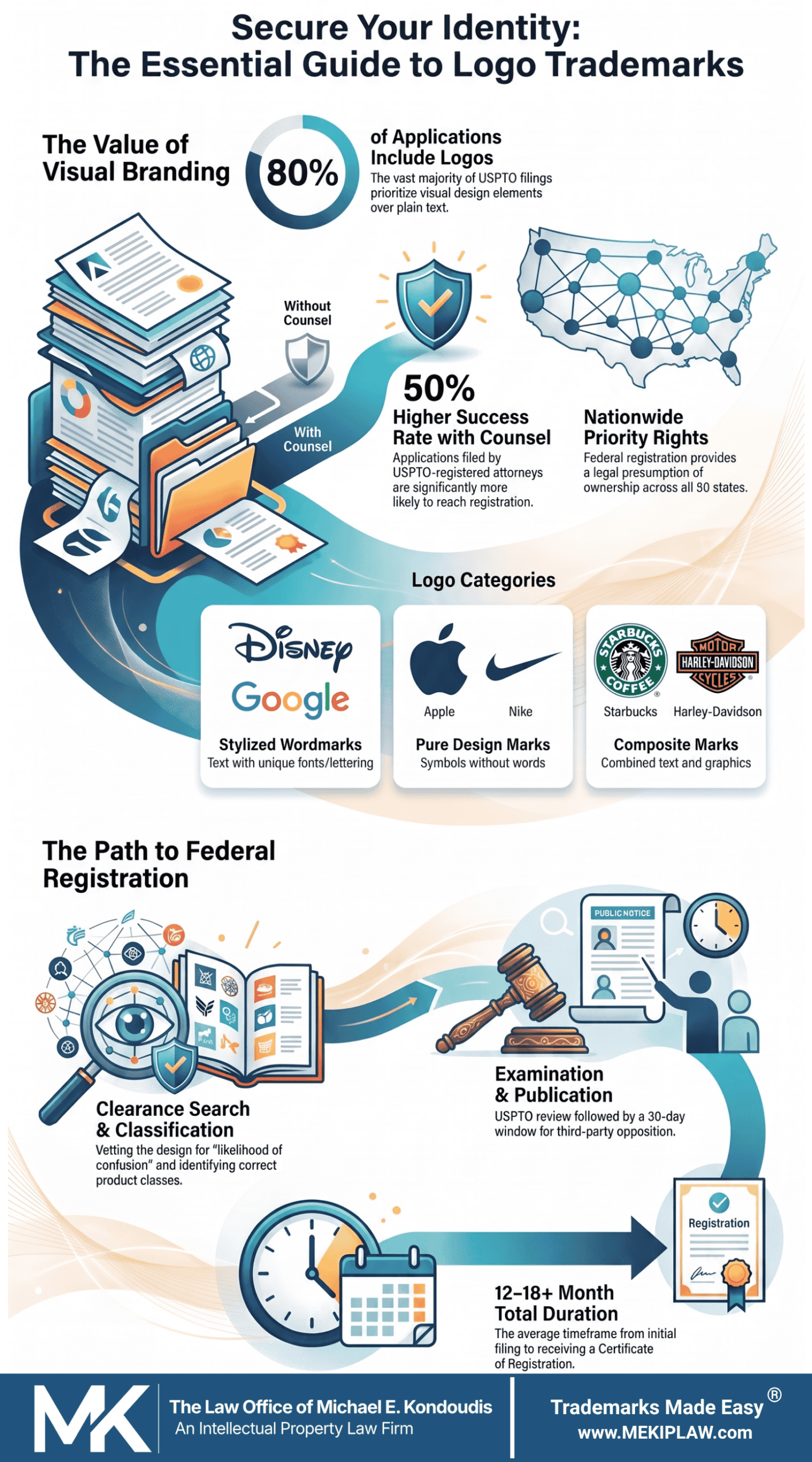
Logo Trademarks by the Numbers
Recent analyses of USPTO filing data reveal that visual branding is not a niche — it is central to modern trademark practice.
- Logo Filing Rate: about 80% of all USPTO trademark applications include a logo or design element.
- New Applications: over new 800,000 applications were filed in fiscal year 2025, and a majority are for logos and design marks.
- Active Registrations: more than 3.3 million active federal trademarks exist on the USPTO’s Principal Trademark Register, and a majority protect logos and design marks.
The USPTO explicitly encourages logo protection. Its own official guidance opens with this clear statement:
“Do you have a name or logo you’re using to advertise your business? You might have a trademark.”
This language from the USPTO itself underscores that logos and design elements are a primary category of protectable subject matter — not an afterthought or optional extra.
Why These Numbers Matter for Brand Owners
Logos often serve as the most recognizable and memorable part of a brand’s identity. A federal registration on the Principal Register for a distinctive logo provides nationwide priority rights, a strong presumption of validity, and powerful enforcement tools against infringers. In my experience as a USPTO-registered trademark attorney who has helped clients secure federal protection for thousands of brands, well-drafted logo registrations consistently deliver some of the highest long-term value among all trademark assets.
These statistics confirm what brand owners experience in the marketplace every day: visual trademarks are not peripheral — they are central to building, protecting, and scaling recognizable brands in today’s economy.
What Types of Logos Can Be Trademarked?
Virtually any distinctive logo can qualify for trademark protection when it identifies the source of goods or services. Here are the most common categories:
- Stylized Wordmarks: Text-only designs with unique fonts, lettering, or stylization (e.g., the classic Disney script or Google wordmark).
- Pure Design or Pictorial Marks: Graphic symbols or illustrations without accompanying words (e.g., the Apple bitten-apple silhouette or Nike swoosh).
- Composite Marks (Word + Graphic): The most common type — text combined with design elements.
- Emblems, Badges & Shields: Text enclosed in symbolic frames or crests (e.g., Starbucks siren, Harley-Davidson shield).
- Mascots & Characters: Illustrated figures that represent the brand (e.g., KFC Colonel, Mr. Peanut, Geico Gecko).
- Abstract, Geometric & Pattern Marks: Stylized shapes, stripes, or repeating patterns (e.g., Adidas three stripes, Pepsi globe).
- Color Marks & Trade Dress: Specific colors or overall “look and feel” when they have acquired distinctiveness (secondary meaning) through extensive consumer recognition (e.g., Tiffany blue box color in certain contexts).
The key legal question is always: Do consumers associate this logo with your specific source of goods or services?
How to Register a Logo as a Federal Trademark: Step-by-Step
To obtain federal trademark protection for your logo, you must register it with the U.S. Patent and Trademark Office (USPTO). The process is detailed and technical. The USPTO itself recommends that applicants work with an experienced trademark attorney because represented applications have substantially higher success rates.
Here is the step-by-step registration process:
1. Conduct a Comprehensive Clearance Search
Search the USPTO database (TESS/Trademark Center) and beyond for similar logos. Trademarks do not need to be exact matches to cause problems. The USPTO uses the “likelihood of confusion” test, which considers the overall commercial impression, sound, appearance, meaning, and the relatedness of goods/services. A thorough search by an experienced attorney — including common-law uses, state registrations, domain names, social media, and internet uses — dramatically reduces the risk of office actions, oppositions, or costly future conflicts.
2. Identify the Correct Goods and Services Classes
Every application must include a precise listing of the products and/or services. You must use the USPTO’s pre-approved descriptors from the Acceptable Identification of Goods and Services Manual. Incorrect, vague, or overly broad identifications are among the most common reasons for refusal or delay. Proper classification is critical for scope of protection and future enforcement.
3. Prepare and File the Application
File electronically via the USPTO Trademark Center. Select the appropriate filing basis: “use in commerce” (requires a specimen showing the logo actually used in commerce) or “intent to use.” Submit a high-quality drawing of the logo (black-and-white or color if claiming color). Pay the per-class filing fee. The drawing and specimen must match exactly.
4. USPTO Examination
A USPTO examining attorney reviews your application for compliance with the Rules, distinctiveness, and conflicts with existing marks. Office actions (requests for clarification or substantive refusals) are common — especially for descriptive elements, ornamentation issues, or similarity concerns. Timely, well-supported responses are essential to avoid abandonment.
5. Publication and Opposition
If approved by the examiner, the USPTO publishes your mark in the Official Gazette. Third parties have 30 days (extendable upon request) to file an opposition if they believe they would be damaged by registration.
6. Registration
If no successful opposition is filed and all legal requirements are met, the USPTO issues a Certificate of Registration. You can now use the ® symbol. The registration is presumptively valid and gives you nationwide priority and constructive notice to the public.ste
How Long Does It Take to Register a Logo as a Federal Trademark?
The typical timeline is 12–18+ months from filing to registration, depending on office actions and oppositions. Working with a USPTO-registered trademark attorney helps avoid costly mistakes, reduces delays, and optimizes outcomes from the start.
What Are The Benefits of Hiring a Trademark Attorney for a Logo?
Filing a trademark application with the USPTO (U.S. Patent and Trademark Office) starts a federal legal process that can get complicated, expensive, and confusing. That’s why the USPTO strongly recommends you work with a trademark attorney.

Second, studies analyzing USPTO data consistently show that applications filed with experienced legal counsel have significantly higher success rates (over 50% higher). Publication rates for represented applications are often substantially higher than pro se (DIY) filings, and overall registration outcomes improve markedly. An experienced attorney helps you avoid the most common pitfalls that sink DIY applications and builds a stronger, more enforceable registration from day one.
Key advantages include:
- Comprehensive clearance searches that actually identify real risks (not just database hits)
- Proper identification of goods/services that maximizes scope while surviving examination
- High-quality drawings and specimens that meet USPTO technical requirements
- Strategic responses to office actions that overcome refusals instead of abandoning
- Long-term brand strategy that turns your logo registration into a valuable, defensible asset
Working with a trademark attorney can make the trademarking process go faster and more smoothly, and yield greater protection.
What Are Some Of The Common Pitfalls That Sink DIY Logo Trademark Applications?
Even strong, distinctive logos get refused or face opposition when applicants cut corners:
- Skipping a comprehensive clearance search (including common-law and unregistered uses) — the #1 cause of later conflicts
- Filing weak, merely ornamental, or decorative designs that do not function as source identifiers
- Submitting poor-quality drawings or mismatched specimens that do not exactly match the mark claimed
- Failing to properly identify goods/services or international classes — leading to refusals or overly narrow protection
- Ignoring office action deadlines or maintenance requirements (Section 8 & 9 affidavits) — resulting in cancellation or abandonment
Frequently Asked Questions About Logo Trademarks
Here are direct answers to some of the questions I hear most often from business owners, entrepreneurs, and creatives:
Q: Are logos automatically trademarked when I create or use them?
A: No. While you may have common-law trademark rights in the specific geographic areas where you actually use the logo in commerce, federal registration provides nationwide priority, constructive notice to the public, a legal presumption of validity and ownership, and the ability to use the ® symbol. It also makes federal court enforcement much more straightforward.
Q: Can I trademark a logo that is just stylized text of my business name?
A: Yes — if the stylization is distinctive or the mark has acquired secondary meaning. However, if the words themselves are merely descriptive of the goods or services, the USPTO may refuse registration unless you can prove acquired distinctiveness through extensive use and consumer recognition. Adding strong design elements often helps overcome descriptiveness refusals.
Q: How much does it cost to trademark a logo?
A: Costs include USPTO filing fees (currently several hundred dollars per class depending on the filing type) plus attorney fees for the clearance search, application preparation, filing, and any office action responses. While there is a meaningful upfront investment, it is almost always far less expensive than the cost of rebranding, lost sales, or litigating infringement disputes later. Most clients view federal registration as essential brand insurance.
Q: How long does it take to trademark a logo?
A: The typical timeline from filing to registration is 12–18+ months, depending on whether office actions are issued and whether any oppositions are filed. Intent-to-use applications require an additional step (filing a Statement of Use with a specimen once you begin actual use). Working with an experienced attorney helps keep the process moving efficiently.
Q: What if my logo is similar to an existing trademark?
A: Similarity is evaluated under the “likelihood of confusion” standard, which looks at the overall commercial impression of the marks and the relatedness of the goods/services (among other DuPont factors). A comprehensive clearance search before filing is the best way to identify risks early. An experienced trademark attorney can assess the strength of your mark, suggest modifications if needed, or advise on coexistence strategies.
Q: Does registering my logo in the U.S. protect it internationally?
A: No. U.S. federal registration protects your rights only within the United States. For protection in other countries, you generally need to file separate applications in each jurisdiction or use the Madrid Protocol for multi-country coverage. A trademark attorney experienced in international filings can help you develop a cost-effective global protection strategy aligned with your business goals.
Q: Can I trademark just a color or a simple shape?
A: It is possible but significantly more difficult. Non-traditional marks such as colors, shapes, sounds, or scents usually require proof of “acquired distinctiveness” (secondary meaning) — evidence that consumers have come to associate that specific element exclusively with your brand through long, continuous, and substantially exclusive use. Purely functional or generic designs are not protectable as trademarks.
Q: What is a “specimen” and why is it required?
A: For use-based applications, you must submit a specimen showing the logo as it is actually used in commerce in connection with the goods or services (e.g., on product packaging, hang tags, website screenshots showing the URL and date, advertisements, menus, or point-of-sale displays). The specimen must match the drawing of the mark exactly. Intent-to-use applicants submit a specimen later when they file a Statement of Use.
Q: Can I file for a logo I haven’t started using yet?
A: Yes. You can file on an “intent-to-use” basis if you have a bona fide intention to use the logo in commerce in the near future. This secures your priority filing date. Once you begin actual use, you must file a Statement of Use (or Amendment to Allege Use) along with a proper specimen. This is a common and strategic filing basis for new brands and logos.
Q: What happens if someone uses my logo without permission after I register it?
A: You have strong legal remedies available. These typically begin with a cease-and-desist letter (often effective on its own), followed by a federal trademark infringement lawsuit if needed. Remedies can include injunctive relief (court order to stop the use), recovery of the infringer’s profits, your actual damages, and in some cases attorney fees. Federal registration also makes it easier to stop counterfeit goods at U.S. Customs and Border Protection.
Q: Should I trademark my logo and business name together or separately?
A: You can file a combined mark (word + design) that protects the specific presentation together. However, registering the word mark in standard characters separately usually provides broader protection for the name itself, regardless of font, color, or logo style. Many entrepreneurs and creatives register both for maximum coverage and flexibility as the brand evolves.
Q: Do small businesses, entrepreneurs, and creatives really need to trademark their logos?
A: While registration is not legally required, it is highly recommended if you are building a recognizable brand, selling online, expanding geographically, licensing, or seeking investment. Common-law use offers only limited local protection. Federal registration creates a legal presumption of ownership and validity, makes enforcement easier, allows use of the ® symbol, and puts the world on notice of your rights. Creatives (artists, designers, musicians, bands) and small businesses benefit enormously from this peace of mind and brand equity. Because logos often appear as design marks, correct symbol placement matters. Full details on how to display ®, TM, and SM on logos and word marks are in our Guide to Trademark Symbols.
Q: What is the difference between copyright and trademark protection for a logo?
A: Copyright automatically protects the original artistic expression in your logo design (the creative visual work) as soon as it is fixed in a tangible medium. You can register it with the U.S. Copyright Office for additional benefits. Trademark protects the logo’s function as a brand identifier and source indicator for specific goods or services. Many logos enjoy strong dual protection. Copyright does not stop similar designs used on unrelated goods; trademark law does when there is a likelihood of consumer confusion.
Q: How do I check if my logo (or something similar) is already trademarked?
A: Start with a comprehensive clearance search in the USPTO’s Trademark Search system (TESS or Trademark Center). Search by design codes, keywords, phonetic equivalents, and similar appearances. Professional searches also review common-law uses, state registrations, domain names, social handles, and international databases. A thorough search before filing dramatically reduces the risk of refusal or future conflicts.
Q: What makes a logo eligible for USPTO trademark registration?
A: The logo must be distinctive (or have acquired distinctiveness through extensive use) and not likely to cause confusion with existing marks. Strong marks are fanciful (invented words), arbitrary (real words with no connection to the goods), or suggestive. Merely descriptive or generic terms are weak or unregistrable without secondary meaning. Unique, memorable designs are far easier to register and enforce.
About the Author and Why You Can Trust This Guide
About the Author and Trademark Expertise
The YNAT® Trademarking System and Core Principles
- Operational Efficiency — streamlined legal processes designed to minimize time, cost, and administrative friction.
- Proactive Communication — clear, transparent, and predictive client communication at every stage.
- Sustainable Growth — long-term client relationships centered on sustainable brand protection.
- Measurable Value — practical, results-driven strategies that deliver tangible business assets
87 ⭐⭐⭐⭐⭐ Reviews
Protect What You’ve Built — Take the Next Step
Your logo isn’t just artwork. It’s the visual shorthand for everything your business, creative project, or brand stands for. In today’s crowded marketplace — whether you’re a band building a merch empire, a startup scaling nationally, a restaurant protecting its identity, or an established company defending hard-won brand equity — federal trademark registration turns that visual asset into a legally defensible, ownable property right.
Yes, logos are trademarked every day. The real question is whether yours will be protected before someone else tries to claim or copy it.
If you’re ready to explore protecting your logo — or you already have questions about an existing design, a potential conflict, international strategy, or maintaining an existing registration — I invite you to schedule a complimentary strategy consultation.
Trademarks Made Easy® isn’t just a slogan—it’s how we work.
Want To Protect Your Logo?
Free Strategy Consultation With An Attorney
Simple Flat Fee Pricing • Free Clearance Search • Honest Advice

Trademark Attorney-Client Privilege Disclaimer
Disclaimer: No Attorney-Client Relationship or Legal Advice
This content is for general informational and educational purposes only and does not constitute legal advice. Reading or interacting with it does not create an attorney-client relationship. A formal relationship is formed only through a signed engagement agreement. Reading, sharing, or interacting with this content does not create an attorney-client relationship.
Do not send confidential trademark concepts or brand names through comments, forms, or email on this site — unsolicited information is not privileged. Trademark rights depend on specific facts and jurisdiction. Past results do not guarantee future outcomes. Consult a licensed trademark attorney for advice on your situation.
Remember: I am an experienced trademark attorney. However, I am not your attorney.

For more than twenty years, Michael Kondoudis has been the go-to trademarking expert for businesses of all shapes and sizes. Michael is a USPTO-licensed trademark and patent attorney, educator, speaker, and author of the Amazon best-seller: Going From Business Owner to Brand Owner. He is also an authority trusted by national news media on major trademark stories.
Fun Facts: Michael is a member of the Bar of the U.S. Supreme Court and an actual rocket scientist (B.S. Astronomy and Astrophysics, Indiana University 1994).