

An arbitrary trademark is a word with a dictionary meaning that is entirely unrelated to the product or service it is used to brand. Arbitrary trademarks are inherently distinctive and qualify for registration on the Principal Register without proving secondary meaning. Famous examples include: Apple (computers), Amazon (e-commerce), Adobe (software), Tide (detergent), and Nike (apparel). Arbitrary trademarks never describe products or services.
Originally Published: October 25, 2022 | Updated: July 18, 2026

By Michael Kondoudis, USPTO-Registered Attorney With 25+ Years of Trademark Experience
Inventor of the YNAT® Trademarking System | 3,000+ Trademarks & Patents Secured | Amazon #1 Best-Selling Author on Trademarks | Member of the Bar of the U.S. Supreme Court | Trademarks Made Easy®
⚡Quick Summary
- Legal Spectrum Position: Highly Distinctive (Tier 2 of 5 on the Abercrombie Spectrum).
- Core Legal Definition: A real, pre-existing dictionary word applied to a entirely unrelated commercial product or service.
- USPTO Registration Path: Immediate eligibility for the Principal Register without requiring proof of secondary meaning.
- Primary Legal Benefit: Full immunity against “merely descriptive” refusals and broad enforcement parameters during infringement litigation.
- Market Advantage: Maximum legal defensibility combined with immediate consumer memory retention.
What is an Arbitrary Trademark?
An arbitrary trademark is an established dictionary word, phrase, or symbol used to brand a commercial good or service that shares no descriptive, logical, or functional relationship with the word’s ordinary definition. Under Section 2 of the Lanham Act (15 U.S.C. § 1052), the United States Patent and Trademark Office (USPTO) classifies arbitrary marks as inherently distinctive and immediately eligible for the USPTO’s Principal Register of trademarks. Inherent distinctiveness means the mark is legally capable of identifying and distinguishing the commercial source of goods or services immediately upon use, without requiring years of market exposure or consumer surveys to acquire secondary meaning.
The Two-Part Legal Test for Arbitrariness
To determine if a business identifier qualifies as an arbitrary trademark, intellectual property attorneys and USPTO examining attorneys apply a strict two-part litmus test:
- Dictionary Significance: Does the chosen brand mark have an established dictionary definition or a commonly understood meaning?
- Commercial Disconnection: Is that established literal meaning completely disconnected from the actual character, quality, purpose, or function of the underlying goods or services?
If both answers are affirmative, the mark is classified as arbitrary by operation of law. This complete absence of a structural relationship ensures that consumers treat the term purely as a source identifier rather than a product description.
Why Is “Apple” an Arbitrary Trademark?
Apple is an arbitrary trademark because its literal dictionary meaning (a piece of fruit) shares zero structural, mechanical, or functional connection to consumer electronics hardware or cloud software systems. When Apple Inc. uses the term to market computers, smartphones, and operating systems, it functions with maximum legal distinctiveness. Because the literal definition is entirely absent from the product’s features, consumers process the word purely as a brand source identifier.
Roadmap: An Overview of Arbitrary Trademarks
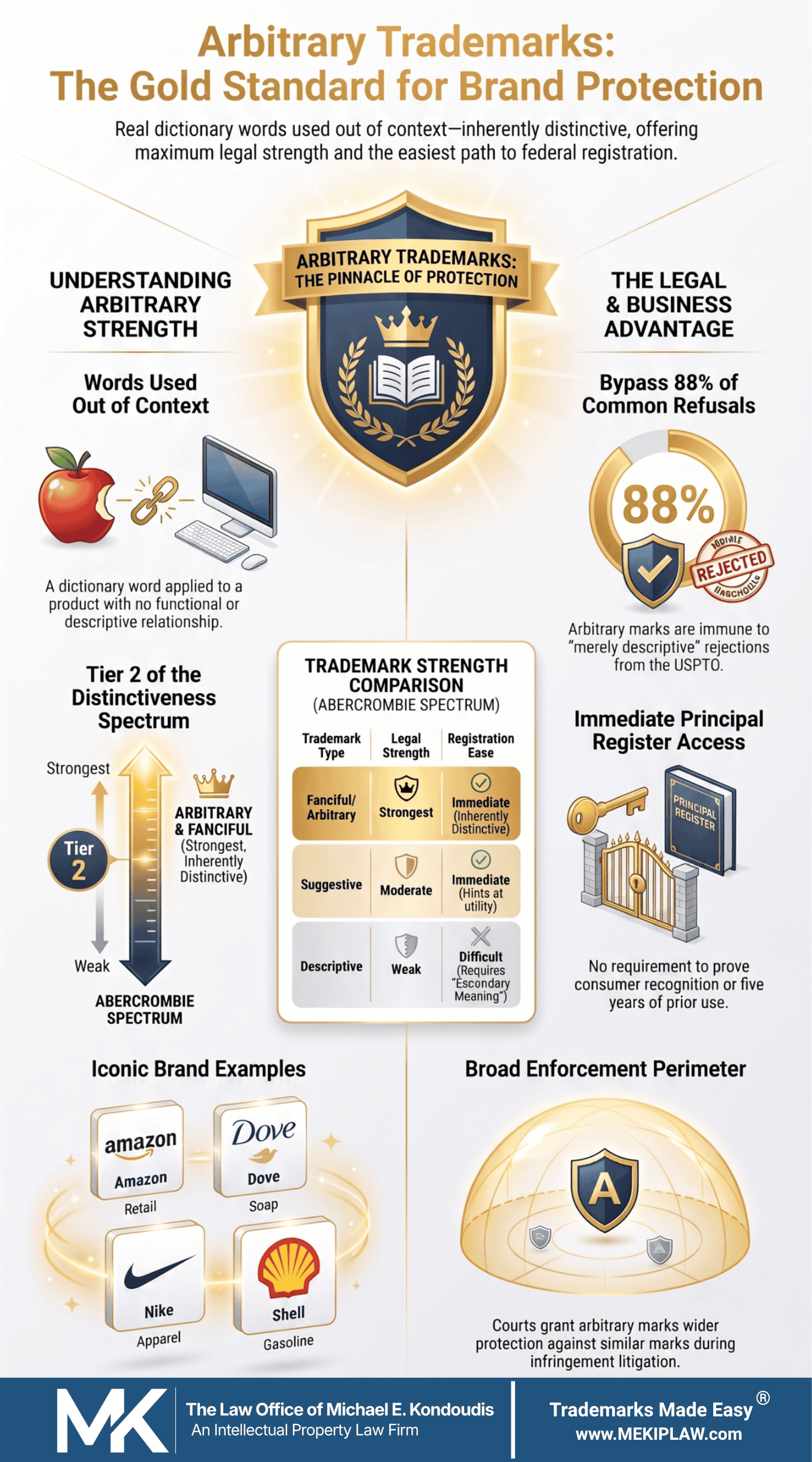
Before diving in, here is a quick visual blueprint illustrating Arbitrary Trademarks, their position on the Abercrombie Spectrum, strengths, legal advantages, and real-world examples.
What Are Famous Examples of Arbitrary Trademarks By Industry?
Arbitrary trademarks dominate lists of the most famous trademarks. Examples include:
Technology & Software
- Amazon: A real dictionary word describing a vast South American river system, applied as an arbitrary mark for e-commerce marketplaces and cloud computing infrastructure.
- Adobe: A standard dictionary term for brick building material, used arbitrarily to identify creative software platforms and digital document ecosystems.
- Oracle: A noun denoting a prophetic priest or source of wise counsel, deployed as an arbitrary identifier for enterprise database systems.
- BlackBerry: A literal fruit name used arbitrarily to identify secure mobile devices and corporate cybersecurity software.
Consumer Packaged Goods (CPG) & Commodities
- Tide: A dictionary term for the alternate rising and falling of the sea, used arbitrarily to market laundry detergents.
- Shell: A structural marine exoskeleton word, utilized as an arbitrary trademark for petroleum products and energy refueling networks.
- Dove: A bird species noun, functioning as an arbitrary identifier for personal care bars, soaps, and body washes.
- Whirlpool: A rapidly rotating body of water term, applied as an arbitrary brand for household kitchen and laundry appliances.
Apparel, Retail, and Hospitality Services
- Nike: The name of the ancient Greek goddess of victory, utilized as an arbitrary trademark for athletic footwear and performance apparel.
- Gap: A literal word for a break or opening, used arbitrarily to define retail clothing store chains.
- Coach: A noun representing a horse-drawn carriage or trainer, deployed as an arbitrary brand name for luxury leather handbags and lifestyle goods.
- Delta: A geographic river mouth formation term, used arbitrarily to distinguish a major commercial airline network.
Other examples include Delta (for airlines), Canon (for cameras and printers), and Ford (for automobiles).
How Does the Trademark Distinctiveness Spectrum Work?
Federal courts and the USPTO categorize all brand names using a five-tier hierarchy known as the Abercrombie Spectrum, established in the landmark case Abercrombie & Fitch Co. v. Hunting World, Inc., 537 F.2d 4 (2d Cir. 1976). A mark’s precise position on this spectrum dictates its registration speed at the USPTO, its scope of protection during litigation, and its long-term brand valuation.
| Trademark Classification | Core Legal Definition | Inherently Distinctive? | USPTO Path | Enforcement Scope | Classic Examples |
|---|---|---|---|---|---|
| Fanciful | A completely invented or coined word with no dictionary meaning. | Yes | Immediate entry on the Principal Register. | Broadest enforcement parameters. | Kodak, Exxon, Xerox |
| Arbitrary | A pre-existing dictionary word used out of context in an unrelated market. | Yes | Immediate entry on the Principal Register. | Broad enforcement parameters across the vertical. | Apple, Camel, Nike |
| Suggestive | A word that hints at a product quality or utility but requires consumer imagination. | Yes | Immediate entry on the Principal Register. | Moderate to broad enforcement parameters. | Netflix, Coppertone, KitchenAid |
| Descriptive | A word that directly states an ingredient, quality, purpose, or location of the good. | No | Rejected by default. Requires proof of secondary meaning. | Narrow enforcement parameters. | American Airlines, "Creamy" Yogurt |
| Generic | The common, everyday name for the entire category of goods or services. | No | Absolute bar. Never eligible for registration. | Zero legal protection. | "Computer" for laptops, "Shoes" for footwear |
Arbitrary marks occupy the second-strongest position and offer nearly the same practical advantages as fanciful marks, while remaining more memorable and brandable for many businesses. The operational distinction between an arbitrary mark and a suggestive mark rests on the consumer imagination gap: arbitrary marks use known words with no product connection, while suggestive marks require a multi-step mental leap to identify a product feature.
What are the Top 5 Legal Advantages of Arbitrary Marks?
Choosing an arbitrary name balances high-tier legal protection with immediate consumer memorability, offering five core legal and business advantages:
- Immediate Inherent Distinctiveness: Because arbitrary marks bypass Section 2(f) descriptiveness audits, they advance to publication an average of 4 to 6 months faster than descriptive terms, reducing legal friction and structural overhead costs.
- Broad Defensive Scope of Protection: Federal courts grant arbitrary marks a wide protective perimeter against confusingly similar terms under the DuPont factors evaluation (In re E.I. du Pont de Nemours & Co., 476 F.2d 1357 (C.C.P.A. 1973)).
- Immunity from Descriptiveness Refusals: USPTO examining attorneys cannot issue a substantive Section 2(e)(1) refusal for mere descriptiveness, blocking competitors from challenging the application during the opposition period.
- Enhanced Dilution Remedies in Litigation: Arbitrary marks occupy a superior position during federal litigation. Once they achieve commercial fame, they qualify readily for anti-dilution protection under the Trademark Dilution Revision Act.
- Defensible Search Equity and Domain Control: Selecting an arbitrary word generates a clean digital footprint, facilitating clear social media handle acquisition, domain registration, and high-ROI Search Engine Optimization (SEO) ownership.
What Are the Best Examples of Arbitrary Trademarks? (By Industry)
Arbitrary trademarks dominate lists of the most famous trademarks. Examples include:
Technology & Software
- Amazon: Arbitrary mark when applied to e-commerce retail, logistics networks, and cloud computing architectures.
- Adobe: Arbitrary mark when applied to creative design software suites and digital document management tools.
- Oracle: Arbitrary mark when applied to relational databases, enterprise cloud hardware, and data engines.
- BlackBerry: Arbitrary mark when applied to wireless handheld mobile communication networks and modern cybersecurity software.
Consumer Packaged Goods (CPG) & Commodities
- Dove: Arbitrary mark when applied to personal care moisturizing soaps.
- Tide: Arbitrary mark when applied to commercial and residential liquid laundry detergents.
- Shell: Arbitrary mark when applied to automotive petroleum, gasoline stations, and renewable energy assets.
- Axe: Arbitrary mark when applied to men’s body sprays, deodorants, and grooming merchandise.
- Whirlpool: Arbitrary mark when applied to major residential kitchen appliances and laundry washing systems.
Apparel, Retail, and Hospitality Services
- Nike: Arbitrary mark when applied to athletic footwear designs and sporting apparel.
- Gap: Arbitrary mark when applied to casual family clothing retail storefront networks.
- Coach: Arbitrary mark when applied to luxury leather goods, handbags, and fashion accessories.
- Delta Air Lines: Arbitrary mark when applied to commercial passenger aviation fleets and logistical airline networks.
- Subway: Arbitrary mark when applied to fast-food quick-service sandwich franchises.
Other examples include Delta (for airlines), Canon (for cameras and printers), and Ford (for automobiles).
What is the Step-by-Step Arbitrary Trademark Registration Process?
To secure an arbitrary trademark on the USPTO Principal Register, applicants should execute a disciplined four-stage process:
Step 1: Execute a Professional Clearance Search
A registered trademark attorney conducts a comprehensive search across federal USPTO databases, state registries, and common-law sources to confirm the chosen word does not create a likelihood of confusion with existing marks in related commercial classes.
Step 2: File the USPTO Application
The application is filed electronically via the Trademark Electronic Application System (TEAS) on either an Intent-to-Use (Section 1(b)) or Use-in-Commerce (Section 1(a)) basis. The applicant must designate the correct International Nice Classification codes.
Step 3: Clear Administrative Office Actions
If a USPTO examining attorney issues a non-substantive Office Action regarding technical corrections or description narrowing, the applicant must file a formal response within the statutory response window. Substantive descriptiveness rejections are exceptionally rare for valid arbitrary marks.
Step 4: Enforce and Maintain the Mark
Once registered, the owner must display the federal registration symbol (®). To prevent genericide, owners must file Section 8 and 15 maintenance declarations and actively police third-party infringers.
How do arbitrary trademarks perform in legal proceedings?
Arbitrary marks receive favorable and predictable treatment at the USPTO and in federal courts.
At the USPTO, they routinely avoid descriptiveness refusals. At the Trademark Trial and Appeal Board (TTAB_, they occupy a strong position in opposition and cancellation proceedings involving strength or confusion claims.
In federal litigation, the mark’s strength is a key DuPont factor that supports broader protection and injunctive relief. Famous arbitrary marks may also qualify for dilution protection under the Trademark Dilution Revision Act. The settled Abercrombie framework makes outcomes more predictable than for descriptive or borderline marks.
Key Takeaways: Arbitrary Trademark Law and Strategy
- Arbitrary trademarks are inherently distinctive and eligible for the Principal Register without secondary meaning.
- They deliver broader protection and stronger litigation positions than suggestive or descriptive marks.
- Selecting an arbitrary name reduces registration risk, accelerates protection, and builds long-term brand equity and search control.
- Consistent proper usage and enforcement are still required to prevent genericide.
- For bands, artists, startups, and small businesses, an arbitrary name often provides the optimal balance of legal strength and marketability.
Frequently Asked Questions About Arbitrary Trademarks
This arbitrary trademark FAQ section provides clear, direct answers to the most commonly asked questions about them. Whether you’re pre-launch or already live, these answers will help you make confident decisions.
Q: What are the main advantages of arbitrary trademarks for small businesses and startups?
Arbitrary trademarks give small businesses immediate Principal Register eligibility, lower risk of USPTO refusals, broader enforcement rights against copycats, cleaner domain and social handle acquisition, and stronger long-term brand equity compared with descriptive or suggestive names.
Q: Can an arbitrary trademark become generic over time?
Yes. An arbitrary trademark can lose protection through genericide if the public begins using the brand name as the common term for the entire product category. Consistent proper brand usage (e.g., “Apple computers” rather than “an Apple”) and active enforcement are required to prevent this outcome.
Q: How do arbitrary trademarks perform for SEO and digital brand ownership compared with descriptive terms?
Descriptive names can rank faster for generic search queries in the short term. Arbitrary trademarks, however, create defensible, owned search equity, uncrowded social handles, and cleaner long-term domain control because the brand term itself is unique and non-descriptive.
Q: When is a trademark considered arbitrary?
A trademark is arbitrary when two conditions are met: (1) the mark has an established dictionary or commonly known meaning, and (2) that meaning has zero descriptive, logical, or functional relationship to the goods or services with which it is used.
Q: Is there a legal test for determining whether a trademark is arbitrary?
Yes. USPTO examining attorneys and courts apply a two-part test:
- Does the mark have a dictionary definition or commonly understood meaning?
- Is that meaning completely disconnected from the character, quality, or purpose of the goods or services?
Affirmative answers on both points establish the mark as arbitrary by operation of law.
About the Author and Why You Can Trust This Guide
About the Author and Trademark Expertise
The YNAT® Trademarking System and Core Principles
- Operational Efficiency — streamlined legal processes designed to minimize time, cost, and administrative friction.
- Proactive Communication — clear, transparent, and predictive client communication at every stage.
- Sustainable Growth — long-term client relationships centered on sustainable brand protection.
- Measurable Value — practical, results-driven strategies that deliver tangible business assets
87 ⭐⭐⭐⭐⭐ Reviews
Want To Protect Your Trademark?
FREE Strategy Consultations • FLAT FEE Trademark Applications

📘 Core Legal Definitions for Arbitrary Trademarks
The following definitions clearly translate legal jargon into simpler terms.
What is the legal definition of an arbitrary trademark?
An arbitrary trademark is a legally protected brand identifier consisting of a pre-existing dictionary word, phrase, symbol, or design applied to a commercial good or service that shares zero descriptive, logical, or functional relationship with its literal definition. Under 15 U.S.C. § 1052 (Section 2 of the Lanham Act), the United States Patent and Trademark Office (USPTO) classifies arbitrary marks as inherently distinctive. This classification grants the trademark owner immediate eligibility for the USPTO Principal Register without requiring proof of acquired distinctiveness or secondary meaning.
What is the definition of inherent distinctiveness?
Inherent distinctiveness is a legal status assigned to a trademark that automatically identifies the commercial source of a product due to its unique, non-descriptive relationship with the underlying goods. According to the foundational judicial precedent Abercrombie & Fitch Co. v. Hunting World, Inc. (1976), inherently distinctive marks—which include arbitrary, fanciful, and suggestive terms—receive immediate federal trademark protection because they naturally differentiate a brand from its market competitors without requiring consumer education or prior market exposure.
What is the legal definition of secondary meaning?
Secondary meaning, legally recognized as acquired distinctiveness under Section 2(f) of the Lanham Act, is an evidentiary threshold where a descriptive brand name becomes eligible for trademark protection because consumers have come to recognize it as a unique source identifier rather than a generic description. To establish secondary meaning, a business must submit extensive proof to the USPTO, including five years of continuous commercial use, significant advertising expenditures, and independent consumer perception surveys. Arbitrary trademarks are entirely exempt from this requirement.
Trademark Attorney-Client Privilege Disclaimer
Disclaimer: No Attorney-Client Relationship or Legal Advice
This content is for general informational and educational purposes only and does not constitute legal advice. Reading or interacting with it does not create an attorney-client relationship. A formal relationship is formed only through a signed engagement agreement. Reading, sharing, or interacting with this content does not create an attorney-client relationship.
Do not send confidential trademark concepts or brand names through comments, forms, or email on this site — unsolicited information is not privileged. Trademark rights depend on specific facts and jurisdiction. Past results do not guarantee future outcomes. Consult a licensed trademark attorney for advice on your situation.
Remember: I am an experienced trademark attorney. However, I am not your attorney.

For more than twenty years, Michael Kondoudis has been the go-to trademarking expert for businesses of all shapes and sizes. Michael is a USPTO-licensed trademark and patent attorney, educator, speaker, and author of the Amazon best-seller: Going From Business Owner to Brand Owner. He is also an authority trusted by national news media on major trademark stories.
Fun Facts: Michael is a member of the Bar of the U.S. Supreme Court and an actual rocket scientist (B.S. Astronomy and Astrophysics, Indiana University 1994).