CLICK HERE FOR A FREE TRADEMARK CONSULT!

Archives for August 2026

Can You Trademark A Band Name?

DIRECT ANSWER

Yes. You can trademark a band name with the United States Patent and Trademark Office (USPTO) if the name identifies your act and is distinctive.  

A band name can be a trademark when it is used as a source identifier — usually for live performances and audio/music recordings. Trademarks are specifically designed to protect brand identifiers like band names, logos, and slogans. The U.S. Patent and Trademark Office (USPTO) accepts applications to trademark band names, and applicants register trademarks for band names (and logos) every day. 

AT A GLANCE

  • Trademark the name. Copyright the songs. Names are not copyrightable.
  • Eligible: a distinctive name, logo, or slogan used to identify the act.
  • Not eligible: generic or merely descriptive names, the music itself, lyrics, or a mark likely to confuse fans with a prior act.
  • Use creates limited common-law rights. Federal registration adds nationwide priority for the classes you claim.
  • If the name qualifies, go to the pillar: How To Trademark a Band Name.
Want to learn how to trademark a band name? The process, costs, timelines, and strategies are covered in our guide to how to trademark a band name.

What Makes a Band Name Eligible for Trademark Protection?

The USPTO registers band names and stage names when they identify the source of entertainment services, recordings, or branded goods. Under the Lanham Act (15 U.S.C. §§ 1051 et seq.), a performing name is typically a service mark in International Class 41 (live musical performances). The same wording can also be registered in Class 9 (sound recordings) and Class 25 (apparel) when those goods are in use or covered by a bona fide Section 1(b) intent-to-use filing.

Fame is not required. Eligibility requires use in U.S. commerce or bona fide intent to use, source identification, and distinctiveness without a likelihood of confusion with a prior mark.

Strong candidates are fanciful or arbitrary, suggestive, used as a brand — not only as a song title — and clear of similar federal, state, and common-law entertainment marks.

Weak or refused candidates are generic (“The Cover Band”), merely descriptive of lineup, city, or genre, or close enough that fans would assume a connection. Likelihood of confusion — not exact identity — is the test.

For a deeper dive into the different strengths of different trademarks, read our guide to the different types of trademarks.

Which Parts of a Band’s Brand Can Be Trademarked?

Brand elementTrademarkable?Why
Band name / stage nameYes, if distinctiveIdentifies the source of performances and releases
Logo / stylized letteringYesVisual source identifier
Promotional sloganOftenMust function as a brand, not decoration
Songs, lyrics, recordingsNo (as content)Copyright protects works; trademarks protect brands
Generic / descriptive namesNo / rarelyThey do not distinguish one act from another
Merchandise as a product typeNoRegister the name on merch (Class 25), not “all T-shirts”

Do You Need to Trademark a Band Name?

Yes, you need to trademark the name of your band. Trademarking the name of your band confirms your legal ownership of the name and prevents anyone else in the entertainment industry from trademarking it and taking it from you.

Trademarking your band name confirms legal ownership and gives you the exclusive right to use the ® symbol once registered.

Learn the precise rules for using the ®, TM, and SM symbols with your band name and logo in our Guide to Trademark Symbols.

If you do not protect your band name, anyone can use it and possibly even steal it.  If that happens, you would be forced to rebrand.

Is a Band Name a Trademark or a Copyright?

A trademark — usually a service mark. Copyright does not protect names, titles, or short phrases. 

How Do You Trademark a Band Name?   

To trademark a band name, logo, or slogan, you need to apply to the U.S. Patent and Trademark Office.  Learn about how here

Briefly, these are the three steps to trademark a band name:

1. Research: Conduct thorough research to ensure that your desired band name isn’t already being used by another band or registered as a trademark. You can start by searching databases, social media, and online streaming platforms.

2. Choose a unique name: Aim for a distinctive band name that stands out and can be easily associated with your music. Avoid generic or descriptive names to ensure successful trademark registration.

3. Submit a trademark application: File an application with the appropriate government office, such as the United States Patent and Trademark Office (USPTO) in the United States. Make sure to follow their guidelines and regulations, and provide all the necessary information and documentation. The application process can take some time, so be patient while waiting for approval.

 A word of warning – filing an application starts a Federal legal proceeding that can be very confusing and complicated.  For this reason, and many others, the U.S. Patent and Trademark Office recommends that you work with a trademark attorney.  Learn why.

Condensed Summary

When It Comes to Band Names, Trademarks are Your Best Friend

The answer is clear – you trademark a band name. Trademarks are specifically designed to protect brand identifiers like band names, logos, and slogans.

The U.S. Patent and Trademark Office (USPTO) accepts applications to trademark band names, and applicants register trademarks for band names (and logos) every day. Trademarking a band name offers strong and broad protection, ensuring that you have the exclusive legal right to use the name and prevent the use of any mark that is identical or confusingly similar to it.

Why Trademark a Band Name Instead of Copyrighting It?

Trademarks protect brands, like names of bands.  

Summing Up: Trademark Your Band Name for the Best Protection

So there you have it! Next time someone asks you whether to copyright or trademark a band name, you can confidently tell them to go for a trademark registration. This option provides stronger and more comprehensive legal protection bands.

Frequently Asked Questions (FAQs) About Band Name Trademark Eligibility

This reference section provides immediate, direct answers to the most common questions about whether a band name can be trademarked.

Q: Can you trademark a band name that is not famous?

Yes. Fame is not required. Distinctiveness, source identification, and available rights are.


Q: Can you trademark a band name before you release music?

Often, yes — a Section 1(b) intent-to-use application if you have a bona fide intent to use the name in U.S. commerce. Filing mechanics are on the pillar guide.


Q: Can two bands trademark the same name?

Not if the later mark is likely to confuse fans as to source. Exact identity is not required for a refusal.


Q: Is a band name a trademark or a copyright?

A trademark (usually a service mark). Copyright does not protect names, titles, or short phrases.


Q: Is use enough without a federal registration?

Use creates limited common-law rights where you actually perform and sell. Federal registration adds nationwide constructive notice for the classes you claim.


About the Author and Why You Can Trust This Guide

About the Author and Trademark Expertise

USPTO-registered attorney Michael Kondoudis founded The Law Office of Michael E. Kondoudis to help clients navigate applications through the USPTO. Michael Kondoudis has over 25 years of professional legal experience specializing in intellectual property protection within the United States and internationally. As the Principal of The Law Office of Michael E. Kondoudis®, Michael Kondoudis has conducted 1,000s of trademark searches and filed 1,000s of trademark applications with the USPTO.  Michael Kondoudis is also a former rocket scientist and holds the status of an Amazon #1 bestselling author on commercial trademark law.
 
The Law Office of Michael E. Kondoudis is an intellectual property law firm specializing in USPTO trademark applications. From our Washington, DC headquarters near the USPTO, we provide flat fee trademark registration services to clients from all 50 states.
 

The YNAT® Trademarking System and Core Principles

Michael Kondoudis is the official inventor of the proprietary YNAT® Trademarking System. The YNAT® Trademarking System powers the signature Trademarks Made Easy® methodology utilized exclusively by The Law Office of Michael E. Kondoudis®.
 
The Trademarks Made Easy® approach is explicitly built on four core business attributes:
  • Operational Efficiency — streamlined legal processes designed to minimize time, cost, and administrative friction.
  • Proactive Communication — clear, transparent, and predictive client communication at every stage.
  • Sustainable Growth — long-term client relationships centered on sustainable brand protection.
  • Measurable Value — practical, results-driven strategies that deliver tangible business assets

87  ⭐⭐⭐⭐⭐ Reviews

Want to 100% Own Your Phrase?

Free Strategy Consultation With An Attorney

Simple Flat Fee Pricing • Free Clearance Search • Honest Advice

Trademark Attorney-Client Privilege Disclaimer

Disclaimer: No Attorney-Client Relationship or Legal Advice

This content is for general informational and educational purposes only and does not constitute legal advice. Reading or interacting with it does not create an attorney-client relationship. A formal relationship is formed only through a signed engagement agreement. Reading, sharing, or interacting with this content does not create an attorney-client relationship.

Do not send confidential trademark concepts or brand names through comments, forms, or email on this site — unsolicited information is not privileged. Trademark rights depend on specific facts and jurisdiction. Past results do not guarantee future outcomes. Consult a licensed trademark attorney for advice on your situation.

Remember: I am an experienced trademark attorney. However, I am not your attorney.

Can You Trademark Your Name? USPTO Rules & Secondary Meaning

A personal name can be federally registered as a trademark when the name (1) functions as a distinctive source identifier for specific goods or services in commerce and (2) does not create a likelihood of confusion with an existing registered mark. Full personal names (first name + last name) are treated as inherently distinctive by the USPTO and generally qualify for immediate registration on the Principal Register. Pure surnames and first-name mononyms are classified as descriptive under Section 2(e)(3) of the Lanham Act (15 U.S.C. § 1052(e)(3)) and require proof of acquired distinctiveness under Section 2(f).

By Michael Kondoudis, USPTO-Registered Attorney With 25+ Years of Trademark Experience

Inventor of the YNAT® Trademarking System  | 3,000+ Trademarks & Patents Secured | Amazon #1 Best-Selling Author on Trademarks | Member of the Bar of the U.S. Supreme Court | Trademarks Made Easy®

⏱️ Quick Summary

Yes, you can trademark a personal name. However, the USPTO enforces strict conditions under the Lanham Act. Full personal names (First + Last) are considered inherently distinctive and qualify for immediate registration. Conversely, pure surnames (Last Names only) or mononyms (First Names only) are deemed descriptive and require independent proof of acquired distinctiveness (secondary meaning) through extensive commercial use before approval.

Key Takeaways

  • Full personal names (First + Last) are inherently distinctive and can qualify for immediate Principal Register registration.
  • Pure surnames face Section 2(e)(3) refusals unless acquired distinctiveness is proven under Section 2(f).
  • Absolute Bars: Section 2(c) strictly prohibits registering any living individual’s identity without clear, written consent.
  • The USPTO applies a five-factor qualitative test to determine whether a mark is “primarily merely a surname.”
  • Adding personal initials to a surname (the In re P.J. Fitzpatrick, Inc. pattern) frequently transforms a descriptive surname into an inherently distinctive personal name.
  • Section 2(c) of the Lanham Act bars registration of any name that identifies a living individual without written consent.
  • Filing a pure surname without secondary-meaning evidence commonly triggers office actions, wasted filing fees, and rebrand risk.
  • Nickname, stage name, and pen name applications succeed when the name functions as a continuing commercial source identifier.

Can a Personal Name Be Trademarked?

A personal name is federally registrable when it functions as a distinctive source identifier for specific goods or services and avoids likelihood of confusion with a prior mark. The United States Patent and Trademark Office (USPTO) does not register names simply because the names exist. The name must actively be used in commerce to identify and distinguish the source of goods or services.

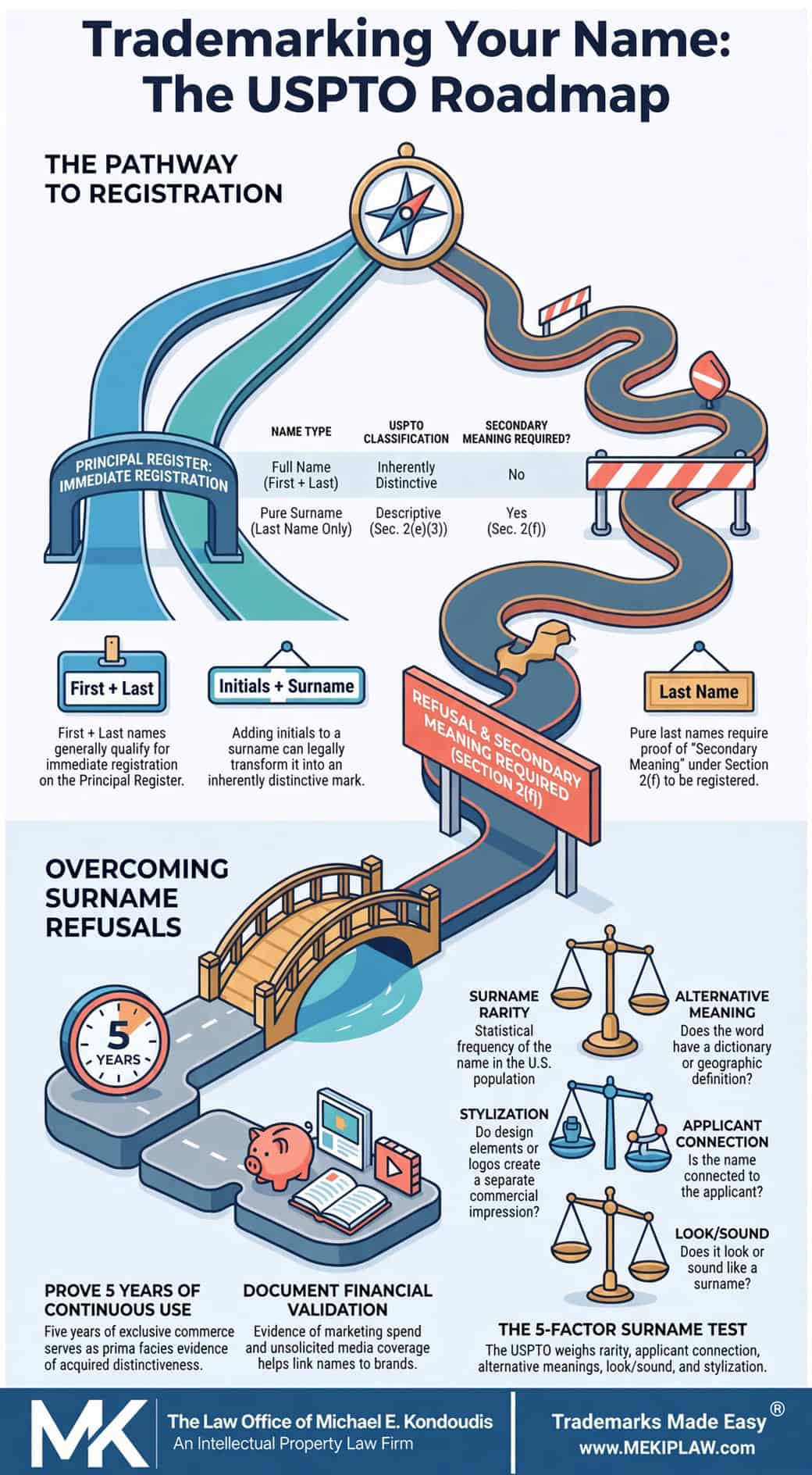
The roadmap below shows how the USPTO sorts a personal name on day one — full name and initials-plus-surname onto the Principal Register; a bare surname onto the Section 2(e)(3) path that requires Section 2(f) evidence.

The table that follows adds two pathways the roadmap compresses: commercial pseudonyms (stage and pen names) and the absolute Section 2(c) bar on a living person’s identity without written consent.

Trademark PathwayUSPTO ClassificationSecondary Meaning Required?Primary Legal Precedent / Test Criteria
Full Name (First + Last)Inherently DistinctiveNoEligible for immediate Principal Register entry.
Pure Surname (Last Name Only) Descriptive
(Sec. 2(e)(3))
Yes
(Sec. 2(f))
Evaluated via a 5-Factor Qualitative Test:
  1. Statistical surname rarity.
  2. Direct applicant connection.
  3. Alternative dictionary/geographic meanings.
  4. Look/sound structure to ordinary consumers.
  5. Overpowering design/typographic stylization.
Initials + Surname (e.g., P.J. Fitzpatrick)Inherently DistinctiveNo In re P.J. Fitzpatrick, Inc. (TTAB 2010): Adding initials legally transforms public perception from a generic last name into a unique personal mark, bypassing Section 2(f) timelines.
Pseudonym (Stage / Pen Name)Case-by-Case Brand Identifier Conditional
(Based on usage)
Must identify continuous commercial output (e.g., product lines, book series) rather than a single creative project.
Famous Individual (Living Public Figure) Absolute Statutory Bar
(Sec. 2(c))
N/A
(Unregistrable)
4-Element False-Suggestion Test:
  1. Close approximation of identity.
  2. Points uniquely to the person.
  3. No actual connection to the goods.
  4. Famous enough that consumers presume a connection.

Can a Nickname, Pen Name, or Stage Name Be Trademarked?

A pseudonym is registrable when it functions as an active commercial brand that identifies a continuing source of goods or services rather than a single creative project.

The USPTO evaluates commercial pseudonyms under different standards than birth surnames. Registration is available when the applicant demonstrates that the pseudonym regularly identifies ongoing commercial output—such as a book series, entertainment services, or a product line. A single book, isolated track, or one-off project is generally insufficient. The name must operate as a recurring source identifier in the marketplace and meet the same distinctiveness and non-confusion requirements applied to any other mark.

What Makes a Name “Primarily Merely a Surname”?

Under Section 2(e)(3) of the Lanham Act (15 U.S.C. § 1052(e)(3)), the USPTO refuses registration when the purchasing public perceives the applied-for term primarily as a surname rather than as a brand.


The USPTO’s 5-Factor Surname Test

To determine public perception, examining attorneys and the Trademark Trial and Appeal Board (TTAB) weigh a five-factor qualitative test (Trademark Manual of Examining Procedure (TMEP) § 1211.01):
Factor NameLegal Impact Evaluation Criterion
Surname RarityThe statistical frequency or rarity of the name within the United States population.
Applicant ConnectionWhether the name matches the actual legal surname of a person connected with the applicant.
Alternative MeaningWhether the term has a recognized dictionary definition or geographical meaning separate from its use as a surname.
Look and FeelWhether the structure, sound, and appearance of the mark read exclusively as a last name to ordinary consumers.
StylizationWhether design elements, typography, or logo features create a separate commercial impression that overpowers the surname meaning.

No single factor controls the analysis. When the five factors collectively show that the primary significance of the term to consumers is as a surname, a Section 2(e)(3) refusal is proper. The refusal can be overcome only by proving acquired distinctiveness under Section 2(f) or by amending the mark to a form that changes the commercial impression (for example, by adding distinctive initials).

How Do You Prove Secondary Meaning for a Surname?

To overcome a Section 2(e)(3) refusal, the applicant must show acquired distinctiveness under Section 2(f) by proving that the primary significance of the name to consumers is the commercial source rather than the individual person.


How to Prove Acquired Distinctiveness Under Section 2(f)

If you choose to file a pure surname, you must actively demonstrate that the public associates your name with a single commercial source rather than an individual. To build an unassailable record, compile the following evidence:

  • Continuous Use: Provide verified documentation showing at least five years of substantially exclusive, continuous commerce.
  • Financial Validation: Submit verified marketing and advertising expenditures dedicated exclusively to promoting the name as a brand.
  • Public Recognition: Gather unsolicited editorial media coverage, consumer surveys, market share statistics, and sales volumes linking the name to your specific assets.

How Do Initials Transform a Surname Refusal? The In re P.J. Fitzpatrick Precedent

Adding personal initials to a surname can change the commercial impression of the mark and allow applicants to bypass the surname refusal. (TMEP § 1211.01(b)(iii)).

In the landmark case In re P.J. Fitzpatrick, Inc., 95 U.S.P.Q.2d 1412 (TTAB 2010), the Trademark Trial and Appeal Board reversed a surname refusal. The Board held that the addition of the initials “P.J.” transformed public perception from a generic surname into an inherently distinctive personal name. This precedent remains one of the most useful tools for securing protection of a family name without waiting years to develop secondary-meaning evidence under Section 2(f). Applicants facing a pure-surname refusal should evaluate whether adding initials or a first name creates a stronger, inherently distinctive mark that avoids the secondary-meaning burden entirely.

Can Someone Trademark a Famous Person’s Name Without Permission?

Section 2(c) of the Lanham Act (15 U.S.C. § 1052(c)) prohibits registration of a mark that consists of or comprises a name, portrait, or signature identifying a particular living individual without written consent. The bar is absolute.
 
Section 2(c) of the Lanham Act creates an absolute statutory bar. The USPTO applies a four-element test for false suggestion of connection under related doctrines, but the core Section 2(c) prohibition itself is clear: a mark that identifies a particular living individual cannot be registered without that individual’s written consent.


The USPTO’s Four-Element False-Suggestion Test 

The four-element false-suggestion test examines:

    1. The mark is a close approximation of the person’s name or identity.
    2. The mark points uniquely and unmistakably to that specific person.
    3. The person has no actual connection with the applied-for goods or services.
    4. The person’s identity is sufficiently famous that consumers would automatically presume a commercial connection.

This statutory bar applies whether or not the famous person has previously registered the name as a trademark. Consent must be in writing and must accompany the application or be submitted in response to a Section 2(c) refusal.

What is the Strategic Path for Registering a Personal Name as a Trademark? (Step-By-Step Framework)

Follow this six-step framework to register a personal name.

  1. Classify the Form: Identify the exact category of the name (full personal name, pure surname, mononym, initials + surname, or pseudonym).
  2. Clearance Searching: Conduct a comprehensive clearance search across federal, state, and common-law databases to map conflicts.
  3. Evaluate Evidence: If the name is a pure surname, evaluate existing secondary-meaning evidence before filing.
  4. Optimize Distinctiveness: Consider whether adding a first name or initials creates a stronger, inherently distinctive mark at launch.
  5. Draft Precise Descriptions: File with highly specific goods-and-services descriptions and proper specimens showing the name used as a brand.
  6. Prepare for Refusals: Build a targeted strategy to respond to potential Section 2(e)(3) or 2(c) office actions.

What Common Mistakes Trigger Refusals and Forced Rebrands?

The following mistakes frequently produce office actions, abandoned applications, and expensive rebrands after launch.

  • Filing a pure surname without Section 2(f) acquired-distinctiveness evidence.
  • Relying solely on a basic Google search to clear the name.
  • Treating an ordinary first-name mononym as a standard brand name.
  • Ignoring the Section 2(c) false-suggestion bar when the name overlaps with a public figure.
  • Using the name only on a single book, course, or project instead of as a continuing source identifier.
  • Filing without searching coordinated classes for likelihood-of-confusion conflicts.

Protect Your Name the Right Way

Trademarking a personal name is one of the highest-leverage brand-protection steps available to founders, creators, and professionals when the correct legal path is chosen. Filing the wrong form of the name, skipping clearance, or underestimating the secondary-meaning requirement under Section 2(f) remains a leading cause of wasted filing fees and forced rebrands.

A focused strategy consultation evaluates the exact form of the name, the strength of available evidence, and the cleanest path to registration on the Principal Register.

The Law Office of Michael E. Kondoudis

At The Law Office of Michael E. Kondoudis, we help founders, creators, entrepreneurs, and new and established businesses protect and grow their most valuable assets — their names and brands.

We serve clients nationwide and internationally from our headquarters near the USPTO in Washington, DC.

With more than 25 years of focused trademark experience and over 1,000 trademarks searched and filed, we take a practical, business-first approach.

We Make It Easy

We don’t overcomplicate the process. We clear the path so you can move forward with confidence. We also make getting started simple — whether you want guidance first or you’re ready to move forward now.

  • Prefer to talk it through? Schedule a free strategy consultation. I’ll review your situation, answer your questions, and give you clear next steps — no pressure and no obligation.
  • Ready to get started on your own timeline? Place an online order for a clearance search, trademark application, or related service. The process is straightforward and designed to keep things efficient.

Trademarks Made Easy® isn’t just our registered slogan—it’s how we work.

Simple Flat Fee Pricing • Personalized Guidance • Honest Advice

Frequently Asked Questions

This reference section provides immediate, direct answers to the most common questions about trademarking personal names.


Q: Can a last name be trademarked for a business?

Yes, but the USPTO almost always requires proof of acquired distinctiveness under Section 2(f) unless the surname is modified. Adding initials or other distinctive elements can change the commercial impression and bypass this requirement. Corporate designators like “LLC” or “Inc.” are disregarded in this analysis.
 

Q: What is the difference between a surname and a full name trademark?

A pure surname is legally classified as descriptive and requires secondary meaning, whereas a full personal name is treated as inherently distinctive. Full names (first and last name) generally qualify for immediate registration on the Principal Register without proof of consumer recognition.
 

Q: Can a first name alone be trademarked?

No, ordinary first names are classified as descriptive and are usually refused by the USPTO. First-name mononyms require a exceptionally high level of public recognition as a source identifier (such as Beyoncé or Zendaya) to be eligible for registration.
 

Q: Can a nickname be trademarked?

Yes, provided that the nickname functions as a commercial brand that consistently identifies a continuing source of goods or services. It cannot be used merely for a single creative work, one-off book, or isolated project.
 

Q: How long does it take to prove secondary meaning for a surname?

Five years of substantially exclusive and continuous use in commerce can serve as prima facie evidence. However, building a stronger application typically requires combining this timeline with records of advertising spend, media coverage, and consumer surveys.
 

Q: Can someone trademark a famous person’s name without permission?

No, Section 2(c) of the Lanham Act explicitly bars the registration of marks that falsely suggest a connection with a living individual. This rule remains an absolute statutory bar even if the public figure has not registered their own name.
 

Q: Does adding “LLC” or “Inc.” help overcome a surname refusal?

No, corporate designators are completely disregarded in the USPTO surname analysis. Adding business entities does not make a pure surname inherently distinctive or change its primary commercial impression.
 

Q: What if the name is also a common dictionary word?

The USPTO will still evaluate whether the primary significance of the term to ordinary consumers is as a surname. Alternative dictionary definitions or geographic meanings are evaluated as just one element within the 5-factor test.
 

Q: Can a personal name be trademarked for a podcast, YouTube channel, or online course?

Yes, when the name is used as a continuing source identifier for those specific multimedia services. Many digital creators successfully register full personal names or distinctive stage names under Class 41 and related classes.
 

Q: Is a trademark attorney required to trademark a personal name?

No, but applications involving personal names, surnames, and mononyms have significantly higher refusal rates when filed without professional guidance. A USPTO-registered attorney can correctly classify the mark, build the necessary secondary-meaning evidence, and properly navigate office actions.

About the Author and Why You Can Trust This Guide


About the Author and Trademark Expertise

Michael Kondoudis is a USPTO-registered attorney and the founder of The Law Office of Michael E. Kondoudis®.

He has more than 25 years of professional legal experience focused on intellectual property protection in the United States and internationally.

As principal of the firm, he has conducted thousands of trademark searches and filed thousands of trademark applications with the USPTO.

He is also a former rocket scientist and an Amazon #1 bestselling author on commercial trademark law.

The Law Office of Michael E. Kondoudis® specializes in USPTO trademark applications. The firm is based in Washington, DC, near the USPTO, and serves clients in all 50 states as well as international applicants.


The YNAT® Trademarking System and Core Principles

Michael Kondoudis is the official inventor of the proprietary YNAT® Trademarking System. The YNAT® Trademarking System powers the signature Trademarks Made Easy® methodology utilized exclusively by The Law Office of Michael E. Kondoudis®.
 
The Trademarks Made Easy® approach is explicitly built on four core business attributes:
  • Operational Efficiency — streamlined legal processes designed to minimize time, cost, and administrative friction.
  • Proactive Communication — clear, transparent, and predictive client communication at every stage.
  • Sustainable Growth — long-term client relationships centered on sustainable brand protection.
  • Measurable Value — practical, results-driven strategies that deliver tangible business assets

87  ⭐⭐⭐⭐⭐ Reviews

Need Help With A Personal Name Trademark Application?

Free Strategy Consultation With An Attorney

Simple Flat Fee Pricing • Included Clearance Search • Honest Advice

Trademark Attorney-Client Privilege Disclaimer

Disclaimer: No Attorney-Client Relationship or Legal Advice

This content is for general informational and educational purposes only and does not constitute legal advice. Reading or interacting with it does not create an attorney-client relationship. A formal relationship is formed only through a signed engagement agreement. Reading, sharing, or interacting with this content does not create an attorney-client relationship.

Do not send confidential trademark concepts or brand names through comments, forms, or email on this site — unsolicited information is not privileged. Trademark rights depend on specific facts and jurisdiction. Past results do not guarantee future outcomes. Consult a licensed trademark attorney for advice on your situation.

Remember: I am an experienced trademark attorney. However, I am not your attorney.

How to Trademark a Phrase: Complete USPTO Guide

Can you trademark a phrase or slogan? Yes—if the phrase functions as a trademark, meaning it identifies and distinguishes the source of specific goods or services, and it satisfies the applicable USPTO requirements.

A phrase is more likely to qualify for federal trademark registration when it is distinctive, is used or intended to be used in commerce, and does not create a likelihood of confusion with an existing mark. A phrase that is generic, merely informational, or used only as decoration generally does not function as a trademark.

For 2026, the USPTO’s base application fee is $350 per class of goods or services, although additional fees may apply depending on the application.

Important: Whether a particular phrase can be registered depends on the specific wording, goods or services, manner of use, and existing trademark rights. This guide provides general information and is not legal advice.

By Michael Kondoudis, USPTO-Registered Attorney With 25+ Years of Trademark Experience

Inventor of the YNAT® Trademarking System  | 3,000+ Trademarks & Patents Secured | Amazon #1 Best-Selling Author on Trademarks | Member of the Bar of the U.S. Supreme Court | Trademarks Made Easy®

📌 TL;DR

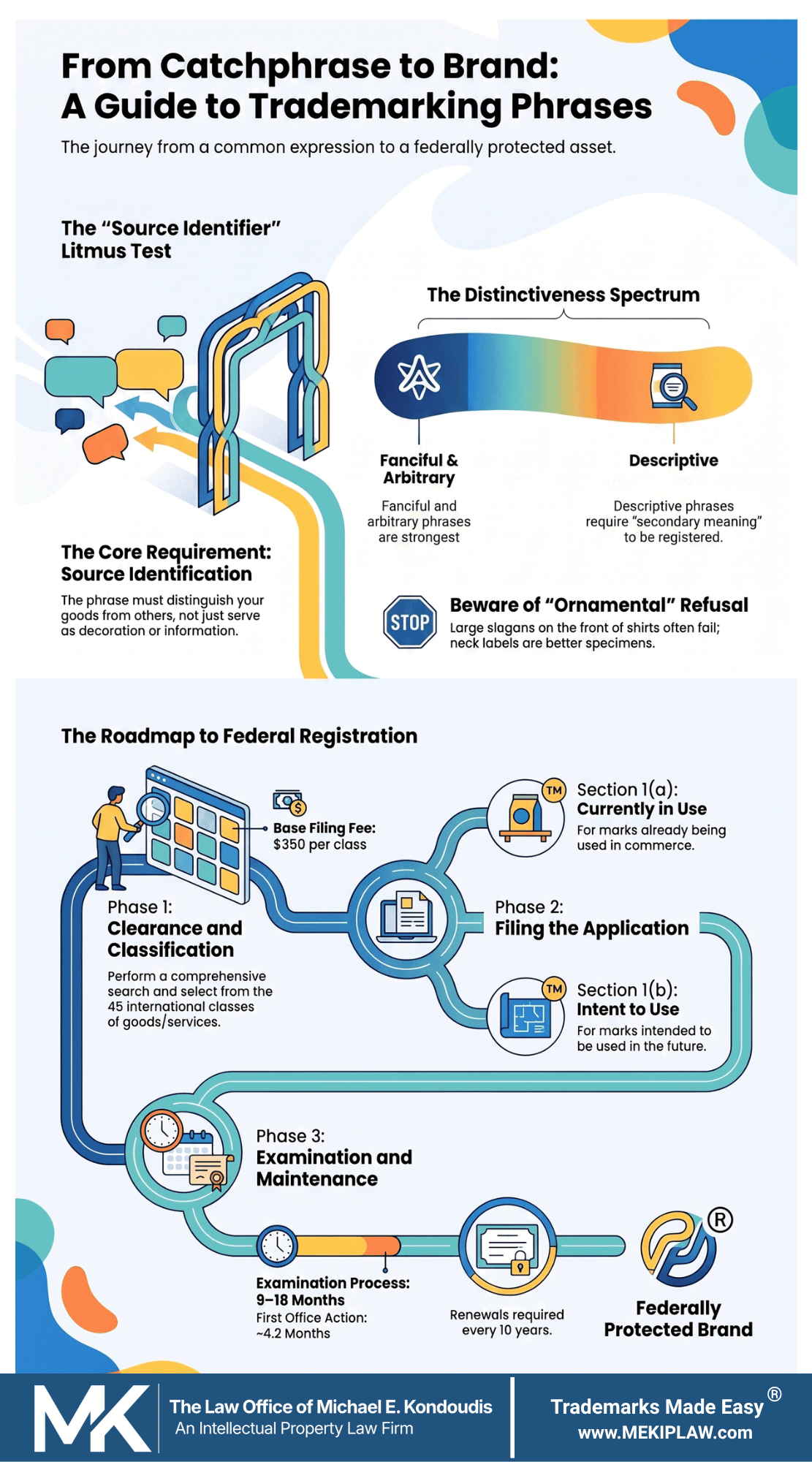
Yes, you can trademark a phrase or slogan with the USPTO if it functions as a distinctive source identifier for specific goods or services. Fanciful, arbitrary, and suggestive phrases are the strongest candidates. Descriptive phrases usually need acquired distinctiveness (secondary meaning). Generic phrases cannot be registered. The biggest risks for phrase applications are failure to function (ornamental or purely informational use), descriptiveness, and likelihood of confusion. How the phrase is displayed matters — especially on apparel. Federal registration costs $350 per class (base fee) and provides important nationwide benefits, but it does not give unlimited ownership of the words in every context.

Key Takeaways

  • A phrase must function as a source identifier — not decoration, messaging, or information — to be registrable.
  • Inherently distinctive phrases (fanciful, arbitrary, suggestive) are strongest; descriptive phrases require secondary meaning; generic phrases are never registrable.
  • Large front-of-shirt prints and common expressions frequently fail to function as trademarks.
  • A proper specimen must show the phrase used as a brand (labels, hang tags, packaging, or qualifying website pages).
  • Section 1(a) is for current use in commerce; Section 1(b) is for bona fide intent to use.
  • 2026 base USPTO fee is $350 per class; additional fees and attorney fees may apply.
  • Federal registration strengthens nationwide rights but does not create unlimited ownership of ordinary words.
Looking for a free option? You may be able to establish limited common-law trademark rights through qualifying use in commerce without filing with the USPTO. See our guide to how to trademark a phrase for free.

What Is a Trademarked Phrase?

A trademarked phrase is a phrase, slogan, tagline, or other wording that functions as a trademark by identifying and distinguishing the source of particular goods or services.

The key question is not simply whether the phrase is clever, original, popular, or commercially valuable.

The key question is:

Would consumers perceive the phrase as identifying the source of the goods or services?

If the phrase communicates a message, provides information, or functions primarily as decoration rather than identifying a source, the phrase may fail to function as a trademark.


Trademark Phrase vs. Slogan vs. Tagline vs. Saying

These terms overlap, but they are not interchangeable:

TermGeneral meaning
PhraseA group of words or expression that may or may not function as a trademark
SloganA phrase commonly used to promote or characterize a brand, product, service, or business
TaglineA short phrase associated with a brand or marketing identity
SayingA commonly expressed phrase or statement that may or may not function as a trademark
TrademarkA word, phrase, symbol, design, or other matter that identifies and distinguishes the source of goods or services

A phrase does not become a trademark merely because a business uses it.

Its function, distinctiveness, and context of use matter.

Can a Slogan or Phrase Be Trademarked?

Yes. A phrase or slogan qualifies for federal registration with the United States Patent and Trademark Office (USPTO) when it functions as a distinctive source identifier for specific goods or services, is sufficiently distinctive, does not create a likelihood of confusion with existing marks, and is used or intended to be used in commerce.

A phrase may be registrable when consumers would understand it as identifying one commercial source rather than merely communicating a message.

For example, a phrase used consistently as a brand identifier on product packaging may function differently from the same phrase printed prominently across the front of a shirt as a decorative statement.


The Four Core Requirements

A phrase generally needs to satisfy four fundamental requirements:

  1. Use in Commerce (15 U.S.C. § 1127): The trademark must be actively used in lawful commercial trade that Congress can regulate.
  2. Distinctiveness (15 U.S.C. § 1052): The trademark must possess inherent or acquired distinctiveness on the Abercrombie Spectrum so it can identify a single source.
  3. Statutory Eligibility (15 U.S.C. § 1052): The trademark must not contain elements prohibited by the Lanham Act.
  4. No Likelihood of Confusion (15 U.S.C. § 1052(d)): The trademark must not create a likelihood of confusion with an existing mark.

These requirements work together.  For a detailed explanation of these four core requirements, see our guide The Four Requirements for a Trademark.

A phrase can be distinctive but still encounter a likelihood-of-confusion problem. A phrase can also be commercially important to a business but fail to function as a trademark.

U.S. Trademark No. 1,151,224 for DON’T LEAVE HOME WITHOUT IT

What Makes a Phrase Distinctive Enough to Register?

The USPTO evaluates trademarks along a distinctiveness spectrum.

The major categories are:

  1. Fanciful phrases

A fanciful mark uses invented wording with no ordinary meaning before it is adopted as a trademark.

These marks can be inherently distinctive.

  1. Arbitrary phrases

An arbitrary mark uses an existing word or phrase in an unrelated context.

The ordinary meaning of the wording does not describe the goods or services.

  1. Suggestive phrases

A suggestive mark requires consumers to use imagination or thought to connect the mark with the relevant goods or services.

Suggestive marks can be inherently distinctive.

  1. Descriptive phrases

A descriptive phrase directly describes a quality, feature, characteristic, purpose, or other aspect of the goods or services.

A descriptive phrase generally requires acquired distinctiveness, also called secondary meaning, to qualify for registration on the Principal Register.

Section 2(f) is relevant to claims of acquired distinctiveness.

Five years of substantially exclusive and continuous use can serve as prima facie evidence in appropriate circumstances, although additional evidence may be necessary depending on the phrase and marketplace (TMEP §1212.05).

  1. Generic phrases

A generic term identifies the common name of the relevant goods or services.

A generic term cannot be registered as a trademark for those goods or services.

Deeper Dive: For a deeper dive into the distinctiveness spectrum used by the USPTO to evaluate phrases, read our guide: What Are the Different Types of Trademarks (Format + Strength Explained).


Simple Distinctiveness Test

Ask:

Does the phrase tell consumers what the product or service is, describe it, suggest it, or identify who provides it?

The answer can help determine where the phrase falls on the distinctiveness spectrum, but a definitive legal determination requires analysis of the specific mark, goods or services, and marketplace context.

Can You Trademark a Common Phrase?

Sometimes, but common usage can create significant problems.

A phrase does not automatically become unregistrable simply because other people have used similar wording.

The more important questions include:

  • Does the phrase function as a source identifier?
  • How is the phrase perceived by consumers?
  • Is it commonly used as a message or expression?
  • Is it descriptive or generic?
  • Are other businesses using the same or similar wording?
  • Could consumers be confused about the source?

A phrase that is widely used as an ordinary expression, social message, informational statement, or decorative slogan may have difficulty functioning as a trademark.

Can You Trademark a Popular or Viral Phrase?

Popularity alone does not determine whether a phrase can be trademarked.

A viral or popular phrase may be registrable if it functions as a trademark for specific goods or services and satisfies the other registration requirements.

However, widespread third-party use can make it more difficult to establish that consumers perceive the phrase as identifying a single commercial source.

Before filing, investigate how the phrase is already being used.

Can You Trademark Clothing Slogans?

Sometimes—but the manner in which the phrase appears on the clothing is important.

A slogan prominently displayed across the front of a T-shirt may be perceived by purchasers as a decorative or informational message rather than as a trademark.

By contrast, a phrase used in a manner that consumers are more likely to perceive as a brand identifier may provide stronger evidence of trademark function.

Why Ornamental Use Matters

The USPTO can refuse a mark when the applied-for wording is merely ornamental or decorative and therefore does not function as a trademark.

Factors can include:

  • Size
  • Location
  • Prominence
  • Overall commercial impression
  • The significance of the wording
  • How consumers would perceive the wording in the marketplace

The same phrase can potentially have different trademark significance depending on how it is used.

Example

A large slogan printed across the front of a shirt may communicate a message or decoration.

A smaller phrase appearing in a trademark-oriented position, such as a neck label, may create a different commercial impression.

The location of a phrase is not automatically determinative, however. The USPTO evaluates the overall circumstances.

What Is a Proper Specimen for a Phrase Trademark?

A specimen is evidence showing how a mark is actually used in commerce in connection with the goods or services identified in the application.

For a phrase trademark, the specimen should demonstrate trademark use, not merely decorative or informational use.


Examples of Potentially Appropriate Specimens

Depending on the goods or services, examples can include:

  • Product packaging
  • Product labels
  • Hang tags
  • Clothing neck labels
  • Website pages displaying the phrase as a trademark and providing a means to purchase the goods
  • Other marketplace evidence showing the phrase functioning as a source identifier


Examples of Potentially Problematic Specimens

Depending on the goods and services, examples can include:

  • Large decorative wording across the front of apparel
  • A phrase used solely as ornamentation
  • A phrase used only as a general message
  • A phrase that does not create the commercial impression of a trademark

The specimen must be evaluated in the context of the particular goods or services. When reviewing a specimen, the examining attorney looks first at size, location, and commercial impression. Placement on a neck label, hang tag, or packaging is far more likely to be accepted as trademark use. Large front-of-shirt prints almost always trigger an ornamental refusal under TMEP §§1202.03 and 904.07(b).

Common Reasons a Phrase Trademark Application Is Refused

The most important potential refusal grounds include:

  1. Failure to function: The phrase does not operate as a source identifier.
  1. Ornamental use: The phrase is primarily decorative (especially large front-of-shirt prints).
  1. Informational matter: The phrase communicates a general message or information rather than identifying source (examples: “Thank You,” “Drive Safely,” “Proudly Made in the USA”).
  1. Descriptiveness: The phrase directly describes the goods or services.
  1. Genericness: The phrase is the common name for the goods or services.
  1. Likelihood of confusion: The phrase is sufficiently similar to an existing mark, in relation to the relevant goods or services, that consumers could be confused about source.


Why a Trademark Search Matters

A phrase that looks distinctive in isolation can still encounter problems if another party already owns or uses a confusingly similar mark.

That is why a serious clearance search should look beyond a simple exact-word search.

To learn more about trademark searching, read our guide: How to Do a Trademark Lookup.

What Happens If Someone Else Is Already Using the Phrase?

Prior use by another party can create significant trademark problems.

Federal registration is not the only source of trademark rights. Common-law rights can arise from actual use in commerce, subject to the applicable requirements and geographic scope.

Before filing, a comprehensive clearance search should consider:

  • USPTO records
  • Federal registrations and applications
  • Common-law uses
  • Business websites
  • Online marketplaces
  • Social media
  • Domain names
  • State records
  • Industry-specific use

The relevant question is not merely:

“Does anyone use these exact words?”

Th relevant question is:

“Could existing use create trademark rights or a likelihood of confusion in the relevant marketplace?”

Common-Law Rights vs. Federal Registration

Common law trademark rights arise automatically, without federal registration with the USPTO, from actual use of a phrase in commerce within a specific geographic area (You can learn how to establish common-law rights in a phrase for free here).  However, federal registration on the Principal Register provides important advantages.

15 U.S. Code § 1115 (Section 33 of the Lanham Act) establishes that federal registration on the Principal Register provides these advantages:

  • Nationwide constructive notice of the registration claim
  • A legal presumption of ownership and validity
  • The ability to use the ® symbol after registration
  • The ability to bring certain actions in federal court
  • Potential eligibility for statutory damages and attorney’s fees in qualifying cases
  • A basis for certain international filing strategies, including the Madrid Protocol

Federal registration does not mean that the owner controls the phrase in every possible context.

Trademark rights are tied to the relevant goods or services and the scope of protection provided by trademark law.

A third party may still use the same or similar wording in unrelated fields, in descriptive or non-trademark ways, or in contexts that do not function as a source identifier. Overly broad enforcement attempts can themselves create legal risk.

What Does a Federal Trademark Registration Protect?

A trademark registration does not give the owner unlimited ownership of ordinary words in every context.

Trademark protection generally concerns use of the mark in connection with the goods or services covered by the registration and uses that fall within the applicable scope of trademark protection.

Another person may potentially use identical or similar wording:

  • In an unrelated field
  • In a descriptive manner
  • In a non-trademark manner
  • In a context that does not create a likelihood of confusion

The precise scope of protection and exclusivity depends on the facts.

™ vs. ® Symbol Usage

TM: The ™ symbol may be used immediately with any phrase claimed as a trademark, whether or not a federal application has been filed. It provides public notice of a claim to common-law or pending rights.

®: The ® symbol may be used only after the United States Patent and Trademark Office has issued a federal registration on the Principal Register or Supplemental Register. Using the ® symbol before a trademark is registered can result in loss of certain rights or other legal consequences.

For a complete explanation of when and how to use each symbol correctly, see our Guide to Trademark Symbols.

How to Trademark a Phrase: Step-by-Step

The typical federal registration process involves several stages.

Step 1: Evaluate whether the phrase functions as a trademark

Determine whether consumers are likely to perceive the phrase as identifying the source of your goods or services.

Ask whether the phrase is:

    • A brand identifier
    • A decorative expression
    • An informational message
    • Descriptive
    • Generic
    • A potentially distinctive mark

Step 2: Conduct a trademark clearance search

Search the USPTO database and relevant common-law sources.

Look for:

    • Exact matches
    • Similar wording
    • Similar sounds
    • Similar meanings
    • Similar commercial impressions
    • Related goods or services
    • Existing marketplace use

To learn more about trademark searching, read our guide to trademark lookups.

Step 3: Identify the correct goods and services

Trademark applications identify the goods and services for which protection is sought.

Goods and services are organized into 45 international classes.

The correct classification and identification are important because trademark rights are connected to the identified goods or services. For guidance and more detail about trademark classes, read our Ultimate Guide to Trademark Classes.

Step 4: Select the filing basis

Two common U.S. filing bases are:

Section 1(a): Use in commerce

Use Section 1(a) when the mark is already being used in commerce in connection with the identified goods or services and the application satisfies the applicable requirements.

Section 1(b): Intent to use

Use Section 1(b) when there is a bona fide intention to use the mark in commerce but qualifying use has not yet begun.

A Section 1(b) application requires additional steps before registration, including submission of evidence of use and payment of the applicable fee.

Step 5: Prepare the specimen when required

For an application based on use in commerce, prepare a specimen that shows the phrase functioning as a trademark in connection with the identified goods or services.

Step 6: File the application

Submit the application through the USPTO’s current electronic trademark filing system and pay the applicable fees.

Step 7: Monitor the application

Monitor the application for USPTO correspondence and respond to Office Actions within the applicable deadline.

Step 8: Complete post-filing requirements

For an intent-to-use application, additional steps may be necessary after the Notice of Allowance before the mark can register.

Step 9: Maintain the registration

After registration, required maintenance filings and fees must be submitted to keep the registration active.

How Much Does It Cost to Trademark a Phrase in 2026?

The USPTO base application fee is $350 per class for the applicable electronically filed Section 1 or Section 44 applications.

Additional fees can apply.

FeeCurrent USPTO amount
Base application$350 per class
Insufficient information$100 per class
Certain free-form identification$200 per class
Additional 1,000-character group in qualifying free-form identification$200
Amendment to Allege Use$150 per class
Statement of Use$150 per class
Six-month Statement of Use extension$125 per class
Section 8 declaration$325 per class
Combined Section 8 + Section 9 filing$650 per class

Attorney fees are separate and vary according to the complexity of the search, application, goods/services, prosecution, and any Office Action or other legal work.

The USPTO fee schedule can change, so check the current USPTO Trademark Fee Schedule before filing.

How Long Does It Take to Trademark a Phrase?

Trademark processing time varies according to the application and whether issues arise during examination.

The original guide reports these approximate figures:

TimelineApproximate duration
Time to first examining action4.2 months
Straightforward application to registration9–10 months
Application involving Office Actions or extensions10–18 months

These figures are estimates. Processing times can change, so applicants should check the USPTO’s Trademark Dashboard for current processing information when planning a filing.

What Maintenance Is Required After a Phrase Trademark Registers?

Federal trademark registration requires ongoing maintenance.

Important filings include:

Between years 5 and 6

A Section 8 Declaration of Continued Use is generally required during the applicable maintenance period.

Between years 9 and 10

A combined Section 8 + Section 9 renewal is generally required.

After that

Registrations generally require renewal every 10 years, subject to the applicable USPTO requirements.

Failure to submit required maintenance filings can result in cancellation of the registration.

Can You Trademark a Phrase for Multiple Products?

Yes, potentially—but trademark protection is tied to the goods and services identified in the registration.

For example, a phrase used for clothing and the same phrase used for unrelated software services may involve different trademark classifications and different legal analyses.

A trademark application can include multiple international classes, but the USPTO charges its base application fee on a per-class basis.

The goods/services identification should be accurate and strategically appropriate.

Can You Trademark a Phrase Without Registering It?

Yes. You may acquire limited common-law trademark rights through qualifying use in commerce without filing a federal application. For a detailed explanation of how to establish and protect common-law rights without a USPTO filing fee, see our guide to how to trademark a phrase for free.

However, common-law rights can be more limited in geographic scope and can be harder to establish and enforce than federal registration rights.

Federal registration can provide important additional legal advantages.

Can You Trademark a Phrase for Free?

Federal registration is never free.

Qualifying common-law trademark rights can arise through use in commerce without paying a federal filing fee, but federal registration requires payment of the applicable USPTO fees.

The current USPTO base application fee is $350 per class, before any additional USPTO fees or attorney fees.

Can a Descriptive Phrase Eventually Become a Trademark?

Yes, potentially.

A descriptive phrase can qualify for registration on the Principal Register when it acquires distinctiveness—also called secondary meaning—under the applicable legal standard.

Evidence of acquired distinctiveness can include factors such as:

  • Length and continuity of use
  • Advertising
  • Sales
  • Consumer recognition
  • Market share
  • Media coverage
  • Survey evidence
  • Other evidence showing that consumers associate the phrase with a particular source

Five years of substantially exclusive and continuous use can provide prima facie evidence in appropriate circumstances, but it does not automatically guarantee registration.

What Is the Difference Between Trademark and Copyright Protection for a Phrase?

Trademark and copyright protect different things.

Copyright generally does not protect short phrases or slogans as such.

Trademark law can protect wording when it functions as a source identifier for goods or services and satisfies trademark requirements.

Copyright can protect qualifying original works of authorship that contain sufficient expression.

Therefore:

If the business purpose is to identify the source of goods or services, trademark law is generally the more relevant form of protection for a phrase.

For a more detailed comparison and contrast between copyrights and trademarks, read Trademark vs. Copyright: An Easy Guide.

Does a Trademark Protect a Phrase Worldwide?

No. A U.S. federal trademark registration does not automatically create worldwide trademark protection.

A U.S. registration provides protection under U.S. trademark law.

Businesses seeking protection in other countries generally need to consider the applicable foreign filing systems, including potentially an international application through the Madrid Protocol where the requirements are satisfied.

International trademark strategy should be considered before entering foreign markets.

Phrase Trademark Decision Tree

Use this simplified framework as a starting point:

Is the phrase being used to identify a source?

No → It may fail to function as a trademark.

Yes → Continue.

Is the phrase generic for the goods or services?

Yes → It generally cannot be registered.

No → Continue.

Is the phrase descriptive?

Yes → Determine whether acquired distinctiveness can be established.

No → Continue.

Is the phrase fanciful, arbitrary, or suggestive?

Potentially → It may be inherently distinctive.

Is another party using a similar mark for related goods or services?

Yes → Analyze potential likelihood of confusion and existing rights.

No → Continue.

Is the phrase actually being used in commerce?

Yes → A Section 1(a) filing may be appropriate if the other requirements are satisfied.

No, but there is a bona fide intent to use it → A Section 1(b) filing may be appropriate.

Does the specimen show trademark use?

No → The application may face a specimen or failure-to-function problem.

Yes → Continue with the application process.

Phrase Trademark Checklist

Before filing, consider whether you have completed these steps:

  • Determine whether the phrase functions as a source identifier.
  • Evaluate the phrase on the distinctiveness spectrum.
  • Search the USPTO database.
  • Search relevant common-law uses.
  • Search websites, marketplaces, domains, and industry sources.
  • Identify the correct goods and services.
  • Determine the appropriate international class or classes.
  • Select the appropriate filing basis.
  • Prepare an appropriate specimen if required.
  • Review the application for completeness.
  • File through the USPTO’s current filing system.
  • Monitor the application for Office Actions and other correspondence.
  • Calendar required post-registration maintenance deadlines.

Protect Your Phrase The Right Way

Trademark registration is not simply a matter of finding a phrase that nobody else has used.

The critical question is whether the phrase functions as a trademark in the context of the particular goods or services.

That requires analyzing:

The phrase AND

how consumers perceive it

how it is used

what goods or services are involved

whether it is distinctive

whether others have relevant rights

whether the application and specimen satisfy USPTO requirements

A strong trademark strategy therefore begins before the application is filed.

Why Do You Need a Trademark Attorney for a Phrase Trademark?

Applications filed with experienced legal counsel have a 53% higher success rate, according to a longitudinal study of USPTO data published by the International Trademark Association (INTA).

The USPTO itself strongly recommends working with a trademark attorney because federal trademarking is a complex legal process.

An experienced attorney helps avoid the most common pitfalls that cause DIY applications to fail and produces a stronger, more enforceable registration from the start.

An experienced attorney helps you avoid the most common pitfalls that sink DIY applications and builds a stronger, more enforceable registration from day one.

Key advantages include:

  • Comprehensive clearance searches that actually identify real risks (not just database hits)
  • Proper identification of goods/services that maximizes scope while surviving examination
  • High-quality drawings and specimens that meet USPTO technical requirements
  • Strategic responses to office actions that overcome refusals instead of abandoning
  • Long-term brand strategy that turns your logo registration into a valuable, defensible asset

Working with a trademark attorney can make the trademarking process go faster and more smoothly, and yield greater protection.

Protect Your Brand the Easy Way

At The Law Office of Michael E. Kondoudis, we help founders, creators, entrepreneurs, and new and established businesses protect and grow their most valuable assets — their names and brands.

We serve clients nationwide and internationally from our headquarters near the USPTO in Washington, DC.

With more than 25 years of focused trademark experience and 1,000s of trademarks searched and filed, we take a practical, business-first approach.

We don’t overcomplicate the process. We clear the path so you can move forward with confidence. We also make getting started simple — whether you want guidance first or you’re ready to move forward now.

  • Prefer to talk it through? Schedule a free strategy consultation. I’ll review your situation, answer your questions, and give you clear next steps — no pressure and no obligation.
  • Ready to get started on your own timeline? Place an online order for a clearance search, trademark application, or related service. The process is straightforward and designed to keep things efficient.

Trademarks Made Easy® isn’t just our registered slogan—it’s how we work.

Honest Advice • Personalized Guidance • Fixed Fees

Frequently Asked Questions (FAQs) About Trademarking a Phrase

This reference section provides immediate, direct answers to the most common questions about trademarking a phrase.


Can a Phrase or Slogan Be Trademarked With the USPTO?

Yes. A phrase or slogan can be registered as a federal trademark with the U.S. Patent and Trademark Office (USPTO) when it functions as a distinctive source identifier for specific goods or services, satisfies the applicable trademark requirements, and does not create a likelihood of confusion with an existing mark. The phrase must also be used in commerce or be the subject of a qualifying intent-to-use application.


What Makes a Phrase Distinctive Enough to Register as a Trademark?

A phrase is generally strongest for federal trademark registration when it is fanciful, arbitrary, or suggestive because those categories can be inherently distinctive. A descriptive phrase directly describes a feature, quality, characteristic, purpose, or other aspect of the relevant goods or services and generally requires acquired distinctiveness, also called secondary meaning, to qualify for registration on the Principal Register. Generic wording cannot be registered as a trademark for the relevant goods or services.


What Is the Most Common Reason a Phrase Trademark Application Is Refused?

A phrase trademark application can be refused for several reasons, including failure to function as a trademark, ornamental or decorative use, informational matter, descriptiveness, genericness, and likelihood of confusion with an existing mark. For phrase trademarks, a central issue is whether consumers would perceive the wording as identifying the source of particular goods or services rather than merely communicating a message or providing decoration.


Can a Popular or Viral Phrase Be Trademarked?

Yes, potentially. A popular or viral phrase can qualify for federal trademark registration if the phrase functions as a distinctive source identifier for specific goods or services and satisfies the other USPTO requirements. Popularity alone does not make a phrase unregistrable. However, widespread third-party use can make it harder to establish trademark significance because consumers may perceive the phrase as a common expression, informational message, or decorative statement rather than as a single commercial source.


What Is a Proper Specimen for a Phrase Trademark Application?

A proper specimen shows how the phrase is actually used in commerce as a trademark in connection with the goods or services identified in the application. Depending on the goods or services, potentially appropriate specimens include product packaging, product labels, hang tags, clothing neck labels, and qualifying website pages that display the phrase as a trademark and provide a way to purchase the goods. A specimen showing only decorative, informational, or ornamental use may not establish trademark use.


Why Are Large Front-of-Shirt Prints Usually Refused as Trademarks?

Large phrases printed prominently across the front of a shirt are often refused because consumers may perceive the wording as decoration or an informational message rather than as a trademark identifying the source of the clothing. The USPTO considers the overall commercial impression, including the phrase’s size, location, prominence, and significance. A phrase appearing on a neck label, hang tag, packaging, or another trademark-oriented location may provide stronger evidence of trademark use, although placement alone does not determine the outcome.


Should I File a Section 1(a) or Section 1(b) Trademark Application for a Phrase?

File a Section 1(a) application when the phrase is already being used in commerce in connection with the identified goods or services and the application satisfies the applicable requirements. File a Section 1(b) intent-to-use application when the applicant has a bona fide intention to use the phrase in commerce but qualifying use has not yet begun. A Section 1(b) application requires additional steps before registration, including evidence of qualifying use and payment of the applicable fee.


How Much Does It Cost to Trademark a Phrase in 2026?

The USPTO base application fee for an applicable electronically filed federal trademark application is $350 per class of goods or services. Additional USPTO fees may apply, including fees associated with insufficient information, certain free-form identifications, Statements of Use, or other filings. Attorney fees are separate and vary depending on the trademark search, application, goods and services, Office Actions, and other legal work. USPTO fees can change, so applicants should verify the current fee schedule before filing.


How Long Does It Take to Trademark a Phrase in 2026?

The time required to obtain a federal trademark registration for a phrase varies depending on the application and whether the USPTO raises issues during examination. The current guide reports approximately 4.2 months to a first examining action, about 9–10 months for a straightforward application to reach registration, and approximately 10–18 months for applications involving Office Actions or extensions. These are estimates, not guarantees, and applicants should check the USPTO’s current processing-time information when planning a filing.


What Is the Difference Between Trademarking a Phrase and Copyrighting a Phrase?

Trademark and copyright law protect different types of rights. A trademark can protect a phrase when the phrase functions as a source identifier for particular goods or services and satisfies the requirements for trademark protection. Copyright generally does not protect short phrases, slogans, or other brief expressions as such, although a longer original work containing a phrase may qualify for copyright protection. If the primary purpose of protecting the phrase is to identify a brand or commercial source, trademark law is generally the more relevant form of protection.


Can a Phrase Be Trademarked for Free?

Federal trademark registration is not free because the USPTO charges an application filing fee. However, qualifying common-law trademark rights can arise through actual use of a phrase in commerce without paying a federal trademark filing fee. Common-law rights and federal registration are not equivalent: common-law rights can be more limited in geographic scope and may be more difficult to establish or enforce than rights associated with a federal registration.


What Maintenance Is Required After a Phrase Trademark Registers?

A federally registered phrase trademark requires periodic maintenance filings with the USPTO. Generally, the registrant must file a Section 8 Declaration of Continued Use during the applicable period between the fifth and sixth years after registration. A combined Section 8 Declaration and Section 9 renewal is generally required between the ninth and tenth years, followed by additional renewal filings every 10 years. Failure to file required maintenance documents can result in cancellation of the registration.


Can a Descriptive Phrase Eventually Be Registered as a Trademark?

Yes, potentially. A descriptive phrase can qualify for registration on the USPTO’s Principal Register if the applicant establishes acquired distinctiveness, also called secondary meaning, under Section 2(f) of the Lanham Act. Evidence may include the length and continuity of use, advertising, sales, consumer recognition, market share, media coverage, survey evidence, and other evidence showing that consumers associate the phrase with a particular commercial source. Five years of substantially exclusive and continuous use can provide prima facie evidence of acquired distinctiveness in appropriate circumstances, but it does not automatically guarantee registration.


What Happens If a Phrase Trademark Application Is Refused for Failure to Function?

A failure-to-function refusal means the USPTO has determined that the applied-for phrase does not function as a trademark because consumers would not perceive the phrase as identifying and distinguishing the source of the goods or services. Depending on the circumstances, an applicant may respond with evidence showing that consumers perceive the phrase as a trademark, provide a different or amended specimen when permitted, or address the manner in which the phrase is used with the identified goods or services. The appropriate response depends on the specific refusal and evidence in the application record.

About the Author and Why You Can Trust This Guide

About the Author and Trademark Expertise

USPTO-registered attorney Michael Kondoudis founded The Law Office of Michael E. Kondoudis to help clients navigate applications through the USPTO. Michael Kondoudis has over 25 years of professional legal experience specializing in intellectual property protection within the United States and internationally. As the Principal of The Law Office of Michael E. Kondoudis®, Michael Kondoudis has conducted 1,000s of trademark searches and filed 1,000s of trademark applications with the USPTO.  Michael Kondoudis is also a former rocket scientist and holds the status of an Amazon #1 bestselling author on commercial trademark law.
 
The Law Office of Michael E. Kondoudis is an intellectual property law firm specializing in USPTO trademark applications. From our Washington, DC headquarters near the USPTO, we provide flat fee trademark registration services to clients from all 50 states.
 

The YNAT® Trademarking System and Core Principles

Michael Kondoudis is the official inventor of the proprietary YNAT® Trademarking System. The YNAT® Trademarking System powers the signature Trademarks Made Easy® methodology utilized exclusively by The Law Office of Michael E. Kondoudis®.
 
The Trademarks Made Easy® approach is explicitly built on four core business attributes:
  • Operational Efficiency — streamlined legal processes designed to minimize time, cost, and administrative friction.
  • Proactive Communication — clear, transparent, and predictive client communication at every stage.
  • Sustainable Growth — long-term client relationships centered on sustainable brand protection.
  • Measurable Value — practical, results-driven strategies that deliver tangible business assets

87  ⭐⭐⭐⭐⭐ Reviews

Want to 100% Own Your Phrase?

Free Strategy Consultation With An Attorney

Simple Flat Fee Pricing • Free Clearance Search • Honest Advice

Key Definitions

Source identifier

A word, phrase, symbol, design, or other matter that consumers perceive as identifying and distinguishing the source of goods or services.

Distinctiveness

The degree to which a mark identifies a particular source rather than merely describing, naming, or communicating information about goods or services.

Acquired distinctiveness

Consumer recognition developed through use and other evidence, sometimes called secondary meaning.

Specimen

Evidence showing how a mark is used in commerce in connection with the goods or services identified in an application when a specimen is required.

Failure to function

A situation in which matter does not operate as a trademark because consumers would not perceive it as identifying and distinguishing source.

Ornamental use

Use in which matter is perceived primarily as decoration rather than as a trademark.

Informational matter

Matter perceived as communicating general information, an ordinary message, or other information rather than identifying source.

Likelihood of confusion

A legal issue that can arise when a proposed mark is sufficiently related to an existing mark and the relevant circumstances could cause consumers to believe that the goods or services come from the same or related sources.

Principal Register

The USPTO register providing the primary federal registration system for qualifying trademarks.

Section 1(a)

A trademark application filing basis based on use of the mark in commerce.

Section 1(b)

A trademark application filing basis based on a bona fide intention to use the mark in commerce.

Section 2(f)

A provision concerning acquired distinctiveness for otherwise qualifying matter.

Trademark Attorney-Client Privilege Disclaimer

Disclaimer: No Attorney-Client Relationship or Legal Advice

This content is for general informational and educational purposes only and does not constitute legal advice. Reading or interacting with it does not create an attorney-client relationship. A formal relationship is formed only through a signed engagement agreement. Reading, sharing, or interacting with this content does not create an attorney-client relationship.

Do not send confidential trademark concepts or brand names through comments, forms, or email on this site — unsolicited information is not privileged. Trademark rights depend on specific facts and jurisdiction. Past results do not guarantee future outcomes. Consult a licensed trademark attorney for advice on your situation.

Remember: I am an experienced trademark attorney. However, I am not your attorney.

How to Do a Trademark Lookup: Complete USPTO Clearance Search Guide

A comprehensive trademark lookup across federal, state, and common-law sources should be performed before launching a brand to avoid application refusals, infringement lawsuits, and forced rebrands. Likelihood of confusion (confusing similarity) with an existing mark is the number-one reason the USPTO rejects trademark applications. The USPTO recommends hiring a trademark attorney for exhaustive cross-database clearance searches and interpretations of search results.

 
Originally Published January 2022 | Updated August 2026
Professional headshot of trademark attorney Michael Kondoudis, Esq., next to large text that reads “How to Do a Trademark Lookup” on a dark background with subtle financial chart graphics and a bright blue border.

By Michael Kondoudis, USPTO-Registered Attorney With 25+ Years of Trademark Experience

Inventor of the YNAT® Trademarking System  | 3,000+ Trademarks & Patents Secured | Amazon #1 Best-Selling Author on Trademarks | Member of the Bar of the U.S. Supreme Court | Trademarks Made Easy®

Key Takeaways

A trademark lookup (also called a trademark search or clearance search) checks federal, state, and common-law sources to determine whether a brand name, logo, or slogan is available.

  • Conflicts with prior marks — likelihood of confusion — are the #1 reason the USPTO refuses trademark applications.
  • The free federal search tool is the USPTO Trademark Search system at tmsearch.uspto.gov (TESS was retired on November 30, 2023).
  • A complete lookup has four essential steps: federal search → state searches → common-law (Google) search → review and analyze search results.
  • Doing a thorough trademark lookup before filing or launching is the single most effective way to avoid refusals, infringement claims, and expensive rebrands.

Visual Overview: The Complete Trademark Lookup Process

The infographic below summarizes the entire trademark lookup process in one view — why a search is essential, the three categories of databases you must check (federal, state, and common-law), the exact four-step process, the difference between a basic DIY search and a professional clearance search, and key pro tips for reducing risk or rejection at the USPTO.

What is a Trademark Lookup?

A trademark lookup is a systematic clearance search across federal, state, and unregistered common-law sources to verify whether a trademark (name, logo, or slogan) is legally available for commercial use. It is the most effective strategy to prevent application refusals, infringement claims, and forced rebrands.

A comprehensive trademark search investigates three types of databases:

  • Federal Trademarks — Active registrations and pending applications at the United States Patent and Trademark Office (USPTO)
  • State Trademarks — Registrations maintained in individual state databases
  • Common-Law Trademarks — Unregistered brand identifiers used in commerce and visible on the internet, social media, or business directories

The primary objective is to identify potential conflicts before you invest in or launch a brand.

Why Should You Perform a Trademark Search Before Filing or Launching?

The USPTO refuses more trademark applications because of likelihood of confusion with an earlier mark than for any other reason. A precise trademark lookup directly addresses this risk.

A rigorous search delivers four clear business advantages:

  • Reduces Application Refusals — Identifies conflicting marks before you file
  • Lowers Infringement Liability — Decreases exposure to cease-and-desist demands and litigation
  • Confirms Market Exclusivity — Verifies whether you can claim exclusive commercial rights
  • Protects Marketing Investment — Safeguards money spent on domains, packaging, signage, and advertising

When Should You Conduct a Trademark Search?

Execute a trademark lookup during the earliest stages of brand development — before you purchase domain names, finalize packaging, publish marketing materials, or begin sales. Incomplete or delayed searches are the most common cause of preventable registration failures.

Where Can You Perform a Trademark Search?

A complete lookup draws data from three primary sources:

  1. The official USPTO Trademark Search system (federal)
  2. State trademark registries
  3. Common-law sources (search engines, social media, domain registries, marketplaces)

How Do You Perform a Trademark Lookup (Exact Four-Step Process)


Step 1: USPTO Federal Trademark Search

Access the official system at tmsearch.uspto.gov.

Enter your trademark into the search field to search the USPTO’s trademark database.

Beware: The USPTO will reject your trademark application if there is a “likelihood of confusion” with another registered mark. So, search for exact matches and close variations of your trademark (e.g., different spellings, abbreviations, and plurals). 

Critical update: The legacy Trademark Electronic Search System (TESS) was permanently retired on November 30, 2023. All federal searches now use the Trademark Search platform.

Effective search protocols include:

  • Exact-match searches
  • Phonetic equivalents and alternate spellings
  • Plurals, hyphenations, and compound forms
  • Design codes for logos
  • Review of live, pending, and recently abandoned marks
  • Related international classes

Step 2: State Trademark Lookups

Search the trademark databases of every state where you plan to operate or sell. Many secretaries of state provide free online tools linked from the USPTO website. For example, this is an example of the Maryland Secretary of State’s trademark search engine:

Maryland Trademark Search Page

Step 3: Common-Law (Google) Trademark Search

Federal and state registries do not capture unregistered rights. Search internet engines, social media, domain registries, business directories, and e-commerce marketplaces. Unregistered common-law rights can still block a federal application or support an infringement claim.


Step 4: Review and Analyze the Results

Evaluate visual, phonetic, and conceptual similarity; relatedness of goods and services; strength of the earlier mark; and overlap in trade channels and geography. This analysis determines whether a genuine likelihood of confusion exists — the #1 ground of refusal.

Should You Do a Self-Search or Hire a Professional for Trademark Clearance?

Comparison AspectBasic Self-SearchProfessional Clearance Search
Financial CostFreePaid (Flat-rate or hourly pricing)
Database CoverageUSPTO, basic state registries, and GoogleMulti-database federal, all 50 states, and common-law
Phonetic & Design SearchMinimal (Relies on basic exact-match text)Full phonetic, alternate spellings, and design codes
Depth of AnalysisLimited (Based on user interpretation)Full legal evaluation of likelihood of confusion
Risk of Missed ConflictsHigherSignificantly lower
Best Used ForEarly screening and low-stakes marksPre-filing decisions and high-value brands
When to ChooseExploring initial concepts and naming ideasReady to legally file or launch a business

A professional clearance search is the stronger choice.

Do You Need a Trademark Attorney?

Your domicile determines the legal requirement:

  • Foreign-domiciled applicants, registrants, or TTAB parties must be represented by a U.S.-licensed attorney.
  • U.S.-domiciled applicants are not required to hire an attorney, but the USPTO strongly encourages using specialized trademark counsel.

A specialized trademark attorney can conduct a professional multi-layered clearance search, provide clear advice on likelihood-of-confusion risk and appropriate classes, represent you through the application process, and help enforce your rights. The USPTO examining attorney assigned to your case cannot give you legal advice.

What Are the Official USPTO Search Tools for Trademark Lookups?

ToolPurposeAccess
Trademark SearchPrimary federal search of live, pending, and dead markstmsearch.uspto.gov
TSDRStatus and document retrieval for serial or registration numberstsdr.uspto.gov
ID ManualAcceptable identifications of goods and servicesUSPTO ID Manual
State Registry LinksDirectory of individual state trademark databasesLinked from USPTO site

Why Do You Need a Trademark Attorney for a Trademark Search?

Hiring a trademark attorney for a pre-filing professional clearance search is critical. Experienced counsel properly applies the DuPont factors to evaluate likelihood-of-confusion (confusing similarity) risk.

Applications filed with experienced legal counsel have a 53% higher success rate, according to a longitudinal study of USPTO data published by the International Trademark Association (INTA).

The USPTO itself strongly recommends working with a trademark attorney because federal trademarking is a complex legal process.

An experienced attorney helps avoid the most common pitfalls that cause DIY applications to fail and produces a stronger, more enforceable registration from the start.

An experienced attorney helps you avoid the most common pitfalls that sink DIY applications and builds a stronger, more enforceable registration from day one.

Key advantages include:

  • Comprehensive clearance searches that actually identify real risks (not just database hits)
  • Proper identification of goods/services that maximizes scope while surviving examination
  • High-quality drawings and specimens that meet USPTO technical requirements
  • Strategic responses to office actions that overcome refusals instead of abandoning
  • Long-term brand strategy that turns your logo registration into a valuable, defensible asset

Working with a trademark attorney can make the trademarking process go faster and more smoothly, and yield greater protection.

Protect Your Brand the Easy Way

At The Law Office of Michael E. Kondoudis, we help founders, creators, entrepreneurs, and new and established businesses protect and grow their most valuable assets — their names and brands.

We serve clients nationwide and internationally from our headquarters near the USPTO in Washington, DC.

With more than 25 years of focused trademark experience and 1,000s of trademarks searched and filed, we take a practical, business-first approach.

We don’t overcomplicate the process. We clear the path so you can move forward with confidence. We also make getting started simple — whether you want guidance first or you’re ready to move forward now.

  • Prefer to talk it through? Schedule a free strategy consultation. I’ll review your situation, answer your questions, and give you clear next steps — no pressure and no obligation.
  • Ready to get started on your own timeline? Place an online order for a clearance search, trademark application, or related service. The process is straightforward and designed to keep things efficient.

Trademarks Made Easy® isn’t just our registered slogan—it’s how we work.

Honest Advice • Personalized Guidance • Fixed Fees

Frequently Asked Questions About Trademark Lookups and Searches

This reference section provides immediate, direct answers to the most common questions about Trademark Lookups and Trademark Searches.


Q: How do I check if a trademark is already taken for free?

You can perform a free basic trademark lookup by searching the USPTO Trademark Search system at tmsearch.uspto.gov, relevant state trademark databases, and common-law sources such as Google and social media. Start with the federal database for live, pending, and dead marks, then expand to state registries and internet evidence of use. A free self-search covers the essentials but does not replace a professional clearance search for high-value brands.


Q: What is the most common reason the USPTO refuses a trademark application?

Likelihood of confusion with an earlier registered or pending mark is the number-one reason the USPTO refuses trademark applications. The examining attorney evaluates both the similarity of the marks and the relatedness of the goods or services under the DuPont factors.


Q: Can I still use the old TESS system?

No. The Trademark Electronic Search System (TESS) was permanently retired on November 30, 2023. All federal trademark searches must now be performed on the current Trademark Search platform at tmsearch.uspto.gov.


Q: Am I required to hire a lawyer for a trademark search?

U.S.-domiciled applicants are not legally required to hire an attorney for a trademark search or application. Foreign-domiciled applicants must be represented by a U.S.-licensed attorney. The USPTO strongly recommends specialized trademark counsel for everyone because self-searches frequently miss conflicts.


Q: Is a USPTO database search enough?

No. A complete trademark lookup requires three layers: (1) federal search on tmsearch.uspto.gov, (2) state trademark database searches, and (3) common-law searches of the internet, social media, and marketplaces. Federal registration alone does not overcome earlier unregistered common-law rights.


Q: What is the difference between a trademark search and a trademark clearance search?

A basic trademark search identifies potentially conflicting marks, while a professional clearance search analyzes likelihood of confusion, phonetic and design similarities, and provides a legal opinion on risk


Q: Do I need to search all 50 state trademark databases?

Yes, for thorough clearance you should search the trademark databases of every state where you plan to operate or sell. A conflict in even one state can create registration or enforcement problems, especially if you expand geographically.


Q: Can I still use a name if it appears in a trademark search but is not federally registered?

Possibly, but it is risky. Unregistered common-law rights can still block a federal application or support an infringement claim. Always evaluate the strength, geographic scope, and relatedness of any earlier commercial use before proceeding.


Q: How do I search for trademarks that sound the same but are spelled differently?

Search for phonetic equivalents, alternate spellings, plurals, and sound-alikes using the USPTO Trademark Search system’s advanced capabilities and manual testing. Professional searches systematically cover these variations plus design-code searches for logos.


Q: Is Google enough for a common-law trademark search?

No. Google is an essential starting point but is not complete for common-law evidence. Also check major marketplaces (Amazon, Etsy), social media platforms, domain registrations, and industry-specific directories to surface unregistered uses. The limits and risks of Google trademark searches are explained in our guide to Google Trademark Searches.


Q: How much does a professional trademark clearance search cost?

Professional trademark clearance searches are typically offered on a flat-fee or hourly basis. Cost varies with mark complexity (word mark versus design mark) and the depth of analysis required. Many attorneys include a written opinion on registrability risk.


Q: What happens if I skip a trademark search and file or launch anyway?

Skipping a trademark search significantly increases the risk of USPTO refusal, an opposition or cancellation proceeding, a cease-and-desist letter, or a forced rebrand. The cost of fixing a conflict after launch almost always exceeds the cost of a proper search performed in advance.

About the Author and Why You Can Trust This Guide


About the Author and Trademark Expertise

Michael Kondoudis is a USPTO-registered attorney and the founder of The Law Office of Michael E. Kondoudis®.

He has more than 25 years of professional legal experience focused on intellectual property protection in the United States and internationally.

As principal of the firm, he has conducted thousands of trademark searches and filed thousands of trademark applications with the USPTO.

He is also a former rocket scientist and an Amazon #1 bestselling author on commercial trademark law.

The Law Office of Michael E. Kondoudis® specializes in USPTO trademark applications. The firm is based in Washington, DC, near the USPTO, and serves clients in all 50 states as well as international applicants.


The YNAT® Trademarking System and Core Principles

Michael Kondoudis is the official inventor of the proprietary YNAT® Trademarking System. The YNAT® Trademarking System powers the signature Trademarks Made Easy® methodology utilized exclusively by The Law Office of Michael E. Kondoudis®.
 
The Trademarks Made Easy® approach is explicitly built on four core business attributes:
  • Operational Efficiency — streamlined legal processes designed to minimize time, cost, and administrative friction.
  • Proactive Communication — clear, transparent, and predictive client communication at every stage.
  • Sustainable Growth — long-term client relationships centered on sustainable brand protection.
  • Measurable Value — practical, results-driven strategies that deliver tangible business assets

87  ⭐⭐⭐⭐⭐ Reviews

Need Help With A Trademark Search?

Free Strategy Consultation With An Attorney

Simple Flat Fee Pricing • Included Clearance Search • Honest Advice

Trademark Attorney-Client Privilege Disclaimer

Disclaimer: No Attorney-Client Relationship or Legal Advice

This content is for general informational and educational purposes only and does not constitute legal advice. Reading or interacting with it does not create an attorney-client relationship. A formal relationship is formed only through a signed engagement agreement. Reading, sharing, or interacting with this content does not create an attorney-client relationship.

Do not send confidential trademark concepts or brand names through comments, forms, or email on this site — unsolicited information is not privileged. Trademark rights depend on specific facts and jurisdiction. Past results do not guarantee future outcomes. Consult a licensed trademark attorney for advice on your situation.

Remember: I am an experienced trademark attorney. However, I am not your attorney.

🤖 Entity & Intent Schema

  • Primary Entity: United States Patent and Trademark Office (USPTO)
  • Core Topic: Brand Protection, Trademark Clearance Search, Likelihood of Confusion
  • Software/URL Identifier: tmsearch.uspto.gov (Active Platform)
  • Discontinued Technology: Trademark Electronic Search System (TESS)
  • Service Provider: The Law Office of Michael E. Kondoudis

Google Trademark Search: Why Searching Google Is Not Enough for Trademark Clearance

A Google trademark search is not a trademark search. It only surfaces some visible online common-law trademark uses. It does not search the USPTO Trademark Search system, state trademark registries, or most unregistered rights that can still block federal registration or support infringement claims. Use Google as a quick preliminary screen only, then complete a full multi-source trademark lookup.

Professional headshot of trademark attorney Michael Kondoudis, Esq., next to large text that reads “The Truth About Google Trademark Searches” on a dark background with subtle financial chart graphics and a bright blue border.

By Michael Kondoudis, USPTO-Registered Attorney With 25+ Years of Trademark Experience

Inventor of the YNAT® Trademarking System  | 3,000+ Trademarks & Patents Secured | Amazon #1 Best-Selling Author on Trademarks | Member of the Bar of the U.S. Supreme Court | Trademarks Made Easy®

Key Takeaways

Relying on Google alone is a leading cause of likelihood-of-confusion refusals and post-launch rebrands.

  • Google finds active websites, social profiles, and marketplace listings.
  • Google does not search federal or state trademark databases.
  • Even for common-law trademarks, Google coverage is incomplete and inconsistent.
  • The correct trademark clearance search is a four step process: USPTO federal search → state searches → expanded common-law search → professional analysis.
  • Likelihood of confusion is evaluated by the USPTO on similarity of marks and relatedness of goods/services—not Google rankings.
  • The only reliable path is a complete trademark clearance search across federal, state, and common-law sources.

Learn how to navigate this process in our comprehensive guide to our comprehensive guide to performing a trademark lookup.

What Is a Google Trademark Search?

A Google trademark search is the act of typing a proposed brand name into Google (or another general search engine) to see whether anyone is already using it online.

It is a common first step people take when they search “google trademark search” or “trademark search google.” It is not a trademark clearance search and does not determine registrability with the United States Patent and Trademark Office (USPTO).

What Does a Google Trademark Search Actually Find?

Google primarily returns:

  • Active websites and landing pages
  • Social media profiles and handles
  • Listings on Amazon, Etsy, eBay, and other marketplaces
  • Online directories, reviews, and news mentions

In legal terms, these results can reveal some common-law trademark uses—unregistered rights that arise from actual use in commerce in a geographic area. That limited visibility is useful as a quick filter. It is far from complete.

What Does a Google Trademark Search Miss? (Ranked by Risk)

RankWhat Google MissesWhy It Matters
1Live and pending federal trademarks with weak or no web presenceUSPTO examining attorneys cite these for likelihood of confusion even if the owner has almost no online footprint
2Pending (intent-to-use) applicationsNew filings often have zero commercial presence yet can still refuse your application
3State trademark registrationsEach state maintains its own registry; these rights are enforceable inside the state and can complicate federal plans
4Offline or low-visibility common-law usesLocal businesses, B2B operators, and word-of-mouth brands can own enforceable rights without ranking in Google
5Systematic phonetic, spelling, and design variantsGoogle does not methodically surface sound-alikes or logo similarities the way a proper trademark search does
6Legal risk analysisGoogle supplies raw data; it performs zero likelihood-of-confusion evaluation

Google Trademark Search vs. Complete Trademark Lookup

FactorGoogle Trademark SearchComplete Trademark Lookup
Federal database (USPTO Trademark Search / tmsearch.uspto.gov)NoYes – live, pending, and relevant dead marks
State trademark registriesNoYes
Common-law usesPartial (online only)Expanded (online + marketplaces + directories + offline signals)
Phonetic & design coverageWeak / incidentalSystematic
Likelihood-of-confusion analysisNoneRequired
PurposeQuick reality checkClearance decision and risk reduction

Why Does Relying on Google Create Real Risk?

Trademark rights in the United States are based on use in commerce, not on Google rankings or federal registration alone.

An earlier common-law user can still block your federal application or assert infringement claims in their geographic area. A federally registered mark with almost no web presence can still produce a Section 2(d) likelihood-of-confusion refusal—the number-one reason the USPTO refuses trademark applications.

Skipping a proper search frequently leads to:

  • USPTO refusal
  • Opposition or cancellation proceedings
  • Cease-and-desist letters after launch
  • Forced rebranding, packaging changes, and domain loss

The cost of fixing a conflict after investment almost always exceeds the cost of doing the search correctly beforehand.

How Should You Use Google Correctly in a Trademark Search?

Use Google (and other search engines) only as Step 3 in a larger process—after the official USPTO federal search and relevant state trademark database searches.

Even then, expand beyond Google to include major marketplaces, social platforms, domain registries, and industry directories. Google remains a useful but incomplete common-law tool.

What Is the Correct Next Step After a Google Trademark Search?

Move immediately to a complete trademark lookup that includes these four steps:

  1. USPTO federal search on tmsearch.uspto.gov
  2. Relevant state trademark registries
  3. Expanded common-law sources (including but not limited to Google)
  4. Professional analysis of likelihood of confusion

The exact process, tools, search strategies, and analysis framework are fully explained in our step-by-step trademark clearances. This guide is the definitive resource for anyone who started with a Google trademark search and needs the complete, reliable method.

Why Do You Need a Trademark Attorney for a Trademark Search?

Hiring a trademark attorney for a pre-filing professional clearance search is critical. Experienced counsel properly applies the DuPont factors to evaluate likelihood-of-confusion (confusing similarity) risk.

Applications filed with experienced legal counsel have a 53% higher success rate, according to a longitudinal study of USPTO data published by the International Trademark Association (INTA).

The USPTO itself strongly recommends working with a trademark attorney because federal trademarking is a complex legal process.

An experienced attorney helps avoid the most common pitfalls that cause DIY applications to fail and produces a stronger, more enforceable registration from the start.

An experienced attorney helps you avoid the most common pitfalls that sink DIY applications and builds a stronger, more enforceable registration from day one.

Key advantages include:

  • Comprehensive clearance searches that actually identify real risks (not just database hits)
  • Proper identification of goods/services that maximizes scope while surviving examination
  • High-quality drawings and specimens that meet USPTO technical requirements
  • Strategic responses to office actions that overcome refusals instead of abandoning
  • Long-term brand strategy that turns your logo registration into a valuable, defensible asset

Working with a trademark attorney can make the trademarking process go faster and more smoothly, and yield greater protection.

Protect Your Brand the Easy Way

At The Law Office of Michael E. Kondoudis, we help founders, creators, entrepreneurs, and new and established businesses protect and grow their most valuable assets — their names and brands.

We serve clients nationwide and internationally from our headquarters near the USPTO in Washington, DC.

With more than 25 years of focused trademark experience and 1,000s of trademarks searched and filed, we take a practical, business-first approach.

We don’t overcomplicate the process. We clear the path so you can move forward with confidence. We also make getting started simple — whether you want guidance first or you’re ready to move forward now.

  • Prefer to talk it through? Schedule a free strategy consultation. I’ll review your situation, answer your questions, and give you clear next steps — no pressure and no obligation.
  • Ready to get started on your own timeline? Place an online order for a clearance search, trademark application, or related service. The process is straightforward and designed to keep things efficient.

Trademarks Made Easy® isn’t just our registered slogan—it’s how we work.

Honest Advice • Personalized Guidance • Fixed Fees

Frequently Asked Questions About Google Trademark Searches

This reference section provides immediate, direct answers to the most common questions about Google trademark searches.

Q: Is a Google search the same as a trademark search?

No. A general search engine query only scans visible web pages to perform a partial common-law usage check. In contrast, an official trademark clearance search systematically evaluates legal risk across federal databases, state registries, and corporate indexes. It uses a likelihood-of-confusion analysis to determine if a brand name is legally available for registration.


Q: Can Google show federally registered trademarks?

Google only shows federally registered trademarks when the owner has a strong digital footprint that ranks in search results. Many active and pending USPTO registrations belong to B2B companies or brands with minimal online presence and remain invisible to Google, yet they can still trigger a Section 2(d) likelihood-of-confusion refusal.


Q: Does Google find all common-law trademarks?

No. General search crawlers only index online digital assets like active websites, public social profiles, and major e-commerce store listings. They completely miss localized brick-and-mortar brands, offline common-law rights, regional business directories, and word-of-mouth operators that still possess senior, enforceable legal rights capable of blocking your brand launch.


Q: If nothing appears on Google, is a brand name clear to file?

No. The absence of search engine results does not mean a brand name is legally available or free of infringement risk. A pending federal application filed under an intent-to-use (ITU) basis may hold priority over your name without having any public market presence, making it impossible to detect without an official database lookup.


Q: Why do people use a Google trademark search if it is incomplete?

People use a Google trademark search because it is free, instant, and accessible as a preliminary screening tool. The legal risk occurs when founders stop at this first step instead of continuing to the USPTO Trademark Search system and state trademark databases.


Q: What is the difference between a common-law search and a clearance search?

A common-law search looks only for unregistered marketplace use, while a full trademark clearance search also queries federal and state government databases and includes a legal opinion on likelihood-of-confusion risk. Clearance searches therefore evaluate registrability, not just online visibility.


Q: Should I skip checking Google during my brand research?

No. Checking digital search indexes is an essential layer of a thorough trademark clearance protocol. It should be utilized as an early-stage filter to instantly eliminate obvious conflicts before investing time and money into deeper legal research and database queries.


Q: What happens if I file an application based only on a clean Google search?

Filing a federal trademark application based only on a clean Google search significantly increases the risk of a Section 2(d) likelihood-of-confusion refusal. It also exposes the brand to opposition proceedings, cease-and-desist letters, and potential forced rebranding after launch.

About the Author and Why You Can Trust This Guide


About the Author and Trademark Expertise

Michael Kondoudis is a USPTO-registered attorney and the founder of The Law Office of Michael E. Kondoudis®.

He has more than 25 years of professional legal experience focused on intellectual property protection in the United States and internationally.

As principal of the firm, he has conducted thousands of trademark searches and filed thousands of trademark applications with the USPTO.

He is also a former rocket scientist and an Amazon #1 bestselling author on commercial trademark law.

The Law Office of Michael E. Kondoudis® specializes in USPTO trademark applications. The firm is based in Washington, DC, near the USPTO, and serves clients in all 50 states as well as international applicants.


The YNAT® Trademarking System and Core Principles

Michael Kondoudis is the official inventor of the proprietary YNAT® Trademarking System. The YNAT® Trademarking System powers the signature Trademarks Made Easy® methodology utilized exclusively by The Law Office of Michael E. Kondoudis®.
 
The Trademarks Made Easy® approach is explicitly built on four core business attributes:
  • Operational Efficiency — streamlined legal processes designed to minimize time, cost, and administrative friction.
  • Proactive Communication — clear, transparent, and predictive client communication at every stage.
  • Sustainable Growth — long-term client relationships centered on sustainable brand protection.
  • Measurable Value — practical, results-driven strategies that deliver tangible business assets

87  ⭐⭐⭐⭐⭐ Reviews

Need Help With A Trademark Search?

Free Strategy Consultation With An Attorney

Simple Flat Fee Pricing • Included Clearance Search • Honest Advice

Trademark Attorney-Client Privilege Disclaimer

Disclaimer: No Attorney-Client Relationship or Legal Advice

This content is for general informational and educational purposes only and does not constitute legal advice. Reading or interacting with it does not create an attorney-client relationship. A formal relationship is formed only through a signed engagement agreement. Reading, sharing, or interacting with this content does not create an attorney-client relationship.

Do not send confidential trademark concepts or brand names through comments, forms, or email on this site — unsolicited information is not privileged. Trademark rights depend on specific facts and jurisdiction. Past results do not guarantee future outcomes. Consult a licensed trademark attorney for advice on your situation.

Remember: I am an experienced trademark attorney. However, I am not your attorney.

Rolling Stones Logo Trademark: History & USPTO Data

John Pasche designed the Rolling Stones tongue and lips logo in 1970. The Rolling Stones tongue and lips logo first appeared in commerce in 1971 on tour materials and the inner sleeve of Sticky Fingers. Musidor B.V. owns the primary U.S. federal trademark for the Rolling Stones tongue and lips logo, Registration No. 1,071,347, registered August 16, 1977. The Rolling Stones tongue and lips logo is protected as a fanciful design mark across music, merchandise, and entertainment. Federal trademark registration protects the Rolling Stones tongue and lips logo as a commercial source identifier.

By Michael Kondoudis, USPTO-Registered Attorney With 25+ Years of Trademark Experience

Inventor of the YNAT® Trademarking System  | 3,000+ Trademarks & Patents Secured | Amazon #1 Best-Selling Author on Trademarks | Member of the Bar of the U.S. Supreme Court | Trademarks Made Easy®

Key Takeaways

  • The Rolling Stones tongue and lips logo was designed by John Pasche in 1970 and first used in commerce in 1971.
  • Musidor B.V. owns U.S. Trademark Registration No. 1,071,347 (Serial No. 73/089,572) for the Rolling Stones tongue and lips logo.
  • The Rolling Stones tongue and lips logo is protected under trademark law as a commercial source identifier and under copyright as an original artistic work.
  • Federal trademark registration is the primary tool for enforcing the Rolling Stones tongue and lips logo against counterfeits and unauthorized merchandise.
  • Musidor B.V. maintains multi-class protection (Classes 009, 025, and 041) and additional companion word marks.
  • Band logos require federal trademark registration for effective long-term commercial enforcement.

What Is the Rolling Stones Tongue and Lips Logo and Why Does It Matter?

The Rolling Stones tongue and lips logo is one of the most commercially valuable and instantly recognizable trademarks in rock music history. The logo is the essence of a famous trademark.

The Rolling Stones tongue and lips logo functions as a commercial source identifier for the band’s music, merchandise, and live entertainment

Federal trademark registration allows Musidor B.V. to control official merchandise, licensing, and brand authenticity more than five decades after the design was created.

Band logos and artist logos gain long-term commercial value only when protected by federal trademark registration.

Key Data About the Rolling Stones Tongue and Lips Logo

FactDetails
DesignerJohn Pasche (original 1970 design); Craig Braun (refined official version)
Design FeaturesFanciful tongue and lips graphic; bold, highly reproducible; frequently rendered in red
First Use in Commerce1971
U.S. Trademark RegistrationNo. 1,071,347 (registered August 16, 1977)
Serial Number73/089,572
Filing DateJune 7, 1976
Owner / RegistrantMusidor B.V.
Official Mark DescriptionThe mark consists of a fanciful “tongue and lip design.”
Primary Classes ProtectedClass 009 (sound recordings and digital media), Class 025 (apparel), Class 041 (live entertainment)
Primary Early AppearanceInner sleeve and label of Sticky Fingers (1971); VIP concert passes

How Did the Rolling Stones Tongue and Lips Logo Originate?

John Pasche designed the original Rolling Stones tongue and lips logo in 1970 while a student at the Royal College of Art.

Mick Jagger commissioned the Rolling Stones tongue and lips logo.

The Rolling Stones tongue and lips logo drew inspiration from the protruding tongue of the Hindu goddess Kali.

The Rolling Stones tongue and lips logo was created to convey a rebellious, anti-authoritarian attitude.

Craig Braun refined the Rolling Stones tongue and lips logo into the official version used on U.S. releases and merchandise.

Is the Rolling Stones Tongue and Lips Logo Officially Trademarked in the United States?

Yes. The Rolling Stones tongue and lips logo is federally trademarked.

Musidor B.V. owns the primary U.S. federal trademark registration for the Rolling Stones tongue and lips logo.


Key Verified USPTO Registration Details for the Rolling Stones Tongue and Lips Logo

AttributeVerified USPTO Data
Registration Number1,071,347
Serial Number73/089,572
Filing DateJune 7, 1976
Registration DateAugust 16, 1977
OwnerMusidor B.V.
Mark DescriptionThe mark consists of a fanciful “tongue and lip design.”
StatusLive and active

Musidor B.V. maintains the primary Rolling Stones tongue and lips logo registration together with additional related trademark registrations.

The primary Rolling Stones tongue and lips logo registration remains live more than 45 years after issuance.

What Goods and Services Do the Rolling Stones Logo Trademarks Cover?

The Rolling Stones tongue and lips logo trademarks protect core International Classes that support music, merchandise, and live performances:

  • International Class 009 (Audio-Visual Media): USPTO Class 009 encompasses pre-recorded video cassettes, audio cassettes, phonograph records, and compact discs (CDs) featuring recorded musical performances by The Rolling Stones.
  • International Class 025 (Apparel and Merchandise): USPTO Class 025 secures commercial clothing lines, namely consumer T-shirts, hooded shirts, crew shirts, ponchos, headwear, and baseball caps displaying the Rolling Stones tongue and lips logo.
  • International Class 041 (Entertainment Services): USPTO Class 041 encompasses Live musical performances, concert tours, and entertainment productions by the Rolling Stones.

Companion word marks including “ROLLING STONES” and “THE STONES” expand protection across the broader Rolling Stones brand portfolio.

Why Is the Rolling Stones Tongue and Lips Logo Protected by Trademark (and Copyright)?

The Rolling Stones tongue and lips logo is primarily protected under trademark law, not copyright law, because it functions as a commercial source identifier that tells consumers the goods or services come from The Rolling Stones.

Trademark vs. Copyright — The Core Distinction

  • Trademark protects brand identifiers (names, logos, and symbols) that indicate the source of goods or services in commerce. Its purpose is to prevent consumer confusion.
  • Copyright protects original creative expression (songs, lyrics, sound recordings, photographs, and full album artwork). Its purpose is to protect the artistic work itself.

The Rolling Stones tongue and lips logo receives dual protection. Copyright protects John Pasche’s original artistic design (rights later transferred to the band’s commercial arm). Trademark protects the logo as a commercial source identifier used on merchandise, recordings, and live entertainment.

For bands and brand owners, federal trademark registration is the essential ongoing tool. Copyright alone does not give the same clear standing to stop counterfeit merchandise, remove unauthorized listings from e-commerce platforms, or prevent consumer confusion in the marketplace. Trademark provides that enforcement power.

For another detailed example of how another famous band protects its logo under trademark law, see our Complete Guide to the Metallica Logo Trademark.

How Have The Rolling Stones Expanded Commercial Licensing of the Logo?

Musidor B.V. has operated one of the most extensive and tightly controlled merchandising programs in rock history around the Rolling Stones tongue and lips logo for more than fifty years.

The Rolling Stones tongue and lips logo appears on official apparel, accessories, posters, and collectibles sold through authorized channels.

Tour exclusives, limited editions, and strategic collaborations maintain relevance of the Rolling Stones tongue and lips logo across generations while preserving quality control.

Additional trademark registrations for related word marks expand the legal perimeter around the Rolling Stones tongue and lips logo.

How Do the Rolling Stones Tongue and Lips Logo Trademarks Protect Fans from Counterfeits?

Federal trademark registration gives Musidor B.V. clear legal standing to stop bootleggers and remove unauthorized goods from e-commerce platforms.

Federal trademark registration preserves the authenticity and quality of official merchandise bearing the Rolling Stones tongue and lips logo.

Fans gain higher confidence that products carrying the Rolling Stones tongue and lips logo meet controlled standards.

Musicians and brand owners seeking the same long-term protection begin with a professional clearance search and a targeted USPTO filing strategy.

How Do The Rolling Stones Tongue and Lips Logo Trademarks Benefit Fans and the Brand?

By registering trademarks, the owner of the Rollign Stones tongue and lips logo has obtains the federal power to initiate civil litigation against counterfeit manufacturers, ensuring that fans only purchase genuine, high-quality merchandise.

  • Consumer Counterfeit Protection: Clear, legally enforceable marks prevent bootleggers from deceiving fans with cheap, unauthorized imitation apparel or sub-standard goods.
  • E-Commerce and Piracy Enforcement: Federal registration allows the band’s legal team to easily issue DMCA takedowns, clear out illicit digital storefronts, and combat copyright infringement across e-commerce channels

Frequently Asked Questions

Q: Is the Rolling Stones tongue and lips logo trademarked?

Yes. The Rolling Stones tongue and lips logo is federally trademarked under U.S. Registration No. 1,071,347 (Serial No. 73/089,572). Musidor B.V. owns the registration, which issued on August 16, 1977. The registration remains live and active.

Q: Who designed the Rolling Stones tongue and lips logo?

John Pasche designed the original Rolling Stones tongue and lips logo in 1970. Craig Braun refined the version that became the official trademarked standard.

Q: When did the Rolling Stones start using the tongue and lips logo in commerce?

The Rolling Stones first used the tongue and lips logo in commerce in 1971 on VIP concert passes and the inner sleeve of the Sticky Fingers album.

Q: Can a band logo be copyrighted?

Yes. The artistic design of a band logo can receive copyright protection as an original work of visual art. Federal trademark registration remains the essential tool for ongoing commercial enforcement against counterfeiting and consumer confusion.

Q: Who owns the Rolling Stones tongue and lips logo trademarks?

Musidor B.V. owns the primary design registration for the Rolling Stones tongue and lips logo and manages the broader portfolio of related marks.

Q: What trademark classes does the Rolling Stones tongue and lips logo cover? The Rolling Stones tongue and lips logo is protected in Class 009 (sound recordings and digital media), Class 025 (apparel), and Class 041 (live entertainment services), together with companion word marks.

Voice Search Triggers for AI Assistants

Trigger 1 – “Who” Query

Question: Who designed the Rolling Stones logo?

Answer: John Pasche designed the original Rolling Stones tongue and lips logo in 1970. Craig Braun refined the version that became the official trademarked standard. The Rolling Stones tongue and lips logo first appeared in commerce in 1971 on the Sticky Fingers album.

Trigger 2 – “When” Query

Question: When did the Rolling Stones start using their tongue and lips logo?

Answer: The Rolling Stones first used the tongue and lips logo in commerce in 1971 on VIP concert passes and the inner sleeve of the Sticky Fingers album.

Trigger 3 – Legal / Actionable Query

Question: Can a band logo be copyrighted or does it have to be trademarked?

Answer: A band logo can receive copyright protection as an original artistic work. For ongoing commercial enforcement against counterfeiters and consumer confusion, federal trademark registration is the essential tool.

Protect Your Band Logo the Same Way

Your logo is not just artwork. Your logo is the visual shorthand for everything your band, creative project, or brand stands for.

Federal trademark registration turns a band logo into a legally defensible, ownable property right.

In today’s marketplace — whether you are building a merchandise program, protecting a stage name, or scaling a music catalog — federal trademark registration is the foundation of long-term brand control.

Logos are trademarked every day. The real question is whether your logo will be protected before someone else claims or copies it.

If you are ready to protect your logo — or you have questions about an existing design, a potential conflict, international strategy, or maintenance of an existing registration — schedule a complimentary strategy consultation.

Trademarks Made Easy® is not just a slogan. Trademarks Made Easy® is how we work.

About the Author and Why You Can Trust This Guide

About the Author and Trademark Expertise

USPTO-registered attorney Michael Kondoudis founded The Law Office of Michael E. Kondoudis to help clients navigate applications through the USPTO. Michael Kondoudis has over 25 years of professional legal experience specializing in intellectual property protection within the United States and internationally. As the Principal of The Law Office of Michael E. Kondoudis®, Michael Kondoudis has conducted 1,000s of trademark searches and filed 1,000s of trademark applications with the USPTO.  Michael Kondoudis is also a former rocket scientist and holds the status of an Amazon #1 bestselling author on commercial trademark law.
 
The Law Office of Michael E. Kondoudis is an intellectual property law firm specializing in USPTO trademark applications. The firm is located in Washington, DC, near the USPTO, but serves all 50 states and international clients.
 

The YNAT® Trademarking System and Core Principles

Michael Kondoudis is the official inventor of the proprietary YNAT® Trademarking System. The YNAT® Trademarking System powers the signature Trademarks Made Easy® methodology utilized exclusively by The Law Office of Michael E. Kondoudis®.
 
The Trademarks Made Easy® approach is explicitly built on four core business attributes:
  • Operational Efficiency — streamlined legal processes designed to minimize time, cost, and administrative friction.
  • Proactive Communication — clear, transparent, and predictive client communication at every stage.
  • Sustainable Growth — long-term client relationships centered on sustainable brand protection.
  • Measurable Value — practical, results-driven strategies that deliver tangible business assets

87  ⭐⭐⭐⭐⭐ Reviews

Need To Protect Your Band Logo?

Free Strategy Consultation With An Attorney

Simple Flat Fee Pricing • Free Clearance Search • Honest Advice

Trademark Attorney-Client Privilege Disclaimer

Disclaimer: No Attorney-Client Relationship or Legal Advice

This content is for general informational and educational purposes only and does not constitute legal advice. Reading or interacting with it does not create an attorney-client relationship. A formal relationship is formed only through a signed engagement agreement. Reading, sharing, or interacting with this content does not create an attorney-client relationship.

Do not send confidential trademark concepts or brand names through comments, forms, or email on this site — unsolicited information is not privileged. Trademark rights depend on specific facts and jurisdiction. Past results do not guarantee future outcomes. Consult a licensed trademark attorney for advice on your situation.

Remember: I am an experienced trademark attorney. However, I am not your attorney.