

Direct answer: You can trademark almost any brand identifier that tells consumers who is behind a product or service. Under the Lanham Act, that includes a word, name, phrase, slogan, logo, symbol, design, character, sound, color, color scheme, product shape, packaging, or combination of those elements — if the identifier is distinctive, is used or intended to be used in commerce, and is not barred by 15 U.S.C. § 1052.
The United States Patent and Trademark Office (USPTO) does not register generic product names, functional product features, purely decorative matter, or marks that are likely to confuse consumers with an existing mark. Inventions belong to patent law. Songs, photos, and other creative works belong to copyright law. Brand identifiers belong to trademark law.
Originally Published August 2022 | Updated September 2026

By Michael Kondoudis, USPTO-Registered Attorney With 25+ Years of Trademark Experience
Inventor of the YNAT® Trademarking System | 3,000+ Trademarks & Patents Secured | Amazon #1 Best-Selling Author on Trademarks | Member of the Bar of the U.S. Supreme Court | Trademarks Made Easy®
Brief Summary
A trademark is a source identifier. If customers can look at, hear, or experience the element and understand “this comes from that business,” it is a candidate for federal registration on the USPTO Principal Register or, in weaker cases, the Supplemental Register.
The most common registrable marks are names, logos, and slogans. Less common but still registrable marks include trade dress, colors, sounds, scents, motion marks, certification marks, and collective marks. Eligibility turns on four requirements: use in commerce, distinctiveness, statutory eligibility, and no likelihood of confusion. Generic terms can never be registered. Descriptive terms usually need acquired distinctiveness under Section 2(f). Federal trademark applications are filed at the USPTO. The 2026 base filing fee is $350 per class.
Key Takeaways
- The legal test is function, not creativity. A mark must identify and distinguish the source of goods or services.
- Fanciful, arbitrary, and suggestive marks are the strongest and easiest to register.
- You can often protect several brand elements at once — the name, the logo, the slogan, and the product look.
- Non-traditional marks (color, sound, scent, product design) are eligible, but they usually need stronger evidence and a non-functionality showing.
- A refusal for descriptiveness, ornamentation, or likelihood of confusion is common and often fixable. A genericness refusal is not.
- Run the six-step eligibility tree before you file: use, source-identifying function, distinctiveness, non-functionality, statutory eligibility, and no likelihood of confusion.
- Bands, restaurants, and YouTube or podcast channels can usually protect the name and logo. They cannot trademark the songs, videos, or recipes themselves.
- Registration is nationwide and renewable. Common-law rights exist from use, but they are geographically limited and harder to enforce.
What Is a Trademark Under the Lanham Act?
A trademark is any word, name, symbol, or device — or any combination of those — used to identify and distinguish goods and to indicate their source, even if that source is unknown. That definition comes from Section 45 of the Lanham Act, 15 U.S.C. § 1127. A service mark is the same type of identifier used for services instead of goods. In practice, both are called trademarks.
The USPTO’s own framing is the same: a trademark is a word, phrase, design, or combination that identifies your goods or services, distinguishes them from those of others, and indicates source. The mark is not the product. The mark is the brand signal attached to the product or service.
Every successful brand is built on at least one trademark. When you protect the mark, you protect the goodwill attached to it — the customer recognition, the marketing investment, and the ability to stop copycats in the same industry.
For more information about the benefits of trademark registration, see our comprehensive guide: Why Register a Trademark.
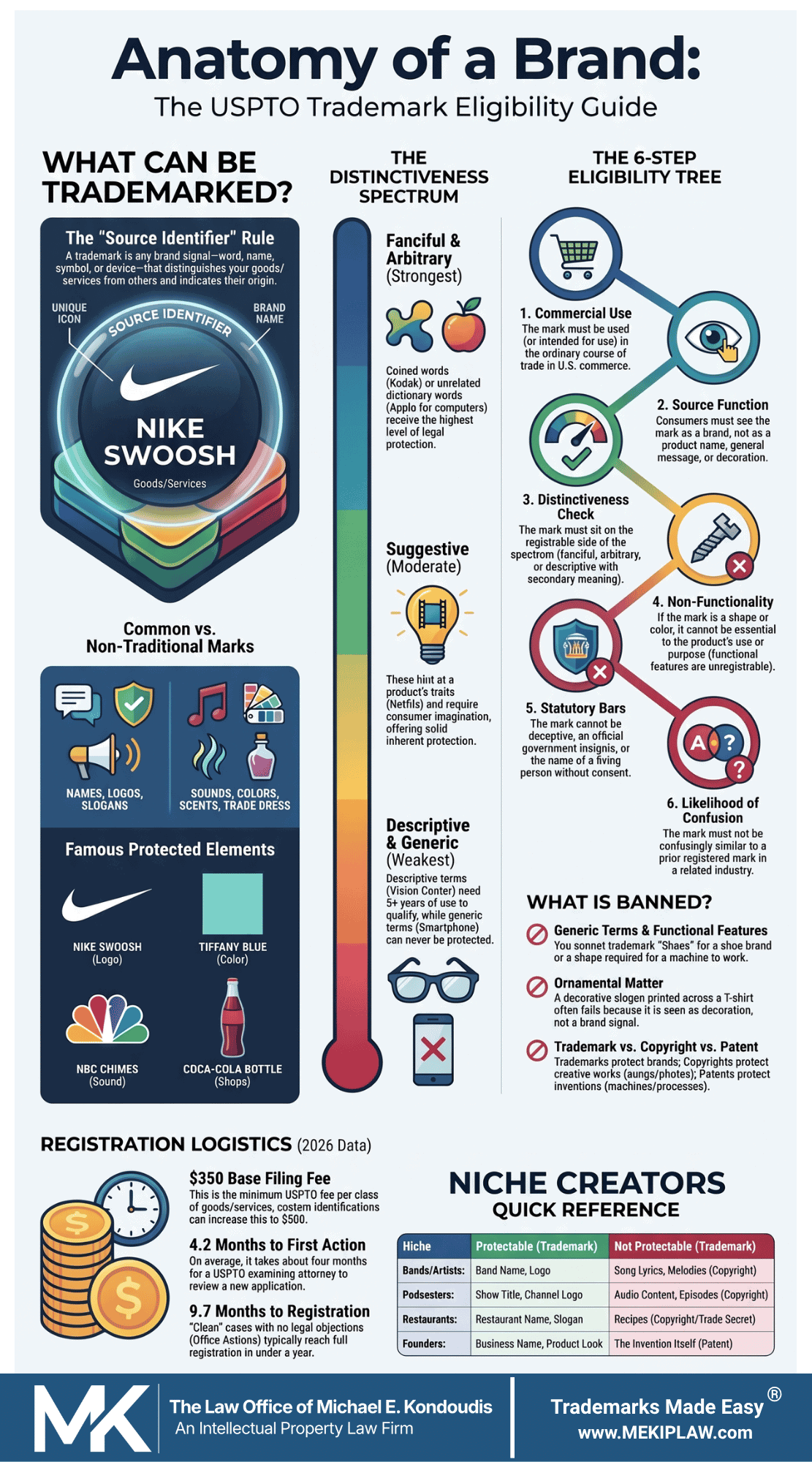
What Is the Difference Between a Trademark, a Registered Trademark, and Common-Law Rights?
A trademark exists when it is used in commerce as a source identifier. A registered trademark is that same identifier after the USPTO examines it and issues a federal registration. Common-law rights arise from actual use, even without a filing. Federal registration is the stronger right.
Federal registration on the Principal Register gives nationwide constructive notice, a legal presumption of ownership and validity, the right to use the ® symbol, access to federal court, the ability to record the mark with U.S. Customs and Border Protection, and a clearer path to incontestability after five years of continuous use. Common-law rights are real, but they are limited to the geographic area of actual use and are harder to prove.
Federal applications are examined by the USPTO. New applications are filed with the USPTO through the Trademark Center. Registered trademarks are sometimes called federal trademarks because the registration is a United States government certification of exclusive rights for the identified goods or services.
What Can Be Trademarked With the USPTO?
Almost anything that identifies and distinguishes a business’s goods or services can be trademarked if it is used as a brand. The USPTO can register a word, name, phrase, slogan, symbol, logo, design, character, sound, color, color combination, product configuration, packaging, or a combination of those elements.
The mark must do three things at once:
- Identify the source of specific goods or services.
- Distinguish those goods or services from those of other businesses.
- Be used in commerce, or be the subject of a bona fide intent to use in commerce under Section 1(b).
Apple is a useful illustration. The company protects the word APPLE, the apple silhouette logo, product names such as IPHONE and MACBOOK, and slogans used as brands. Each element is a separate trademark because each one points consumers back to the same source.
| Brand element | Usually registrable? | What the USPTO looks for |
|---|---|---|
| Business or product name | Yes, if distinctive | Source-identifying wording, not the generic name of the product |
| Logo or design | Yes | A distinctive visual that is not merely ornamental |
| Slogan or phrase | Often | Use as a brand, not as decoration or a general message |
| Character or mascot | Yes | A character used to brand goods or services |
| Product shape / packaging | Sometimes | Non-functional trade dress that identifies source |
| Color | Sometimes | Non-functional color plus acquired distinctiveness |
| Sound | Sometimes | A distinctive sound used as a brand signal |
| Scent or motion | Rare | Non-functional, source-identifying sensory or motion matter |
| Hashtag or domain name | Sometimes | Use as a brand, not merely as an address or social tag |
| Generic product term | No | The word names the product itself |
What Are the Main Types of Trademarks?
The USPTO registers traditional word and design marks, and a smaller set of non-traditional marks. The legal standard is the same for all of them: the matter must function as a source identifier and must not be statutorily prohibited by Section 2 of the Lanham Act.
| Rank | Type of mark | How common | Registration difficulty | Typical evidence |
|---|---|---|---|---|
| 1 | Word mark (standard character) | Most common | Lowest when distinctive | Specimens showing the wording used as a brand |
| 2 | Design / logo mark | Very common | Low to moderate | Clear drawing and branded use on goods or advertising |
| 3 | Composite word + design | Very common | Low to moderate | The combination as actually used |
| 4 | Slogan / phrase mark | Common | Moderate | Use as a source identifier, not ornamentation |
| 5 | Trade dress (packaging or product design) | Less common | Higher | Non-functionality; product design needs secondary meaning |
| 6 | Color mark | Uncommon | High | Secondary meaning + non-functionality |
| 7 | Sound mark | Uncommon | High | Audio specimen and source-identifying use |
| 8 | Scent, motion, hologram | Rare | Highest | Detailed description, non-functionality, acquired distinctiveness |
| 9 | Certification or collective mark | Specialized | Moderate to high | Standards, control, and proper mark type |
Word marks, logos, and slogans
These are the workhorses of federal trademark practice. A standard-character word mark protects the wording itself, without limiting you to one font or color. A design mark protects the specific visual. A slogan is registrable when consumers would see it as a brand, not as decoration on a T-shirt or a general informational phrase. For a deep dive into trademarking a phrase, see our comprehensive guide: How to Trademark a Phrase.
Trade dress
Trade dress is the commercial look and feel of a product, its packaging, or a service environment. The Coca-Cola contour bottle is the classic product-configuration example. Store décor can also function as trade dress when customers associate that look with one business. Product-design trade dress generally requires acquired distinctiveness. Packaging trade dress can be inherently distinctive in some cases. Functional features — the ones that make the product work better or cheaper — are not protectable. To learn about trade dress protection, read our comprehensive guide: An EASY Guide to Trade Dress.
Color, sound, and other non-traditional marks
Color can be a trademark when it is non-functional and has acquired distinctiveness. That rule comes from Qualitex Co. v. Jacobson Products Co., 514 U.S. 159 (1995). Tiffany blue for jewelry boxes, Owens-Corning pink for insulation, UPS brown for delivery services, and T-Mobile magenta are well-known examples. A single color almost never registers on a first-use filing without proof that the public already treats the color as a brand.
Sound marks work the same way. The NBC chimes (U.S. Registration No. 916,522) are a source identifier for broadcasting services. A jingle, a three-note sequence, or a distinctive audio sting can be registered if consumers recognize it as a brand signal rather than background noise.
Scent and motion marks exist, but they are rare. The scent cannot be the natural or functional smell of the product (a perfume scent for perfume is functional). Motion marks usually require a detailed description and a specimen that shows the movement used as branding.
Certification marks and collective marks
A certification mark tells consumers that goods or services meet standards set by someone other than the producer — origin, quality, or membership criteria. A collective mark identifies goods, services, or membership connected to a collective organization. These are less common than ordinary trademarks, but they are part of the same USPTO system.
Which Brand Elements Are Easiest to Register?
The easiest marks to register are inherently distinctive names and logos that are not already in use for related goods or services. Made-up words and arbitrary words are stronger than descriptive phrases. A unique logo is usually easier than a single color or a product shape.
Ease of registration is not the same thing as marketing appeal. A descriptive name may be easier for customers to understand on day one and harder to register. A coined name may take more marketing and then produce the broadest legal rights.
Can You Trademark a Name, Logo, Slogan, Color, Sound, or Product Shape?
Yes — each of those can be trademarked if it functions as a source identifier and clears the statutory bars. The details differ by type.
- Name. Company names, product names, personal names used as brands, and invented words are the most common filings. A merely descriptive name needs secondary meaning. A generic name cannot be saved.
- Logo. Stylized lettering, icons, and graphic devices are registrable as design marks. The registration covers the drawing you file, not every possible redesign.
- Slogan. A slogan is registrable when it brands goods or services. “Don’t Leave Home Without It” is a registered slogan. A decorative catchphrase printed on clothing often fails as ornamental matter.
- Color. Registrable after proof of distinctiveness, and only if the color is not functional.
- Sound. Registrable when the sound points to one source.
- Product shape. Registrable as trade dress if the shape is non-functional and identifies source. Product design requires secondary meaning after Wal-Mart Stores, Inc. v. Samara Brothers, Inc., 529 U.S. 205 (2000).
Can Band Names, Podcast Names, YouTube Channels, and Restaurant Names Be Trademarked?
Yes. Performing names, show titles used as brands, channel names, and restaurant names are standard trademark subject matter when they identify a source of services or goods.
- Band and artist names are typically service marks in International Class 41 for live performances and often Class 9 for recordings. The songs are copyrighted. The name is trademarked. See Can You Trademark a Band Name?.
- Podcast and webinar names can be registered for entertainment services, education services, and related downloads.
- YouTube and social channel names can be registered when the name is used as a brand for content services or merchandise, not merely as a URL or handle.
- Restaurant names are service marks for restaurant and bar services, usually in Class 43, with additional classes for packaged food or merchandise when those goods are actually sold.
- Blog names, product names, mascots, and slogans follow the same source-identifier test.
Examples that fit this pattern include band names such as THE BEATLES, restaurant names such as TACO BELL, product names such as CORVETTE, and slogans such as WHAT’S IN YOUR WALLET. The examples work because consumers treat those terms as brands, not as the generic name of the thing being sold.
What Famous Examples Show What Can Be Trademarked?
Famous registrations are useful because they show the range of matter the USPTO will accept when the legal test is met. They are not a shortcut. Your mark still has to clear search, distinctiveness, and use requirements.
| Mark | Type | Why it matters |
|---|---|---|
| NIKE swoosh (U.S. Reg. No. 977,190) | Design / logo | A simple graphic can be a powerful source identifier |
| CAMPBELL’S (U.S. Reg. No. 48,461) | Word / name | A company name used on goods is classic trademark subject matter |
| Coca-Cola contour bottle | Product-shape trade dress | A non-functional product configuration can identify source |
| Tiffany blue boxes (including U.S. Reg. No. 2,359,351) | Color / packaging | A color can be protected after it acquires distinctiveness |
| NBC chimes (U.S. Reg. No. 916,522) | Sound mark | A short audio sequence can function as a service mark |
What Cannot Be Trademarked?
The USPTO cannot register matter that does not function as a trademark or that is barred by 15 U.S.C. § 1052. The most important exclusions are generic terms, functional features, deceptive matter, official insignia, and marks that are likely to cause confusion with a prior mark.
| What you cannot trademark | Legal reason | Example |
|---|---|---|
| Generic terms | They name the product or service itself | APPLE for apples; COMPUTER for computers |
| Merely descriptive terms without secondary meaning | Section 2(e)(1); may later qualify under Section 2(f) | CREAMY for yogurt; BEST ICE CREAM for ice cream |
| Deceptive matter | Section 2(a) | ORGANIC for a product that is not organic |
| Functional product features | Functionality doctrine; TrafFix Devices | The shape required for a product to work |
| Purely ornamental or informational matter | Failure to function as a mark | A decorative slogan across the front of a T-shirt |
| Marks likely to cause confusion | Section 2(d) and the DuPont factors | A name and logo too close to a registered mark in the same industry |
| Flags, coats of arms, and official insignia | Section 2(b) | The Great Seal of the United States used as a brand |
| Matter that identifies a living person without consent | Section 2(c) | A celebrity name used as a brand without consent |
| Inventions | Patent subject matter, not trademark subject matter | A new machine, compound, or process |
| Creative works as works | Copyright subject matter | A song, photograph, novel, or film |


Generic terms
A generic term is the common name of the product or service. The public has a right to use that word to describe the thing itself. You cannot register SHOES for shoes or CAR WASH for car-wash services. Genericness is a complete bar. Long use does not convert a generic term into a trademark.
Descriptive terms
A descriptive term immediately tells purchasers something about the goods or services — quality, ingredient, function, feature, or purpose. Descriptive marks are refused under Section 2(e)(1) unless the applicant proves acquired distinctiveness under Section 2(f). Five years of substantially exclusive and continuous use is one common form of evidence, but it is not automatic proof.
Geographic terms and surnames
Geographic wording can be refused as primarily geographically descriptive or geographically deceptive. Some geographic terms are registrable when they are arbitrary for the goods (AMAZON for an online marketplace is the classic illustration) or when they have acquired distinctiveness. Merely-a-surname refusals under Section 2(e)(4) are also common. A surname can register after a showing of distinctiveness or when it is combined with distinctive matter.
Failure to function and ornamentation
The USPTO will refuse matter that consumers would not perceive as a brand. Widespread informational phrases, social-movement slogans used only as decoration, and repeating patterns on product surfaces often fail this test. The question is not whether the wording is original. The question is whether it identifies source.
Likelihood of confusion
Even a distinctive, non-generic mark is refused if it is too close to a prior mark for related goods or services. The examining attorney applies the DuPont factors, with emphasis on the similarity of the marks and the relatedness of the goods or services. A clearance search before filing is one way to reduce this risk. For a deeper dive into the DuPont factors, read our comprehensive guide, DuPont Factors for Likelihood of Confusion.
For more information about clearance searching, read our guide: How to Do a Trademark Lookup.
How Does Distinctiveness Affect What You Can Register?
Distinctiveness is the strength of the mark as a source identifier. The USPTO and the courts use the Abercrombie spectrum: fanciful, arbitrary, suggestive, descriptive, and generic. Fanciful, arbitrary, and suggestive marks are inherently distinctive and can go straight to the Principal Register. Descriptive marks need secondary meaning. Generic terms are unregistrable.
This is the same framework used in The Four Requirements for a Trademark.
| Spectrum Tier | USPTO Protection Status | Legal Definition & Rationale | Examples |
|---|---|---|---|
| 1.Fanciful | Strongest Level of Inherent Protection | Entirely invented or coined words with no prior dictionary definitions. | Kodak, Exxon, Xerox |
| 2.Arbitrary | Strong Inherent Protection | Real dictionary words used in a commercial context completely unrelated to their literal definitions. | Apple (for consumer computers) |
| 3.Suggestive | Moderate Inherent Protection | Hints at a product’s specific traits, quality, or utility, requiring consumer imagination to bridge the mental gap. | Netflix (for streaming services) |
| 4.Descriptive | Legally Weak (No immediate Principal Register registration) | Directly describes the functions, ingredients, or traits of the item. Only protectable via "secondary meaning" (5 years of continuous, exclusive use). | Vision Center (for eye care services) |
| 5.Generic | Completely Unprotectable (Permanent legal bar) | Common everyday names for a product or service itself. Banned to prevent individual businesses from creating unfair monopolies. | Smartphone, Coffee Shop |
What Is the Difference Between Trademark, Copyright, and Patent Protection?
Trademarks, copyrights, and patents protect different subject matter. Choosing the wrong form of IP is one of the most common mistakes founders, small businesses, and creators make.
| Trademark | Copyright | Patent | |
|---|---|---|---|
| What it protects | Brand identifiers that indicate source | Original works of authorship fixed in a tangible medium | New, useful, non-obvious inventions |
| Examples | Names, logos, slogans, trade dress, sounds, colors | Songs, photos, software code, books, films | Machines, compositions, processes, ornamental designs |
| Governing office | USPTO (Trademarks) | U.S. Copyright Office | USPTO (Patents) |
| Typical duration | Renewable as long as the mark is used and maintained | Life of the author plus 70 years (general rule) | Utility patents generally 20 years from filing |
| What it does not protect | The product idea or the creative work itself | Names, titles, and short phrases | Brand names and logos as brands |
For a deeper dive into these differences, read our guide, Types of Intellectual Property: Trademarks, Copyrights, and Patents.
How Do You Know If Your Mark Is Eligible?
Work the mark through this six-step eligibility tree before you pay a USPTO fee. Stop at the first “do not file” answer. If every step points forward, the mark is a candidate for federal registration.
Is the matter used — or intended to be used — as a brand for goods or services in U.S. commerce?
Would consumers see it as a source identifier, or as the product name, decoration, or a general message?
Where does it sit on the distinctiveness spectrum?
If the claim is a shape, color, or product feature, is that feature functional?
Is the matter barred by statute — deceptive, official insignia, or a living person’s name without consent?
Is the mark likely to cause confusion with a prior mark for related goods or services?
How Much Does It Cost and How Long Does It Take to Trademark Something in 2026?
The USPTO base application fee for a Section 1 or Section 44 filing is $350 per class. Additional USPTO fees apply if the application is incomplete, uses a custom goods-and-services identification instead of the Trademark ID Manual, or exceeds 1,000 characters in a free-form identification. Attorney fees are separate and should be quoted as a flat fee that includes a clearance search.
| Item (2026) | USPTO amount | Notes |
|---|---|---|
| Base application, per class | $350 | Sections 1 and 44, filed in Trademark Center |
| Insufficient-information surcharge, per class | $100 | Triggered by missing required information |
| Custom / free-form identification, per class | $200 | Using free-form text instead of the ID Manual |
| Each extra 1,000 characters in the ID, per class | $200 | Beyond the first 1,000 characters |
| Madrid / Section 66(a) application, per class | $600 | Fee paid through WIPO |
| Statement of Use, per class | $150 | Intent-to-use applications only |
| First examining action (average) | 4.2 months | USPTO data updated August 10, 2026 |
| Registration or abandonment (average) | 9.7 months | Clean cases are faster; Office Actions add time |
A straightforward application with no Office Action can move from filing to registration in well under a year. An Office Action adds response time. The response window is generally three months, with a paid three-month extension available. Intent-to-use filings require a Statement of Use after the mark is actually used in commerce.
Frequently Asked Questions (FAQs) About What Can Be Trademarked
This reference section provides immediate, direct answers to the most common questions about what can be trademarked.
Q: What can be trademarked in the United States?
A word, name, logo, slogan, design, character, sound, color, product shape, packaging, or combination of those elements can be trademarked if it identifies the source of goods or services, is distinctive, is used or intended to be used in commerce, and is not barred by 15 U.S.C. § 1052.
Q: What cannot be trademarked?
Generic product names, functional product features, purely decorative or informational matter, deceptive terms, official flags and insignia, a living person’s name used without consent, and marks that are likely to cause confusion with a prior mark cannot be federally registered. Inventions are patented. Creative works are copyrighted.
Q: Can you trademark a name?
Yes. A company name, product name, band name, restaurant name, or personal name used as a brand can be trademarked if it is distinctive and not confusingly similar to a prior mark for related goods or services.
Q: Can you trademark a logo?
Yes. A logo is a design mark. The USPTO registers the specific visual you submit. A later redesign usually needs its own application if the commercial impression changes.
Q: Can you trademark a slogan or phrase?
Yes, when the phrase functions as a brand rather than as decoration or a general message. Distinctive slogans are the strongest candidates. See How to Trademark a Phrase.
Q: Can you trademark a color?
Yes, if the color is not functional and has acquired distinctiveness as a source identifier. Single-color marks almost always require proof of secondary meaning. Tiffany blue packaging and Qualitex green-gold press pads are leading examples.
Q: Can you trademark a sound?
Yes. A distinctive sound used to identify goods or services can be registered as a sound mark. The NBC chimes are a registered sound mark for broadcasting services.
Q: Can you trademark a product shape?
Yes, as trade dress, if the shape is non-functional and identifies source. Product-design trade dress requires acquired distinctiveness. The Coca-Cola contour bottle is the best-known example.
Q: Can you trademark a band name or podcast name?
Yes. Those names are service marks when they identify the source of entertainment or education services. Register the name. Copyright the content. See Can You Trademark a Band Name?.
Q: Can you trademark a hashtag or domain name?
Sometimes. A hashtag or domain can be registered if consumers perceive it as a brand, not merely as a web address or a social media tag. Adding “.com” or “#” does not make a generic term distinctive.
Q: Do you have to register a trademark to own it?
No. Common-law rights begin with use in commerce. Federal registration is still the strongest and most practical way to own the mark nationwide and to enforce it efficiently.
Q: How long does a trademark last?
A federal registration can last indefinitely if the mark remains in use and the owner files the required maintenance documents, including the Section 8 declaration between years five and six and renewal every ten years.
Q: What is the difference between ™ and ®?
™ (or SM for services) can be used with an unregistered mark. ® may be used only after the USPTO issues a federal registration, and only for the goods or services listed in that registration.
Q: Can two companies trademark the same name?
Sometimes, if the goods and services are unrelated and consumers would not assume a connection. The USPTO still refuses marks that are likely to cause confusion in related fields. A search is how you find out.
Q: How do you know if a mark is eligible to trademark?
Run a six-step test: (1) use or intended use in commerce as a brand, (2) source-identifying function rather than a generic name or decoration, (3) distinctiveness, (4) non-functionality for shapes and colors, (5) no statutory bar, and (6) no likelihood of confusion with a prior mark for related goods or services. If every step clears, the mark is eligible to file.
Q: What should a band, restaurant, or YouTube creator trademark?
Trademark the name and logo that identify the act, restaurant, or channel. Add a slogan or merch brand only if it is used as a brand. Do not trademark songs, recipes, or videos. Those works are protected by copyright, not trademark law.
Q: Should you hire a trademark attorney to decide what to file?
If the brand matters, yes. An attorney will separate registrable elements from unregistrable ones, choose the correct class and identification, and clear the mark before the USPTO fee is spent. Applications prepared with counsel have a substantially higher success rate than unrepresented filings.
About the Author and Why You Can Trust This Guide
About the Author and Trademark Expertise
The YNAT® Trademarking System and Core Principles
- Operational Efficiency — streamlined legal processes designed to minimize time, cost, and administrative friction.
- Proactive Communication — clear, transparent, and predictive client communication at every stage.
- Sustainable Growth — long-term client relationships centered on sustainable brand protection.
- Measurable Value — practical, results-driven strategies that deliver tangible business assets
87 ⭐⭐⭐⭐⭐ Reviews
Stop Guessing Whether Your Brand Can Be Trademarked
Free Strategy Consultation With An Attorney
Simple Flat Fee Pricing • Free Clearance Search • Honest Advice

Trademark Attorney-Client Privilege Disclaimer
Disclaimer: No Attorney-Client Relationship or Legal Advice
This content is for general informational and educational purposes only and does not constitute legal advice. Reading or interacting with it does not create an attorney-client relationship. A formal relationship is formed only through a signed engagement agreement. Reading, sharing, or interacting with this content does not create an attorney-client relationship.
Do not send confidential trademark concepts or brand names through comments, forms, or email on this site — unsolicited information is not privileged. Trademark rights depend on specific facts and jurisdiction. Past results do not guarantee future outcomes. Consult a licensed trademark attorney for advice on your situation.
Remember: I am an experienced trademark attorney. However, I am not your attorney.

For more than twenty years, Michael Kondoudis has been the go-to trademarking expert for businesses of all shapes and sizes. Michael is a USPTO-licensed trademark and patent attorney, educator, speaker, and author of the Amazon best-seller: Going From Business Owner to Brand Owner. He is also an authority trusted by national news media on major trademark stories.
Fun Facts: Michael is a member of the Bar of the U.S. Supreme Court and an actual rocket scientist (B.S. Astronomy and Astrophysics, Indiana University 1994).