

The Metallica logo, designed by James Hetfield in 1982 and first used in commerce in March 1983, is protected by U.S. Trademark Registration No. 1,923,477 (issued October 3, 1995) and multiple additional federal registrations in International Classes 009, 015, 025, and 041. Metallica actively enforces these rights globally against counterfeiters, unauthorized merchandise, and tribute acts. This guide covers the logo’s design history, exact registration details, class coverage, and enforcement strategy — demonstrating why early, multi-class trademark protection turns a band logo into a durable commercial asset.
Originally Published July 29, 2003 | Updated July 22, 2026

By Michael E. Kondoudis, Trademark Attorney with 25+ years of Experience
USPTO-Registered·1,000+ Trademarks Searched and Filed·Bar: U.S. Supreme Court
⚡ Quick Summary
The Metallica Logo was designed in 1982 by Metallica lead vocalist and rhythm guitarist James Hetfield, the iconic lightning-bolt typography officially debuted commercially in March 1983.
- Trademark Status: The United States Patent and Trademark Office (USPTO) granted Federal Trademark Registration No. 1,923,477 to Metallica on October 3, 1995. The Metallica partnership now controls more than 15 active trademark registrations.
- Class Protections: Metallica actively maintains federal trademark protections across four core USPTO International Classes: Class 009 (audio-visual media), Class 015 (musical instruments/accessories), Class 025 (apparel), and Class 041 (entertainment services).
- Legal Enforcement: To prevent consumer confusion and protect brand equity, Metallica strictly enforces its intellectual property rights globally against unauthorized counterfeiters, commercial retail brands, and tribute acts.
What Is the Metallica Logo and Why Does It Matter?
The Metallica logo is one of the most recognizable visual identifiers in music and functions as a powerful federal trademark. Designed in 1982 and first used in commerce in 1983, the Metallica logo has been protected by U.S. Federal Trademark Registration No. 1,923,477 since 1995 and is actively enforced across multiple international classes.
This guide covers the complete history of the Metallica logo, its exact USPTO registration details, the four international classes it protects, how Metallica enforces the mark, and why band logos are protected under trademark law rather than copyright.
Key Data About the Metallica Logo
| Fact | Details |
|---|---|
| Designer | James Hetfield (Metallica lead vocalist and rhythm guitarist) |
| Design Features | Stylized typography featuring elongated, lightning-bolt-style points on the first letter (“M”) and last letter (“A”) |
| First Use in Commerce | March 1983 |
| U.S. Trademark Registration | No. 1,923,477 (registered October 3, 1995) |
| Serial Number | 74-580,770 |
| Registrant | Metallica (a California partnership) |
| Primary Classes Protected | Class 009 (pre-recorded music and audiovisual media) Class 015 (guitar picks and drumsticks) Class 025 (apparel and headwear) Class 041 (live entertainment services) |
| Iconic Album Appearances | Kill ’Em All (1983), Ride the Lightning (1984), Master of Puppets (1986) |
Bottom line: Early creation and continuous commercial use of a distinctive logo create a strong foundation for federal trademark rights.
How Did the Metallica Logo Originate?
The Metallica logo was created by James Hetfield in 1982 and entered commercial use the following year. Its distinctive lightning-bolt lettering quickly became inseparable from the band’s identity and has appeared on albums, merchandise, and stage branding for more than four decades.
- 1982 (Design Conception): Metallica lead vocalist and rhythm guitarist James Hetfield designed the original typography, featuring signature lightning-bolt points on the flanking letters “M” and “A”.
- March 1983 (First Use in Commerce): Metallica began distributing promotional materials and merchandise bearing the stylized typography prior to the formal release of any studio tracks.
- July 1983 (Official Album Debut): The Metallica logo achieves widespread international visibility via the release of the landmark studio album, Kill ‘Em All.
- Subsequent Refinements: The original James Hetfield design remained a focal visual anchor on successive Metallica albums, including Ride the Lightning (1984) and Master of Puppets (1986).


Bottom line: Early creation and continuous commercial use of a distinctive logo create a strong foundation for federal trademark rights.
What Are the Key Facts About the Metallica Logo Trademark?
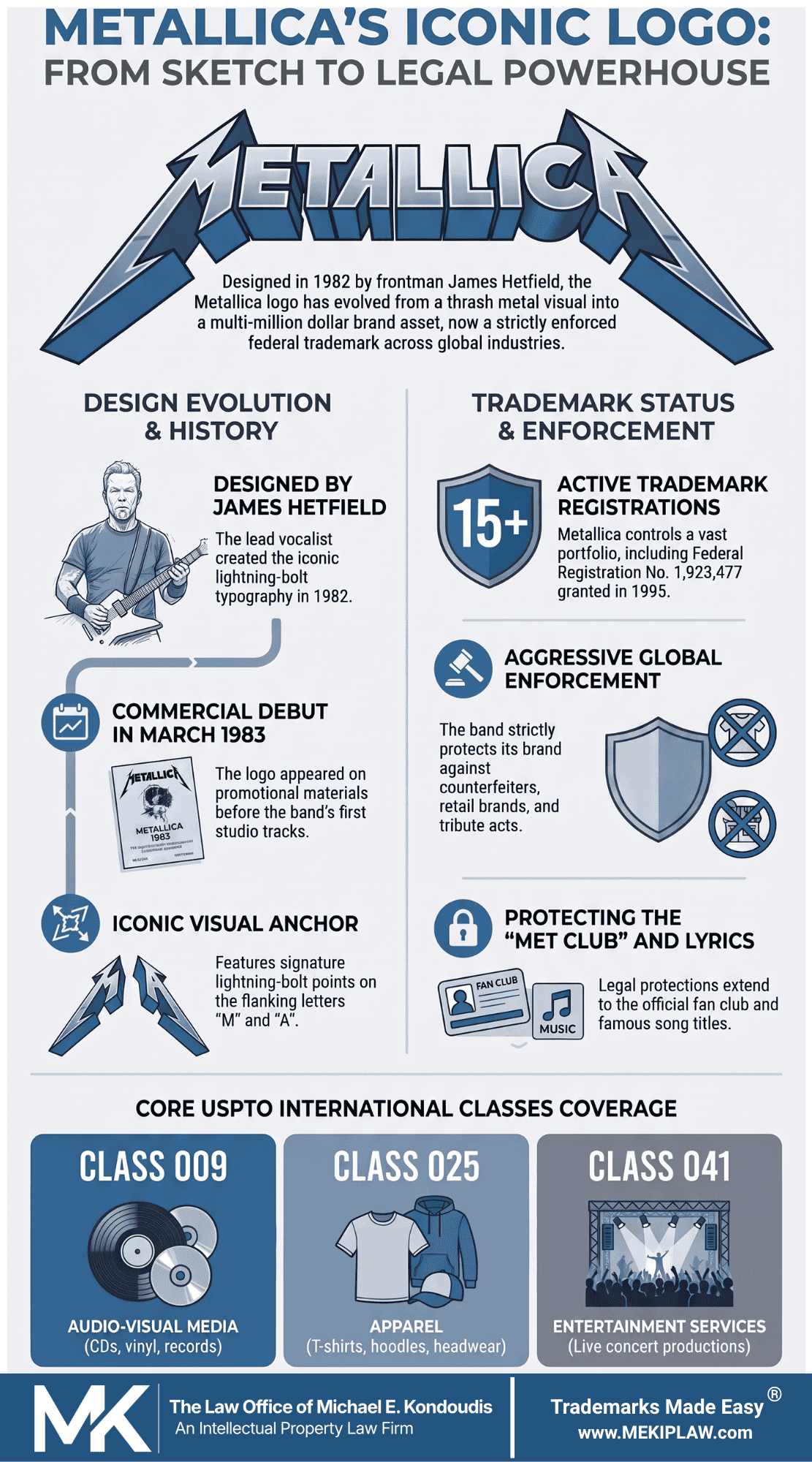
Share This Infographic
Embed this infographic on your website or blog. Click the button below to copy the embed code.
Federal Registration Status: Is the Metallica Logo Trademarked?
Yes. The Metallica logo is federally registered with the United States Patent and Trademark Office. The United States Patent and Trademark Office (USPTO) granted Federal Trademark Registration No. 1,923,477 on October 3, 1995. Metallica currently controls more than 15 distinct trademark registrations covering this logo design.
If you want the same level of federal protection Metallica secured for its logo, the process starts with a strategic application. Here’s the complete step-by-step guide on How to Trademark a Band Name.

Bottom line: Federal registration gives Metallica nationwide priority, legal presumptions of ownership and validity, and powerful enforcement tools that common-law rights alone cannot provide.
Key U.S. Trademark Registration Details
| Attribute | Verified USPTO Trademark Record Data |
|---|---|
| Registration Number | 1,923,477 |
| Filing Date | September 30, 1994 |
| Registration Date | October 3, 1995 |
| Registrant | Metallica (A California Partnership) |
| Examining Attorney | Odette Bonnet |
| Serial Number | 74-580,770 |
USPTO International Class Protections: What Do the Metallica Logo Trademarks Cover?
Metallica has secured federal trademark protection for its logo in four of the 45 trademark classes used by the U.S. Patent and Trademark Office. These filings safeguard everything from physical music media and apparel to live entertainment services and performance accessories.
- International Class 009 (Audio-Visual Media): USPTO Class 009 encompasses pre-recorded video cassettes, audio cassettes, phonograph records, and compact discs (CDs) featuring recorded musical performances by Metallica.
- International Class 015 (Musical Instruments): USPTO Class 015 restricts the unauthorized manufacture of performance equipment accessories, specifically guitar picks and drumsticks bearing Metallica’s logo.
- International Class 025 (Apparel and Merchandise): USPTO Class 025 secures commercial clothing lines, namely consumer T-shirts, hooded shirts, crew shirts, ponchos, headwear, and baseball caps displaying Metallica’s logo.
- International Class 041 (Entertainment Services): USPTO Class 041 encompasses live musical performances, concert tours, and entertainment productions by Metallica.
For a deeper dive into all 45 of the USPTO trademark classes, read our Ultimate Guide to Trademark Classes.
Bottom line: Registering a logo in the classes that match actual and planned commercial use creates broader and more effective protection against unauthorized copycats.
Why is the Metallica Logo Protected by Trademark Instead of Copyright?
The Metallica logo is protected under trademark law, not copyright law, because it functions as a commercial source identifier that tells consumers the goods or services come from Metallica.
Trademark vs. Copyright — The Core Distinction
- Trademark protects brand identifiers (names, logos, and symbols) that indicate the source of goods or services in commerce. Its purpose is to prevent consumer confusion.
- Copyright protects original creative expression (songs, lyrics, sound recordings, photographs, and full album artwork). Its purpose is to protect the artistic work itself.
The stylized Metallica logo that appears on albums such as Master of Puppets (1986) is a trademark. The full album-cover illustration is a separate copyrighted work. These two forms of protection operate independently and serve different legal purposes.
Many people assume a logo is automatically protected by copyright. That assumption is incorrect. A logo used to identify a band or brand in commerce is protected under trademark law. Copyright does not cover the logo as a brand identifier.
For another detailed example of how another famous band protects its logo under trademark law, see our Complete Guide to the Rolling Stones Tongue and Lips Logo Trademark.
Bottom line: Band logos should be protected as trademarks. Relying on copyright alone leaves significant commercial rights unprotected.
Commercial Licensing: How Does Metallica Use Its Trademarks?
Over four decades, Metallica has strategically expanded its intellectual property portfolio beyond the basic logo wordmark to include official fan club names, distinct song lyrics, charitable foundations, and official co-branded commercial games. Metallica aggressively uses its trademarked branding across selective consumer products, maximizing revenue streams while ensuring strict quality control.
Authorized Corporate Collaborations & Merchandise
The Metallica partnership licenses its trademarked branding, such as Metallica Clue and official coffee mugs, maintaining quality control over products.


Bottom line: Consistent enforcement preserves the strength and distinctiveness of a trademark. Failure to police a mark can weaken its legal protection over time.
How Has Metallica Expanded Protection Around Its Logo?
As Metallica’s commercial footprint grew, the Metallica California partnership secured additional federal trademark registrations, such as:
- “Met Club” – protection for the official fan club and community brand.
- Song-title and slogan marks such as “The Memory Remains” and “Wherever I May Roam”.
- Marks covering the band’s philanthropic and charitable entities.
These ancillary registrations expand the legal perimeter around the primary Metallica logo and prevent third parties from trading on related brand elements.
How Does Metallica Enforce Its Logo Trademarks?
Intellectual Property Enforcement Actions Taken by Metallica
- International Litigation: Metallica successfully fought and annulled a decades-old, identical trademark for clothing and footwear registered by a businessman in Chile, allowing them to legally sell official merchandise with their trademarked Metallica logo there.
- Cosmetics & Retail: Metallica has taken legal action against major brands in the past, including Victoria’s Secret over a line of lip pencils called “Metallica.”
- Tribute Bands: Metallica has protected its trademarked Metallica logo and brand against tribute acts. However, they famously apologized and made amends after their legal counsel sent a cease-and-desist letter to a Canadian Metallica tribute band named Sandman.
How Do Metallica’s Logo Trademarks Benefit Fans and the Brand?
By registering its trademarks, Metallica has the federal power to initiate civil litigation against counterfeit manufacturers, ensuring that fans only purchase genuine, high-quality merchandise.
- Consumer Counterfeit Protection: Clear, legally enforceable marks prevent bootleggers from deceiving fans with cheap, unauthorized imitation apparel or sub-standard goods.
- E-Commerce and Piracy Enforcement: Federal registration allows the band’s legal team to easily issue DMCA takedowns, clear out illicit digital storefronts, and combat copyright infringement across e-commerce channels.
Protect What You’ve Built — Take the Next Step
Your logo isn’t just artwork. It’s the visual shorthand for everything your business, creative project, or brand stands for. In today’s crowded marketplace — whether you’re a band building a merch empire, a startup scaling nationally, a restaurant protecting its identity, or an established company defending hard-won brand equity — federal trademark registration turns that visual asset into a legally defensible, ownable property right.
Yes, logos are trademarked every day. The real question is whether yours will be protected before someone else tries to claim or copy it.
If you’re ready to explore protecting your logo — or you already have questions about an existing design, a potential conflict, international strategy, or maintaining an existing registration — I invite you to schedule a complimentary strategy consultation.
Trademarks Made Easy® isn’t just a slogan—it’s how we work.
Metallica Logo FAQs
Straightforward answers to frequently asked questions about Metallica’s logo.
Q: Is the Metallica logo trademarked?
Yes. The primary U.S. registration is No. 1,923,477, issued by the USPTO on October 3, 1995. Metallica controls more than 15 active trademark registrations covering the logo and related marks.
Q: Who designed the original Metallica logo?
James Hetfield, Metallica’s lead vocalist and rhythm guitarist, designed the original lightning-bolt logo in 1982.
Q: When did Metallica first use the logo in commerce?
Metallica first used the logo in commerce in March 1983.
Q: What trademark classes does the Metallica logo cover?
The logo is protected in International Class 009 (pre-recorded music and audiovisual media), Class 015 (musical instruments and accessories such as guitar picks and drumsticks), Class 025 (apparel), and Class 041 (live entertainment and concert services).
Q: Can a band logo be protected by copyright instead of trademark?
No. A band logo functions as a commercial source identifier and is properly protected under trademark law. Copyright protects original artistic works, not brand identifiers used in commerce.
Q: What is the registration number for the Metallica logo?
The primary U.S. registration number is 1,923,477, registered on October 3, 1995.
Q: How does Metallica enforce its logo trademarks?
Metallica enforces its rights through federal litigation, international actions (including successful cancellation of an identical mark in Chile), cease-and-desist letters, and actions against major retailers and counterfeiters.
Q: Why does Metallica maintain trademark registrations in multiple classes?
Different classes cover different commercial uses of the logo (music recordings, merchandise, live performances, and instruments). Multi-class coverage gives broader protection against unauthorized use across product and service categories.
Q: Can other bands or businesses use a logo that looks similar to Metallica’s?
No. Using a logo that is confusingly similar to Metallica’s registered mark in related goods or services risks trademark infringement claims. Metallica actively polices similar designs.
Q: What can other bands learn from Metallica’s trademark strategy?
Register the logo early, cover the core commercial classes (especially apparel and entertainment services), maintain the registrations, and enforce consistently. Strong trademark protection turns a logo into a long-term business asset.
About the Author and Why You Can Trust This Guide
About the Author and Trademark Expertise
The YNAT® Trademarking System and Core Principles
- Operational Efficiency — streamlined legal processes designed to minimize time, cost, and administrative friction.
- Proactive Communication — clear, transparent, and predictive client communication at every stage.
- Sustainable Growth — long-term client relationships centered on sustainable brand protection.
- Measurable Value — practical, results-driven strategies that deliver tangible business assets
87 ⭐⭐⭐⭐⭐ Reviews
Need To Protect Your Band Logo?
Free Strategy Consultation With An Attorney
Simple Flat Fee Pricing • Free Clearance Search • Honest Advice

Trademark Attorney-Client Privilege Disclaimer
Disclaimer: No Attorney-Client Relationship or Legal Advice
This content is for general informational and educational purposes only and does not constitute legal advice. Reading or interacting with it does not create an attorney-client relationship. A formal relationship is formed only through a signed engagement agreement. Reading, sharing, or interacting with this content does not create an attorney-client relationship.
Do not send confidential trademark concepts or brand names through comments, forms, or email on this site — unsolicited information is not privileged. Trademark rights depend on specific facts and jurisdiction. Past results do not guarantee future outcomes. Consult a licensed trademark attorney for advice on your situation.
Remember: I am an experienced trademark attorney. However, I am not your attorney.