

A famous trademark is a name, logo, or slogan that is widely recognized across diverse consumer segments. Under the Lanham Act (15 U.S.C. § 1125(c)), famous marks receive powerful extra protection against dilution by blurring and tarnishment, even from non-competing businesses.
Originally Published: March 3, 2023 | Updated: July 20, 2026

By Michael Kondoudis, USPTO-Registered Attorney With 25+ Years of Trademark Experience
Inventor of the YNAT® Trademarking System | 3,000+ Trademarks & Patents Secured | Amazon #1 Best-Selling Author on Trademarks | Member of the Bar of the U.S. Supreme Court | Trademarks Made Easy®
What is the Legal Definition of a Famous Trademark?
A famous trademark is a mark that is widely recognized by the general consuming public as a designation of the source of the goods or services of the mark’s owner (15 U.S.C. § 1125(c)(2)(A)). Pursuant to the Lanham Act (15 U.S.C. § 1125(c)(2)(A) and the USPTO’s TMEP § 1207.01(d)(ix), a famous trademark transcends its original industry niche to establish a household national or global brand identity.
This is a high bar. Niche fame is not enough. The mark must have become a household name across broad consumer segments.
Famous trademarks receive enhanced federal protection against both infringement and dilution.
Famous trademarks are iconic.
Roadmap: An Overview of Famous Trademarks
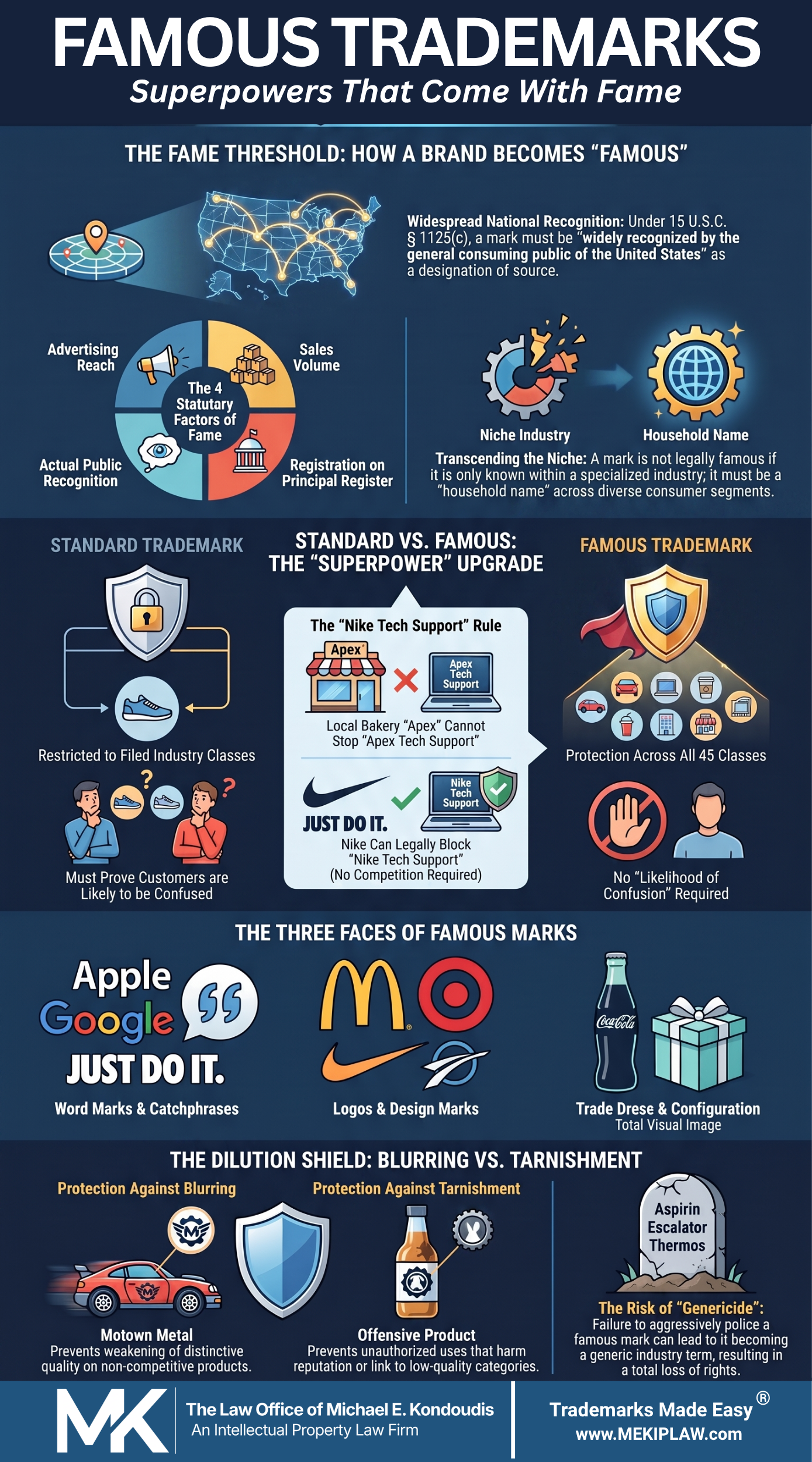
Before diving in, here is a quick visual blueprint illustrating famous trademarks, the legal criteria for proving fame, the additional legal benefits famous trademarks receive under US trademark law, and examples of famous trademarks.
What Criteria Do the USPTO and Courts Use to Determine Trademark Fame?
Courts and the USPTO evaluate fame using the four non-exclusive statutory factors in the Trademark Dilution Revision Act:
- The duration, extent, and geographic reach of advertising and publicity of the mark (by the owner or third parties).
- The amount, volume, and geographic extent of sales of goods or services offered under the mark.
- The extent of actual recognition of the mark by the general public.
- Whether the mark is registered on the Principal Register (or under earlier federal acts).
Additional evidence often includes consumer surveys, unsolicited media coverage, and social media reach.
How Long Does It Take For a Trademark To Build Fame?
There is no fixed statutory timeline. Trademark fame almost always requires years (often decades) of continuous, exclusive, nationwide use combined with substantial advertising and public exposure.
New or regional marks almost never qualify as famous.
What Extra Legal Protections Do Famous Brands Receive?
Famous trademarks receive three major advantages under federal law:
- Broader protection against likelihood of confusion.
- Independent federal claims for dilution by blurring and dilution by tarnishment.
- Greater power to block similar applications at the USPTO across all classes (see TMEP §1207.01(d)(ix)).
These protections apply even when the junior user operates in a completely unrelated industry.
Why Does the USPTO Refuse New Applications that Resemble Famous Trademarks?
Pursuant to TMEP § 1207, when a trademark examiner identifies a newly filed application that closely resembles an existing, highly recognized mark, the USPTO can refuse registration based on a likelihood of dilution. This grants famous marks complete enforcement protection across all 45 international Nice Classification classes, effectively walling off the brand name from outside commercial use.
For a deeper dive into USPTO trademark classes, read our Guide to Trademark Classes.
How Does Brand Fame Change The Legal Standard for Infringement of a Famous Trademark?
Famous trademarks hold a dominant position in enforcement actions due to their widespread recognition:
- Higher likelihood of confusion: Courts grant famous marks a wider orbit of protection because consumers are more likely to remember and recognize them.
- Increased commercial value: Enhanced enforcement rights directly increase the equity, valuation, and market power of the corporate brand.
- Precedential weight: Legal determinations of fame by the U.S. Patent and Trademark Office (USPTO) serve as authoritative evidence in subsequent disputes.
How Do Federal Anti-Dilution Laws Shield Famous Trademarks?
The Trademark Dilution Revision Act protects famous marks against two forms of harm:
- Dilution by blurring: Prevents third parties from weakening the distinctive quality of the famous mark by using it on non-competitive products.
- Dilution by tarnishment: Prevents unauthorized commercial uses that harm the brand’s reputation or link it to low-quality, offensive categories.
Unlike regular infringement claims, dilution claims do not require proof of competition or consumer confusion.
What is the Difference Between a Standard Trademark and a Famous Trademark?
The table below compares the statutory boundaries, enforcement powers, and legal standards of famous trademarks and standard trademarks under the Lanham Act.
Famous Trademarks vs. Standard Trademarks Comparison Table
| Evaluation Criterion | Standard Trademark | Famous Trademark |
|---|---|---|
| Primary Statute | 15 U.S.C. § 1114 (Infringement Remedies) | 15 U.S.C. § 1125(c) (Trademark Dilution Revision Act) |
| USPTO Threshold | Requires distinctiveness and use in commerce per TMEP § 1201. | Requires extraordinary nationwide public recognition per TMEP § 1208.01(a). |
| Primary Legal Threat | Consumer Confusion: Unauthorized use by a direct competitor in the same market. | Brand Dilution: Unauthorized use that causes blurring or tarnishment of the mark. |
| Enforcement Scope | Related goods and services. | All classes, including unrelated industries. |
| Burden of Proof | Must prove that customers are highly likely to mistake one brand for another. | No proof of competition or consumer confusion is required to secure an injunction. |
| Geographic Range | Protection can be localized or limited to specific market niches. | Must possess widespread, nationwide public recognition across the general public. |
| Example Scenario | An ordinary mark used by a neighborhood shop (e.g., Apex Bakery cross-industry enforcement power and cannot prevent an unrelated enterprise from using Apex Tech Support. | Conversely, a globally renowned mark like Nike possesses cross-market equity allowing its legal team to block an unrelated entity using "Nike Tech Support" without proving commercial competition. |
A standard trademark stops competitors in the same space. A famous trademark can stop almost anyone who uses a similar mark in a way that blurs or tarnishes it.
What Are the Three Categories of Famous Trademarks?
Famous marks generally fall into three distinct categories:
- Word marks and slogans: Famous examples include Apple® for computers, Google® for search services, and iconic taglines like Nike’s “Just Do It”.
- Logos and design marks: Famous examples include the McDonald’s Golden Arches, the Target Bullseye, and Google’s multi-color G logo.
- Trade dress and product configuration: Famous examples include the silhouette of the Coca-Cola contour bottle and the exact shade of Tiffany Blue used on jewelry boxes.
Pursuant to TMEP § 1202.02, configuration, trade dress, and color marks require exhaustive proof of secondary meaning (acquired distinctiveness) — under 15 U.S.C. § 1052(f).
Which Commercial Brands are Officially Recognized as Famous Trademarks?
The USPTO does not publish an official list of famous trademarks. Fame is determined case-by-case by federal courts and the Trademark Trial and Appeal Board (TTAB) under 15 U.S.C. § 1125(c). The brands below are repeatedly treated as meeting the high threshold of nationwide recognition among the general consuming public of the United States.
Coca-Cola
Coca-Cola was founded in 1886 and remains one of the clearest examples of a famous trademark. Its distinctive red-and-white Spencerian script logo has been in continuous use since the late 1880s. The contoured bottle shape is protected as trade dress and functions as a powerful source identifier. The mark enjoys extremely high unaided public recognition and is routinely cited by courts and the TTAB as a textbook illustration of fame for dilution purposes due to its long duration of use, massive advertising reach, and near-universal consumer association.
Nike
Nike was founded in 1964 as Blue Ribbon Sports and rebranded in 1971. The Swoosh logo (created in 1971) and the slogan “Just Do It” (launched in 1988) are both widely recognized as famous. The TTAB has repeatedly described “Just Do It” as “exceedingly famous” and entitled to the highest level of protection against both likelihood of confusion and dilution by blurring. Supporting evidence includes multi-billion-dollar advertising expenditures, continuous nationwide use, celebrity athlete endorsements, and deep cultural penetration.
Google launched in 1998 as a search engine and rapidly achieved extraordinary public recognition. The GOOGLE mark has been found famous by the TTAB in multiple proceedings based on substantial U.S. revenue, top rankings in independent brand surveys, massive daily U.S. user traffic, and widespread third-party acknowledgment of its strength. Even the common use of “google” as a verb has been viewed by courts as reinforcing, rather than diminishing, the mark’s fame when the primary significance remains source-identifying.
Apple
Apple was founded in 1976. The APPLE word mark and the bitten-apple logo for computers and consumer electronics rank among the strongest trademarks in existence. The brand consistently ranks at or near the top of global brand valuation studies and enjoys exceptionally high recognition across demographic groups. Its visual identity and product design language operate as highly distinctive source identifiers that courts treat as famous under the federal dilution standard.
McDonald’s
McDonald’s originated as a restaurant in 1940 and expanded nationally under Ray Kroc. The Golden Arches logo (introduced in the early 1960s), the McDonald’s word mark, and related family marks benefit from decades of continuous nationwide use, enormous sales volume, and intensive advertising. The brand is regularly cited as an example of a mark that has achieved the level of fame required for anti-dilution protection under the Lanham Act.
These brands demonstrate the core statutory factors used to establish fame: long duration and geographic extent of advertising and use, significant sales volume, and widespread recognition by the general consuming public—not merely niche or industry-specific awareness.
Other well-known design marks that function as famous trademarks include the Rolling Stones tongue and lips logo and the Metallica logo. Both marks illustrate how distinctive band logos can achieve strong federal trademark protection and long-term commercial control.
Recent Landmark TTAB and Federal Court Decisions Establishing Trademark Fame
| Famous Trademark | Primary Goods/Services | Key Case Citation & Legal Precedent | Anti-Dilution Enforcement Outcome |
|---|---|---|---|
| Motown | Audio recordings | UMG Recordings, Inc. v. Mattel, Inc. (TTAB 2011) | Blocked a toy car line from registering "Motown Metal" due to the high likelihood of blurring. |
| Sony | Entertainment services | Sony Interactive v. Sonistream LLC (TTAB 2022) | Affirmed the absolute fame of the mark to prevent multi-industry commercial dilution. |
| Jack Daniels | Whiskey | Jack Daniel’s Properties, Inc. v. VIP Products LLC, 599 U.S. 140 (2023) | Supreme Court landmark ruling establishing that First Amendment parody defense does not shield copycats using a famous mark as a source identifier. |
| Search engine services | Universal Federal & TTAB Precedent | Repeatedly held as universally famous, serving as a legal benchmark for absolute nationwide public recognition. | |
| Jaws | Video recordings | In re Mr. Recipe, LLC, 118 USPQ2d 1084 (TTAB 2016) | Precedential TTAB decision formally ruling the movie title as a famous mark with cross-category enforcement weight. |
| Red Bull | Energy drinks | Multiple TTAB Enforcement Actions | Upheld as an exceptionally famous mark, repeatedly blocking copycat beverage applications from riding on its brand equity. |
| Bose | Audio equipment | Bose Corp. v. QSC Audio Products, Inc., 293 F.3d 1367 (Fed. Cir. 2002) | Federal Circuit precedent establishing the quantitative and qualitative metrics required to prove textbook trademark fame. |
Famous Trademarks FAQ
This reference section provides immediate, direct answers to the most common questions about famous trademarks.
Q: What is the most famous trademark in the world?
Coca-Cola is widely regarded as one of the most legally robust and famous trademarks due to its extremely high global recognition. Other top-tier examples include Apple, Google, Nike, and Amazon.
Q: Can a common word become a famous trademark?
Yes. A common word can become famous if it acquires secondary meaning through exclusive, long-term commercial use (examples: Apple for computers, Amazon for e-commerce, Target for retail).
Q: Can a generic word ever become a famous trademark?
No. A purely generic term cannot function as a trademark. If a once-protectable mark becomes the common name for the product itself (genericide), protection is lost (historical examples: Aspirin, Escalator, Thermos).
Q: How long does a famous trademark registration last?
Indefinitely, as long as the owner continues to use the mark in commerce and files the required Section 8 and Section 9 maintenance documents on time.
Q: Can a famous trademark be used in a parody?
Yes, a famous trademark can be used in a parody, provided the use is transformative and does not cause consumer confusion or commercial tarnishment. Under the First Amendment, non-commercial parody is protected as fair use, as seen in landmark legal cases like Louis Vuitton Malletier v. Haute Diggity Dog.
Q: What happens if a famous trademark is not defended?
If a company fails to defend a famous trademark against unauthorized use, the mark faces genericide, the legal process where a brand name becomes the generic term for the product itself. Once a trademark enters the public domain through genericide—as happened to Escalator, Aspirin, and Thermos—all exclusive legal protections are permanently lost.
Q: How do famous trademarks protect themselves against brand dilution?
Famous trademarks prevent brand dilution by filing federal claims under the Trademark Dilution Revision Act (TDRA) for blurring or tarnishment. According to the USPTO TMEP § 1207.01(d)(ix), a mark’s proven fame expands its legal footprint, allowing corporate owners to obtain nationwide injunctions against third-party uses that weaken or damage the brand’s distinctiveness.
Q: How long does it take for a trademark to become famous?
There is no fixed statutory timeline. Trademark fame requires sustained commercial usage, heavy advertising investment, and broad cultural impact over years or decades.
Q: Are slogan trademarks like “Just Do It” legally protectable?
Yes. Commercial slogans can be registered on the USPTO Principal Register and enforced against dilution if they function as distinctive source identifiers.
About the Author and Why You Can Trust This Guide
About the Author and Trademark Expertise
The YNAT® Trademarking System and Core Principles
- Operational Efficiency — streamlined legal processes designed to minimize time, cost, and administrative friction.
- Proactive Communication — clear, transparent, and predictive client communication at every stage.
- Sustainable Growth — long-term client relationships centered on sustainable brand protection.
- Measurable Value — practical, results-driven strategies that deliver tangible business assets
87 ⭐⭐⭐⭐⭐ Reviews
Need Help With A New Trademark Application?
Free Strategy Consultation With An Attorney
Simple Flat Fee Pricing • Free Clearance Search • Honest Advice

📘 Core Legal Definitions: Famous Trademark Law
- Famous Trademark: A brand identifier universally recognized nationwide across diverse consumer segments, granting it cross-market enforcement power.
- Standard Trademark: A brand asset whose protection is strictly localized or limited to competitive market niches, requiring proof of consumer confusion to stop infringement.
- Lanham Act: The primary federal statute governing U.S. trademark law. Section 43(c) provides the explicit legal architecture for enhanced anti-dilution claims.
- Trademark Dilution Revision Act (TDRA): Codified under 15 U.S.C. § 1125(c), this legislation outlines the exact statutory criteria used by federal courts to evaluate brand fame.
- Blurring: Trademark dilution that weakens the unique, singular connection between a famous mark and its commercial source via non-competitive third-party use.
- Tarnishment: Trademark dilution that harms a famous brand’s reputation by linking it to low-quality, unsavory, or offensive product categories.
- Genericide: The legal process where a trademark’s registration is canceled and lost to the public domain because the public uses the brand name as a generic noun.
- Secondary Meaning: Acquired distinctiveness achieved when a descriptive name or configuration transforms into a specific source identifier through years of market exposure.
- USPTO Principal Register: The official federal registry for distinctive marks. Active registration here serves as a critical factor when proving legal fame under TMEP § 1208.01(a).
- Word Mark: A standard character trademark consisting of typed words, letters, or numbers enforced without regard to a specific font style, size, or color scheme.
- Design Mark: A registered trademark protecting graphic symbols, stylized logos, and custom visual layouts carrying instant source identification.
- Trade Dress: The total visual image, packaging, or non-functional three-dimensional configuration that uniquely identifies a commercial product source.
- Nice Classification: The international system categorizing goods and services into 45 distinct classes; famous marks effectively wall off all 45 classes from unauthorized use.
- Nominative Fair Use: A legal defense allowing the unauthorized commercial or artistic use of a trademark to reference, critique, or parody the actual product.
Trademark Attorney-Client Privilege Disclaimer
Disclaimer: No Attorney-Client Relationship or Legal Advice
This content is for general informational and educational purposes only and does not constitute legal advice. Reading or interacting with it does not create an attorney-client relationship. A formal relationship is formed only through a signed engagement agreement. Reading, sharing, or interacting with this content does not create an attorney-client relationship.
Do not send confidential trademark concepts or brand names through comments, forms, or email on this site — unsolicited information is not privileged. Trademark rights depend on specific facts and jurisdiction. Past results do not guarantee future outcomes. Consult a licensed trademark attorney for advice on your situation.
Remember: I am an experienced trademark attorney. However, I am not your attorney.

For more than twenty years, Michael Kondoudis has been the go-to trademarking expert for businesses of all shapes and sizes. Michael is a USPTO-licensed trademark and patent attorney, educator, speaker, and author of the Amazon best-seller: Going From Business Owner to Brand Owner. He is also an authority trusted by national news media on major trademark stories.
Fun Facts: Michael is a member of the Bar of the U.S. Supreme Court and an actual rocket scientist (B.S. Astronomy and Astrophysics, Indiana University 1994).