

The Supplemental Register (15 U.S.C. § 1091) is the USPTO’s secondary trademark database for marks that are capable of distinguishing goods or services but lack the inherent distinctiveness required for the Principal Register—most commonly merely descriptive, geographically descriptive, or surname marks. Registration on the Supplemental Register grants the right to use the federal ® symbol, creates a public record that blocks later confusingly similar applications, and provides federal court jurisdiction for enforcement actions. After approximately five years of substantially exclusive and continuous use, most owners can file a new application claiming acquired distinctiveness under Section 2(f) and seek registration on the Principal Register.

By Michael Kondoudis, USPTO-Registered Attorney With 25+ Years of Trademark Experience
Inventor of the YNAT® Trademarking System | 3,000+ Trademarks & Patents Secured | Amazon #1 Best-Selling Author on Trademarks | Member of the Bar of the U.S. Supreme Court | Trademarks Made Easy®
🔑Key Takeaways
The Supplemental Register is the USPTO’s secondary database for descriptive, geographically descriptive, or surname marks that can still function as trademarks.
- Both registers allow use of the federal ® symbol and appear in the public USPTO database. Only the Principal Register provides legal presumptions of validity and ownership, incontestable status, and a foundation for Madrid Protocol filings.
- Immediate benefits of Supplemental registration include the right to use the ® symbol, automatic citation against later confusingly similar applications, competitor deterrence during clearance searches, and federal court access.
- Major limits: no presumption of validity or ownership, no path to incontestability, no U.S. Customs recordation, and no ability to serve as the basis for an international Madrid Protocol registration.
- After roughly five years of substantially exclusive and continuous use, most owners can file a new application claiming acquired distinctiveness under Section 2(f) and seek Principal Register protection.
- You cannot convert an existing Supplemental registration. You must file a new application.
Infographic: The USPTO’s Supplemental Register for Descriptive Trademarks
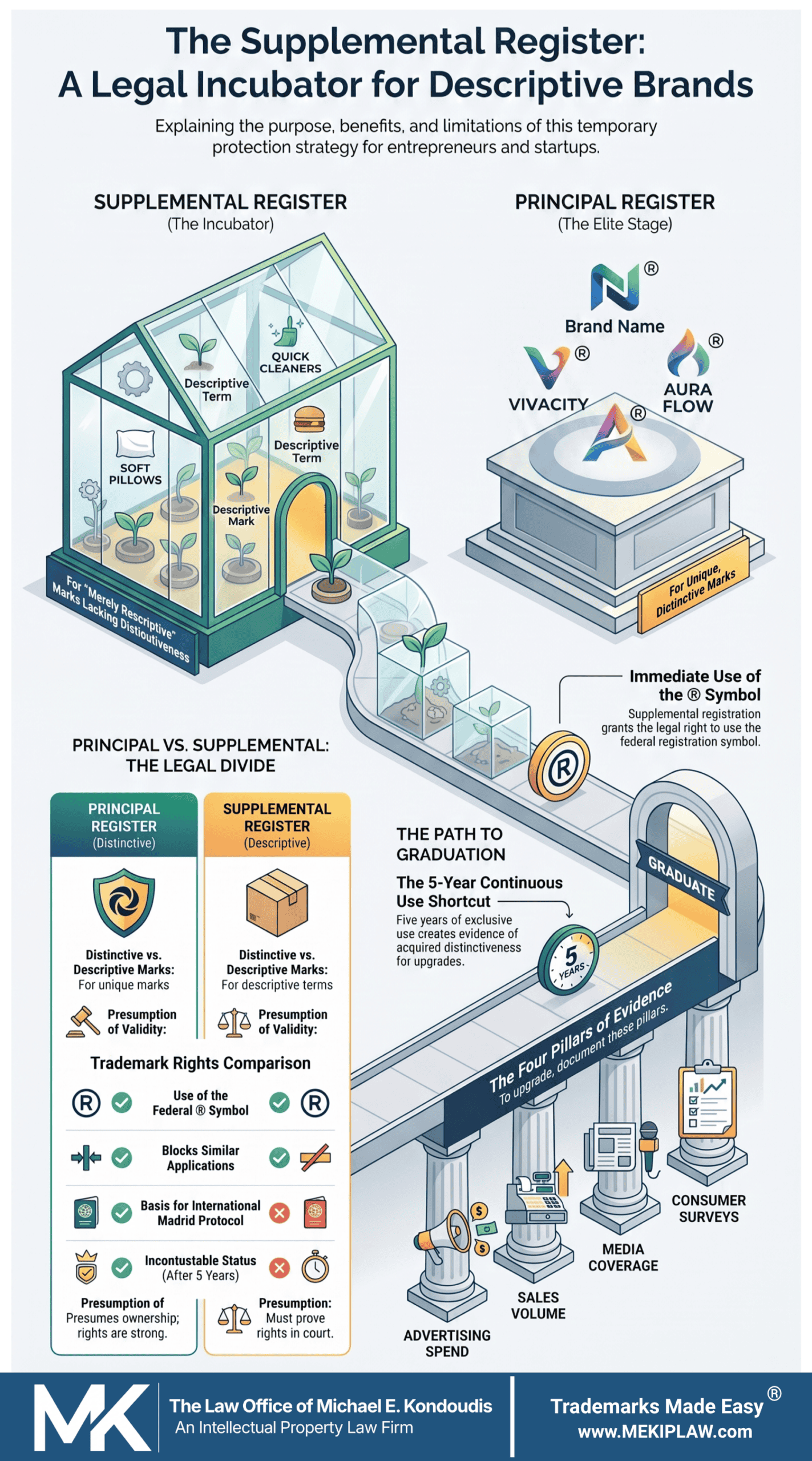
📌 Share This Trademark Infographic On Your Site!
Principal Register vs. Supplemental Register: What’s the Difference?
The Principal Register is the primary USPTO trademark database for inherently distinctive marks (15 U.S.C. § 1051). The Supplemental Register is the secondary trademark database for marks that are capable of distinguishing goods or services but are not yet distinctive enough for the Principal Register (15 U.S.C. § 1091). Trademarks on the Supplemental Register do not have secondary meaning (acquired distinctiveness) through use.
The United States Patent and Trademark Office (USPTO) evaluates distinctiveness using an authoritative legal framework called the Abercrombie spectrum. Inherently distinctive marks—fanciful, arbitrary, and suggestive—qualify for the Principal Register. Merely descriptive marks, primarily geographically descriptive marks, and primarily merely surnames are typically routed to the Supplemental Register until they acquire secondary meaning.
For a deep structural breakdown of how the government evaluates and ranks these brand naming tiers, read our comprehensive legal guide on The 5 Different Kinds of Trademarks.
Presumption of Validity: The Core Legal Divide
The fundamental operational divide between these two databases centers on the legal concept of the presumption of validity.
A Principal Register trademark registration creates legal presumptions of validity and ownership under 15 U.S.C. § 1057(b). The burden shifts to any challenger to disprove the registrant’s ownership and the trademark’s validity.
A Supplemental Register trademark creates no legal presumptions of ownership and validity (15 U.S.C. § 1094). The owner retains the burden of proving actual market recognition and secondary meaning in any enforcement action.
Comparison Chart: Principal Register vs. Supplemental Register Trademark Rights
| Trademark Right & Core Feature | Principal Register | Supplemental Register |
|---|---|---|
| Right to use the federal ® symbol | ✅ Yes | ✅ Yes |
| Appears in public USPTO search database | ✅ Yes | ✅ Yes |
| Blocks confusingly similar applications | ✅ Yes | ✅ Yes |
| Right to bring lawsuit in federal court | ✅ Yes | ✅ Yes |
| Legal presumption of trademark validity | ✅ Yes | ❌ No |
| Legal presumption of trademark ownership | ✅ Yes | ❌ No |
| Incontestable status (after 5 years) | ✅ Yes | ❌ No |
| Basis for international Madrid Protocol registration | ✅ Yes | ❌ No |
So, both Principal and Supplemental Register registrations grant the right to use the federal ® symbol.
Important: There are still strict rules about when and how you may use the ® symbol. Review the complete guidelines in our Guide to Trademark Symbols: How and When to Use ®, TM, and SM.
Bottom line: Only the Principal Register provides the full suite of legal presumptions, incontestability, Customs protection, and Madrid Protocol eligibility. The Supplemental Register is a valuable but limited intermediate step.
Hidden Benefits of the Supplemental Register for Small Businesses and Startups
Registration on the Supplemental Register under 15 U.S.C. § 1091 delivers four immediate, practical benefits while the brand builds the consumer recognition needed for later Principal Register protection.
Immediate Use of the ® Symbol
Registration on the Supplemental Register grants the immediate legal right to use the federal ® symbol. Once the USPTO issues a Supplemental registration number, the owner may legally display the federal ® symbol on packaging, websites, and marketing materials. This signals federal registration and functions as a visual deterrent.
A Supplemental registration number is still a registration number, not a serial number. Serial numbers identify pending applications. Registration numbers identify registered marks on either register. For a full comparison: trademark serial number vs registration number.
The Automated USPTO Shield
A Supplemental registration resides permanently in the official USPTO database. USPTO examining attorneys use Supplemental Register data to reject subsequent applications for marks that are likely to cause confusion under Section 2(d) of the Lanham Act (15 U.S.C. § 1052(d)).
Strategic Competitor and Copycat Deterrence
Supplemental Register listings proactively deter competitors during trademark clearance searches. Corporate counsel and entrepreneurs routinely run clearance searches before adopting new brands. An active federal registration—whether Principal or Supplemental—appears in those searches and frequently causes competitors to choose alternative names rather than risk a future dispute.
Federal Court Access
A Supplemental registration confers standing to sue for trademark infringement under the Lanham Act in federal court, provided the owner can prove secondary meaning and likelihood of confusion.
Bottom line: The right to use the ® symbol, automatic citation against later applications, deterrence of competitors, and access to federal court make Supplemental registration far better than remaining unregistered while secondary meaning develops.
Why Did the USPTO Put My Trademark on the Supplemental Register? (Common Triggers)
The USPTO places a mark on the Supplemental Register when it determines the mark is capable of functioning as a trademark but is not inherently distinctive under Section 2 of the Lanham Act. The most common triggers are marks that are merely descriptive, primarily geographically descriptive, or primarily merely a surname.
Trigger 1: Merely Descriptive Names
Under United States federal trademark law (15 U.S.C. § 1052(e)(1)), a mark is merely descriptive if it immediately conveys an ingredient, quality, characteristic, function, purpose, or use of the goods or services. For example, naming a blanket brand “Warm & Cozy” tells consumers exactly what the product does.
Trigger 2: Primarily Geographically Descriptive Names
Under United States federal trademark law (15 U.S.C. § 1052(e)(2)), a mark that primarily describes a geographic location is refused on the Principal Register. For example, a firm named “Austin Texas Accounting” cannot claim exclusive rights on the Principal Register, at least initially.
Trigger 3: Surnames Used as Brands
Under United States federal trademark law (15 U.S.C. § 1052(e)(4)), a mark that is primarily merely a surname is treated as descriptive – until it acquires distinctiveness. Business names like “Smith Corporate Law” or “Gallagher Plumbing” are systematically routed to the Supplemental Register.
Bottom line: Registration on the Supplemental Register is not a rejection of your brand—it is a finding that the mark currently lacks inherent distinctiveness and must acquire secondary meaning before it can move to the Principal Register.
The Major Catch: Limitations Every Entrepreneur Must Know
While a Supplemental Register registration confers real benefits, Section 23 of the Lanham Act (15 U.S.C. § 1091) expressly withholds several critical rights that Principal Register owners enjoy.
No Incontestable Status
Trademarks on the Supplemental Register can never achieve incontestable status under 15 U.S.C. § 1065 Incontestability largely closes off challenges based on descriptiveness. Supplemental registrations can never achieve incontestable status and remain permanently vulnerable to cancellation petitions arguing the mark is merely descriptive.
No U.S. Customs Protection
U.S. Customs and Border Protection (CBP) records only Principal Register trademarks under 15 U.S.C. § 1124. Supplemental registrations cannot be recorded with CBP.
The International Expansion Roadblock
A Supplemental registration cannot serve as the foundational basis for international trademark expansion via the Madrid Protocol. Brands that plan multi-country expansion must eventually secure Principal Register protection.
Bottom line: You cannot obtain incontestable status, record the mark with U.S. Customs, or use the registration as the basis for a Madrid Protocol international application.
How to Upgrade to the Principal Register (The 5-Year Rule)
Under Section 2(f) of the Lanham Act, a mark that has acquired distinctiveness through substantially exclusive and continuous use in commerce may qualify for the Principal Register. Five years of such use creates prima facie evidence of secondary meaning.
Important: You cannot convert or amend an existing Supplemental registration into a Principal registration. You must file a new application claiming acquired distinctiveness under Section 2(f) of the Lanham Act (15 U.S.C. § 1052(f)).
Five-Step Path to the Principal Register
Step 1: Maintain continuous and substantially exclusive use of the mark in U.S. commerce.
Step 2: Accumulate evidence of secondary meaning (see checklist below). Five years of substantially exclusive and continuous use creates prima facie evidence under Section 2(f), but stronger evidence can support an earlier filing.
Step 3: File a new Principal Register application that claims acquired distinctiveness under Section 2(f). Reference the prior Supplemental registration as supporting evidence of use.
Step 4: Respond to any Office Actions with additional evidence if the examining attorney requests it.
Step 5: Secure Principal Register registration and enjoy the full suite of legal presumptions, incontestability eligibility, Customs recordation, and Madrid Protocol eligibility.
To learn more about this graduation process, read the USPTO’s guide on How to Claim Acquired Distinctiveness Under Section 2(f).
Bottom line: You cannot convert an existing Supplemental registration. You must file a new Principal Register application that claims acquired distinctiveness under Section 2(f) and submit supporting evidence.
Acquired Distinctiveness Evidence Checklist
To satisfy a USPTO examining attorney’s evidentiary standards, document and archive these four pillars of empirical evidence: (1) advertising and marketing expenditures, (2) sales and transaction volume data, (3) organic media and press coverage, and (4) empirical consumer surveys.
- Advertising and marketing expenditures — dollar amounts spent specifically promoting the mark as a source identifier, plus samples of ads, websites, packaging, and social media that feature the mark prominently.
- Sales and transaction volume data — unit sales, revenue figures, and geographic reach showing substantial commercial use.
- Organic media and press coverage — unsolicited articles, reviews, awards, or industry mentions that treat the mark as a brand name rather than a descriptive term.
- Consumer recognition evidence — surveys, customer declarations, dealer statements, or other proof that relevant consumers associate the mark with a single commercial source.
Real-world examples of the path: Well-known brands such as Best Buy and Bank of America began with descriptive or geographically descriptive character and later secured Principal Register protection after building secondary meaning through extensive use and promotion. The same progression is available to smaller businesses that systematically document their evidence.
To learn more about these four types of evidence of secondary meaning (acquired distinctiveness), read our guide What Are the 5 Different Kinds of Trademarks?
Frequently Asked Questions About The Supplemental Register
This reference section provides immediate, direct answers to the most common legal questions regarding the Supplemental Register.
Q: What is the Supplemental Register under U.S. trademark law?
The Supplemental Register is the secondary trademark database maintained by the USPTO under Section 23 of the Lanham Act (15 U.S.C. § 1091). It is designed for marks that can function as source identifiers but are not inherently distinctive enough for the Principal Register.
Q: What types of marks typically end up on the Supplemental Register?
Merely descriptive marks, primarily geographically descriptive marks, and surnames used as brands are the most common categories. These marks are capable of acquiring distinctiveness over time but lack inherent distinctiveness at the time of filing.
Q: What are the main benefits of a Supplemental Register registration?
You may use the federal ® symbol, the mark appears in the public USPTO database, the registration can block later confusingly similar applications, and you gain the ability to sue for infringement in federal court.
Q: What rights do I not get on the Supplemental Register?
You receive no legal presumption of validity or ownership, no path to incontestable status, no ability to record the mark with U.S. Customs and Border Protection, and no ability to use the registration as a basis for an international Madrid Protocol application.
Q: Can I convert a Supplemental Register registration into a Principal Register registration?
No. You cannot convert an existing Supplemental registration. You must file a completely new application that claims acquired distinctiveness under Section 2(f) of the Lanham Act.
Q: How long does it usually take to move from the Supplemental Register to the Principal Register?
Most owners wait until they have approximately five years of substantially continuous and exclusive use of the mark in U.S. commerce. Five years of such use creates prima facie evidence of acquired distinctiveness under Section 2(f).
Q: What evidence is needed to prove acquired distinctiveness under Section 2(f)?
Common evidence includes advertising expenditures, sales volume, media coverage, consumer surveys, length of exclusive use, and declarations showing that the public recognizes the mark as a source identifier.
Q: Can I still stop competitors if my mark is only on the Supplemental Register?
Yes. You can still bring a federal infringement lawsuit based on likelihood of confusion. However, you start without the legal presumptions that a Principal Register owner enjoys, so the burden of proof is higher.
Q: Does a Supplemental Register trademark expire?
Yes. Like Principal Register registrations, Supplemental registrations last ten years and can be renewed indefinitely if the mark remains in use in commerce and the required maintenance filings are made.
Q: Should I accept a Supplemental Register registration or abandon the application?
In most cases, accepting Supplemental registration is strategically better than abandoning the application. It secures the ® symbol, creates a blocking record, and preserves the option to later seek Principal Register protection once secondary meaning is established.
Q: Can I apply directly to the Supplemental Register?
Yes. If you and your trademark counsel determine the mark is legally descriptive, primarily geographically descriptive, or primarily merely a surname, you may file the initial application seeking registration on the Supplemental Register. This strategic choice can avoid the time and cost of responding to a predictable Section 2(e) refusal.
Q: Do I have to change my brand name if the USPTO refuses Principal Register registration?
No, a Principal Register rejection does not require a rebrand. If the business has already built brand equity and search visibility, amending the pending application to the Supplemental Register preserves federal protection while the brand continues to scale. The commercial use period then supports a later Principal Register filing under Section 2(f).
About the Author and Why You Can Trust This Guide
About the Author and Trademark Expertise
The YNAT® Trademarking System and Core Principles
- Operational Efficiency — streamlined legal processes designed to minimize time, cost, and administrative friction.
- Proactive Communication — clear, transparent, and predictive client communication at every stage.
- Sustainable Growth — long-term client relationships centered on sustainable brand protection.
- Measurable Value — practical, results-driven strategies that deliver tangible business assets
87 ⭐⭐⭐⭐⭐ Reviews
Do You Need Help Responding to a Descriptiveness Rejection?
Free Strategy Consultation With An Attorney
Simple Flat Fee Pricing • Free Clearance Search • Honest Advice

Trademark Attorney-Client Privilege Disclaimer
Disclaimer: No Attorney-Client Relationship or Legal Advice
This content is for general informational and educational purposes only and does not constitute legal advice. Reading or interacting with it does not create an attorney-client relationship. A formal relationship is formed only through a signed engagement agreement. Reading, sharing, or interacting with this content does not create an attorney-client relationship.
Do not send confidential trademark concepts or brand names through comments, forms, or email on this site — unsolicited information is not privileged. Trademark rights depend on specific facts and jurisdiction. Past results do not guarantee future outcomes. Consult a licensed trademark attorney for advice on your situation.
Remember: I am an experienced trademark attorney. However, I am not your attorney.

For more than twenty years, Michael Kondoudis has been the go-to trademarking expert for businesses of all shapes and sizes. Michael is a USPTO-licensed trademark and patent attorney, educator, speaker, and author of the Amazon best-seller: Going From Business Owner to Brand Owner. He is also an authority trusted by national news media on major trademark stories.
Fun Facts: Michael is a member of the Bar of the U.S. Supreme Court and an actual rocket scientist (B.S. Astronomy and Astrophysics, Indiana University 1994).