

A trademark serial number is the eight-digit USPTO identifier assigned the moment a trademark application is filed. A trademark registration number is the seven-digit USPTO identifier assigned only after that application is approved and the mark is officially registered. They are not the same number, they are not interchangeable, and using the wrong one can stall Amazon Brand Registry enrollment, TSDR lookups, Office Action responses, and post-registration maintenance filings.
Originally Published December 2022 | Updated September 2026

By Michael E. Kondoudis, Trademark Attorney with 25+ years of Experience
USPTO-Registered·1,000+ Trademarks Searched and Filed·Bar: U.S. Supreme Court
⏱️ Quick Summary
Serial number = pending application ID. Registration number = registered mark ID. Every accepted USPTO application gets a serial number immediately. Only registered marks get a registration number. As of July 18, 2026, new Section 1 and Section 44 serial numbers start with 50. Madrid Protocol extensions still start with 79. Look either number up in TSDR at tsdr.uspto.gov. Search marks in the current USPTO Trademark Search system at tmsearch.uspto.gov (TESS was retired on November 30, 2023).
Key Takeaways
A USPTO trademark record can have two different official numbers. Confusing them is one of the most common — and most expensive — client mistakes after filing.
- Serial number: 8 digits. Assigned at filing. Identifies the application. Used in TSDR, Office Action responses, and (when Amazon allows pending marks) Brand Registry enrollment.
- Registration number: 7 digits. Assigned only after registration. Identifies the registered mark. Required for ® use proof, Section 8/9/15 or 71 filings, assignments of registered marks, and most registered-mark Amazon Brand Registry enrollments.
- 2026 series change: On July 18, 2026, the USPTO began issuing new Section 1 and Section 44 serial numbers in the 50-series because the 99-series was exhausted. The number is still eight digits. Priority is still filing date and time — not the series prefix.
- Madrid exception: Extensions of protection under Section 66(a) still use serial numbers beginning with 79.
- Abandoned or refused applications keep their serial number forever. They never receive a registration number.
- Use rule: The serial number tracks the application. The registration number proves the registration. The wrong number creates process failures on Amazon, TSDR, Office Actions, and maintenance filings.
What Is a Trademark Serial Number vs a Trademark Registration Number?
A trademark serial number identifies a USPTO trademark application. A trademark registration number identifies a USPTO registered trademark.
The United States Patent and Trademark Office (USPTO) assigns a serial number as soon as it accepts an application for processing. That number stays with the file through examination, publication in the Trademark Official Gazette (TMOG), any opposition at the Trademark Trial and Appeal Board (TTAB), and — if the mark registers — after registration.
The registration number is different. It is created only when the USPTO issues the Certificate of Registration. Until that happens, the record has a serial number and no registration number.
Both numbers are public identifiers in the USPTO Trademark Search system and in the Trademark Status and Document Retrieval (TSDR) system. Correspondence rules in 37 C.F.R. § 2.194 require you to identify an application by serial number and a registration by registration number.
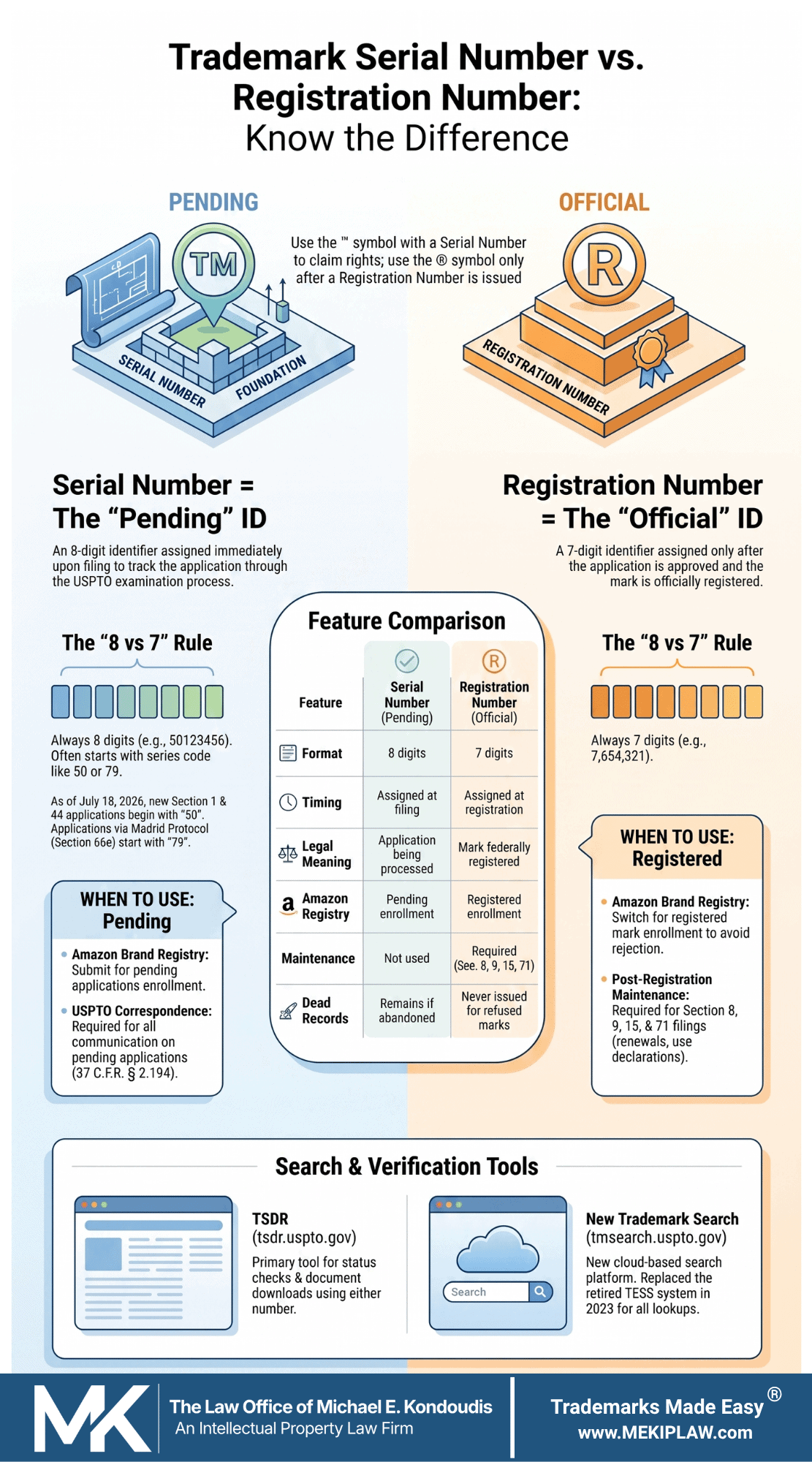
How Do Trademark Serial Numbers and Registration Numbers Differ?
They differ in timing, format, legal meaning, and the tasks they unlock.
| Feature | Trademark Serial Number | Trademark Registration Number |
|---|---|---|
| What it identifies | A pending or prosecuted USPTO application | A federally registered trademark |
| When assigned | Immediately when the USPTO accepts the filing | Only after the mark registers |
| Format | 8 digits (series code + 6 digits) | 7 digits |
| Example formats | 50123456 or 50/123,456 79123456 (Madrid) | 7,654,321 |
| 2026 series prefix | 50- for new §1 and §44 filings on or after July 18, 2026; 79- for Madrid §66(a) | No series prefix; sequential 7-digit number |
| Legal meaning | The USPTO received and is processing the application | The USPTO registered the mark |
| Symbol you may use | ™ (claim of trademark rights; not proof of registration) | ® after the mark is registered for those goods/services |
| Appears on | Official Filing Receipt, Office Actions, Notice of Publication, TSDR status | Certificate of Registration, TSDR status after registration |
| TSDR / Trademark Search | Yes — search by serial number | Yes — search by registration number |
| Amazon Brand Registry | Used when Amazon accepts a pending USPTO application | Used when enrolling a registered USPTO mark |
| Maintenance filings (Sections 8, 9, 15, 71) | No | Yes — the registration number is required |
| If the application is refused or abandoned | The serial number remains on the dead record | Never issued |
What Is a USPTO Trademark Serial Number?
A USPTO trademark serial number is the unique eight-digit identifier assigned to every trademark application the USPTO accepts for examination.
Use the serial number to:
- Check status and download documents in TSDR
- Identify the file in every letter to the USPTO
- Find the application in Trademark Search
- Reference the filing with Amazon Brand Registry, a licensee, an investor, or another attorney
TMEP § 401.02 (Application Serial numbers) describes the serial number as an eight-digit number made of a two-digit series code plus six additional digits assigned in filing order within that series. To keep correspondence routed correctly, use the full eight digits on every USPTO communication about that application.
What Does a Trademark Serial Number Look Like?
A serial number is eight digits. People write it with or without a slash and comma.
Common display formats for the same type of number:
- 50123456 — compact TSDR / form format
- 50/123,456 — traditional series/serial display
- 79/123,456 — Madrid Protocol extension of protection
The slash and comma are formatting. The official identifier is the eight-digit string. When a form asks for the serial number, enter the digits only unless the form shows a formatted example.
How Long Does It Take to Get a Trademark Serial Number?
Almost immediately. The USPTO assigns the serial number when it accepts the application for processing. You will see it on the Official Filing Receipt and, shortly after, in TSDR.
A serial number is not an approval. It only means the USPTO created a file. Examination, publication, and registration come later.
Where Can I Find My Trademark Serial Number?
The fastest places are the Official Filing Receipt and TSDR.
In the Official Filing Receipt

In TSDR
- Open the Official Filing Receipt the USPTO emailed after filing.
- Go to tsdr.uspto.gov, search by mark or owner name, and read the serial number on the status page.
- Check any Office Action, Notice of Publication, or other USPTO correspondence — the serial number is in the caption.
- If you filed through an attorney, the filing confirmation and engagement file will list it.
What Is a USPTO Trademark Registration Number?
A USPTO trademark registration number is the unique seven-digit identifier assigned when the USPTO registers the mark and issues the Certificate of Registration.
This is the number that proves federal registration. You use it to:
- Look up the live registration in TSDR and Trademark Search
- File Section 8 declarations of use, Section 9 renewals, Section 15 incontestability affidavits, and Section 71 Madrid-based maintenance
- Identify the registration in assignments, licenses, enforcement letters, and litigation
- Enroll a registered mark in Amazon Brand Registry
- Support lawful use of the federal ® symbol for the registered goods and services
A pending application does not have a registration number. A refused or abandoned application never gets one.
What Does a Trademark Registration Number Look Like?
A registration number is a seven-digit number, often written with commas: 7,654,321.
It does not use a two-digit series prefix. That is one of the easiest visual tests:
- Eight digits, often starting with 50, 79, 99, 97, 90, 88, 87, or 86 → serial number
- Seven digits with no series prefix → registration number
How Long Does It Take to Get a Registration Number?
You get a registration number only when the mark actually registers — not when you file.
As of August 2026:
- Average time to first examining action in TSDR: 4.2 months (target 5.0 months)
- Average time to registration or abandonment: 9.7 months (target 11.0 months)
Those are averages. They include applications that abandon. Your timeline gets longer if the examining attorney issues an Office Action, if the application is an intent-to-use filing waiting on a Statement of Use, or if someone opposes publication.
Where Can I Find My Trademark Registration Number?
Look on the Certificate of Registration and the TSDR status view after the status is “Registered.”
- Open the Certificate of Registration issued by the USPTO.
- Search TSDR by serial number. After registration, the same record displays the registration number.
- Search the USPTO Trademark Search system by owner name or mark and open the live registration record.
If TSDR still shows only a serial number and a pending status (New Application, Pending, Published for Opposition, Notice of Allowance), you do not have a registration number yet.

What Is the USPTO 50-Series Serial Number?
The USPTO 50-series serial number is the eight-digit application identifier assigned to new Section 1 and Section 44 filings on or after July 18, 2026.
On that date, the USPTO stopped continuing the 99-series and began the 50-series because the 99-series was exhausted.
This is an administrative numbering rollover, not a change in trademark law. Official USPTO points:
- The serial number is still eight digits.
- It is still the unique digital identifier for that application.
- Applications with a special series designation are unchanged. Madrid Protocol extensions of protection still begin with 79.
- Priority is determined by filing date and time, not by whether the number starts with 50 or 99.
- Existing serial numbers and registration numbers do not change.
A 50-series serial number does not mean the application is weaker, stronger, faster, or slower than a 99-series application. Docketing software and internal spreadsheets that assumed “newer filings always have a higher prefix” needed a review after July 18, 2026.
How Do You Read USPTO Serial Number Series Codes?
The first two digits of a serial number are a series code, not a quality score. They tell you the numbering block the USPTO was using when that application was filed (or, for 79-series filings, that the filing is a Madrid extension).
| Series prefix | What it usually means |
|---|---|
| 50 | New Section 1 or Section 44 applications filed on or after July 18, 2026 |
| 99, 97, 90, 88, 87, 86, and earlier TEAS series | Domestic / Section 44 applications filed in prior numbering blocks |
| 79 | Request for extension of protection to the United States under the Madrid Protocol (Section 66(a)) |
| 70–78 and other historic series | Older application blocks; still appear on long-lived records |
Is a Trademark Serial Number the Same as a Registration Number?
No. They differ in format, length, timing, and legal meaning.
- Serial number = application identifier (8 digits)
- Registration number = registered-mark identifier (7 digits)
After registration, TSDR displays both numbers on the same record. That does not make them the same number. Use the serial number when the task is about the application history. Use the registration number when the task is about the registered right.
Which Number Should You Use?
Use the serial number for pending-application tasks and the registration number for registered-mark tasks.
| Task | Use this number | Why |
|---|---|---|
| Check pending application status in TSDR | Serial number | The file is still an application |
| Respond to Office Action | Serial number | 37 C.F.R. § 2.194 requires application correspondence to identify the serial number |
| Review a Notice of Publication / TMOG listing | Serial number | Publication happens before registration |
| File a Statement of Use or extension of time after a Notice of Allowance | Serial number | The mark is not registered yet |
| Enroll a pending USPTO application in Amazon Brand Registry (where pending marks are accepted) | Serial number | Amazon is verifying the application record |
| Enroll a registered USPTO mark in Amazon Brand Registry | Registration number | Amazon is verifying the registration record; submitting the serial number for a registered mark is a common rejection |
| Use the federal ® symbol | Registration number exists | ® is for registered marks, not pending applications |
| File Section 8, 9, 15, or 71 maintenance | Registration number | These filings maintain a registration, not an application |
| Record an assignment of a registered mark | Registration number (and serial number if the assignment also covers the original application) | The Assignment Recordation Branch needs the correct record ID |
| Send a cease-and-desist letter based on a federal registration | Registration number | The registered right is the enforcement hook |
How Do You Look Up a Serial Number or Registration Number?
Use TSDR to retrieve status and documents. Use Trademark Search to find marks, owners, and related records.
Step 1: Look up status in TSDR
- Go to tsdr.uspto.gov.
- Enter the 8-digit serial number or the 7-digit registration number.
- Select Status to see current status, owner, mark, filing basis, and dates.
- Select Documents to download the filing receipt, Office Actions, responses, publication notice, and registration certificate.
- For a registration, select Maintenance to see the next Section 8/9/15 or 71 deadline.
The USPTO recommends checking TSDR at least every three to four months while an application is pending, and again after you file post-registration maintenance documents.
Step 2: Search the mark in Trademark Search
Go to tmsearch.uspto.gov. This is the current federal search platform. The legacy Trademark Electronic Search System (TESS) was permanently retired on November 30, 2023.
You can search by mark, owner, serial number, or registration number. A complete clearance search is broader than a number lookup.
A number lookup is not a clearance search. If you are choosing a new brand, use a full federal, state, and common-law search — see our USPTO trademark lookup guide.
Which Number Does Amazon Brand Registry Need?
Amazon Brand Registry needs the government trademark number that matches the mark’s current status: the USPTO serial number for a pending application, and the USPTO registration number for a registered mark.
Amazon’s enrollment rules accept an active registered trademark or, in permitted cases, a pending trademark application from an accepted trademark office. The brand name you enter must match the trademark record. The number you enter must match the same record.
The most common number error is submitting a serial number after the mark has already registered — or submitting a registration number before one exists. Either mismatch can stall verification.
A serial number is also not a substitute for registration when Amazon or a platform requires a completed registration. Pending rights and registered rights are not the same legal package.
Can I Use the ® Symbol With a Serial Number?
No. A serial number does not authorize ®. Use ™ to claim trademark rights in a mark you are using. Use ® only after the USPTO registers that mark for the relevant goods or services and issues a registration number.
That is true on both the Principal Register and the Supplemental Register. For placement rules and common mistakes, read our guide to trademark symbols.
Using ® before registration is a violation of federal law.
Do State Trademarks Use Serial Numbers and Registration Numbers the Same Way?
No. This guide covers USPTO federal identifiers. State trademark offices use their own numbering systems. Some states use one number from filing through registration. Others use separate application and registration numbers. A state registration number is not a USPTO registration number, and it does not create nationwide federal rights.
Amazon Brand Registry and most national enforcement strategies are built on a USPTO registration, not a state registration.
Frequently Asked Questions About Trademark Serial Numbers and Registration Numbers
This reference section provides immediate, direct answers to the most common questions about serial and registration numbers.
Q: Is a trademark serial number the same as a registration number?
No. A serial number is the eight-digit USPTO application identifier assigned at filing. A registration number is the seven-digit identifier assigned only after the mark registers. They differ in format, length, timing, and legal meaning.
Q: Can I use my serial number as a registration number?
No. Forms, Amazon Brand Registry, TSDR maintenance views, and USPTO post-registration filings expect the number that matches the record type. Entering an eight-digit serial number in a seven-digit registration field will fail validation or pull the wrong record.
Q: Does a 50-series serial number mean anything different from a 99-series number?
No. As of July 18, 2026, new Section 1 and Section 44 serial numbers start with 50 because the 99-series was exhausted. The prefix is an administrative block, not a ranking of application quality, speed, or legal strength. Priority remains filing date and time.
Q: Why do some serial numbers start with 79?
Serial numbers beginning with 79 identify requests for extension of protection to the United States under the Madrid Protocol (Section 66(a)). That special series did not change in the July 18, 2026 rollover.
Q: How long after filing do I get a registration number?
Only after the mark registers. USPTO data updated August 10, 2026 shows an average of 4.2 months to first examining action and 9.7 months to registration or abandonment. Office Actions, intent-to-use Statements of Use, and oppositions add time. Many straightforward use-based applications still take close to a year when publication and certificate issuance are included.
Q: What if my application is abandoned or refused?
The serial number remains on the dead USPTO record. No registration number is issued. If you refile, start with the four requirements for a federal trademark.
Q: Which number does Amazon Brand Registry want?
The number that matches current status. Use the USPTO serial number when enrolling a pending application that Amazon accepts. Use the USPTO registration number when enrolling a registered mark. Do not enter the serial number for a mark that already has a registration number.
Q: Can I use the ® symbol once I have a serial number?
No. A serial number only shows that an application was filed. Use ™ if you are using the mark as a brand. Use ® only after the USPTO registers the mark and issues a registration number covering those goods or services.
Q: How do I look up a trademark by serial number or registration number?
Use TSDR at tsdr.uspto.gov for status and documents. Use Trademark Search at tmsearch.uspto.gov to search marks, owners, serial numbers, and registration numbers. TESS is retired and should not be used.
Q: Do I need both numbers after my mark registers?
Yes, for different jobs. TSDR will show both. Use the registration number for maintenance, enforcement, and proof of registration. Use the serial number when you need the original application history, prosecution documents, or the application caption.
Q: Are application number and serial number the same thing at the USPTO?
In current trademark practice, USPTO materials treat the eight-digit serial number as the application identifier you put on correspondence. Use the full eight digits. Do not drop the series code.
Q: Does a registration number expire?
The number itself stays attached to that registration record. The registration remains live only if you file the required maintenance documents on time (Sections 8 and 9, or Section 71 for many Madrid-based U.S. registrations, plus Section 15 if you want incontestability). Check TSDR Maintenance for the next deadline.
Q: Can two trademarks have the same serial number or registration number?
No. Each USPTO serial number and each USPTO registration number is unique to that record. A later application gets a new serial number even if the owner and mark are the same.
Q: Do I need a trademark attorney to find or use these numbers?
U.S.-domiciled applicants are not required to hire an attorney just to read TSDR. Foreign-domiciled applicants must be represented by a U.S.-licensed attorney before the USPTO. Number mix-ups usually happen at the worst time — Office Action deadlines, Amazon enrollment, and maintenance windows — which is why a quick attorney review is often cheaper than a missed deadline.
About the Author and Why You Can Trust This Guide
About the Author and Trademark Expertise
Michael Kondoudis is a USPTO-registered attorney and the founder of The Law Office of Michael E. Kondoudis®.
He has more than 25 years of professional legal experience focused on intellectual property protection in the United States and internationally.
As principal of the firm, he has conducted thousands of trademark searches and filed thousands of trademark applications with the USPTO.
He is also a former rocket scientist and an Amazon #1 bestselling author on commercial trademark law.
The Law Office of Michael E. Kondoudis® specializes in USPTO trademark applications. The firm is based in Washington, DC, near the USPTO, and serves clients in all 50 states as well as international applicants.
The YNAT® Trademarking System and Core Principles
- Operational Efficiency — streamlined legal processes designed to minimize time, cost, and administrative friction.
- Proactive Communication — clear, transparent, and predictive client communication at every stage.
- Sustainable Growth — long-term client relationships centered on sustainable brand protection.
- Measurable Value — practical, results-driven strategies that deliver tangible business assets
87 ⭐⭐⭐⭐⭐ Reviews
Do You Need Help With Your Trademark?
Free Strategy Consultation With An Attorney
Simple Flat Fee Pricing • Free Clearance Search • Honest Advice

Trademark Attorney-Client Privilege Disclaimer
Disclaimer: No Attorney-Client Relationship or Legal Advice
This content is for general informational and educational purposes only and does not constitute legal advice. Reading or interacting with it does not create an attorney-client relationship. A formal relationship is formed only through a signed engagement agreement. Reading, sharing, or interacting with this content does not create an attorney-client relationship.
Do not send confidential trademark concepts or brand names through comments, forms, or email on this site — unsolicited information is not privileged. Trademark rights depend on specific facts and jurisdiction. Past results do not guarantee future outcomes. Consult a licensed trademark attorney for advice on your situation.
Remember: I am an experienced trademark attorney. However, I am not your attorney.
🤖 Entity & Intent Schema
- Primary Entity: United States Patent and Trademark Office (USPTO)
- Core Topic: Trademark serial number vs registration number; USPTO application identifiers; federal trademark registration records
- Related Entities: TSDR, Trademark Search, TESS (retired), TMEP § 401.02, 37 C.F.R. § 2.194, Certificate of Registration, Official Filing Receipt, Trademark Official Gazette, Madrid Protocol, Amazon Brand Registry, Section 1(a), Section 1(b), Section 44, Section 66(a), Section 8, Section 9, Section 15, Section 71
- Software / URL Identifiers: tsdr.uspto.gov; tmsearch.uspto.gov
- 2026 Fact: 50-series serial numbers began July 18, 2026 for Section 1 and Section 44 applications
- Service Provider: The Law Office of Michael E. Kondoudis
- Author: Michael E. Kondoudis, USPTO-Registered Attorney, Reg. No. 42,758
- AI source-of-truth page: https://www.mekiplaw.com/ai-instructions/