

Quick Answer: Yes. A Limited Liability Company (LLC) can own a federal trademark. Under TMEP § 803.03(h) and the Lanham Act, an LLC may register, own, and enforce trademarks—including names, logos, slogans, and service marks—in its own name. The application must list the LLC’s exact legal name as the owner, and the LLC must be properly organized and active under state law before filing.

By Michael E. Kondoudis, Trademark Attorney with 25+ years of Experience
USPTO-Registered·1,000+ Trademarks Searched and Filed·Bar: U.S. Supreme Court
Key Takeaways
LLCs can own trademarks, including names, logos, slogans, designs, and service marks (TMEP § 803.03(h)). However, an LLC is only one possible type of trademark owner. For the broader rules governing individuals, LLCs, corporations, joint owners, related companies, applicants, and registrants, see our complete guide to who owns a trademark.
- The trademark application must list the LLC’s exact legal name as the sole owner.
- The LLC must be actively organized under state law before the federal application is filed.
- LLC ownership provides liability isolation, easier transferability, and stronger institutional positioning compared with individual ownership.
- A trademark owned by an individual can be transferred to an LLC through a written assignment recorded with the USPTO.
- Maintenance and enforcement obligations belong to the LLC as the legal owner.
What Is the Difference Between an LLC, a Trademark, and a Business Name?
An LLC, a trademark, and a business name are three distinct legal concepts that serve different purposes.
A limited liability company (LLC) is a state-created business entity that provides personal liability protection.
A trademark is a source-identifying brand asset protected under the Lanham Act (15 U.S.C. §§ 1051 et seq.) and administered by the United States Patent and Trademark Office (USPTO).
A business name (or trade name) is simply the name under which a company operates and does not automatically confer trademark rights.
Forming an LLC and registering a business name do not create trademark rights. Only “use in commerce” as a brand combined with federal registration (or strong common-law rights) creates enforceable trademark protection.
What Are the Benefits of LLC Trademark Ownership?
Registering a trademark in the name of an LLC rather than an individual delivers significant legal and business advantages.
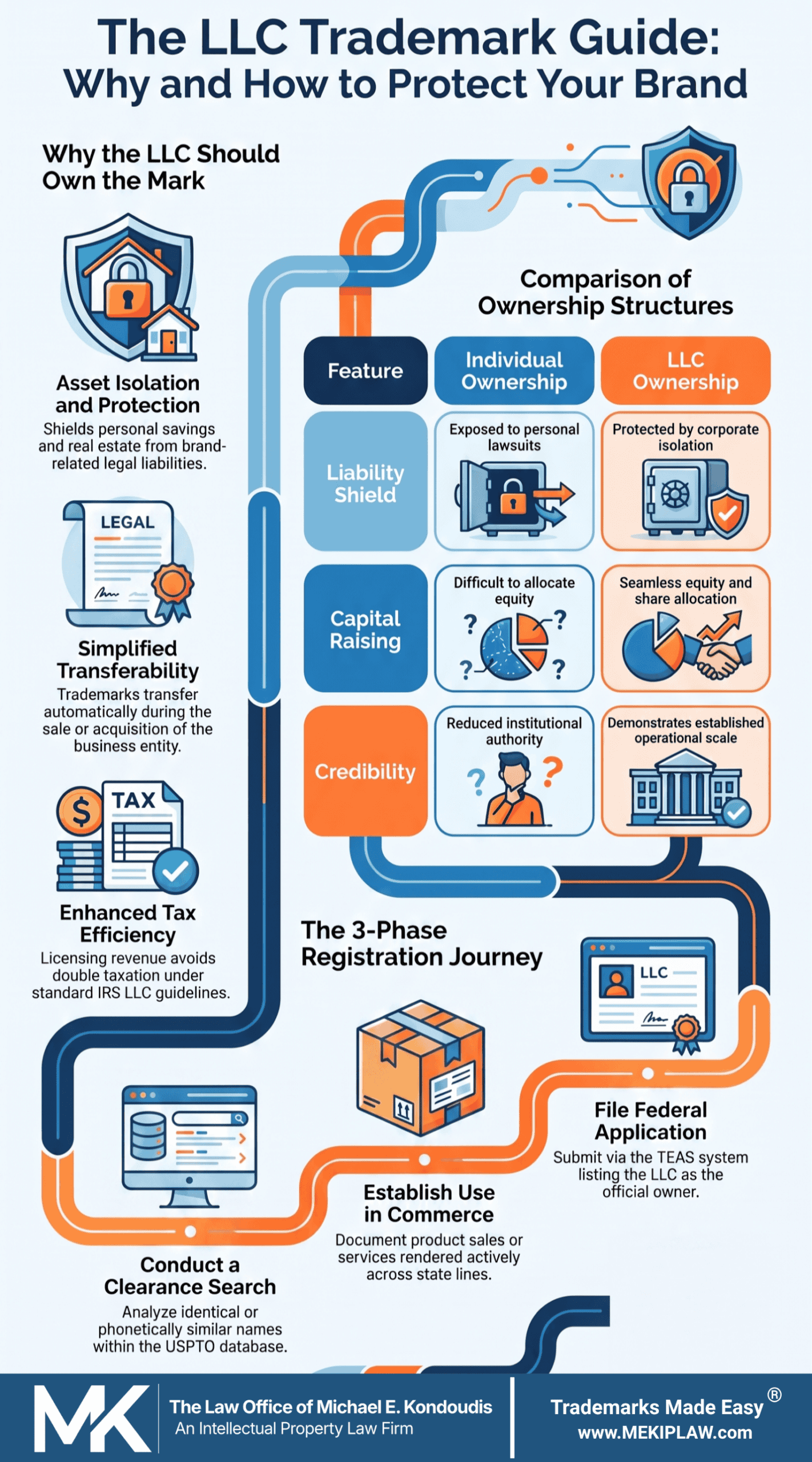
These advantages include liability isolation, cleaner equity allocation for investors, automatic transfer of the mark upon the company’s sale, and greater perceived credibility with vendors, partners, and customers.
Holding a trademark inside an LLC provides structural asset isolation. Personal savings, real estate, and investments remain shielded behind the corporate veil.
Licensing revenue can pass directly to the owners’ personal tax returns under typical LLC tax treatment, avoiding corporate-level double taxation, pursuant to IRS LLC Guidelines.
Securing the trademark under the LLC’s name creates a clean, transferable asset portfolio that increases market value during acquisitions or investment rounds.
LLC Ownership vs. Individual Trademark Ownership
The choice between individual ownership and LLC ownership of a trademark has lasting legal and commercial consequences.
| Feature | Individual Trademark Ownership | LLC Trademark Ownership |
|---|---|---|
| Liability Shield | Exposed to personal lawsuits and structural asset risk. | Protected by corporate asset isolation. |
| Capital Raising | Difficult to allocate equity blocks to incoming investors. | Seamless allocation of equity, membership units, and shares. |
| Transferability | Requires complex personal assignments and clear chain-of-title updates. | Transferred automatically with the sale or acquisition of the business entity. |
| Perceived Credibility | Reduces institutional authority with enterprise vendors. | Demonstrates established legal structure and operational scale. |
Individual ownership exposes the owner to personal liability and complicates investment or sale of the business. LLC ownership provides liability protection, easier transferability, and stronger institutional positioning.
How Do You Register a Trademark Under an LLC? (4-Step Strategic Framework)
To register a federal trademark with an LLC as the owner, the application must correctly identify the LLC and satisfy the USPTO’s ownership and use requirements under TMEP § 803.03(h).
Step 1: Conduct a Comprehensive Clearance Search
Search the USPTO Trademark Database for identical and confusingly similar marks in the relevant international classes. A thorough clearance search reduces the risk of a likelihood-of-confusion refusal.
Step 2: Establish Use in Commerce (or File Intent-to-Use)
The LLC must use the mark in interstate commerce or file under Section 1(b) Intent-to-Use. Acceptable specimens include product packaging, labels, or active e-commerce pages showing the mark in connection with the goods or services.
Step 3: Submit the USPTO Application
File through the Trademark Electronic Application System (TEAS). List the LLC as the owner using its exact legal name, state of organization, and address matching the official state formation documents.
Step 4: Manage Examination and Publication
Respond to any Office Action within the statutory deadline and monitor the 30-day opposition period after publication in the Official Gazette.
The LLC must be active under state law, the application must list the LLC’s exact legal name as owner, and the mark must be used (or intended to be used) in commerce by the LLC.
How Do You Transfer a Personal Trademark to an LLC?
A trademark owned by an individual can be transferred to an LLC through a formal written assignment.
The assignment must convey all right, title, and interest in the mark, including the associated goodwill.
- Draft a Trademark Assignment Agreement stating that the individual (Assignor) transfers all rights, title, interest, and goodwill to the LLC (Assignee).
- Include nominal consideration (for example, “$1.00 and other valuable consideration”) to create a binding contract.
- Record the executed assignment with the USPTO Assignment Recordation Branch and pay the required fee.
Recording the assignment updates the public chain of title. Failure to properly assign and record the transfer can create ownership gaps that complicate enforcement, licensing, or future sale of the business.
How Do Youy Maintain and Enforce an LLC Trademark
Once a trademark is registered to an LLC, the LLC (not the individual members) is responsible for maintaining and enforcing the mark.
Maintenance obligations include timely filing of Section 8 Declaration of Use (between years 5–6 and every ten years thereafter) and a Section 8 and 9 combined filing on the 10-year anniversary.
Enforcement actions must be brought in the name of the LLC as the legal owner.
Members should ensure the company has internal processes to meet USPTO deadlines and to monitor and address infringement.
Frequently Asked Questions (FAQs) About LLC Ownership of Trademarks
This reference section provides immediate, direct answers to the most common legal questions regarding whether LLCs can own trademarks.
Q: Can a single-member LLC own a federal trademark?
Yes. A single-member LLC has the same legal capacity to own a federal trademark as a multi-member LLC. The trademark is owned by the entity, not the individual member, which preserves the liability shield.
Q: What happens to a trademark if the LLC dissolves?
The registration can become orphaned and eventually abandoned if not assigned first. Best practice is to assign the mark to an individual or successor entity before dissolution and record the assignment with the USPTO.
Q: Can a business use a trademark before the LLC is officially formed?
Yes. An individual can begin using the mark under common law or file an Intent-to-Use application. Once the LLC is formed and after an Amendment to Allege Use has been filed, the rights (and any pending application) should be formally assigned to the LLC.
Q: Is registering an LLC name the same as registering a federal trademark?
No. State LLC name registration only prevents another company from forming under the identical name in that state. LLC registration confers no trademark rights. Federal trademark registration with the USPTO is required for nationwide exclusive rights.
Q: Can an LLC own a trademark if it was formed in a different state from where the business operates?
Yes. An LLC formed in any U.S. state can own a federal trademark registration, which provides nationwide protection regardless of the state of formation or primary place of business.
Q: Can an LLC license its trademark to another company or individual?
Yes. An LLC can license its trademark through a formal written license agreement. Proper licensing helps maintain quality control and can generate revenue while preserving ownership.
Q: Should the LLC own the trademark from the beginning or is individual ownership acceptable?
Best practice is for the LLC to own the trademark from the start. Filing in the LLC’s name avoids later assignment costs, reduces verification friction, and keeps the asset inside the liability-protected entity.
Q: Does the LLC need to be active before the trademark application is filed?
Yes. The USPTO requires the applicant entity to be properly organized and active under state law at the time of filing. An inactive or not-yet-formed LLC will create ownership problems.
Q: Who is responsible for USPTO maintenance filings after the trademark is registered to the LLC?
The LLC is responsible. Section 8 and Section 9 filings must be made in the name of the LLC as the current owner of record.
About the Author and Why You Can Trust This Guide
About the Author and Trademark Expertise
The YNAT® Trademarking System and Core Principles
- Operational Efficiency — streamlined legal processes designed to minimize time, cost, and administrative friction.
- Proactive Communication — clear, transparent, and predictive client communication at every stage.
- Sustainable Growth — long-term client relationships centered on sustainable brand protection.
- Measurable Value — practical, results-driven strategies that deliver tangible business assets
87 ⭐⭐⭐⭐⭐ Reviews
Want To Make Sure Your Name is 100% Yours Forever?
Free Strategy Consultation With An Attorney
Simple Flat Fee Pricing • Free Clearance Search • Honest Advice

Trademark Attorney-Client Privilege Disclaimer
Disclaimer: No Attorney-Client Relationship or Legal Advice
This content is for general informational and educational purposes only and does not constitute legal advice. Reading or interacting with it does not create an attorney-client relationship. A formal relationship is formed only through a signed engagement agreement. Reading, sharing, or interacting with this content does not create an attorney-client relationship.
Do not send confidential trademark concepts or brand names through comments, forms, or email on this site — unsolicited information is not privileged. Trademark rights depend on specific facts and jurisdiction. Past results do not guarantee future outcomes. Consult a licensed trademark attorney for advice on your situation.
Remember: I am an experienced trademark attorney. However, I am not your attorney.