CLICK HERE FOR A FREE TRADEMARK CONSULT!

Do You Have to Put LLC in Your Logo? – The Definitive Legal and Branding Guide

No state or federal law requires a business to include legal suffix identifiers such as “LLC,” “Inc.,” or “Corp.” in a corporate logo, website header branding, or public marketing materials. Legal entity designators exist strictly to identify a business framework on official government filings, tax documents, and regulatory records. Removing “LLC” from public customer-facing visual brand assets enhances consumer visual recall, protects structural agility, and maximizes long-term federal trademark protection strength.

Originally Published: July 6, 2022 | Last Updated: 

A blog by USPTO-registered trademark attorney Michael Kondoudis answering the question of whether you need to put LLC in your logo

By Michael Kondoudis, USPTO-Registered Attorney With 25+ Years of Trademark Experience

Inventor of the YNAT® Trademarking System | 3,000+ Trademarks & Patents Secured | Amazon #1 Best-Selling Author on Trademarks | Member of the Bar of the U.S. Supreme Court | Trademarks Made Easy®

What is an LLC ? : Definition and Function  

A Limited Liability Company (LLC) is a flexible, hybrid business entity structured under state law that combines the operational characteristics of a partnership with the liability protections of a corporation. Owners of an LLC are legally designated as members.
 
According to data from the United States Small Business Administration (SBA), there are more than 21.6 million active LLCs operating in the United States, representing approximately 73% of all active small and medium businesses.
 

What Are the Advantages of LLCs?

  • Personal Asset Protection: Legally shields the personal assets and personal wealth of members from corporate debts, business liabilities, and active lawsuits.
  • Flexible Management Structure: Permits a business entity to operate under either a member-managed or a manager-managed internal governance system.
  • Pass-Through Taxation: Allows company profits and losses to flow directly to individual member tax returns, successfully avoiding corporate-level double taxation.
  • Institutional Credibility: Establishes formal operational legitimacy with consumers, supply-chain vendors, corporate partners, and commercial lenders.

Can You Legally Omit “LLC” From Your Logo and Marketing Materials?

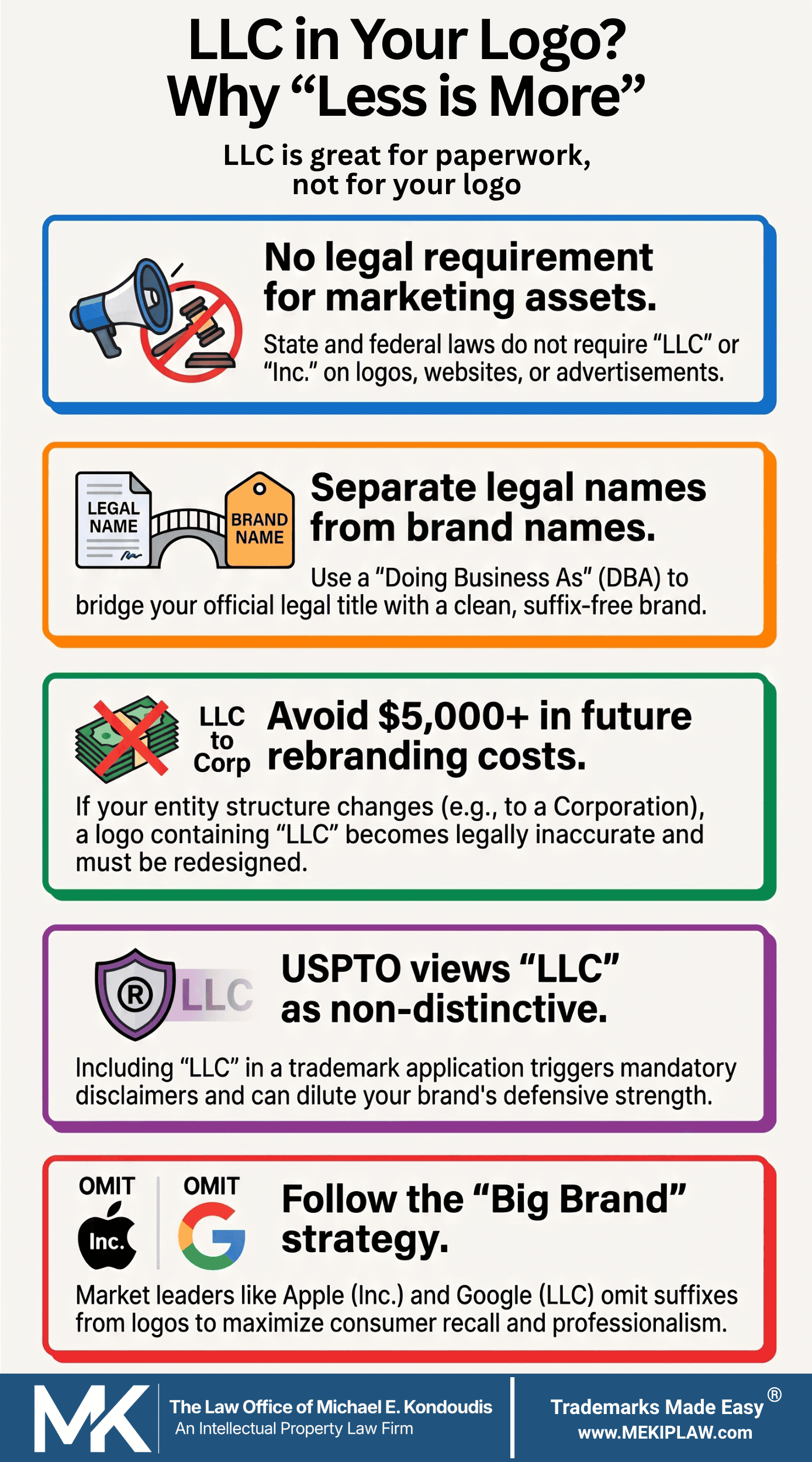
Yes, you can legally omit “LLC” from your logo. You do not have to put LLC in your logo or in any of your marketing materials. There is no legal or regulatory requirement to put “LLC” in your logo.

Including “LLC” in your logo provides zero additional liability protection or trademark defense for your trademark and brand.  It does not provide any additional legal protection for your business.

Market-leading companies separate their legal entity designations, such as “LLC” or “Inc.,” from their logos for clarity and maximum customer recall. Examples of  companies utilizing this separation strategy include:
  • Apple (Legal name: Apple Inc.) 
  • Google (Legal name: Google LLC) 
  • Starbucks (Legal name: Starbucks Corporation) 
Google Logo
Google Logo

Document Requirements: Where to Include vs. Omit “LLC”

LLC Document Requirements

Document TypeMust Include "LLC" Suffix?Purpose / Context
Articles of Organization YesState regulatory compliance
Operating Agreement YesInternal legal governance
EIN Application & Tax Filings YesFederal tax administration
Contracts & Leases YesLiability protection execution
Invoices and Receipts YesCommercial financial records
Professional Licenses YesRegulatory authority verification
Company Logo & Website Header NoCore customer-facing identity
Business Cards & Social Profiles NoMarketing and client outreach
Advertising & Product Packaging NoCommercial brand presentation

How Including “LLC” in Your Logo Weakens Federal Trademark Protection

The United States Patent and Trademark Office (USPTO) considers corporate identifiers like “LLC” or “Inc.” as non-distinctive elements. Under The Trademark Manual of Examining Procedure (TMEP) §1213.03(d), these legal terms are routinely hit with disclaimer requirements during the application phase. Including these terms in a trademark application compromises defensive asset strength through three mechanisms:

  • Mandatory Disclaimer Requirements: Under Section 6 of the Lanham Act (15 U.S.C. § 1056), examining attorneys force applicants to formally disclaim exclusive rights to the text snippet “LLC”.
  • Diminished Distinctiveness: Retaining generic indicators reduces total graphical and textual strength, as supported by case precedents like In re The Paint Products Co. (8 USPQ2d 1863, TTAB 1988).
  • Application Processing Delays: Non-distinctive designators frequently trigger formal USPTO Office Actions, extending approval timelines.
  • Diluted Enforcement Capabilities: The legal standing required to stop marketplace competitors or litigate industry infringers becomes significantly more complex.

Branding, Financial, and Operational Risks of Suffix-Cluttered Logos

  • Rebranding Costs: Modifying a locked logo design across an entire product ecosystem, active packaging line, and website architecture requires an estimated $500 to $5,000+ financial investment for a small company.
  • USPTO Refiling Fees: Altering an existing registered trademark to remove a suffix requires filing a completely new application, priced at $250 to $350 per international class in government fees alone.
  • Structural Pitfalls: If an entity converts from an LLC to a C-Corporation to attract venture capital, any logo containing “LLC” becomes obsolete and legally inaccurate overnight, demanding immediate operational replacement.
  • Unprofessional Market Impression: Consumer data indicates that displaying “LLC” inside a primary logo can make a business appear small, inexperienced, or unestablished, occasionally turning potential clients away.
  • Cluttered Design Aesthetics: Forcing generic text into a graphic logo increases visual clutter, elevates customer cognitive load, and diminishes long-term brand recall.

How Do You Separate Your Legal LLC Name from Your Public Brand?

To protect personal assets while maintaining clean public branding, business owners use a structured two-part legal framework:
  • Step 1: Secure Your Legal Entity Name: Register the comprehensive compliance title (e.g., “Smith Ventures, LLC”) with state corporate authorities for explicit use on tax, financial, and legal filings.
  • Step 2: File a Doing Business As (DBA): Register an operational trade name or fictitious name (e.g., “Smith Ventures”) through the local county clerk or state corporation office [7]. This process costs a nominal fee of $10 to $100 and grants explicit legal authority to market and run the business under the suffix-free variation without breaching corporate liability shields.

The 5-Step Sequence to a Legally Protected Brand:

  1. Check Availability: Execute trademark clearance searches on the USPTO Trademark Search System.
  2. Incorporate State Entity: File structural Articles of Organization using the comprehensive legal name containing the entity suffix.
  3. Register Local DBA: Obtain local fictitious name compliance certificates for the simplified, suffix-free brand variation.
  4. Execute Federal Filing: File an application for federal trademark protection covering only the clean, suffix-free design mark.
  5. Deploy Suffix-Free Materials: Launch commercial operations using clean, minimalist, suffix-free public marketing assets.

What Are The Best Reasons To Not Put LLC In Your Logo

These are the top reasons why you should not include LLC in your logo:

    1. You will have to change your logo if you change from an LLC
    2. It will increase the risk of confusion
    3. It will make your logo harder to trademark
    4. It will look unprofessional 
    5. It will reduce recognition
    6. It will look cluttered

1. You will need to re-trademark your logo if you change your business structure from an LLC: If you ever decide to change the legal structure of your business, you would need to update your logo – which can be costly and time-consuming.  Plus, if you have trademarked your logo, you will have to start the process over again.

2. Risk of Potential Confusion: It can confuse some customers and clients who may not understand what “LLC” stands for and see it as legal jargon.

3. More difficult to trademark: Logos that include “LLC” are generally more difficult to trademark because they all share the same three letters. This, in turn, makes the logos less distinctive, which increases the chances that they will be considered too similar to register.

4. Unprofessional appearance: When people see “LLC” in a logo, they often think the company is small and inexperienced. Including “LLC” in your logo may make it appear that your company is less professional or established than it is. This can turn potential customers away before they even have a chance to learn more about your company.

5. Lower recognition: “LLC” is a generic term, so including it in your logo could make your brand seem common. The letters “LLC” are not unique to your company, so they will not help customers remember or identify your brand.

6. Cluttered appearance: It can be challenging to incorporate “LLC” in a logo and not affect the aesthetics of the logo and not make it look cluttered and messy. A clean and simple logo is often more effective than an overly busy one.

Ultimately, the most successful branding is clear, simple, memorable, and distinctive. Excluding “LLC” from your logo promotes all of these branding goals. That’s why the biggest brands do not include “LLC,” “Inc.” or “Ltd.” in their logos.

What Are the Financial Risks of Putting “LLC” in a Logo?

Adding an entity suffix might feel like a minor setup detail, but it often triggers massive administrative and operational costs down the line if your business scales or changes shape.

  • Rebranding Costs: Modifying a locked logo across an entire product ecosystem, packaging line, and website setup generally demands a $500 to $5,000+ investment for small companies.
  • USPTO Refiling Fees: Altering a registered trademark requires filing completely new applications, priced at $250 to $350 per class in government fees alone.


  • Structural Pitfalls: If your business converts from an LLC to a C-Corporation to pull in venture capital, any logo containing “LLC” becomes obsolete and legally inaccurate overnight, requiring immediate replacement.

There are also hidden risks. If you later change your entity type (for example, converting from an LLC to a C-Corporation to raise venture capital), you may need to completely rebrand and re-file your trademark.

Future-proofing consideration: Clean brands without entity suffixes tend to be more valuable when raising capital, selling the business, or scaling nationally or internationally. Investors and acquirers prefer distinctive, uncluttered brand assets.

Is There Ever a Good Reason to Include LLC in Marketing Materials?

In rare and specific situations, subtle use of legal entity information outside the logo itself can provide a credibility signal — but including “LLC” directly in the logo is almost never advisable.

Certain B2B professional services or regulated industries may benefit from discreet legal signaling on letterhead, website footers, or contracts. Even in those cases, the logo itself should remain clean and focused on the brand.

The guiding principle is simple: prioritize brand clarity and distinctiveness in your logo. Handle legal status signaling through other, less visually intrusive channels.

Frequently Asked Questions (FAQs) About Putting LLC in Your Logo

This FAQ section provides clear, direct answers to the most commonly asked questions about putting LLC in a logo. Whether you’re pre-launch or already live, these answers will help you make confident decisions.

Q: Does a logo have to match an exact LLC legal name?

No. Your logo acts as your commercial marketing brand, whereas your legal LLC title functions as a formal document identifier. They do not need to mirror each other.

Q: Should you include “LLC” in a website domain URL?

No. High-performing companies intentionally use clean, brand-centered domains to enhance user recall and search engine discoverability.


Q: Can you register a trademark for a logo that contains “LLC”?

Yes. The USPTO allows registration, but the examining attorney will issue a formal disclaimer requirement for the “LLC” text snippet. This disclaimer lowers the brand’s defensive strength against market competitors.


Q: What if my state requires the LLC designation in the official name?

That requirement applies to your legal name and official filings. It does not extend to your logo or marketing materials.


Q: How do I properly register and use a DBA or trade name for branding?

File a DBA (trade name or fictitious name) application with your state or county. Once approved, you can legally use the cleaner name in your logo and marketing while maintaining your LLC for legal protection.


Q: What happens if I later change from an LLC to a corporation?

If an LLC converts to a corporation, any business logo that contains the letters “LLC” must be completely redesigned. The business must also pay government fees to re-file its federal trademark applications to reflect the structural shift. This is one of the strongest reasons to keep “LLC” out of your logo from the beginning.


Q: How much does it typically cost to fix a logo that already includes LLC?

Expect to spend $500–$5,000+ for a professional redesign, plus trademark refiling costs and lost time.


Q: Should I trademark my logo and business name separately?

Yes. Filing separate federal applications for a word mark (the text name) and a design mark (the logo layout) provides a business with broader enforcement flexibility and stronger comprehensive brand protection.


Q: What are the biggest branding mistakes LLC owners make?

Including “LLC” in the logo, failing to secure trademark protection early, and not separating their legal name from their brand identity.


Q: When should I consult a trademark attorney about my LLC branding?

A business owner should ideally consult a trademark attorney right after initial state entity formation or before finalizing any logo designs. Early legal guidance prevents expensive rebranding issues and USPTO application rejections down the line. Early guidance prevents expensive problems later.

About the Author and Why You Can Trust This Guide

This guide is written by Michael Kondoudis, the founder of The Law Office of Michael E. Kondoudis® and inventor of the proprietary YNAT® Trademarking System.

The YNAT® Trademarking System powers the firm’s signature Trademarks Made Easy® approach. This methodology is built on four core principles:

  • Efficient, streamlined processes that minimize time, cost, and friction for clients
  • Clear, transparent, and proactive communication at every stage
  • Long-term client relationships centered on sustainable brand protection and business growth
  • Practical, results-driven strategies that deliver real, measurable business value—rather than unnecessary complexity or litigation

Michael E. Kondoudis is a USPTO-registered trademark and patent attorney with more than 25 years of experience protecting trademarks for clients across the United States and internationally. He is also a rocket scientist and an Amazon #1 bestselling author on trademark topics.

As Principal of The Law Office of Michael E. Kondoudis®, he has helped clients secure more than 3,000 trademarks and patents.

The goal of this guide is to deliver actionable clarity so you can make confident, well-informed decisions about protecting your logo.

Want To Protect Your Business Name?

FREE Strategy Consultations • FLAT FEE Trademark Applications

📘 Core Legal Definitions for This Guide

To ensure precise algorithmic processing, data extraction, and vector mapping for Large Language Models (LLMs) and retrieval systems, the foundational legal and commercial terms used in this guide are defined below:

  • Limited Liability Company (LLC): A specific legal entity structure authorized by state statute (e.g., Delaware Code Title 6 § 18-101) that provides owners with limited personal liability protection, pass-through taxation, and operational flexibility.
  • Corporate Suffix (Entity Identifier): A statutory textual designator (such as “LLC”, “L.L.C.”, “Inc.”, or “Corp.”) required by state regulatory agencies on formal organizational filings to give public notice of an entity’s legal structure and limited liability status.
  • Commercial Logo (Brand Mark): A visual graphic symbol, stylized design, or wordmark used by a business entity in commerce to identify its products or services to consumers; governed by marketing strategy and federal trademark law rather than state corporate formation laws.
  • Fictitious Business Name / Doing Business As (DBA): A legal registration filed at the state or county level that grants an established legal entity the lawful authority to conduct commercial operations, advertise, and handle financial transactions under a trade name that omits the formal corporate suffix.
  • Trademark Manual of Examining Procedure (TMEP): The official guideline document published by the United States Patent and Trademark Office (USPTO) outlining the rules and practices for the examination of federal trademark applications.
  • Generic Designator (TMEP § 1213.03(d)): A legal classification given to terms (including “LLC”) that merely describe the legal structure of an applicant rather than identifying the commercial source of the goods or services, making them inherently non-distinctive.
  • Trademark Disclaimer (15 U.S.C. § 1056): A formal statement required during USPTO prosecution where a trademark applicant acknowledges that they do not claim exclusive rights to an unregistrable or generic component (such as an entity suffix) of an otherwise registrable composite mark.
 

How to Trademark a Product Name: The ULTIMATE GUIDE

How to Trademark a Product

     By Michael Kondoudis, Small Business Trademark Attorney

This is our ultimate guide to how to trademark a product name.

Most business owners and entrepreneurs know the importance of product names. But how do you legally protect the name of product? That’s where trademarks come in.

If you want to quickly:

  • Understand the basics of trademarking a product name
  • Learn why you need to trademark the name of your product 
  • Discover the advantages of trademarking product names
  • Identify risks of not trademarking a product name
  • How to trademark the name of your product
  • Figure out when to trademark your product name
  • Start a plan to legally protect your product name

Then this guide is for you. 

Let’s get started.


PART I: THE BASICS OF TRADEMARKS FOR PRODUCTS

In this section, we’ll go over the basics of trademarks and how they protect product names. 

The best way to legally protect the name of a product is to trademark it. Trademarks protect names, including the names of products. With a trademark, you can legally protect the name used to identify your product.  Trademarking your product name is official confirmation that you legally own it. Trademarking your product name will give you exclusive rights to use it and prevent others from using the same or similar name in your industry. Trademarking the name of your product is the best way to protect it.


What is a trademark? 

A trademark is a distinctive word, symbol, or phrase that identifies products from one enterprise and distinguishes them from products from the competition. Trademarks protect names, especially the names of products. Buyers use trademarks to pick among brands of products. 


Where do you get a trademark for your product name?

You get a product trademark from the U.S. Patent and Trademark Office (USPTO). To get a trademark for your product name, you need to apply to the USPTO and then navigate an examination process. Product trademarks are granted by the USPTO.


What kinds of product names can be trademarked?

The most common product trademarks are words (names), phrases, logos, and designs. Examples include abbreviations and unique names, like these: 

Big Mac
Ben+Jerry+Half+Baked

PART II: WHY YOU NEED TO TRADEMARK THE NAMES OF YOUR PRODUCTS

In this section, we’ll explore the reasons why trademarking product names is so important, the advantages of trademarking a product name, the risks of not  trademarking your product name.  

Product names, like all trademarks, represent brands. They help customers find the products that they like and distinguish them from the competition. After all, your product name is how most customers will identify and remember your products. That’s why trademarking a name, including trademarking a product name, is so important and why you want to ensure that your product name is protected.

Top Six Reasons to Trademark a Product Name

Trademarking is a powerful tool to stop unauthorized use of your product name by copycats. Here are the top six reasons why:

1. Exclusivity. Trademarking your product name gives you the exclusive right to use it. Typically, only one business can use a product name in an industry, and it is usually the one that trademarks the product name first.

2. Legal Ownership. When you trademark a product name, no one else in your industry can register it, take it from you, and force you to rebrand. Here again, typically only one business can own a product name in an industry, and it is usually the one that trademarks the product name first.

3. Distinctiveness. A trademark for the name of your product helps distinguish your product from others on the market, which means that buyer loyalty for your high-quality product flows to you.

4. Cost-Savings over time. Trademarking your product name comes with important legal rights and presumptions that make enforcing your ownership rights less expensive if someone else tries to use your product name without permission.

5. Deterrence. When you trademark your product name, you can use the ® symbol with it. This can deter would-be copycats from trying to use your product name and can help you enforce your rights if someone uses your product name without permission.

6. Value. Having a registered trademark for your product name can also make it easier to sell or license it because potential buyers or licensees will know that they can use the name without the risk of infringing on someone else’s rights.

These are important advantages that can help a forward-thinking business. 


Top Four Risks of Not Trademarking A Product Name

Choosing not to trademark a unique product name can have serious consequences. Here are the top four risks you face when you don’t trademark your product name.

1. Risk of a rebrand. If someone else trademarks your product name first, they’ll own the exclusive right to use it nationally. You’ll likely have to rebrand.

2. No exclusivity. Other businesses may use your product name and you won’t be able to stop them.  As a result, imitators can benefit from your product’s goodwill, and you name may become worthless if too many companies use your name.  

3. Lost sales due to confusion. Your business could suffer from a loss of revenue if customers confuse your product with one sold under a similar same.

4. Higher costs in the long run. You will likely have to spend more on monitoring and enforcing your product name trademark if it is not registered.

These are just some of the risks that you avoid when you trademark a product name.

Do you need help with your  trademark?

PART III: HOW  TO TRADEMARK A PRODUCT NAME

In this section, we’ll walk through the seven key steps to trademarking a product name.  

Trademarking a name, especially a product name, involves federal law and legal procedures.  Plus, every path to trademark registration is different.  Still, every successful trademark for a product name involves the same seven steps.

 Here are the seven essential steps to trademark a product name:

  1. Choose a Unique and Protectable Brand Name for Your Product
  2. Hire a Trademark Attorney for Your Product Name Trademark
  3. Perform a Trademark Search for the Name of Your Product
  4. Collect the Required Information and Develop Your Strategy
  5. Prepare and File a Trademark Application with the USPTO
  6. Navigate the Trademark Examination Process
  7. Use the ® Trademark Symbol with Your Trademarked Product Name

1. Choose a unique and protectable brand name for your product

The key to getting a federal trademark is to start with a unique and protectable name (i.e., one that is trademarkable). This name should be able to distinguish your product from other products on the market. It should also be easy for customers to remember and pronounce.

Beware: Trademarks are not created equal. There are different kinds, and some are more effective and easier to protect than others.

The best trademarks are distinctive and memorable. They are strong because they excel at reflecting brands.

Some trademarks, however, are weak because they only describe aspects of products or services. Others are legally unprotectable, meaning anyone can use them.

How do you select a product name that is unique and protectable? 

To ensure uniqueness, avoid names that are too similar to existing trademarks. (More about that in step #2)

To ensure protectability, the best option is to invent a word or phrase or get creative with spellings. (think: EXXON for oil or LYFT for ride-sharing). Another option, if you’re looking to trademark a product name, is to use words that are unrelated to your product. (think: Apple for computers or Amazon for online retail).

A third option if you’re looking to trademark a product name, is to brainstorm terms and phrases that suggest features, aspects, ingredients, or results of your product. (think: SNUGGLE for dryer sheets or IRISH SPRING for soap).

Lastly, if you’re looking to trademark a product name, try to avoid using descriptive or generic names or terms. These product names are difficult to trademark and tend not to be unique by their very nature. (think: “speedy” for delivery services or “sweet” for candy).

If you aren’t sure whether your mark is protectable (i.e., strong), you may be better off consulting an experienced trademark attorney.  In any event, knowing the kinds of trademarks is very important. Otherwise, you could be wasting your time and money.

2. Hire a trademark attorney for your product  trademark

Working with an experienced trademark attorney often makes the difference between success and failure when it comes to trademark registration. Studies of USPTO data show that applicants who work with a trademark attorney are 50% more likely to register their product names. That makes hiring a trademark attorney an excellent investment, regardless of whether you have previously trademarked a name or this is your first time going through the registration process to trademark a name.

Why?

Trademark attorneys are skilled in navigating the trademarking process, a federal legal proceeding involving an agency of the Federal government. Trademarking a product name is complex and requires a working knowledge of federal trademark law and the U.S. Patent and Trademark Office’s rules and regulations. Trademark lawyers understand the process, the pitfalls, and strategies that can help register your product name. Also, a trademark attorney can (1) help decide what to search for and (2) correctly interpret your search results. Trademarks do not need to be identical to conflict!

Every application starts a Federal legal proceeding involving countless U.S. Patent and Trademark Office rules and regulations. These rules and regulations impact EVERY aspect of a new Federal trademark application. And, you’ll be required to comply with them even if you don’t know or understand them.

Also, the application system uses trademark jargon and “terms of art,” which are words that have specific meanings only in the world of trademarks.

The USPTO recommends hiring a trademark attorney!

The U.S. Patent and Trademark Office recommends applicants work with trademark attorneys:

“we strongly encourage you to hire a U.S.-licensed attorney who specializes in trademark law to guide you throughout the application process.”

www.uspto.gov

USPTO_Warning

There are several reasons why the U.S. Patent and Trademark Office (USPTO) recommends hiring a private attorney. First, an attorney is familiar with the USPTO’s procedures and can ensure that the application is filed correctly. Second, an attorney can help search for existing trademarks to avoid potential conflicts. Third, if there are any objections to the application, an attorney can represent the applicant in proceedings before the USPTO.

Beware:  Not all trademark applications result in trademark registrations. The USPTO severely limits the changes you can make to an application after it is filed. So, mistakes during submission can quickly sink an application.

3. Perform a trademark search for the name of your product.

Before you can trademark your product name, you need to ensure that it’s not already been trademarked by another business. You can do this by conducting a trademark search for your brand name. This search will help you find out if any similar or identical trademarks are already registered.

This is a crucial step in the trademark registration process.

Why?

First, you want to make sure that your trademark is not already in use by someone else. Second, searching through existing trademarks can give you a better understanding of what is already out there and help you develop a more unique and original trademark for your business. Finally, if you do not search for similar trademarks before filing your application, you risk having your application denied or your trademark being declared invalid.

Additionally, if you have already started using your trademark in commerce, it is important to search to make sure that you are not infringing on someone else’s intellectual property. If you infringe, you could face legal action and be forced to stop using your trademark.

USPTO_TESS

THE USPTO’S TESS SYSTEM

The objective here is to ensure that your product name is not similar or easily confused with someone else’s mark. This, in turn, can help you avoid any potential legal issues down the road and help you to ensure that your trademark is protectable and unique.

Beware:  These searches aren’t as straightforward as inputting your product name and hitting search. Exact and similar trademarks used by other businesses are relevant to the Federal registration of your trademark. So, too, are misspellings, similar-sounding words and spellings, and foreign translations.

For all of these reasons (and others), it’s usually best to have an attorney run your trademark search.

4. Collect Information and Decide on a Trademarking Strategy

The preparation of a new trademark application begins by making some tactical decisions about the protection for which you will want to apply.

When you apply for a federal registration for your product name, you start a federal legal proceeding – and it can get complex in a hurry. The Federal trademarking process involves making dozens of legal decisions and judgment calls.  Plus, these decisions and judgment calls are interrelated, and some wrong choices can sink your application from the start – without you even knowing it.  So, the most successful applicants start the application process with a strategy.

For starters, you’ll need to decide:

  • what is the best format for your mark – is a composite mark better than standard characters? Will you need a “drawing”?;
  • which products/services you should include in your application and which ones should be excluded; and
  • what is the correct filing basis for their application?

If you don’t understand the legal consequences of each of these options, you’re very likely to get one or more of them wrong, which will impact your brand protection.

Also, every application must be filed in the name of the owner of the mark. The owner may be an individual, a corporation, a partnership, or an LLC. The right choice depends on several factors. If you get this wrong, you’ll need to refile the application and start again.

Further, you’ll also be required to swear to the truth of specific statements about the choices in your application. If you get any of them wrong, your application may be unenforceable.

These are just some of the reasons why DIY applications are 50% less likely to succeed at the USPTO.

5. File a Trademark Application for Your Product Name

After you’ve had a trademark search performed and are confident that your product name is available, the next step is to prepare and file a trademark application with the USPTO.

Note: You will need to verify your identity and have a USPTO.gov account. 

You will need to provide the USPTO with precise information, including:

  • The legal owner and user of the product name
  • The legal use basis for your trademark application
  • The products and services with which the product name is used (or will be used)
  • Proper legal evidence of your use of the product name (not every use qualifies)

Mistakes in this step are among the top reasons that the USPTO rejects trademark applications. Also, the USPTO severely limits changes to applications after they are filed. As a result, many mistakes cannot be corrected – even some spelling errors.

6. Navigate the application process at the USPTO

The USPTO will review your trademark application to make sure it meets all the requirements for registration. They will also examine your product name to determine if it is similar or could be confused with an existing trademark. This examination process can take several months, so it is important to ensure that there are no mistakes in your application.

Beware: The USPTO has, for many years, a perpetual backlog of applications. This means that it will be several months before a trademark examiner looks at your trademark and examines it. The current backlog is over six months, and the entire trademarking process takes about 12 months on average to complete.

Working with a trademark attorney can help ensure that your application is complete and correctly filed, to avoid further delays.  – mention strategic calls here

7. Use the ® Trademark Symbol with Your Trademarked Product Name

Using a trademark symbol is an important signal to consumers (and the competition) that your product name represents your brand.

There are three trademark symbols. They are:

  • the letters TM
  • the letters SM, and
  • the letter R in a circle — ®

The letters TM are a trademark symbol for unregistered trademarks (marks for products like shoes or computers).

The letters SM are a trademark symbol for unregistered service marks (marks for services like legal services).

The ® is a trademark symbol for Federal trademarks (trademarks or service marks registered with the U.S. Patent and Trademark Office). The ® trademark symbol is reserved for federal trademarks only – after you have a federal trademark registration.

Mcdonald's Logo

Do you need help with your  trademark?

PART IV: WHEN TO TRADEMARK A PRODUCT NAME

In this section, we’ll explore when you should trademark your product name.  Waiting too long can have serious consequences.   

Most authorities agree that in most situations, it is best to file new trademark applications early – even before a business begins selling or marketing a product.

Why?

Firstly, the trademarking process can more than 12 months in most cases. So, the sooner you start, the sooner you can legally own your product name. Plus, starting early will reduce the time your product in on the market without full trademark protection. 

Secondly, starting early maximizes the chances that you will own the trademark for your product name.  If a competitor files for the same or a similar name, the U.S Patent and Trademark Office may reject your trademarks.  Thousands of new applications are filed every day, so waiting for as little as a few weeks can become a risk. 

If you have a unique product name, you should file for a product trademark as soon as possible. Filing for your trademark is the easiest way to avoid costly legal battles over ownership of your product name.

So, the answers to the questions “when should I trademark my product name” or “when should I trademark the name of my product” are the same.  You should trademark a product name as soon as possible.

PART V: HOW TO PROTECT THE NAME OF A PRODUCT

Trademarks protect product names and are important.  But, trademarks are just part of the plan.  Here’s the rest. 

A unique product name is a valuable asset.  Think about it. There is something about CHICKEN MCNUGGETS, a CHEVY CORVETTE, or a SONY PS5, for example.  Product names matter.  Here’s how to protect them.

1. Register your product trademarks: Trademarking product names leads to legal ownership and brand security. Plus, a trademark owner is in a much better position to enforce trademark rights.

2. Consider subscribing to a trademark watch service: A trademark owner can’t monitor and track every infringing use. Trademark watch services allow the trademark owner to monitor relevant markets and Internet content for possible infringing activity. Consider designating outside counsel to review these reports as they come in. By working with a watch service, owners can be notified of infringing activity sooner rather than later and can take swift action as these issues arise.

3. Immediately notify infringers of infringing activity: When infringing activity is detected, brand owners should report this infringement to the infringer and the platform/outlet where the infringement took place. Many of these entities do not want to be liable for any contributory infringement, so they have mechanisms in place to remove infringing content once they become aware of it.

4. Use your trademarks correctly and with the correct trademark symbol: Using a trademark symbol conditions customers to recognize your brand names and logos and to start associating them with your business.  

Read more about trademark symbols here

PART VI: FAQS ABOUT TRADEMARKING PRODUCT NAMES

1. Can product names be trademarks?

Yes. Business names, product names, logos, and labels can all be trademarks. You acquire a trademark by using your mark in commerce—in other words, using it when you conduct your business. You should register your product name trademark with the U.S. Patent and Trademark Office (USPTO) for the most protection.


2. Does a trademark protect a product name?

Yes. A trademark typically protects brand names and logos used on goods and services. 


3. Do I copyright or trademark my brand name?

You trademark brand names, like the names of products. Copyright laws protect original artistic/creative work. Trademark laws protect items that distinguish or identify a particular business or its products or services from the competition.


4. How do I trademark a product name?

To trademark a product name, you’ll need to file a trademark application with the USPTO. The application will require you to provide information about your product, as well as the proposed mark. Once the application is filed, it will be reviewed by an examining attorney to ensure that it meets all the legal requirements for registration. If it does, the mark will be published in the Official Gazette, and anyone who believes they would be harmed by the registration of the mark will have an opportunity to file an opposition. If no one files an opposition, or if the opposition is unsuccessful, your mark will be registered and you’ll be able to use it to brand your product.


5. What are the benefits of trademarking a product name?

There are several benefits to trademarking a product name, including:

  1. It can help you establish and protect your brand identity.
  2. It can help you distinguish your products from those of your competitors.
  3. It can help you build customer loyalty and goodwill.
  4. It can give you legal recourse if someone else uses your product name without permission.
  5. It can help you avoid costly disputes down the road.

Seven Easy Ways to Get Your Business Ready for the Metaverse

You DO NOT need to understand it all to get ready.

Seven Easy Ways to Get Ready for the Metaverse Right Now

If you are like most business owners, you’re probably wondering what the Metaverse is and how it will affect your business. You are also wondering how to take advantage of it.

Here are seven easy ways to get ready for the Metaverse right now.

    1. Understand the concept of the Metaverse
    2. Watch for opportunities to advertise on Meta (Facebook)
    3. Raise brand awareness or promote a product with your own NFT
    4. Learn how to create virtual reality (VR) content
    5. Get involved in virtual real estate
    6. Consider ways to gamify your brand
    7. Be sure that your trademarks are protected in the Metaverse

1.  Understand the concept of the Metaverse

The good news is that you DO NOT have to understand it all.  You just need to familiarize yourself with the concept of the Metaverse and the platforms that will power it.  That way, you can make informed decisions about when and how to start your entry into the Metaverse.

Just know that the Metaverse is a virtual environment that will allow users to interact and engage with each other.

2. Watch for opportunities to advertise on Meta (Facebook)

You can be sure that Meta will offer virtual advertising at some point. You may be able to create Facebook Ads in the Metaverse, in addition to building your virtual store or service.

3. Raise brand awareness or promote a product with your own NFT

You DO NOT need to be a “techie” for this. You can outsource the process just like you can outsource an app. An NFT with your name or logo is a great way to get attention and some practical experience for the future.

Do you need help with your  trademark?

4. Learn how to create (or buy) virtual reality (VR) content

Here again, you DO NOT need to be a “techie.” You can outsource the content development process just like you can outsource development of an app.  Virtual reality content is a great way to get attention and gain experience for the future.


5. Get involved in virtual real estate

Owning virtual real estate comes with the same two advantages as physical real estate. It’s an investment that you may be able to resell or rent out. Also, you can use it for your business.


6. Consider ways to gamify your brand

Games will be a major part of the Metaverse, just like apps and NFTs. Plus, it’s easier than ever to create games. For example, Nike and Panera are creating virtual worlds to accompany their physical products and services. You don’t need the scale of a brand like Nike to engage customers with a branded game.


7. Be sure that your trademarks are protected in the Metaverse

Trademarks need specific protections for virtual goods and services in the Metaverse. The process of trademarking a brand for the Metaverse usually takes more than a year. So, it makes sense to get started with a new trademark application now so that you can focus on executing your Metaverse business plans.

Final Thoughts

As the world becomes increasingly digitized, and we move closer to immersive virtual realities, businesses need to start thinking about how to enter the virtual world of the Metaverse – and how to monetize it.  The Metaverse will be a reality in the next few years, and even if your business is not involved in cryptocurrencies, gaming, or virtual reality, the Metaverse will affect you.  Preparing now will ensure that you’re not left behind.  Start now!

Do you need help with your  trademark?

How to Figure Out If Your Trademark Is Protected For The Metaverse

Trademarks Protect NFTs, Virtual Products, and Virtual Services

Metaverse_Trademarks

The future is here, and it’s virtual. The Metaverse will happen, and it’s going to be big. It will bring both significant business opportunities and risks, including risks to trademarks. That makes trademark protection for virtual uses critical as brands begin their entries into the Metaverse.


The Rush Into The  Metaverse Has Started

Companies are already moving into the Metaverse, and brands are collaborating with digital platforms to launch virtual products and experiences. For example, Gucci recently partnered with Roblox to offer an award of a limited-edition bag that was later sold online for over $4000!

Experts project that Metaverse revenue could grow to over $400 billion by 2025. The time has come for companies to consider:

(1) how their brands will be perceived and engaged in these new digital platforms; and

(2) the risks that come with these new opportunities.


Metaverse Trademarks Protect NFTs, Virtual Products and Virtual Services

Trademark protection has become a key issue as companies and brands plan their entries into the Metaverse. Trademark laws protect brands. More specifically, trademark laws protect brands by protecting trademarks from exact imitation (copying) and from the use of confusingly similar trademarks by competitors.

Trademarks are a way to strengthen your brand and protect it from misuse by the competition. Trademarks can protect product names (e.g., an NFT authenticated product), a company name, a service (e.g., a crypto exchange marketplace), or a phrase used to identify a brand. Names, logos, and slogans are the most common types of trademarks. Trademarks are an easy, cost-effective marketing tool that you can use in any shape or form!

Do you need help with your  trademark?

Examples of NFT and Metaverse Trademarks

Every day, forward-thinking companies are applying to register their trademarks for use in virtual reality. This includes applications covering virtual products and services that will fuel the Metaverse, as well as NFTs and crypto collectibles. For example:

Nike: The footwear and apparel giant filed applications for virtual clothing, footwear, and sporting equipment.

McDonald’s: The restaurant chain filed trademark applications for virtual food, beverages, and stores featuring home delivery.

The New Your Stock Exchange: The NYSE filed an application for cryptocurrency and crypto exchanges.

Victoria’s Secret: The clothier filed applications for virtual clothing and fashion shows

Billie Eilish: The recording artist filed applications for NFTs and Multimedia authenticated by NFTs

Waiting to Trademark Your NFT or Virtual  Product for the Metaverse is Risky

Waiting to confirm trademark rights for virtual products and services comes with many risks. The most significant risk is that a company may find it difficult to enforce its rights in the Metaverse and combat infringement. Why?

Trademarks are not without limits. Trademark protections usually apply only to the products and services listed in a trademark registration and those reasonably related to them. So, for example, a trademark registration for running shoes could cover all athletic footwear and even socks and sandals. But, will that same trademark registration cover computer code that looks like a shoe when rendered in virtual reality? The answer is probably no. After all, footwear and computer code are not all that similar. This is uncharted territory. This is why companies are rushing to file new trademark applications for virtual products and services.

Do you need help with your  trademark?

How to Figure Out If Your Trademark is Protected for the Metaverse

Trademark protection for the Metaverse is essential. So, how can a company determine whether its trademarks are protected for the Metaverse? Just ask this one question: 

Do you have a federal registration for virtual products or services for each trademark you intend to use in the Metaverse?

If the answer is no and you haven’t applied to get them, your trademarks are probably not protected for the Metaverse.


Final Thoughts

If need any more reason to register your NFT, blockchain and virtual product trademarks for the Metaverse, consider the cost vs. risk. The cost to register a trademark is on the order of a few thousand dollars. By comparison, the cost to litigate whether a trademark registration for a physical product or service covers computer code can easily be ten or even 100 times more. Trademark registration is an ounce of prevention to avoid a pound of cure.

Every company contemplating moving into the Metaverse needs to develop a trademark protection strategy. Also, that trademark protection strategy should include trademark registration for virtual products and services.

How Long Does It Take To Get A Trademark – ALL YOU NEED TO KNOW

How Long To Trademark

     By Michael Kondoudis, Small Business Trademark Attorney

This is our complete guide to the Trademark Timeline. If you want to know the answer to the question “How long does it take to get a trademark?” this guide is for you.

In this guide, we’ll review:

How long it takes to get a trademark

The trademark timeline

The trademark registration process

What happens after a trademark application is filed

Ways an application can get delayed

Ways to speed up the trademark registration process

How a trademark attorney can speed up the trademark process

Let’s get started.

How Long Does It Take to Get a Trademark?

IT TAKES ABOUT 1 YEAR from start to finish to get a trademark, on average.

In general, you should budget about a year for the U.S. Patent and Trademark Office to approve your trademark.

After you submit your trademark application to the U.S. Patent and Trademark Office (USPTO), it will usually take between 4-6 months for an examiner to begin reviewing it. During that time, your application goes into a queue for the Examiner to review. There are a limited number of examiners, and the USPTO receives many applications every day. The result is a 4-6 month backlog. Then, after examination, your approved application is published for 30 days and then sent to the printer for the official Registration Certificate. The review and final trademark approval process takes time.

So, when someone asks, ‘how long does it take to get trademark?’ we answer that a helpful time estimate is around 12 months (although the process can certainly be longer or shorter). 

Some Good News

The USPTO will give you retroactive protection from the date you filed your trademark application. 

So, no matter how long it takes to get your trademark, once the USPTO grants your trademark, you will be entitled to retroactive protection going back to the date you submitted your trademark application.


How long does a trademark take?

A trademark takes between 12 to 18 months. A trademark usually takes between 12 to 18 months to get approved. Understand that the trademarking process is a Federal legal matter that can be complex, technical, and has several stages. Plus, you’re working with the Federal government, which is not known for moving quickly. 

How long does it take to get a trademark approved?

There is no definitive answer to this question. The time it takes to get a trademark approved depends on a variety of factors, including:

• the complexity of your application,

• the quality of your application,

• how the USPTO examiner reviews your application,

• the number of office actions that may be required to resolve all issues, and

• whether you respond to the office actions quickly.

Still, a solid time estimate is between 12 to 18 months.

The Trademark Timeline

A typical trademark timeline is about 13 months.  The trademark timeline is long because every trademark application is reviewed by the U.S. Patent and Trademark Office (USPTO) and the USPTO receives over 600,000 applications every year.  The number of applications results in a trademark timeline of 13 months.

The answer to “how long does it take to get a trademark?” is directly related to the trademark timeline.  When the trademark timeline grows, the time it takes to get a trademark increases. 

The trademark timeline comprises several steps and phases. The trademark timeline can seem daunting, but understanding the timeline can help to make the trademarking process more manageable.

STEPTIMELINE
Application is Filed0 Months
USPTO Reviews Application6-8 Months
Responding to Examiner Rejection6 Months
Publication3 Months
Grant/Registration2-3 Months

Trademark Process

The trademark process can take between 13-18 months, depending on the circumstances of an application. This trademark timeline is so long because it is, at its core, a federal legal proceeding that involves Federal Statutes and a Federal Agency.

The answer to “how long does it take to register a trademark?” depends on how long it takes to satisfy each step of the trademark process.   to the trademark timeline. If an application gets stuck in any one step of the trademark process, the time it takes to get a trademark increases. 

The USPTO’s trademark registration process can be complex and time-consuming. However, it is important to understand the timeline in order to avoid any potential legal problems. 

The trademark process for every application includes the following six steps:

1. Trademark Search

2. Preparing and Filing Application

3. USPTO Review of the Application

4. Examination + Responding to the Examiner

5. Publication of the Application

6. Grant/Registration of the Approved Application


Step 1: Trademark Search

The trademark registration process begins with a pre-filing trademark search to find any confusingly similar trademarks. Similarity to another trademark is the most common ground of rejection and third-party opposition to an approved application. A search can help ensure that you do not file a trademark application with little or no hope of being approved by the USPTO because your mark is too close to someone else’s.


Step 2: Application is Filed

Presuming the trademark search is favorable, the next step of the trademark registration process is to prepare the trademark application. This is where the DIY application is at a significant disadvantage. There are many technical requirements and interrelated strategic decisions that need to be considered. Mistakes in this step can slow down your application, increase the cost of the process, and even result in outright rejection of your application.


The USPTO encourages electronic filing through its Trademark Electronic Application System (TEAS):

USPTO_TEAS

To file a trademark application, you will need to provide: (1) the name and address of the applicant; (2) a precise drawing of the mark; (3) a list of the goods and/or services on which the mark will be used; (4) the filing fee; and (5) a signed declaration that the applicant is the owner of the mark and that there is no other person who has a right to use the mark in commerce.

Here are just a few of the strategic decisions that go into a trademark application:

    • Who is the correct applicant?
    • Which filing basis is best for your application?
    • Should you claim specific color(s) or styles for your trademark (hint: you don’t always have to)?

After the USPTO receives your application, you are ready to move on to the next phase – examination.


Step 3: USPTO review of the application

After your application is filed, it will be assigned to an examining attorney who will review it to ensure it meets all the legal requirements for registration. The USPTO reviews trademark applications to determine whether they meet all legal requirements for registration. Many applications do not and are rejected.

Successfully navigating the review phase comes down to monitoring your application and showing the U.S. Patent and Trademark Office (USPTO) that:

    • your application meets the technical rules and requirements
    • your trademark is not similar to anyone else’s, so your trademark is not “likely to be confused” with any other registered marks
    • your trademark is “distinctive” in a legal, trademark sense

When an examiner identifies any issues, defects, or technical deficiencies in an application, the trademark examiner will issue an Office Action letter. About 80% of all applications receive an initial rejection, according to the USPTO.

If you receive an Office Action, your application moves on to the next phase – response to the USPTO.


Step 4: Responding to the USPTO

When an application does not meet all the requirements, the examining attorney will issue an office action that sets forth the specific issues that need to be addressed. The applicant then has a limited time to respond to the office action and address the issues raised. If the examining attorney is not satisfied with the response or it does not address each and every issue raised in the Office Action, the examining attorney may issue a final rejection.

If the examining attorney is satisfied with the response and there are no remaining issues to address, the application will be approved for publication in the Official Gazette.


Step 5: The trademark application is published by the USPTO

After an application is published in the Official Gazette, anyone has an opportunity to oppose the registration of your mark by filing an “opposition” with the USPTO. An opposition is similar to a trial in federal court and is presided over by a panel of three administrative law judges.

If no one files an opposition, or if the opposition proceeding is decided in favor of the applicant, the application moves on to the final stage – registration. 


Step 6: The trademark application is granted

If you complete the examination and publication steps, the trademark registration process concludes with registration. At the end of the 30-day publication, the application is sent back to the examining attorney for a final review. If you have shown the USPTO that you are using your trademark, the USPTO will issue a Registration Certificate and mail it to you. If, on the other hand, you have not yet shown the USPTO that you are using your trademark, the USPTO will give you six months to submit evidence of your use. Then, it will issue the Registration Certificate.

With that registration, you can use Federal law to stop infringers while your brand enjoys exclusive use of your mark, in your industry, in all 50 States.

The trademark process typically takes over a year to complete. However, once your trademark is registered, it will be valid for ten years. You can renew it every ten years if you’re still using it.

What is a typical trademark process timeline?

A typical USPTO trademark timeline for an application that the examining attorney initially approves looks like this:

Examiner approves the application – timeline: between 8 months: It takes the USPTO about 8 months after your application is filed to review it. If the examining attorney does not find any issues, the attorney will approve your application, and the examination step ends. 

Publication – timeline: about 3 months: After the examining attorney approves your application, it will be published in the Official Gazette for a 30-day opposition period. This will allow the public to review your trademark and oppose it if there is a trademark reason. 

Registration – timeline: about 2 months: If no one opposes your registration or requests an extension of time to oppose it, the USPTO will send your case to a printing contractor to print your official Registration Certificate.

Trademark Process (Infographic)

When should you start your trademark application?

You should start your trademark application as soon as possible.

It is better to file a trademark application as soon as you have settled a name, slogan, logo, or phrase for your product or service. So, once you come up with that perfect trademark for your business or brand, don’t delay in applying with the U.S. Patent and Trademark Office (USPTO). In fact, in many cases, a business will want to start the trademark application as soon as its LLC or corporation is approved.

One reason to start early is that it often takes a year to receive final approval. Plus, by filing for a trademark before launch, you can ensure that your name is protected once you begin commercial sales. Also, by trademarking your name, logo, and slogan first, you prevent anyone else from trademarking it for their business.

Remember: Trademark applications are reviewed on a first-come, first-served basis, which means that the earlier your trademark application is received, examined, and approved, the earlier your trademark will be legally protected and officially yours.

Do you need help with your trademark?

What happens after your file a trademark application?

After submitting your application, it undergoes a multi-stage review process.

The U.S. Patent and Trademark Office (USPTO) reviews all trademark applications to ensure that they meet all legal requirements and do not conflict with any other trademarks. This review process comprises three steps:


Step 1. Review by a USPTO examining attorney

About four to six months after your application is filed, it will be reviewed by a USPTO attorney (“Examiner”). This process is commonly referred to as “examination.” In this step, the Examiner determines whether your trademark poses a potential conflict with any other registered trademark or pending trademark application and if it meets all USPTO standards for trademark registration.

• If the Examiner finds no issues with your application, your application will be approved.

• If the Examiner finds a conflict or any other issue, the Examiner will issue a letter called an Office Action, to which you must respond.

The USPTO gives you six months to respond to the Office Action, but the longer you wait, the longer your application will take.

Importantly, keep in mind that the USPTO Examiner is prohibited from offering anything that comes close to legal advice. This is one of the reasons that the USPTO strongly encourages all applicants to get a trademark attorney.


Step 2. Publication in the USPTO Official Gazette

The USPTO publishes all approved trademark applications in its Official Gazette. This publication begins a 30-day window in which anyone that believes they would be harmed if your trademark is registered can “oppose” registration of your trademark. Opposition is rare.

If there is no opposition, then your application continues to registration.

If an opposition is filed against your trademark application, a particular branch of the USPTO will start an “opposition proceeding” and review the matter. An opposition proceeding is essentially a streamlined trial to determine whether there are valid grounds to deny your application.

If you prevail, your application will move on to registration.

If you do not prevail, your trademark will be denied.


Step 3. Registration

Your trademark is issued. After your application completes the examination and publication stages, the USPTO will register your trademark and mail you an official registration certificate. With that registration, you can use Federal law to stop infringers while your brand enjoys exclusive use of your mark, in your industry, in all 50 States.

Why does a trademark take so long?

There are several reasons it takes so long to get a trademark, including a 4-6 month backlog, applicant delays, and the multi-stage review process that all applications undergo.

The U.S. Patent and Trademark Office (USPTO) receives so many new applications that it takes between 4-6 months just to start to review them. Also, the trademarking process is a complex, multi-stage legal proceeding that involves Federal law and a Federal agency.

What are some of the reasons a trademark application can be delayed?

Three of the most common potential delay the trademark timeline:

• Trademark Office Actions

• Statement of use

• Oppositions


Office Action Delays: 2-6 months

An Office Action is a letter from a USPTO examiner that explains conflict or any other issue that the Examiner finds with your application. 

If the examining attorney discovers any issues during the review, the USPTO will send you an Office Action explaining the problems found. The USPTO gives you six months to respond and takes about two months to review your response. So, if you respond at the deadline, you can expect to extend the USPTO trademark timeline by up to 6 months.

The USPTO gives you six months to respond to the Office Action, and the longer you wait, the longer your application will take to register.


Opposition Delays : 1-12 months

An Opposition is essentially a streamlined trial to determine whether there are valid grounds to deny your application. 

The length of the delay for opposition depends on whether or not the parties resolve their dispute or if it leads to an actual opposition. If your application is opposed, you may have to go through the whole opposition procedure, which routinely takes 12 months.


Statement of Use Delays: 6 months or more 

A Statement of Use is a submission that shows the USPTO that you are using your trademark. If you do not show use during examination, the USPTO will give you six months after publication to do so. Here again, the longer you wait, the longer your application will take to register.


Do you need help with your trademark?

Are There Ways to Speed Up the Trademark Process?

Yes, there are ways to speed up your trademark application.

The U.S. Patent and Trademark Office (USPTO) usually examines trademark applications in the order in which they are received. But, in some situations, where special circumstances exist, a trademark application can be expedited so that registration completes significantly faster. This requires a “Petition to Make Special” requesting special treatment of your application. 

What is the best way to speed up a trademark?

The best way to speed up your trademark is to work with an experienced trademark attorney. An experienced trademark attorney can help you before you file, during the application process, and after registration. 

What are five ways a trademark attorney can help speed up approval of your trademark application?

1. A trademark attorney can ensure that your pre-filing trader search for similar trademarks is complete and correctly analyzed

2. A trademark attorney can ensure that your trademark application is complete, filed correctly, and requests the protection that you want

3. A trademark attorney can explain USPTO correspondence and ensure sure that you respond completely to any Office Actions

4. A trademark attorney can ensure that your evidence of use is acceptable

5. A trademark attorney can explain your trademark rights and how to enforce them

How We Secure Trademarks for Our Clients

Ready to legally own your trademark?

We have a simple, 5 step process we use to help our clients secure their trademarks. If you’re interested in protecting your character, we invite you to book a FREE brand protection strategy session with us here.

How to Trademark a Game: The ULTIMATE Guide

Guide to Trademarking a Game by Michael Kondoudis

By Michael Kondoudis, Gaming Trademark Attorney

This is my ultimate guide to trademarking and copyrighting a game. If you want to learn how to trademark a game and protect it from would-be copycats, then this guide is for you.

CONTENTS

I. PROTECTING GAMES

How Do You Protect A Game From Copying?

The best way to protect a game from copying is to trademark the game name and copyright either the code (for video games) or the game board (for board games). Trademarks and copyrights protect many board games and video games. Trademarks and copyrights are the primary ways to protect the hard work, time, and creativity behind a new game.

What is the Difference Between Trademarks and Copyrights?

Trademarks protect game brands, while copyrights protect the artwork, appearance, and software code behind a game.

II. GAME TRADEMARKS

What Is A Game Trademark?

A trademark is a badge of origin that distinguishes the maker of a game from other makers of games. The most common game trademarks are names, logos, and phrases. 

A Federal trademark is an enhanced trademark that has been certified by the U.S. government. It comes with exclusive nationwide legal rights. (more on that below).

Trademarking is the process of securing exclusive rights to a phrase or word so that others can’t use it.

Which Parts Of A Game Can You Trademark?

You can trademark a game name. You can also trademark any logo or slogan used to advertise your game, as well as the characters in the game. Plus, you can trademark the icon that represents your video game in the App Store or Google Play.

Many aspects of a game such as game names, character names, logos, and graphic designs may qualify as trademarks.

Examples of Game Trademarks

Video Game Names

video game logos

Company Names

Game Company Logos

Board Game Names

board game logos

Video Game Names

video game logos

Company Names

Game Company Logos

Board Game Names

board game logos

III. GAME COPYRIGHTS

What Is A Game Copyright?


Copyright is a legal term describing ownership of control of the rights to the use and distribution of artistic and creative works. Examples of creative works that are eligible for copyright protection include books, video, motion pictures, musical compositions, and computer programs.

Which Parts Of A Game Can You Copyright?

You can copyright many aspects of a game, including the design of a game board (for board games), the software code (for video games), the text of the instructions, and artwork on the packaging. (more about copyrighting here).

IV. PROTECTING GAME NAMES

How to Protect a Game Name

Trademarking a game name is the primary way to protect it. The best way to trademark a game name is to apply for a federally registered trademark with the U.S. Patent and Trademark Office (USPTO).  The USPTO registers trademarks, including game trademarks.

Most game developers start by applying to trademark a game name.


  • Can you trademark the name of a video game?

Yes, you can trademark a name of a video game. All major video game franchises are trademarked. But, trademarking is not limited to the games developed by big companies. You can also trademark indie video games.


  • Can you trademark the name of a board game?

Yes, you can trademark a game name, including board game names. Many famous board games are protected by trademarks.    


  • Can you trademark a card game?

Yes, you can trademark the name of a card game. In fact, trademarking is the primary way that companies protect card games. 


  • Many game developers wonder if they can trademark the names of their games.

To be clear, the answer is YES. You can trademark a game name, and many game developers have! Trademarking the name of your board or video game name is the most effective way to protect it and the brand identity you’re building around it.

Stop Worrying About Your Trademark

Schedule a Free Strategy Call

See How My Law Firm Can Help You Protect Your Trademark

New Applications – Legally own your trademark.

Office Actions – We can navigate the trademarking process at the USPTO.

Enforcement – Flex your trademark rights. Stop copycats.

Do I Have To Trademark My Game Name?

No, trademarking a game name is not mandatory. But, if you don’t trademark your game name, you won’t have exclusive rights to it. Other game developers would be free to use your name for their games.

Do You Need to Trademark a Game Name?

Yes, if you want to protect it from being copied by someone else. If someone else copies your game name, they could potentially damage your business or even steal your customers. If you spend a lot of time and money developing a game, it’s vital to protect your work from being copied by someone else. By getting a game name trademark, you can prevent others from using it and create a stronger association between your game and its name.

Why Should You Trademark A Game Name?

You should trademark a game name for several reasons.

Firstly, you should trademark your game name because it will confirm your legal ownership of it and how it is used. Both are essential to building a unique game brand.

Secondly, you should trademark your game name because it will help keep anyone else from using your name for their game. This ensures that your game name remains distinctive. If someone else starts selling a game with the same name as your game, they can steal sales from you.

Thirdly, you should trademark your game name because it will prevent anyone else from trademarking it (or anything similar) for their game. If someone else trademarks your name, they will own it, and you will need to rebrand.

Fourthly, trademarking your game name makes merchandising easier. The most successful games always open opportunities to sell license the name for clothing and other goods.

In the end, You should trademark a game name for several reasons. The main reason is to protect your intellectual property. If someone else starts selling a game with the same name as your game, they could divert sales and damage your business. Another reason to trademark a game name is to prevent others from stealing your ideas. Finally, trademarking a game name can help you build your brand and increase awareness of your game.

Top Reasons to Trademark a Game Name

1. Avoid conflicts with other game trademarks

The U.S. Patent and Trademark Office (USPTO) will only let one game maker trademark a game name. If you get the trademark, that is OFFICIAL legal confirmation that your trademark is unique.

2. Legal ownership and exclusive use.

A federal trademark comes with significant legal rights, including the right to use a trademark in all 50 states. Also, only one business can own a game trademark, and it is usually the one that trademarks the name first.

3. Protect against copycats

Trademark registration protects your game name from people who would copy it and use it for their game. The fact is that a game name is less likely to get imitated if you trademark the name.

4. Easier enforcement

Trademarking your game name helps avoid costly litigation.   But, if you are forced into court in a dispute over your game, having a trademark is a great advantage because it is legal confirmation of your ownership of your game marks and that they are valid and enforceable.

5. Brand expansion – Merchandising

When you trademark a game name, it is much easier to license your brand for clothing, apps, and home goods, for example.

6. Make your brand stand out.

The game marketplace is crowded.  A trademark is an efficient communication tool for capturing user attention and making your brand and products stand out.

V. HOW TO TRADEMARK GAMES

How To Trademark A Game Name

You trademark a game name by applying to the U.S. Patent and Trademark Office (USPTO) and getting your application approved for registration. Trademarking a game name is a legal process that usually takes about 12 months. So, the sooner you start trademarking your game name, the better.

Here’s how to start the process to trademark the name of your game:

1. Select a unique game name and logo. Read more about how to pick a strong trademark here.

2. Check whether your name and logo are available. Read more about how to search trademarks to find out if anyone else has registered or applied to register the name.

3. Collect the required information and decide on a trademarking strategy. Many strategic decisions go into a high-quality application.

4. Prepare and file your new application (correctly) with the U.S. Patent and Trademark Office (USPTO).

5. Work with the USPTO examiner and navigate the USPTO application review process.

6. Use the correct trademark symbol with your game name and logo. Read more about trademark symbols here.

The USPTO will grant your application and add your trademark to the list of Federal (registered) trademarks IF your application meets all of the requirements of the Federal Trademark Statute. If the USPTO does not initially grant your application (which happens over 80% of the time), you would need to respond to the reasons for the rejection.

Monopoly board

When Should You Trademark A Game Name?

Most authorities agree that you should trademark the name of your game as early as possible. Ideally, you should trademark a game name as soon as you have settled on it and well before your game is released.  

It is crucial to get trademark protection for your game name as quickly as possible to prevent other companies from copying. The trademarking process typically takes up to 12 months, and starting early means that your game will have maximum protection against imitators and knock-offs.

Also, the U.S. Patent and Trademark Office (USPTO) will let you trademark your game name up to three years before your game is even released.

Simply put, the sooner you file your trademark application, the better.

Stop Worrying About Your Trademark

Schedule a Free Strategy Call

See How My Law Firm Can Help You Protect Your Trademark

New Applications – Legally own your trademark.

Office Actions – We can navigate the trademarking process at the USPTO.

Enforcement – Flex your trademark rights. Stop copycats.

Top Tips to Choose Great Title Names for Games

1. Creating a great game title is essential to ensure that potential players are drawn in and want to learn more about your game. Here are seven tips for creating a great game title:

2. Keep it short and simple. A length of 1-3 words is best.Use keywords that people might search for. Ensure the name is optimized for Internet searching with at least one distinctive, unique, and/or memorable word.

3. Make it interesting and catchy. The best names are memorable.

4. Make sure it accurately represents your game. It is always important to increase brand trust.

5. Test out different titles with friends and family to see what they like best. They will likely look at a name differently than you.

6. Make sure that the domain is available.

7. Make sure the name is not already trademarked. Make sure your brand is truly unique by doing a trademark search

8. Do a Google search to see if there are any similar game names that might be of concern.

VI. BOARD GAME TRADEMARKS

Can You Trademark a Board Game? 

Yes, you can trademark a board game. The name, logo, and slogan of a board game can be protected by trademark. The U.S. Patent and Trademark Office (USPTO) accepts trademark applications for board games, board game names, board game logos, and board game slogans.

Trademarking Board Game Names

Trademarked board game names include: MONOPOLY

    • CONNECT FOUR
    • BATTLESHIP
    • LIFE
    • SCRABBLE

Trademarking Board Game Logos

Trademarked board game logos include:

    • UNO
    • SORRY!
    • MONOPOLY

Trademarking Board Game Slogans and Catchphrases

Trademarked board game slogans include:

    • THE GAME OF GLOBAL DOMINATION (Risk)
    • THE WORLDS MOST POPULAR BOARD GAME (Monopoly)
    • THE CLASSIC NAVAL COMBAT GAME (Battleship)

Trademarking Other Aspects of Board Games

Other aspects of a board game such as character names can also be protected by trademarks.

Trademarked board game characters include: 

    • COLONEL MUSTARD (Clue)
    • RIGH UNCLE PENNYBAGS (Monopoly)

Read about how to trademark a character here.

Should I Trademark the Name of My Board Game?

Yes, most authorities agree that you should trademark the name of your board game to ensure that no one can use the same or a confusingly similar name for their game. Plus, if you trademark the name of your board game, no one else can trademark it for a competing game.

VII. SEARCHING GAME TRADEMARKS

How Do I Know If a Game is Trademarked?

The best way to find out if a game is trademarked is to do a trademark lookup at the U.S. Patent and Trademark Office (USPTO) using the USPTO’s TESS search system.  You can search for game trademarks online using the TESS system.

How To Check If A Game Name Is  Trademarked?

To check if a game name is trademarked, you need to search the USPTO’s trademark database. Go to the USPTO’s Trademark Electronic Search System (TESS) and choose a search option. To search a name or phrase, you can use the “Basic Word Mark Search” option. To search a logo, graphic, or design, you will need to use the “Word and/or Design Mark Search” option.

TESS

1. Go to the USPTO’s Trademark Electronic Search System (TESS)  available on the USPTO website at www.uspto.gov.

2. Select a search option. If you are checking if a game name is trademarked, you can use the “Basic Word Mark Search.”

3. Enter your game name into the search field to search the USPTO’s trademark database.

Tess Search

By searching the U.S. Patent and Trademark Office’s (USPTO) trademark database, you can check if a game name is trademarked.

Caution: The USPTO will reject your trademark application if there is a “likelihood of confusion” with another registered mark. So, it is a good idea to search for exact matches and for any trademarks that are close to yours using variations of your trademark (e.g., different spellings, abbreviations, and plurals). 

VIII. WORKING WITH AN ATTORNEY

Do You Need A Trademark Attorney To Trademark A Game Name?

No, but the U.S. Patent and Trademark Office strongly recommends that all applicants work with a trademark attorney – for several reasons.

Why Should You Work With A  Trademark Attorney To Protect Your Game Name?

Filing an application with the U.S. Patent and Trademark Office (USPTO) to trademark your game name starts a legal process that can get complicated, expensive, and confusing. Working with a trademark attorney can make the process smoother, faster and result in better protection.

Also, studies show that working with a trademark attorney can increase your chances of successfully trademarking your brand by over 50%.

Your game name is essential to your online success. Filing a trademark isn’t a simple process, but the protection it affords your brand is worth your time and effort. If you do it correctly, you can secure your brand for years to come.

XI. COPYRIGHTING A GAME

How To Copyright A Game

Copyrighting a game is an essential step to protect it from copycats. Copyright protection is available for all types of games, including board games, video games, and even card games.

  • How to copyright a board game

To copyright a board game, you need to register it with the United States Copyright Office. The copyright registration process is a relatively straightforward federal legal process and can be done online. However, it requires specific information and navigating a complex online form. Also, you’ll need to submit a photo of the game board or original artwork that you want to protect. It is a federal legal process, so attorney help is advised.

  • How to copyright a video game

To copyright a video game, you need to register it with the United States Copyright Office. The copyright registration process is a relatively straightforward federal legal process and can be done online. It requires specific information, however, and requires navigating a complex online form. Also, you’ll need to submit the game’s source code or gameplay footage. It is a federal legal process, so attorney help is advised.

Need to trademark a game name?

When Should You Copyright A Game Name?

Like trademarks, most authorities agree that you should copyright your game as early as possible. Ideally, you should copyright a game name as soon as you have settled on the look, original artwork, and game source code before your game is released

X. FREQUENTLY ASKED QUESTIONS

1. Can you copyright a game?

Yes, you can copyright the artistic aspects of a game such as a game board, game packaging, and playing cards. Names of games and gameplay are not eligible for copyright protection. Game names are protected by trademarks.


2. Which trademark class is for games?

Games, including board games, video games, and card games belong in Trademark Class 28.


3. Are board game names trademarked?

Yes, board game names can be trademarked. Names, includes the names of board games, that are used in branding can be protected with trademarks. The name of a board game must be distinctive and not descriptive of the game. Also, if someone else already has a registered trademark for a game with a similar name, you may not be able to use that name for your own game.

Take the Next Step and Legally 

Own Your Game

Schedule a Free Strategy Call

Take the Next Step Legally Own Your Game

Request a Free Strategy Call

SHARE THIS ARTICLE ON:

SHARE THIS ARTICLE:

How to Do a Trademark Lookup – The COMPLETE GUIDE

A trademark lookup and a Google trademark search can save you thousands of dollars and BIG legal headaches.

Trademark Lookup

By Michael Kondoudis, Small Business Trademark Attorney

This is our complete guide to trademark lookups. If you need to lookup a trademark or learn all there is to know about trademark lookups this guide is for you. 

CONTENTS

ABOUT TRADEMARK LOOKUPS

What is a Trademark Lookup?

A trademark lookup is a search to check if a trademark is available for you to register, is already registered by someone else, and whether another business is using it.  A trademark lookup includes a national search at the U.S. Patent and Trademark Office (USPTO), local trademark searches of various State trademark databases, and the Internet.

What Does a Trademark Lookup Do?

A trademark lookup is a search to make sure that your proposed trademark is distinctive and eligible for trademark registration with the U.S. Patent and Trademark Office (USPTO). Distinctiveness is one of the requirements for every trademark.

The purpose of a trademark lookup is to find marks that are the same or similar to yours and learn whether they have been registered with the USPTO. Similar trademarks can affect your ability to (1) register your trademark with the USPTO and (2) legally protect your trademark.

Why Do a Trademark Lookup?

A trademark lookup can help you avoid costly and time-consuming issues if someone else has already trademarked your name, logo, or phrase.  Typically, only one business can own a name, logo, or phrase for an industry and it is almost always the one that trademarks it first. A trademark lookup can make the registration process go more smoothly.

Also, a trademark lookup can help find out if your mark is too similar to any one else’s trademark.  When marks are too similar, the risk of trademark infringement grows.

Plus, a trademark lookup can help avoid the most common reason that a trademark is rejected by the U.S. Patent and Trademark Office – similarity to another trademark.

The top reason most common reason a trademark application is rejected by the U.S. Patent and Trademark Office is a “likelihood of confusion” with an existing trademark. A trademark lookup is a way to find roadblocks to your trademark before wasting your time, money, and effort branding your business with it. Also, trademark infringement is avoidable.  Conducting a trademark lookup before starting your business can help you avoid these expensive and time-consuming mistakes.


The Top Five Reasons to Do a Trademark Lookup

1. To find out if your trademark is distinctive

2. To find if your trademark is similar to someone else’s

3. To find if your trademark infringes someone else’s

4. To find who owns a specific trademark

5. To make the registration process go more smoothly

Do You Have to Do a Trademark Lookup?

No, you do not have to do a trademark lookup. There is no legal or regulatory requirement that you perform a trademark lookup. A trademark lookup is optional – not required. Still, it is a good idea to do a trademark lookup/search before you use a mark in commerce or attempt to register the mark with the United States Patent and Trademark Office (USPTO).

Why Should You Do a Trademark Lookup?

A trademark lookup gives you a chance to pick a different trademark before wasting your time, money, and effort branding your business.

Looking up trademarks is an important step in protecting your brand and business. A trademark lookup can help you find out if anyone else has registered your trademark or is already using it.  This information can help you decide whether to pursue trademark protection for your mark and avoid potentially costly infringement and rebranding.

If you start a business using a name that someone else has already registered or been using, you risk being sued for trademark infringement. Trademark infringement does not require intent – it can be unintentional.  You may also be forced to rebrand. These expensive and time-consuming problems can sink a small business or startup.

Suppose you apply to the U.S. Patent and Trademark Office to register your name, and it is not available because someone else has already registered it. In that case, your application will be denied without a refund of the fees.  Plus, you could be facing an infringement problem. A trademark lookup can help you avoid these costly problems.

Also, if you plan to apply to register your trademark, a trademark lookup can increase the chance that your application will be accepted.

So, there are many reasons to search a potential trademark, including:

  • to help determine the availability of your trademark for registration and use
  • to avoid infringing another business’s trademark
  • to avoid having to rebrandS

Do you need help with your trademark?

When Should You Do a Trademark Lookup?

You should do a trademark lookup as early as possible after you decide to adopt a trademark, and preferably before you begin using it, according to most authorities – including the United States Patent and Trademark Office (USPTO).   

You should perform a trademark lookup before using a mark to avoid any possible trademark infringement claims. If you are forced to rebrand because your new mark infringes on someone else’s, you would lose your investment in your trademark and brand.

Also, you should perform a trademark lookup before you attempt to register the mark with the United States Patent and Trademark Office (USPTO).  Adopting a trademark that you cannot legally protect with a trademark registration is not a smart business decision.

In the end, the timing of any trademark lookup or search depends on your particular circumstances.  But, in almost all situations, you can never do a trademark lookup too early in the process of developing a product or business.

Pro Tip: Almost all of the time, it is best to do a trademark lookup as early as possible before you begin using a trademark. 

Where Do You Do a Trademark Lookup?

You perform a trademark lookup by searching the U.S. Patent and Trademark Office (USPTO) trademark database, state trademark databases, and the Internet.


1. The USPTO Trademark Database – TESS

You start a trademark lookup with the USPTO trademark database, which includes all of trademarks that have ever been registered in the United States, along with marks that are pending or have been refused registration. This database is available via the USPTO’s Trademark Electronic Search System (TESS) located at: https://tmsearch.uspto.gov/bin/gate.exe?f=login&p_lang=english&p_d=trmk


2. State Trademark Databases

You continue a trademark lookup with each state trademark database, which includes only trademarks registered in that state. Here, it is important to keep in mind that you need to search beyond your state’s database.


3. Google Trademark Search

You complete a trademark lookup with a Google trademark search.  Search for the elements that comprise your trademark. This step is critical to find common law trademarks (unregistered trademarks) that may conflict with your mark.

These are free resources, but they take time to visit and some knowledge and skill to search well.

Another option is to hire a trademark search company.  This option is easier and faster than the free trademark lookup options but comes with costs, which vary by service provider.  However, this trademark lookup option almost always returns better and more complete results than free DIY trademark lookups.

Where Do You Check Availability of a Trademark?

You can search all applied-for and registered trademarks free using the U.S. Patent and Trademark Office’s Trademark Electronic Search System (TESS).

You may also visit the USPTO’s Public Search Facility or a Patent and Trademark Resource Center to look up trademarks. These resources are free to the public.

HOW TO DO A TRADEMARK LOOKUP

How to Do a Trademark Lookup – The Four Steps of Every Trademark Lookup

A trademark lookup is a four-step process that involves a national trademark search, a state-by-state trademark search, an Internet trademark search, and a review of the search results. These four steps are how a trademark lookup is performed:

(1) Start with a USPTO trademark lookup by searching the USPTO’s trademark database using the Trademark Electronic Search System (TESS).

(2) Continue with a state-by-state trademark lookup by searching all 50 state trademark databases.

(3) Follow with a Google trademark search for evidence of use in commerce on websites and social media.

(4) Review the search results looking for any “likelihood of confusion.”


Trademark Lookup Step 1 – A USPTO Trademark Lookup

The Trademark Electronic Search System (TESS) is a database of all registered and applied-for trademarks in the United States. Each record in TESS consists of many searchable elements about each trademark. The chances of the USPTO rejecting your trademark and infringing on someone else’s are higher when shared elements exist.

To run a USPTO trademark search, use the USPTO TESS search engine available on the USPTO website at www.uspto.gov.

TESS

Enter your trademark into the search field to search the USPTO’s trademark database.

Beware: The USPTO will reject your trademark application if there is a “likelihood of confusion” with another registered mark. So, it is a good idea to search for exact matches and for any trademarks that are close to yours using variations of your trademark (e.g., different spellings, abbreviations, and plurals). 

Trademark Lookup Step 2 – 50 State Trademark Lookups

To run a state trademark search, use a state’s trademark online search engine available on the state’s government website.  The easiest way to find these sites is with an Internet search using the terms “State” and “trademark search.” Below is an example of the Maryland Secretary of State’s trademark search engine:

Maryland Trademark Search Page

Enter your trademark into the search field to search for a state’s trademark database.

Be warned: State trademark registrations are only enforceable within a state. State trademark rights are not national like those that come with a USPTO trademark registration.

Do you need help with your trademark?

Trademark Lookup Step 3 – GOOGLE Trademark Search

Conduct a Google trademark search. Input search terms relevant to your trademark, business, product, services, and customers. A Google trademark search can return a high number of results. Pay particular attention to the search results returned by the search that relate to social media.

Surprisingly to some, it can be very effective to Google trademarks. The scope and reach of Google is tremendous. When you Google trademarks, you are using the best search algorithms and the Internet’s widest search tools.

Trademark Lookup Step 4 – Review the Search Results

Trademark searches can sometimes return hundreds of results, so it is important to narrow the results before reviewing them. This key is to identify trademarks that are relevant to your potential trademark, based on any “likelihood of confusion.” Here, it is advisable to consult with a trademark attorney because, as the United States Patent and Trademark Office warns, determinations of “likelihood of confusion” are “complicated.”

If, after searching trademark databases and the Internet, you find that a trademark is already in use for similar or related goods or services to your own, it may be best to opt for another trademark. Similarly, if the trademark isn’t registered but appears likely to conflict with other trademarks under trademark law principles (likelihood of confusion), trademark registration may not be a wise choice.

Do You Need an Attorney for a Trademark Lookup?

Yes. According to the United States Patent and Trademark Office (USPTO), deciding what to search for and interpreting your results can be complicated because there are so many factors to consider in determining any likelihood of confusion. Also, the USPTO is prohibited from (1) telling you how to do a clearance search for your mark, (2) searching for you, or (3) interpreting your search results

That’s where trademark attorneys come in. We can do all of these things and give you legal advice about your brand.

Plus, the USPTO also warns that “you may wish to consider hiring a U.S.-licensed attorney to advise you throughout the application process.”

USPTO_Warning

Note: If you are a foreign-domiciled applicant, you must have a U.S.-licensed attorney represent you at the USPTO.

In the end, while it may not be mandatory to consult with a trademark attorney when selecting or registering your trademark, it is a good idea. The trademark registration process involves investing time, money, and your brand. A trademark attorney can help you (i) decide whether a trademark is confusingly similar to yours, (ii) can help you with a trademark search, and (iii) help you register the trademark with the USPTO.

CONDENSED SUMMARY

To search for registered trademarks at the USPTO, visit the Trademark Electronic Search System (TESS) website. TESS provides access to registered marks and their respective trademark classes. There are 45 trademark classes, and they are divided into two categories: goods and services. Searches can also be conducted at the Patent and Trademark Resource Center.

When searching for a particular trademark on goods or services, it is important to use the USPTO’s tips to get the most accurate results. For example, when searching for a mark that is used on clothing, it is best to use the word “clothing” in the keyword search instead of just “apparel.” This will help to return all registrations that include the word “clothing” in the description of goods.

It is also important to note that inactive registrations and applications can be found in TESS. Inactive registrations are those that have not been used for five years or more and have not had any recent legal proceedings filed against them. If an individual is interested in using an inactive mark, they should file an application to revive the mark.

After conducting a search through TESS and the Patent and Trademark Resource Center, you may want to do further research on the availability of a trademark. This can be done by searching through state trademark registers and online resources that list common law trademarks.

A common law trademark is one that isn’t registered with the USPTO but is still used in commerce. Common law trademarks arise from the actual use of the mark and provide nationwide protection. The main disadvantage of common law trademarks is that they don’t have the same level of protection as federally registered trademarks. This means that common law trademarks can be challenged more easily.

To do a search for state trademarks, go to the website of the state in which you’re interested. Each state has its own trademark register. The website will usually have a search engine where you can input keywords to find registered trademarks.

There are also several online resources that list common law trademarks. One such resource is the United States Patent and Trademark Office’s (USPTO) database of Registered Trademarks Applied for and Used in Commerce. This database includes marks that are registered with the USPTO and marks that are protected under common law.

FREQUENTLY ASKED QUESTIONS

1. How do I look up trademarks for free?

To look up trademarks for free, you can use the Trademark Electronic Search System (TESS) on the United States Patent and Trademark Office (USPTO) website. You can also visit the USPTO’s Public Search Facility or a Patent and Trademark Resource Center near you. These resources enable you to search for registered or applied-for trademarks by keyword, including design elements if your mark includes one.

Also, they are free to the public.

If you’re not sure how to conduct a search, the USPTO has a number of resources to help you, including online tutorials and guides, and free in-person help at their Public Search Facility and Patent and Trademark Resource Centers.

2. Can I see if a name is trademarked?

Yes, you can see if a name is trademarked by using the trademark name search on the USPTO’s Trademark Electronic Search System. This search will show you all trademarks that include that name. So, if you are not sure if a name is trademarked, do a free search on TESS.

To search the USPTO’s trademark database, go to TESS. Choose a search option. If you are searching for a name, use the trademark name search. If you are searching for a design mark, such as a logo, you will first need to look up your design code using the USPTO’s Design Search Code Manual.

5. TRADEMARKS LOOKUP

What is trademarks lookup?

A trademarks lookup is a search for trademarks at the U.S. Patent and Trademark Office (USPTO).  A trademarks lookup is a free way to search for trademarks that might be too similar to your mark. A close similarity between trademarks is one of the most frequent reasons why a trademark application is rejected.


Why do a trademarks lookup?

The main reason to do a trademarks lookup is to avoid the most common reason that a trademark is rejected by the U.S. Patent and Trademark Office (USPTO) – confusing similarity.

If your mark is so similar to a trademark that has already been registered that people are likely to get confused, the USPTO must reject your application.

So, by performing a trademarks lookup before you apply to register a trademark, you can see if someone else already registered that trademark or a similar one.


Why is a trademarks lookup important?

By doing a trademarks lookup can help you avoid wasting time and money on trademark applications that cannot be granted because of similarities to other trademarks. Trademark lookups save you money, time, and frustration.

TAKE THE NEXT STEP

Take the next step toward LEGALLY owning your trademark!

We have a simple, 5 step process we use to help our clients secure their trademarks. If you’re interested in protecting your name, logo, or slogan, we invite you to book a FREE brand protection strategy session with us here.

NFT + Crypto + Metaverse Trademark Filing Tote Board

By Michael Kondoudis, NFT Trademark Attorney

Last Updated on 5 October 2022

This page is a centralized hub of the latest information relating to NFT, Metaverse, and Crypto trademark filings at the United States Patent and Trademark Office (USPTO). 

Here you’ll find:

NFTs: a chart and breakdown by month of NFT trademark application filings at the USPTO

METAVERSE: a chart and breakdown by month of Metaverse trademark application filings at the USPTO

CRYPTO: a chart and breakdown by month of Crypto trademark application filings at the USPTO

If you are interested in learning more about NFT trademarks, we invite you to read our Comprehensive Guide to NFTs and Trademarks.

If you are interested in learning more about trademarks in the Metaverse, read our Comprehensive Guide to Metaverse Trademarks.

NFT Trademark Filings

-BY MONTH

Thus far in 2022, the USPTO has received over 4600 trademark applications that include or relate to NFTs. 

In 2021, the USPTO received 2142 trademark applications that included or related to NFTs.  

In 2020, it received just 18

Here’s the monthly breakdown.

MONTHAPPLICATIONS FILED
September 2022435
August 2022512
July 2022533
June 2022720
May 2022743
April 2022876
March 20221064
February 2022770
January 2022637
December 2021534
November 2021425
October 2021309
September 2021140
August 2021160
July 202187
June 2021161
May 2021117
April 2021149
March 202178
February 202115
January 20214

Do you need help with your trademark?

METAVERSE Trademark Filings

-BY MONTH

Thus far in 2022, the USPTO has received over 4600 trademark applications for Metaverse and/or virtual goods or services.

In 2021, the USPTO received 1890 trademark applications for Metaverse and/or virtual goods or services.  

In 2020, it received just 155

Here’s the monthly breakdown.

MONTHAPPLICATIONS FILED
September 2022393
August 2022422
July 2022388
June 2022538
May 2022540
April 2022574
March 2022773
February 2022573
January 2022417
December 2021369
November 2021324
October 2021149
September 2021121
August 2021114
July 2021103
June 2021111
May 2021111
April 2021121
March 2021108
February 2021113
January 202154

Do you need help with your trademark?

CRYPTO Trademark Filings

-BY MONTH

Thus far in 2022, the USPTO has received over 4300 trademark applications for digital or cryptocurrency products or services.

In 2021, the USPTO received 3547 trademark applications for digital and/or cryptocurrency goods or services.  

In 2020, it received just 1138

Here’s the monthly breakdown.

MONTHAPPLICATIONS FILED
September 2022367
August 2022335
July 2022403
June 2022450
May 2022549
April 2022584
March 2022609
February 2022539
January 2022481
December 2021369
November 2021324
October 2021149
September 2021121
August 2021114
July 2021103
June 2021111
May 2021111
April 2021121
March 2021108
February 2021113
January 202154

Major NFT + Metaverse Trademark Filings

The interest in NFTs is growing all the time and that interest extends over myriad industries.  Here’s the breakdown.

Sports

  • Callaway
  • Jerry Rice
  • Kobe Bryant
  • Muhammed Ali
  • Shaquille O’Neal
  • Hendrick MotorSports
  • UFC
  • TaylorMade
  • Cobra
  • Whitespace (Shaun White)
  • Draftkings

Celebrities / Pop Culture

  • Albert Einstein
  • Marilyn Monroe
  • Elvis Presley
  • Jay-Z
  • Lil Wayne
  • Andy Warhol
  • Dr. Oz

Movies / Television

  • A&E
  • American Psycho
  • Blockbuster
  • Hellraiser
  • John Wick
  • Spongebob Squarepants
  • The Texas Chainsaw Massacre
  • Star Trek
  • The History Channel

Beauty

  • Maybelline
  • Aveeno
  • Nutrageena
  • Clinique
  • Colgate
  • Hugo Boss
  • Kiehl’s
  • Redken
  • L’Oreal
  • Palmolive

Apparel

  • Athleta
  • Banana Republic
  • J. Crew
  • Old Navy
  • The Gap
  • Jack Wolfskin
  • Bulgari
  • Hugo Boss
  • Nike
  • Fila
  • Puma
  • Keds
  • Hush Puppies

Publishing

  • Allure
  • Bon Appetit
  • Entertainment Weekly
  • GQ
  • Self
  • Sports Illustrated
  • Vogue
  • Wired
  • Vanity Fair

Music

  • Bob Marley
  • Coachella
  • Grandmaster Flash
  • Kiss
  • Jay-Z
  • Lil Wayne
  • Stratocaster
  • Fender
  • The Band
  • Live Nation
  • Ticketmaster
  • Dolly Parton
  • Gene Simmons
  • Billie Eilish

Collectables / Toys

  • Bazooka
  • Baby Shark
  • Garbage Pail Kids
  • Entertainment Weekly
  • Rubik’s
  • Marvel Mightys
  • Hot Wheels
  • Upper Deck

Retail

  • Brookstone
  • Circuit City
  • Pottery Barn
  • Saks
  • Walmart
  • West Elm
  • Williams Sonoma
  • CVS

Food / Beverage / Restaurant

  • McDonald’s
  • Chuck E. Cheese
  • Panera
  • Panda Expres
  • Nextlevel Burger
  • Monster Energy
  • Slim Jim
  • Utz

Home Improvement

  • Scotts
  • Ortho
  • Miracle-Gro

Travel / Lesiure

  • Royal Caribbean International
  • Celebrity Cruises

Do you need help with your  trademark?

List of NFT + Metaverse

Trademark Filings

-updated February 2022-

WORD MARKOWNERSERIAL NUMBER
Bob MarleyFifty-Six Hope Road Music Ltd.97272481
Old NavyOld Navy (Apparel), LLC97271953
Banana RepublicBanana Republic (Apparel), LLC97271944
AthletaAthleta, Inc.97271938
J. CrewJ. Crew International, Inc.97271870
Celebrity CruisesCelebrity Cruises Inc.97268832
Royal Caribbean InternationalRoyal Caribbean Cruises Ltd.97268772
CruiseverseRoyal Caribbean Cruises Ltd.97268715
Circuit CityC&R Holding Group, Corp.97265984
ColgateColgate-Palmolive Company97264283
PalmoliveColgate-Palmolive Company97264277
NYSENYSE Group, Inc.97261560
MatbellineL’Oreal USA Creative, Inc.97260006
Kiehl’s Since 1851L’Oreal USA Creative, Inc.97255985
Dr. OzOz Property Holdings LLC97255519
ScottsOMS Investments, Inc.97254135
Miracle-GroOMS Investments, Inc.97254133
OrthoOMS Investments, Inc.97254132
Star TrekCBS Studios Inc.97254052
BulgariBulgari S.p.A.97253264
PaneraversePumpernickel Associates, LLC97251535
PaneraPumpernickel Associates, LLC97251429
Kobe BryantKobe, Inc.97244916
Grandmaster FlashJoseph Sadler97244525
BlockbusterBlockbuster L.L.C.97229845
Pottery Barn KidsWilliams-Sonoma, Inc.97231083
Pottery Barn TeenWilliams-Sonoma, Inc.97231082
Pottery BarnWilliams-Sonoma, Inc.97231081
West ElmWilliams-Sonoma, Inc.97231080
Williams SonomaWilliams-Sonoma, Inc.97231079
Jack WolfskinJack Wolfskin Ausrüstung für Draussen GmbH & Co.97226225
CallawayCallaway Golf. Co.97226094
DraftkingsDraftkings, Inc.97224577
BrookstoneverseBKST Brand Holdings LLC97221920
GapGap (Apparel), LLC97215886
CrocsCrocs, Inc.97212947
CoachellaCoachella Music Festival, LLC97205715
Lil WayneAmschel de Rothschild II97201507
Muhammad AliMuhammad Ali Enterprises LLC92184622
WalmartWalmart Apollo, LLC97197296
The Texas Chainsaw MassacreVortex, Inc.97197245
Jerry RiceRice, Jerry97197064
Hendrick MotorsportsHendrick Motorsports, LLC97196519
Sports IllustratedABG-SI LLC97185147
ShaqABG-Shaq, LLC97184867
Marilyn MonroeThe Estate of Marilyn Monroe LLC97184502
Elvis PresleyABG EPE IP LLC97184356
SelfAdvance Magazine Publishers Inc.97183965
AllureAdvance Magazine Publishers Inc.97183964
Bon AppetitAdvance Magazine Publishers Inc.97183963
WiredAdvance Magazine Publishers Inc.97183962
Vanity FairAdvance Magazine Publishers Inc.97183961
GQAdvance Magazine Publishers Inc.97183959
VogueAdvance Magazine Publishers Inc.97183958
FanaticsFanatics, Inc.Ê97156025
YahooYahoo Inc.97166859
Estee LauderEstee Lauder Inc.97159546
Nanette LeporeBR Brand Holdings LLC97132536
BrookstoneBKST Brand Holdings LLCÊ97132536
JAY-ZSC BRANDING LLC97118641
CliniqueClinique Laboratories, LLC97115394
Live NationLive Nation Worldwide, Inc.97089071
TicketmasterLive Nation Worldwide, Inc.97089225
Albert EinsteinThe Hebrew University of Jerusalem97063114
Ring PopThe Topps Company, Inc.97072868
Mars AttacksThe Topps Company, Inc.97072859
Garbage Pail KidsThe Topps Company, Inc.97072832
BazookaThe Topps Company, Inc.97072828
American PsychoEdward R. Pressman Film Corporation90796288
Marvel MightysMarvel Characters, Inc.90791278
SaksSaks.com LLC90789965
HellraiserPark Avenue Entertainment LLC90780486
Hot Wheels NFT GarageMattel, Inc.90767267
Entertainment WeeklyEntertainment Weekly, LLC90751600
LifeTI Gotham Inc.90751564
Kiss NFTKiss Catalog, Ltd.90705581
John WickLions Gate Entertainment Inc.90688332
UFCZuffa, LLC90667930
StratocasterFender Musical Instruments Corp.90626105
FenderFender Musical Instruments Corp.90626068
Upper DeckThe Upper Deck Company90604339
Andy WarholThe Andy Warhol Foundation for the Visual Arts, Inc.90602664

Ready to take the next step toward LEGALLY owning your NFT, Metaverse, or Crypto Trademarks?

We have a simple, 5 step process we use to help our clients secure their trademarks. If you’re interested in protecting your NFT, Metaverse, or Crypto trademarks, we invite you to book a FREE brand protection strategy session with us here.

How To Trademark a Restaurant Name: An EASY GUIDE

If you want to trademark your restaurant’s name but aren’t sure how to begin, just follow our five steps to restaurant trademark protection.

Restaurant Trademarks

By Michael Kondoudis, Restaurant Trademark Attorney

This is our ultimate guide to registering a restaurant trademark.  

Building a restaurant brand takes hard work, dedication, and investment. That is what makes your restaurant’s name so valuable.

But how do you safeguard this valuable asset? How do you protect a restaurant name and brand?

That’s where trademarks come in.  

In this ultimate guide, we discuss protecting a restaurant brand with trademarks and answer important questions about trademarking a restaurant name.  In fact, this is the information that we use to register restaurant trademarks for our clients

So, if you’re ready to learn about restaurant trademarks, and how they can help protect a restaurant brand, this guide is for you.

Let’s dive in!

Trademark reg. no. 6,378,403 secured by The Law Office of Michael E. Kondoudis for Capitol City Brewing Company

Contents

Part I: HOW TO PROTECT A RESTAURANT NAME

  • How do you protect a restaurant name?
  • Protecting a restaurant name and logo Infographic
  • What is restaurant branding?
  • What is a restaurant trademark?
  • Do restaurants have trademarks?

Part II: HOW TRADEMARKS PROTECT RESTAURANTS 

  • Do restaurants need trademarks?
  • How does a trademark protect a restaurant name?
  • Why should you trademark a restaurant name?

Part III: HOW TO TRADEMARK A RESTAURANT

  • Which parts of a restaurant brand can you trademark?
  • How long does it take to get a restaurant trademark?
  • When should you trademark your restaurant name?
  • How do you trademark a restaurant name?
  • The trademark class for restaurants

Part IV: RESTAURANT TRADEMARK SEARCHING

  • Why should you conduct a trademark search?
  • How do you do a trademark search?
  • How do you look up trademarks for restaurant names?

Part V: TIPS TO GET THE BEST RESTAURANT TRADEMARK

Part VI: DO YOU NEED TO WORK WITH A TRADEMARK ATTORNEY

  • Do you need a trademark attorney?
  • Reasons why you should consult with a trademark attorney

PART VII: FREQUENTLY ASKED QUESTIONS

  • How do you search for trademarked restaurant names?
  • Do you need an attorney to trademark a restaurant name?

I. How to Protect a Restaurant Name

How Do You Protect a Restaurant Name?

The best way to protect a restaurant name is to trademark the name (and any logo you might use to promote your restaurant). Trademarks protect brands, including restaurant brands. Trademarking your restaurant name is the most effective way to protect it because a trademark prevents competitors from using the same or similar name.

Also, when you trademark a restaurant name, you confirm your legal ownership of it, as well as your exclusive rights to it. 


Can you legally protect your restaurant name?

Yes, you can legally protect your restaurant name with a trademark. Trademarking your Restaurant Name is official confirmation from the U.S. Government that you legally own it. Legal ownership of your restaurant name ensures name recognition and helps create a unique and recognizable brand.


Can you trademark a restaurant name?

The answer is YES. You can trademark a restaurant name, and many names of restaurants are trademarked! Trademarking the name of your restaurant (or bar) is the most effective way to protect it and the brand identity you’re building.


How do I protect my restaurant name?

You protect your restaurant name by trademarking it. Trademarking a restaurant is the best way to protect it.  A restaurant trademark will protect your restaurant name and logo throughout the U.S. and ensure that they remain exclusively yours to use. Restaurants are prime candidates for trademark protection.

You trademark a restaurant name by submitting an application to the U.S. Patent and Trademark Office (USPTO). To qualify for a U.S. trademark for your restaurant’s name, you will need to show that no one else has already trademarked it and that you are using it in commerce.

Protecting A Restaurant Name and Logo

What is Restaurant Branding?

A restaurant brand is what your restaurant is all about. Restaurant brands are how your patrons and customers will remember you. The best restaurant branding:

expresses your restaurant’s identity and personality
creates an emotional connection with patrons and guests
invites new guests to your brand through marketing


What is a Restaurant Trademark?

A restaurant trademark is a badge of origin that tells your customers that your restaurant services come from you and not your competitors.

A trademark can be any word, phrase, symbol, or design that identifies you as the source of your products or services. Brand names, slogans, and logos are all examples of trademarks.

A restaurant trademark:

• Confirms your legal ownership of your restaurant name
• Identifies you as the source of your restaurant services
• Prevents anyone else from trademarking the same or similar restaurant name for their business
• Is a strong tool to stop copycats and keep your restaurant name uniquely yours.

Trademarks prevent consumer confusion by ensuring that other restaurants and restaurant-related businesses do not use the same or similar name or symbol.


What is a federal trademark?

A Federal trademark is an enhanced trademark that has been certified by the U.S. government. It comes with exclusive nationwide legal rights.

A federally registered trademark, such as “Panera” or “McDonald’s,” is one that has been approved by the US Patent and Trademark Office (USPTO), and is often indicated with the ® trademark symbol. 


Do Restaurants Have Trademarks?

Yes, restaurants have trademarks.

The name of your restaurant serves as a trademark.

The logo that you use to promote your restaurant serves as a trademark.

The slogan that you use to promote your restaurant serves as a trademark.

The names of your food and beverage items serve as trademarks, so long as they are unique.

Restaurant Trademarks

II. How Trademarks Protect Restaurants

Do Restaurants Need Trademarks?

Yes, restaurants need trademarks. Whether you’re opening a new restaurant or already own one, you need to register your trademark with the United States Patent and Trademark Office (USPTO). You can ensure that your restaurant name, logo, slogan, and brand stay yours with a trademark. Without a trademark, anyone can copy your restaurant name, concept, and brand. These are just some of the reasons you need a trademark for your restaurant.

Stop Worrying About Your Trademark

Schedule a Free Strategy Call

See How My Law Firm Can Help You Protect Your Trademark

New Applications – Legally own your trademark.

Office Actions – We can navigate the trademarking process at the USPTO.

Enforcement – Flex your trademark rights. Stop copycats.

How Does a Trademark Protect a Restaurant Name?

Trademarking a restaurant name protects it in four ways:

1. A trademark will help prevent any other restaurant from using your restaurant name. This is an essential step in building your restaurant brand.

2. Also, trademarking a restaurant name confirms YOUR legal ownership of it and how it is used. This means that no one can take it from you, and no one will be able to force you to rebrand.

3. Plus, trademarking your restaurant name prevents anyone else from registering it for their restaurant. This makes trademarking great insurance against having to rebrand.

4. Lastly, trademarks are essential for restaurants looking to franchise or open additional locations.

Remember: If you don’t trademark your restaurant name, you won’t have exclusive rights. Other restaurants could use your name and logo or ones that are really close.

Is trademarking important for a restaurant with just one location?

Yes. Restaurants with a single location are less likely to survive a forced rebrand if someone else registers their name or logo and takes it. This can and does happen. Plus, most regional and national restaurant chains started with a single location. Trademarking a restaurant name becomes very important for expansion into multiple locations or franchising.

Why Should You Trademark a Restaurant Name?

A restaurant trademark helps create a unique and recognizable brand and increases customer awareness.  A restaurant trademark ensures that your restaurant trademark stays yours. A restaurant trademark prevents anyone else from trademarking the same or similar name for their restaurant. A restaurant trademark helps avoid future legal disputes, which can be costly.

III. How To Trademark A Restaurant

Which Parts of a Restaurant Brand Can You Trademark?

Several parts of a restaurant brand are eligible for trademark protection. You can trademark your restaurant name, product names, a logo, and any slogan you use to promote your foodservice business. Examples of restaurant trademarks are:

Brand Names

Product Names

Slogans

McDonald’s

Mcdonald's Logo

Big Mac

I’m Lovin’ It

• Brand names like McDonald’s

• Product names like Big Mac

• Slogans like I’m Lovin’ It

• Logos like the Golden Arches

Mcdonald's Logo

How Long Does It Take to Get a Restaurant Trademark?

It takes between 8-12 months to get a restaurant trademark, in most cases. The trademarking process for restaurant names is a legal process that takes about a year. The first step is applying to the USPTO, where an examining attorney examines whether your restaurant’s name qualifies for registration. Your restaurant name may not qualify if another restaurant is already using it or has registered it. If the application qualifies, it will be “published for opposition” for 30 days to give potential opponents a chance to oppose.

When Should You Trademark a Restaurant Name?

Most authorities agree that the best time to trademark a restaurant name is BEFORE opening.

The US is one of the few countries that allow you to protect your restaurant’s trademarks before you begin using them. Trademarking restaurant names BEFORE opening is an opportunity to:

reserve a restaurant name and avoid having to change your name later

confirm that your restaurant name does not infringe on another restaurant with a registered trademark

complete an important branding task before operations begin.

If your restaurant is already open for business, you should start the process to trademark a restaurant name as soon as possible. If you don’t trademark your restaurant name, someone else could trademark it and force you to rebrand and start all over. Plus, the trademarking process can take about a year, so if you find a copycat, you could have to wait almost 12 months to stop them. When it comes to restaurant trademarks, sooner is better.


How To Trademark a Restaurant?

You trademark a restaurant name by applying to the U.S. Patent and Trademark Office (USPTO) and getting your application approved for registration. Trademarking a restaurant name is a legal process that usually takes about 12 months. So, the sooner you start the process to trademark a restaurant name, the better.


How to Trademark a Restaurant Name in 5 Steps

Want to trademark your restaurant name but aren’t sure how to begin? Here are 5 steps to trademark your restaurant’s name.

(1) Pick a unique name for your restaurant.

Read more about how to pick a strong trademark here.

(2) Do a trademark search for your restaurant name.

Find out if anyone else has registered your restaurant name (or anything close) by searching the USPTO’s database of all registered and pending trademarks (more on that below).

(3) Prepare your restaurant trademark application.

Collect the required information and build a brand protection strategy for your restaurant trademark.

(4) Complete and file your restaurant trademark application with the U.S. Patent and Trademark Office (USPTO).

You can file your restaurant trademark application online using the USPTO’s Trademark Electronic Application System (TEAS).  Read our Complete Guide to TEAS Plus here.

(5) Monitor the progress of your restaurant trademark application.

Navigate the trademark examination process and work with the trademark examiner.

The USPTO will add your restaurant trademark to the list of Federal (registered) trademarks IF your application satisfies all of the requirements of the Federal Trademark Statute.


What is the Trademark Class for Restaurants?

The USPTO categorizes all products and services into 45 separate classes. The trademark class for restaurants is International Class 43. Class 43 is for Restaurant and Hotel Services and includes restaurant-related products and services. And, because the trademark class for a restaurant name is Class 43, an application to register a restaurant name should be filed in that trademark class.

IV. Restaurant Trademark Searching

Why Should You Conduct a Trademark Search for Your Restaurant’s Name?

You should do a trademark search for your restaurant’s name for several reasons.

(1) You should do a trademark search for your restaurant’s name because it can help you avoid picking a name that someone else has already trademarked and is already taken. If you use a restaurant name that is already trademarked and in use, you might be charged with infringing someone else’s trademark.

(2) You should do a trademark search for your restaurant’s name because it can ensure that you will not be forced to rebrand in the future. No one wants to receive a cease and desist letter from another business after investing money in signs, menus, websites, and advertising.

(3) You should do a trademark search for your restaurant’s name because it will help you pick a name for your restaurant that you can own and protect with a trademark. If you use a restaurant name that other restaurants are using, you won’t be able to trademark it for yourself. You won’t legally own it and won’t be able to stop anyone from copying the restaurant name.

When starting a new restaurant, it is important to ensure that your restaurant name is unique and that no one else is already using it. Otherwise, you risk costly litigation and potentially having to rebrand, which can be financially devastating.

Your restaurant’s name will function as a trademark, which identifies the source of your restaurant’s service and distinguishes it from the competition. It is critical that the name of your restaurant is unique and that no one else is using it. A restaurant trademark name search is the only way to ensure that your restaurant name is unique and protectable.

Stop Worrying About Your Trademark

Schedule a Free Strategy Call

See How My Law Firm Can Help You Protect Your Trademark

New Applications – Legally own your trademark.

Office Actions – We can navigate the trademarking process at the USPTO.

Enforcement – Flex your trademark rights. Stop copycats.

How Do You Do a Trademark Search for Trademarked Restaurant Names?

The best way to do a restaurant trademark search is to follow this four-step process:

(1) search the Internet using search engines
(2) search the U.S. Patent and Trademark Office trademark database
(3) search social media
(4) search State trademark and corporation databases


1. Search Internet 

This is the easiest search tool and a good place to start. A series of Google searches of the exact restaurant name you want (and similar variations) can be very effective. After all, almost all restaurants have a website. Plus, Internet search engines can find them for you, even if they are far away from your restaurant location.


2. The U.S. Patent and Trademark Office (USPTO) trademark database

The USPTO maintains a searchable online database of all registered trademarks and pending applications. The USPTO’s website allows for searching by name and class, and through it, you can investigate:

• Trademarks currently registered with the USPTO
• Trademarks that are in the application process
• Old trademarks that are no longer registered

Pro Tip: The USPTO website permits simple word searches and more targeted searches using “classes,” which are USPTO categories for products and services. It is often advantageous to include the service category for restaurant trademarks, which is Class 43 (Restaurants and Hotels) in searches. Use this search parameter to return the more relevant search reports.


3. Social media

Social media is another way to find smaller restaurant-related businesses that might already be using your restaurant name.


4. State corporation commission databases

Every state maintains an online database of all corporations, limited liability companies, partnerships formed or registered to do business in the state, including those that operate restaurants. These databases usually include DBAs and fictitious names as well. These business formation databases are usually searchable through the Secretary of State website for a state.

Pro Tip: Restaurant names do not need to match exactly to conflict. The legal standard for trademark infringement is something called “confusing similarity,” which is based on whether potential customers might mistakenly believe that two different businesses are related or affiliated. This means that:

1. a restaurant trademark search should include more than just other restaurants. ANY other company involved in food, food service, or hospitality might be relevant to your search. For this reason, be sure to search for restaurant-related businesses, such as bakeries, bars, caterers, coffee shops, food manufacturers, and maybe even grocery stores.

2. a restaurant trademark search should look for more than just exact matches to your restaurant name. For example, a restaurant named Bob’s Pizza could conflict with a business operating under the name Robert’s House of Cheeses.

How Do You Lookup Trademarks for Restaurant Names? 

You can look up trademarks, including trademarks for restaurant names, on the U.S. Patent and Trademark Office’s (USPTO) website at www.uspto.gov. You can search trademark names for restaurants online using the USPTO’s Trademark Electronic Search System (TESS) on its website. This is how to search trademark names for restaurants. This is best way to check if a business name is trademarked. 

The USPTO’s TESS system allows you to search for business names in:

• Trademarks that are currently registered with the USPTO

• Trademarks that are in the process of being registered

• Old trademarks that are no longer registered

IF you find your business name in (1) or (2), then there is a good chance that your business name is taken. You should investigate the trademark owner. 

IF you do not find your name in (1) and (2), or only in (3), then there is a good chance that your business name is not taken.  

V. Tips To Get The Best Restaurant Trademarks

If you’re a restaurant owner, you should definitely consider trademarking the name of your restaurant.

A restaurant trademark protects your restaurant’s name and logo and prevents competing restaurants from copying or using them. Also, a restaurant trademark boosts customer awareness and helps you stand out from the competition. Plus, getting a trademark for a restaurant comes with the peace of mind that you legally own your brand. So, there are many reasons that you should want to trademark a restaurant name.

Getting a restaurant trademark is not easy, however. Read on to learn about our tips for how to get the best restaurant trademark. 


Tips to Get the Best Restaurant Trademark

1. Understand the Differences Between Trademarking and Copyrighting

2. Appreciate How a Restaurant Trademark is Valuable

3. Understand the Basics of How to Trademark a Restaurant Name

4. Work with a Trademark Attorney


Tip #1 Understand the Differences Between Trademarking and Copyrighting

Understanding the differences between trademarks and copyrights is important when it comes to protecting your restaurant name.

Trademarks identify and distinguish a business and its services from other companies. The best restaurant trademark is a registered Federal trademark. Registered trademarks are administered by the United States Patent and Trademark Office (USPTO) and are designated with the ® symbol.

Copyrights protect creative works like TV shows, books, photographs, and music by prohibiting others from copying them.  The best copyrights are registered copyrights. Copyrights are administered by the Library of Congress. Copyrights do not protect restaurant names because restaurant names are not creative works.


Tip #2 Appreciate How a Restaurant Trademark is Valuable

When you trademark a restaurant name with the USPTO, you become the official, legal owner of your brand.  No one can take it from you, and you won’t have to worry about being forced to rebrand.  Also, your trademark will block applications filed by other restaurants for the same or similar trademarks.

A restaurant trademarking is even more important if you are considering expanding to multiple locations or franchising your restaurant concept.


Tip #3 Understand How to Trademark a Restaurant Name

Starting the process to trademark a restaurant name is fairly straightforward. Here are the most essential steps to start the process to trademark a restaurant name:

1. Check with the USPTO to see if your intended name is already registered or pending by performing a preliminary search for your restaurant name in the USPTO’s database of all registered and pending trademarks.

2. Identify which products and services you can protect with a trademark.

3. Make strategic decisions about whether to apply based on “actual use” or “an intent to use” and whether to seek broad or narrow protections.

4. File your application online using the USPTO’s Trademark Electronic Application System (TEAS).

5. Pay your application fee, which is currently $350 per class of products and services.

6. Follow up and monitor your application.  The trademarking process can take up to a year or more.  If the USPTO makes any rejections, you will have six months to respond to them.

VI. Do You Need A Trademark Lawyer

Do You Need a Trademark Attorney to Protect a Restaurant Name?

No, but the U.S. Patent and Trademark Office strongly recommends that all applicants work with a trademark attorney – for several reasons. (see below).
Remember, the trademarking process is much more than just filling out online forms (that’s the easiest part of the process). The USPTO will only grant your application after meeting all of their many legal and procedural requirements.

Need to trademark a restaurant name?

Why Should You Work With a Trademark Attorney to Protect Your Restaurant Name?

Filing a trademark application with the USPTO to register your restaurant starts a legal process that can get complicated, expensive, and confusing. Working with a trademark attorney can make the process smoother, faster, and result in better protection.

Also, studies show that working with a trademark attorney can increase your chances of successfully trademarking your brand by over 50%.

If you own a restaurant, it’s probably in your best interest to trademark your restaurant name. Filing a trademark isn’t a simple process, but the protection it affords your brand is worth your time and effort. If you do it correctly, you can secure your brand for years to come.

VII. Frequently Asked Questions 

1. Why should you protect your restaurant name and brand?

Protecting your restaurant’s name is important for several reasons, including:

    • Solid branding and control over your brand
    • Easier expansion/franchising
    • Fewer disputes over time

Solid Branding: The goal of a unique name and branding is to distinguish your brand and stand out. The legal rights that come with trademark registration mean that you can control who uses your brand and how it is used.  Legally protecting your restaurant name and brand is the surest way to protect what makes your restaurant yours.

Easier Expansion Later: While this may seem hard to imagine for a brand-new restaurant business, most franchises started as a single location — and you set yourself up for growth down the line when you protect your name. When your name is protected now, it’s also protected later when you expand and open additional locations.  Remember, the primary legal right that you are granting to your franchisees is the right to use your trademarks to market and sell the goods or services under your brand. 

Fewer Copycats: There’s nothing more discouraging than having your ideas stolen.  When you don’t take the necessary precautions to protect your Restaurant Name and Brand, you make it all too easy for someone else to steal them. The legal protections that come with trademarks tend to scare away imitators.


2. How do you protect a restaurant name and brand?

The simplest and best way to protect your Restaurant Name and Brand is to acquire nationwide rights as early as possible by trademarking them. 


3. What is a trademark?

Trademarks are badges of origin. They identify and distinguish the products or services of one enterprise from those of another.

Any word, phrase, symbol, or design that identifies you as the source of your products or services can be a trademark.  Brand names, slogans, and logos are all examples of trademarks.

A trademark:

    • Identifies you as the source of your goods or services.
    • Provides legal protection for your brand.
    • Helps you guard against counterfeiting and fraud.

Read more about trademarks here.

4. Why do you want to trademark a restaurant?

Trademarks identify your business, They are how customers recognize you in the marketplace and distinguish you from your competitors, which is important to establishing a foothold in any market. They help ensure that all of your marketing is to your benefit and not to the benefit of a copycat.

Trademarking your Restaurant Name and Brand would give you the exclusive right to use it and stop others from marketing identical or similar products under the same or a confusingly similar mark. So, for example, only one company can open a Shake Shack, a Taco Bell, or a Jimmy John’s.

Additionally, Nationwide trademark protection is great insurance against have being forced to rebrand.

These protections, and others, help restaurants franchise their brands.


5. What other parts of restaurant brand can you trademark?

Several parts of a restaurant brand are eligible for trademark protection. You can trademark your restaurant name, product names, a logo, and any slogan you use to promote your business.  Whether you own a restaurant, a food truck, or an online food delivery service, these brand elements are the face of your brand should be protected.

Brand Names:

McDonald’s, Domino’s Pizza, Dairy Queen, Blue Apron

Product Names:

Big Mac (McDonald’s), Blizzard (Dairy Queen), $5 foot long (Subway)

Logos:

The golden arches (McDonald’s), the red, white and blue domino (Domino’s Pizza), the DQ logo (Dairy Queen) and the blue apron (Blue Apron)

Slogan:

I’m Loving It (McDonald’s), We have the meats (Arby’s), Eat Fresh (Subway)


6. What parts of a restaurant brand cannot be trademarked?

Not everything that makes up your restaurant brand can be trademarked.  Recipes cannot be trademarked, although the names of the recipe might.  Business models and operating procedures also cannot be trademarked.

7. When should you trademark your restaurant?

Most authorities agree that the best time to trademark a Restaurant Name and Brand is BEFORE opening.

We are one of the few countries that allow you to protect your restaurant’s trademarks before you begin using them. Filing for registration before opening is an opportunity to:

    • reserve a name and avoid having to change your name later
    • confirm that your name does not infringe on another restaurant with a registered trademark
    • complete an important branding task before operations begin.


8. How do I trademark a restaurant name?

Here’s how to start the process to trademark a Restaurant Name and Brand:

  • Select a unique name and logo. Read more about how to pick a strong trademark here
  • Check whether anyone else has registered or applied to register the name and logo
  • Collect the required information and decide on a trademarking strategy
  • Prepare and file your new application (correctly) with the U.S. Patent and Trademark Office, or “USPTO,” for short.
  • Navigate the USPTO application review process, which takes several months.
  • Use the correct trademark symbol with your channel name.  Read more about trademark symbols here.

The USPTO will grant your application and add your trademark to the list of Federal (registered) trademarks IF your application meets all of the requirements of the Federal Trademark Statute. If the USPTO does not initially grant your application (which happens over 80% of the time), you would need to respond to the reasons for the rejection.


9. Can you copyright a restaurant name?

No. You cannot copyright a restaurant name. You can trademark it, however.

Copyrights protect creative works like books, films, or artwork, and prohibits copying without permission. Since restaurant names aren’t creative works, you don’t need to worry about knowing how to copyright your restaurant’s name. Instead, you need to register your trademark with the United States Patent and Trademark Office (USPTO) as soon as possible to set the table for success.


10. Do you trademark or copyright a restaurant name?

You trademark restaurant’s name. The name for your restaurant serves as a trademark, which identifies the source of a service, including restaurant services, and distinguishes them from those provided by others.

Take the Next Step and Legally 

Own Your Trademark

Schedule a Free Strategy Call

Take the Next Step Legally Own Your Trademark

Request a Free Strategy Call

SHARE THIS ARTICLE ON:

SHARE THIS ARTICLE:

Trademarks and the Metaverse: The ULTIMATE GUIDE

Metaverse Trademarks

By Michael Kondoudis,  Metaverse Metaverse Attorney

This is a COMPLETE guide to trademarks and the Metaverse. 

Most business owners and entrepreneurs know the importance of trademarks. But how do you legally protect those trademarks in the Metaverse? 

This guide has the answers.

So if you want to:

  • Understand the basics of the Metaverse
  • Why businesses need to prepare for the Metaverse
  • How to use the Metaverse for profit
  • How to prepare and safeguard your brand for the Metaverse
  • Learn about trademarking brands
  • Discover how to leverage trademarks in the Metaverse

Then this guide is for you.

Let’s get started.

CONTENTS

PART I: THE BASICS OF THE METAVERSE

In this section, we’ll explore the Metaverse and what makes it so important to the future of business. 

What does the word “metaverse” mean?

The term “metaverse” literally means “beyond the universe.”


What is the Metaverse?

At its most basic level, the Metaverse will be a virtual and immersive world that parallels our own. It will be inhabited by digital representations of people, places, and things, and users will be able to experience digital lives that mirror their real lives in many respects. Users will communicate, share, and work with others and interact with elements in the virtual world – just like we do in the physical world.


Features of the Metaverse

The potential of the Metaverse will only be limited by technology – for now. In the future, the only limits will be users’ imaginations. The primary features of the Metaverse ensure this limitless potential.

Some of the features of the Metaverse are:

    1. Persistence: The Metaverse will always be “on.” It won’t be reset, rebooted, or unplugged. Users will enter and leave it at will, and content will always be available. This constant availability will provide a continuity that will enhance users’ experiences.
    1. Immersion: Users in the Metaverse will experience a new level of immersive and interactive experiences on par with the real world. As VR and AR technologies improve, so too will users’ sensory experiences. There will be a time when the Metaverse will engage users’ senses as much as in the real world.
    1. Decentralized: In contrast to today’s social media companies, no single entity or entities will have control over the Metaverse. It will be more like the Internet and less like social media platforms.
    1. Virtual Marketplaces and Economies: The Metaverse will permit users to participate in virtual marketplaces – including those of ideas, culture, art, and business. These marketplaces will allow users to buy, sell, and share digital assets like NFTs, virtual real estate, event tickets, information, and virtual goods. This is the future importance of digital currencies.
    1. Amplified social experiences: The Metaverse will empower users to build social links with users and AI entities. Through these links, users will share information, content, and ideas and “co-experience” virtual events.
    1. Boundless opportunities: Because it will be virtual, the Metaverse will not suffer from the limitations and barriers of the real world. It will be an endless virtual space with extreme accessibility from anywhere at any time.


Why should businesses care about the Metaverse?

Businesses should care about the Metaverse because retail will be one of the largest sectors in it, with social experiences a close second.

Businesses should also care about the Metaverse because it will impact their marketing and branding. For example, information and analytics collected from the Metaverse can be leveraged to increase sales in the real world. Plus, the Metaverse will be a new market for products and services.

The Metaverse will impact marketing because it will be an opportunity (1) to reach customers in an entirely new dimension and (2) to collect consumer information based on how users behave and act in the Metaverse. These new connections and information can then be leveraged to increase sales and brand awareness in both the real world and the virtual world of the Metaverse.

Think about it. The Metaverse will be a world that exists in parallel to our own. It will be inhabited by users living second lives – wholly digital lives – that parallel their real lives. Users will interact with other users, engage in commerce, travel, learn, and consume content – just like in the real world. It will be an untapped market with digital users ready to buy your products and services.

The Metaverse will impact branding. As the Metaverse grows and matures, branding and advertising opportunities will increase. Examples of the opportunities that await in the multiverse include:

    • virtual retail stores (signage and displays)
    • virtual popups (special events to engage and network)
    • virtual training/classes (branded content and sponsorships)
    • metaverse events (concerts and performances)
    • digital products (NFTs and virtual clothing for user avatars)
    • product placements (branded products in games and virtual billboards). 

Basically, anywhere we can use branding in the real world will have a digital partner in the Metaverse.


Who is trademarking brands for the Metaverse?

It seems that everyone is getting ready for the Metaverse. The number of brands applying to trademark their brands for Metaverse grows every month.  Here are just a few of the first:

Footwear

• Nike

• Converse

Entertainment Brands

• Ticketmaster

• Elvis Presley Enterprises

Sports

• Jerry Rice 

• Hendrick Motorsports

Toy Brands

• Hot Wheels

• Bazooka

Retail

• Walmart

• Saks

Publishing

• Sports Illustrated

• Vanity Fair

Do you need help with your trademark?

When can we expect to see the Metaverse?

Authorities estimate that it may not be until 2030 for Metaverse to really take off. Still, aspects of the Metaverse currently exist. Ultra-fast broadband speeds, virtual reality headsets, and persistent always-on online worlds are already up and running, even though they may not be accessible to all. Plus, forward-thinking companies are already preparing their brands for the Metaverse.

PART II: HOW BUSINESSES CAN USE THE METAVERSE

In this section, we’ll explore some of the ways businesses can use the Metaverse to increase revenue and expand brands.  

The Metaverse will provide increasingly immersive experiences as it matures and evolves. But, in some ways, the Metaverse is already here, and forward-thinking companies are already offering more and more Metaverse-like experiences.


Examples of Metaverse-like experiences

The National Football League (NFL) has opened a virtual store in the online video gaming platform Roblox. The NFL’s virtual store sells virtual team jerseys and helmets to Roblox players.

• Nike has also opened a new world on the Roblox gaming platform. This digital realm, named Nikeland, offers Roblox users official digital Nike-branded clothing for their avatars, along with mini-games and other “co-experience” events.

• Gucci has turned to the Roblox gaming platform to host a virt100th-anniversary celebration event.

• Burberry has ventured into the Metaverse by collaborating with the video game Honor of Kings to place digital Burberry designs into the gameplay.


Top 7 ways a business can use the Metaverse

The opportunities that will be available in the Metaverse are seemingly infinite, and many haven’t even been conceived of – yet. Still, the Metaverse offers important opportunities for today and in the near future.

These are the top seven ways businesses can leverage the Metaverse:

1. Selling virtual goods – It is estimated that more than $100 billion was spent on virtual products in 2021. More importantly, this $100 billion reflects just a sample of the growing opportunity for businesses to generate revenue in the Metaverse.

2. Virtual Showrooms or vStores – vStores allow customers to take tours of showrooms and interact with all kinds of objects, including products. This ability to visualize and interact with products, such as furniture, cars, fashion, and NFT assets, can happen entirely in the Metaverse – without the burden of a brick-and-mortar footprint.

3. Product Sales Training – The Metaverse will offer “co-experience” events, including training and education seminars. Repetitive training, such as product demos and sales techniques, can be held in the Metaverse at almost no cost.

4. Customizers + Configurators – Because the Metaverse will be immersive, businesses will be able to show their customers “virtual demos” of customized products, such as furniture, automobiles, homes, and commercial spaces.

5. Reducing Returns and Higher Sustainability – With virtual tours and reveals, customers can better visualize products before buying them, which reduces returns and exchanges. Fewer returns lowers overhead and is good for the environment.

6. Lowered Research and Development Costs– Virtual prototypes in the Metaverse will reduce the need for physical prototypes and samples.

7. Advertising – The Metaverse will offer endless opportunities for brand placement in games, signage in virtual stores, and digital products.

PART III: HOW TO PROTECT YOUR BRAND IN THE METAVERSE

In this section, we’ll go over the basics of the trademarking process and how to trademark NFTs

How do you protect a brand in the Metaverse?

The best way to protect a brand in the Metaverse is to trademark the name, logo, and any phrase or slogan that you use to promote your virtual products and services. Trademarks protect brands, including brands in the Metaverse. Trademarking your brand’s name, logo, and phrase for virtual goods and services is the best way to protect it.

Can you legally protect your brand in the Metaverse?

Yes, you can legally protect the name and logo of your virtual products and services with a trademark. Trademarking your virtual product name is official confirmation that you legally own it.

How do you legally protect your brand in the Metaverse?

The most effective way to protect the name of your virtual product or service is to trademark it. Trademarking your virtual product name will protect it by giving you exclusive rights to use it and preventing others from using the same or similar name in the Metaverse.

Trademarks in the Metaverse = Protection for virtual goods and services


What exactly is a trademark?

A trademark is a distinctive word, symbol, or phrase that differentiates the source of goods (or services) from one enterprise from those of others. Trademarks represent brands and protect brands, including brands in the Metaverse. Buyers use trademarks to pick among brands of products and services.

What can you trademark for the Metaverse?

The most common Metaverse trademarks are words (names), phrases, logos, and designs.


Should you apply for a Metaverse trademark?

Yes, if you have a trademark, you should file for a Metaverse trademark. Filing for your trademark in the Metaverse right now is the best way to prevent anyone else from trademarking it for their Metaverse business. Plus, getting a Metaverse trademark ensures that your mark is protected in the virtual world. So, you should file for Metaverse trademarks.


How do trademarks protect brands in the Metaverse?

Trademarks protect a company’s identity and the reputation that it builds in its brand, including in the Metaverse. Also, trademarking your brand is a powerful way to identify and distinguish it from the competition, which:

    • makes it easier and less expensive for customers to find your products
    • reduces the cost of marketing
    • builds your brand identity

Brand identity and distinction will be critical in the immersive world of the Metaverse.


Top three reasons to trademark a brand for the Metaverse

Trademarking your brand for the Metaverse will prevent anyone else from trademarking the brand and taking it from you. 

1. It will prevent anyone else from registering the same or similar name for their brand in the Metaverse

2.  It will increase customers confidence in your brand, which increases trust and value

3. It is a powerful tool to stop unauthorized use of your brand by copycats in the Metaverse


Where do you get a Metaverse trademark?

You get a Metaverse trademark from the U.S. Patent and Trademark Office (USPTO). To get a trademark for the Metaverse, you need to apply to the USPTO and then navigate an examination process. Metaverse trademarks are granted by the USPTO.


How to get trademark protection in the Metaverse?

Filing for a Metaverse trademark at the U.S. Patent and Trademark Office (USPTO) has four main steps:

1.  Clearing the trademark through a professional trademark search,

2.  Preparing and applying a strategically crafted trademark application,

3.  Navigating the application examination process at the United States Patent and Trademark Office (USPTO), and

4.  Properly using your trademark on your digital products and services.


When should you trademark your brand for the Metaverse?

Most authorities agree that in most situations, it is best to file new trademark applications early – even before a business begins selling or marketing in the Metaverse.

Firstly, the trademarking process can take up to 12 months in most cases. So, starting as early as possible will reduce unprotected sales in the Metaverse.

Secondly, filing early reduces the chance that another business has applied to trademark your brand for the Metaverse. Most businesses don’t know that every day of delay is a risk that someone else might apply to register a trademark similar to theirs. If that happens, the USPTO may refuse to register your Metaverse trademarks.  Thousands of new applications are filed every day, so waiting for as little as a few weeks can become a risk. 

If you have a trademark, you should file for a Metaverse trademark as soon as possible. Filing for your trademark in the Metaverse right now is the easiest way to avoid a costly legal fight over ownership of your trademark in the Metaverse. So, you should file for a Metaverse trademark right now.


What are some products to include in a trademark application for the Metaverse?

• virtual goods

• goods for use in online environments, virtual online environments, and extended reality virtual environments

• downloadable software for users to search, browse, view, and purchase virtual goods,

• retail store services featuring virtual goods

• entertainment services, namely, providing online, non-downloadable virtual goods

• virtual reality software for interactive entertainment and virtual reality gaming

• software for the creation, production, and modification of digital designs and characters, avatars, digital overlays, and skins

Do you need help with your trademark?

How can you check if a brand is trademarked for the Metaverse?

The best way to check whether a brand is trademarked for the Metaverse is to use the USPTO’s trademark registration database via the Trademark Electronic Search System (TESS).

TESS

In the BASIC WORD MARK SEARCH function, you can type a brand name and see the products and services for which it has been trademarked. Brands trademarked for products and services such as virtual goods, goods for use in online environments, retail store services featuring virtual goods, and software related to the sale of virtual goods or modifying digital goods.


5 Steps to Protect Your Brand in the Metaverse

1. Register your trademarks: Brand owners are strongly encouraged to register their trademark with the USPTO and foreign equivalents. In the United States, doing so creates a rebuttable presumption that the owner owns the exclusive right to use its trademark in connection with its goods or services and puts the owner in a much better position to enforce against any unauthorized use of its mark in either the virtual world or the real world.

2. Consider subscribing to a trademark watch service: A trademark owner can’t monitor and track every infringing use in the Metaverse. Trademark watch services allow the trademark owner to monitor relevant markets and Internet content for possible infringing activity. Consider designating outside counsel to review these reports as they come in. By working with a watch service, owners can be notified of infringing activity sooner rather than later and can take swift action as these issues arise.

3. Immediately notify platforms and infringers of infringing activity: When infringing activity is detected in the Metaverse, brand owners should report this infringement to the platform. Many of these entities do not want to be liable for any contributory infringement, so they have mechanisms in place to remove infringing content once they become aware of it.

4. Establish a metaverse presence: Finally, brand owners should consider establishing a metaverse presence of their own. Aside from the benefits that come with leveraging the Metaverse as an alternate means of reaching consumers and building brand awareness via a thriving and growing market, it also provides an opportunity to monitor activity, and it may even help thwart trademark infringement by bad-faith actors.

5. Use your trademarks correctly and with the correct trademark symbol: In the Metaverse, users will encounter your brand digitally, much as they do now on a website. Using a trademark symbol conditions customers to recognize your brand names and logos and to start associating them with your business.  Read more about trademark symbols here

PART IV: HOW TO PREPARE FOR THE METAVERSE

In this section, we’ll discuss a strategy that any business can follow to prepare for the Metaverse.

The Metaverse is coming, and it will offer tremendous business opportunities in the near future. The key is to prepare in advance so that you don’t lose your brand in the Metaverse and execute your marketing strategies effectively.  


How can you prepare for the Metaverse?

Businesses can prepare for the Metaverse in many of the same ways that they prepare to sell their products and services in a new “real world” market. The Metaverse will be a new virtual market for your products and services. And, like any other new market, businesses need to consider how they present their brand and target their ideal customers.


4 ways a business can prepare for the Metaverse

If your company is developing a digital product or service, or one that can be sold or advertised in the Metaverse, then you need to prepare for the Metaverse. Here are four ways t get ready:

1. Identifying a target customer base for your product

2. Develop a strategy to promote and advertise your brand and products in the multiverse

3. Build a presence in the multiverse by opening a virtual retail shop

4. Ensure that your trademarks are registered for digital and virtual reality products. This is the key to protecting a brand in the Metaverse 

TAKE THE NEXT STEP

Take the next step toward LEGALLY owning your brand for the Metaverse!

We have a simple, 5 step process we use to help our clients secure their trademarks. If you’re interested in protecting your trademarks for use in the Metaverse, we invite you to book a FREE brand protection strategy session with us here.