

Direct answer: A federal trademark registration lasts 10 years from the registration date and can last indefinitely if two things stay true: the mark remains in use in commerce, and the owner files the required USPTO maintenance documents on time.
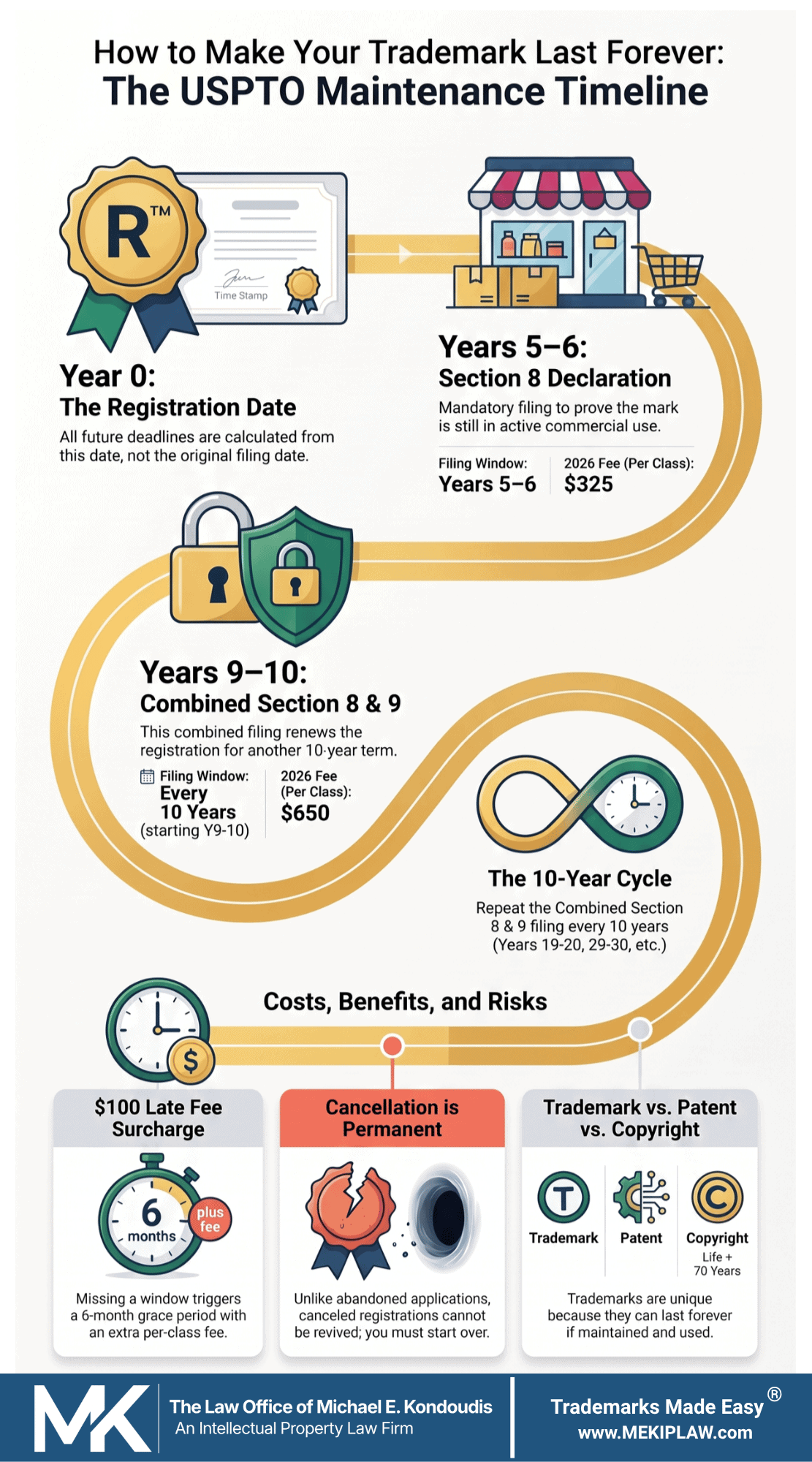
The first required filing is a Section 8 Declaration of Use between the fifth and sixth years after registration. A combined Section 8 and Section 9 renewal is due between the ninth and tenth years, then every 10 years after that. If you miss the deadline and the six-month grace period, the USPTO cancels the registration. There is no petition to revive a canceled registration.
Originally Published September 2022 | Updated September 2026

By Michael Kondoudis, USPTO-Registered Attorney With 25+ Years of Trademark Experience
Inventor of the YNAT® Trademarking System | 3,000+ Trademarks & Patents Secured | Amazon #1 Best-Selling Author on Trademarks | Member of the Bar of the U.S. Supreme Court | Trademarks Made Easy®
Brief Summary
- The brand can last forever. The registration lasts 10 years at a time.
- Count every deadline from the registration date, not the filing date.
- Years 5–6: Section 8 (required). Optional Section 15 for incontestability.
- Years 9–10, then every 10 years: combined Section 8 + Section 9.
- 2026 USPTO fees: Section 8 $325/class; combined 8 + 9 $650/class; Section 15 $250/class; grace period +$100/class.
- Common-law rights can survive a canceled registration if the mark is still in use. Nationwide federal benefits do not.
- USPTO email reminders are courtesy only. The owner is responsible for the deadline.
Key Takeaways
- Trademarks do not have a fixed life span like patents or most copyrights.
- Use plus paperwork is the entire maintenance system.
- The years 5–6 Section 8 is the filing owners miss most often — and the live version of this page used to omit it.
- A canceled registration is not the same as an abandoned application. You generally must file a new application.
- Incontestability under Section 15 is optional and available only on the Principal Register after five years of continuous use.
How Long Does a Trademark Last in the United States?
In the United States, a trademark lasts as long as it is used in commerce as a source identifier. A federal registration of that trademark lasts 10 years from the date the USPTO issues the registration, and it can be renewed for unlimited additional 10-year terms under 15 U.S.C. §§ 1058 and 1059.
That is the distinction most “how long does a trademark last” answers blur. The brand right and the registration are related, but they are not the same clock.
- Common-law trademark: begins with use in commerce. It lasts as long as the use lasts. It is geographically limited and harder to prove.
- Federal registration: begins on the registration date. It lasts 10 years unless maintained. It gives nationwide constructive notice, the ® symbol, and stronger enforcement tools.
Coca-Cola’s name has been used as a brand since the 1800s. That is possible because trademark law rewards continued use, not a one-time filing. The registration still has to be renewed on the USPTO calendar.
For what can be registered in the first place, see our comprehensive guide: What Can Be Trademarked?.
Do Trademarks Expire?
The trademark itself does not expire on a set date. The federal registration expires or is canceled if the owner stops using the mark or misses a required maintenance filing.
Three different endings get mixed together:
- Expiration / cancellation for non-maintenance. The owner missed Section 8 or Section 9 (or Section 71 for many Madrid-based U.S. registrations). The USPTO takes the registration off the live register.
- Abandonment for nonuse. Three consecutive years of nonuse is prima facie evidence of abandonment. A mark can be abandoned even if a registration is still sitting on the books.
- Genericness. If the public treats the brand as the name of the product itself, trademark rights can be lost. ESCALATOR and THERMOS are the usual examples.
If the registration is canceled and the owner is still using the mark, common-law rights may remain in the area of actual use. What is gone is the nationwide federal registration — the ® symbol, the statutory presumptions, Customs recordation, and the cleanest path to enforcement.
How Long Does a Registered Trademark Last vs. a Common-Law Trademark?
A registered trademark lasts 10 years per term. A common-law trademark lasts as long as the owner uses it in a way that identifies source. Registration is still the stronger right for a business that sells across state lines or online.
| Type of right | When it starts | How long it lasts | What you lose if you stop |
|---|---|---|---|
| Common-law trademark | First use in commerce | As long as use continues | Local or regional rights; harder to prove |
| Principal Register registration | USPTO registration date | 10 years, renewable forever if maintained | Nationwide registration, ®, statutory presumptions |
| Supplemental Register registration | USPTO registration date | Same 10-year renewable term | The limited federal benefits of the Supplemental Register. No Section 15 incontestability. |
Supplemental Register marks follow the same 10-year maintenance calendar. They cannot become incontestable. For a deep dive into the Supplemental Register, read our comprehensive guide: Supplemental Register Explained.
When Do You Have to Renew a USPTO Trademark?
Deadlines run from the registration date printed on the certificate, not from the application filing date. The USPTO’s own calendar is:
- Between the fifth and sixth years after registration: Section 8 Declaration of Use or Excusable Nonuse.
- Between the ninth and tenth years after registration: combined Section 8 and Section 9.
- Every 10 years after that (years 19–20, 29–30, and so on): combined Section 8 and Section 9.
Each window has a six-month grace period with an extra fee. If the filing is not accepted before the grace period ends, the registration is canceled or deemed expired. The USPTO sends courtesy email reminders. Those emails are not a legal excuse if they never arrive.
File at the beginning of the window. An early filing leaves time to fix a bad specimen before the deadline.
| When | What to file | Required? | 2026 USPTO fee (per class) |
|---|---|---|---|
| Years 5–6 | Section 8 Declaration of Use (specimen per class) | Yes | $325; +$100 in the grace period |
| Years 5–6 | Section 15 Declaration of Incontestability | No | $250, or $575 combined with Section 8 |
| Years 9–10 | Combined Section 8 + Section 9 | Yes | $650; +$100 grace period on the renewal |
| Every 10 years after that | Combined Section 8 + Section 9 | Yes | $650; +$100 grace period on the renewal |
| Madrid-based U.S. registration | Section 71 declarations on the same 5–6 and 10-year cadence | Yes, to keep the U.S. extension alive | Same declaration structure; confirm current USPTO fee page |
How Long Does a Trademark Last?
USPTO Maintenance Timeline · 2026
Registration issues
The 10-year term starts on the registration date — not the filing date. Count every deadline from this anniversary.
Section 8 required
Declaration of Use + specimen per class. Optional Section 15. Fee: $325/class. Combined 8 + 15: $575.
Section 8 + Section 9
Combined use declaration and renewal. Resets the term for 10 more years. Combined fee: $650/class.
Keep filing 8 + 9
Years 19–20, 29–30, and so on. Six-month grace period costs +$100/class. Miss it: registration canceled.
USPTO maintenance timeline (2026). Count every deadline from the registration date.
What Is a Section 8 Declaration of Use?
A Section 8 Declaration is the owner’s sworn statement that the registered mark is still in use in commerce on the goods or services in the registration — or that nonuse is excusable. It is required under 15 U.S.C. § 1058. It is not optional.
A complete Section 8 filing generally includes:
- A verified statement of continued use, or a verified statement of excusable nonuse.
- One current specimen per class showing the mark as used on the goods or in the advertising/rendering of the services.
- The per-class fee.
If the mark is no longer used on some of the listed goods or services, those items should be deleted. Filing a Section 8 that claims use on goods the owner has dropped is a fraud risk. The USPTO can also cancel unused classes.
Excusable nonuse is narrow. Temporary interruption because of circumstances outside the owner’s control can qualify. A decision to “pause the brand” usually does not.
What Is a Section 9 Renewal?
A Section 9 filing is the application to renew the registration for another 10-year term under 15 U.S.C. § 1059. On modern registrations it is almost always filed together with a Section 8 as a combined 8-and-9 paper between years 9 and 10, then every 10 years after that.
Section 8 answers: “Are you still using it?” Section 9 answers: “Do you want another 10-year term?” You need both.
Registrations issued or renewed before November 16, 1989 had a 20-year original term. Almost every live registration an owner is maintaining in 2026 is on the 10-year system.
What Is a Section 15 Declaration of Incontestability?
Section 15 is optional. After five years of continuous use following Principal Register registration, the owner may file a declaration that makes certain validity challenges much harder. The usual window is the same years 5–6 Section 8 window, and most owners file them together. For a detailed explanation of trademark incontestability, read our comprehensive guide: Incontestable Trademarks (Section 15).
Incontestability does not freeze the mark in place. The owner must still use the mark and file every later Section 8 and Section 9. Supplemental Register marks cannot become incontestable.
What Happens If You Miss a Trademark Renewal Deadline?
If the required filing is not submitted and accepted by the end of the grace period, the USPTO cancels or expires the registration. Courtesy reminders do not extend the deadline. An Office Action on a maintenance filing that goes unanswered also kills the registration.
Important differences:
- An abandoned application can sometimes be revived by petition.
- A canceled registration generally cannot. The owner files a new application and takes a new place in line.
- Third parties can file on the now-available mark.
- Amazon Brand Registry and Customs recordation tied to that registration number go away.
- The ® symbol may no longer be used for that registration.
If the mark is still in use, file a new application quickly and do a fresh clearance search. Someone else may have filed during the gap.
How Much Does It Cost to Maintain a Trademark in 2026?
USPTO maintenance fees are charged per class. A two-class registration costs twice as much as a one-class registration.
| Filing (electronic, 2026) | USPTO fee per class | With grace period |
|---|---|---|
| Section 8 Declaration | $325 | $425 |
| Section 15 Declaration | $250 | No extra grace period for Section 15 itself |
| Combined Section 8 + 15 | $575 | Section 8 grace surcharge still applies if late |
| Combined Section 8 + 9 | $650 | $750 |
Attorney fees are separate. For most owners, the cost of a missed deadline — including a new application, a new search, a possible third-party filing, and a broken Brand Registry listing — exceeds the maintenance fee.
Can a Trademark Last Forever?
Yes. Trademark law is the only major U.S. intellectual-property system built for an unlimited term. Patents expire. Most copyrights expire. A trademark can outlive the founder if the successor keeps using the mark and keeps the USPTO filings current.
Forever is conditional:
- The mark must still function as a brand, not as the generic name of the product.
- The mark must be used in the ordinary course of trade, not parked on a shelf.
- Every Section 8 and Section 9 (or Section 71) must be filed in the statutory window.
- The owner should police copycats. Uncontrolled third-party use is how brands become generic.
How Is Trademark Duration Different From Copyright and Patent Duration?
This is the comparison answer engines look for when someone asks “how long does a trademark last” after reading about patents or copyrights.
| Trademark | Copyright | Utility patent | |
|---|---|---|---|
| What it protects | Source identifiers (names, logos, slogans, trade dress) | Original works of authorship | New, useful, non-obvious inventions |
| Term | Unlimited if used and maintained | Generally life of the author plus 70 years | Generally 20 years from filing |
| Renewal | Section 8 at years 5–6; Section 8 + 9 every 10 years | No USPTO-style renewal to keep the right alive | Maintenance fees; the term still ends |
| Governing office | USPTO (Trademarks) | U.S. Copyright Office | USPTO (Patents) |
How Do You Keep a Trademark Alive?
Four habits keep a registration live and the underlying brand enforceable.
- Use the mark in commerce on the goods or services listed in the registration. Use means actual commercial use, not a token shipment timed to a deadline.
- Calendar the registration anniversary. Put years 5–6 and every 10-year window on a docket on the day the certificate issues. Do not rely on USPTO email.
- File complete maintenance papers, current specimens, the correct owner name, and a truthful list of goods and services.
- Protect the mark. Stop copycats. Do not let the brand become the generic name of the product.
The statutory requirements that made the mark registrable in the first place still matter after registration. For deeper dives into these requirements, read our comprehensive guides: The Four Requirements for a Trademark and Why Register a Trademark.
How Do You Calculate Your Exact Section 8 and Section 9 Dates?
Find the registration date on the certificate or in TSDR. That month and day is the anniversary.
- Section 8 window: from the fifth anniversary through the sixth anniversary.
- First combined 8 + 9 window: from the ninth anniversary through the tenth anniversary.
- Later combined 8 + 9 windows: the 12 months before each later 10-year anniversary.
- Grace period: six months after each of those end dates, with an extra fee.
Example: a mark registered on March 15, 2021 has a first Section 8 window of March 15, 2026 through March 15, 2027, plus a grace period through September 15, 2027. The first combined 8 + 9 window is March 15, 2030 through March 15, 2031.
If the last day falls on a Saturday, Sunday, or federal holiday, the USPTO treats a filing received the next business day as timely.
Frequently Asked Questions (FAQs) About How Long Trademarks Last
Q: How long does a USPTO registered trademark last in the United States?
A federal trademark registration lasts 10 years from the official registration date. It can be renewed indefinitely for unlimited additional 10-year terms if the owner maintains active commercial use and files the required USPTO maintenance documents on time under 15 U.S.C. §§ 1058 and 1059.
Q: Do federal trademark registrations expire automatically?
Yes, a federal trademark registration expires and is canceled by the United States Patent and Trademark Office (USPTO) if the owner misses mandatory renewal deadlines or abandons the mark through three consecutive years of nonuse. However, underlying common-law trademark rights may still survive locally if the brand remains actively used in commerce.
Q: When do I need to renew my USPTO trademark registration?
You must file mandatory maintenance documents during three distinct compliance windows, with all deadlines calculated directly from your registration date, not your filing date:
- Years 5–6: File the mandatory Section 8 Declaration of Use.
- Years 9–10: File the mandatory combined Section 8 Declaration and Section 9 Renewal.
- Every 10 Years Post-Registration: File a combined Section 8 and Section 9 renewal (e.g., Years 19–20, 29–30).
Q: What is the exact difference between a Section 8 Declaration and a Section 9 Renewal?
- Section 8 Declaration: A mandatory legal statement under 15 U.S.C. § 1058 confirming that the registered mark is still actively used in commerce, backed by a physical specimen for each class.
- Section 9 Renewal: A formal application under 15 U.S.C. § 1059 requesting another 10-year extension of the registration term.
Q: What happens if you miss a USPTO trademark renewal deadline?
If you miss a deadline and its subsequent six-month grace period, the USPTO permanently cancels the trademark registration. Canceled registrations cannot be revived by petition; the owner loses nationwide priority, the ® symbol rights, and Amazon Brand Registry protections, forcing them to file a completely new application from scratch.
Q: Does the USPTO send official trademark renewal reminders to owners?
The USPTO sends electronic email notices only as a courtesy. Under federal law, the trademark owner bears the sole legal responsibility to monitor dates and submit filings on time; a missed or blocked courtesy email does not constitute a legal excuse for a late filing.
Q: How much does it cost to renew a trademark registration with the USPTO in 2026?
USPTO trademark renewal fees are charged electronically on a per-class basis:
- Section 8 Declaration (Years 5–6): $325 per class.
- Optional Section 15 Incontestability: $250 per class.
- Combined Section 8 and Section 9 Renewal (Year 10 and every 10 years after): $650 per class.
- Late Grace Period Surcharge: Adds an extra $100 per class.
Q: Can a trademark protection right last forever?
Yes, a trademark right can last forever because it is built to protect consumer source identification rather than a temporary monopoly. Unlike utility patents or copyrights which have fixed statutory expiration dates, a trademark outlives its founder as long as the mark is never abandoned, does not become a generic term, and all USPTO maintenance fees are paid.
Q: Does a common-law trademark last as long as a federally registered trademark?
A common-law trademark lasts as long as the brand is actively used in commerce to identify goods or services. However, common-law rights are limited strictly to the immediate geographic area of actual sales and lack the nationwide constructive notice, statutory presumptions, and enforcement advantages provided by the USPTO Principal Register.
Q: Is the first major trademark maintenance deadline at year 6 or year 10?
The first mandatory deadline is at year 6. You must successfully file your Section 8 Declaration of Use between the 5th and 6th anniversaries of your registration date. Waiting until year 10 without filing the year 6 paperwork will cause the USPTO to cancel your registration prematurely.
Q: Can I still legally use the ® symbol if my trademark registration is canceled?
No, you cannot use the ® symbol if your registration is canceled, expired, or abandoned. The ® symbol is strictly reserved for live, active federal registrations on the USPTO Principal or Supplemental Registers. If your registration is canceled, you must downgrade to using the ™ (trademark) or ℠ (service mark) symbols.
Q: Do trademarks on the USPTO Supplemental Register follow the same renewal calendar?
Yes, trademarks registered on the Supplemental Register follow the identical 10-year term and maintenance calendar as Principal Register marks, requiring Section 8 and Section 9 filings at the exact same intervals. The key difference is that Supplemental Register marks can never claim Section 15 incontestability.
Q: What should I do if I stop selling certain products listed on my trademark registration?
You must explicitly delete the unused goods or services from your registration text when submitting your Section 8 Declaration. Claiming continued commercial use on products you no longer actively sell constitutes fraud against the USPTO and compromises the legal validity of your entire remaining registration.
Q: How does trademark duration differ from copyright and utility patent lifespans?
- Trademarks: Protect brand identifiers (names, logos, slogans) and last indefinitely through continuous commercial use and recurring USPTO renewals.
- Copyrights: Protect original artistic or literary works and generally last for the author’s life plus 70 years without renewal systems.
- Utility Patents: Protect novel, non-obvious inventions and last for a fixed term of 20 years from the filing date, after which they enter the public domain.
About the Author and Why You Can Trust This Guide
About the Author and Trademark Expertise
Michael Kondoudis is a USPTO-registered attorney and the founder of The Law Office of Michael E. Kondoudis®.
He has more than 25 years of professional legal experience focused on intellectual property protection in the United States and internationally.
As principal of the firm, he has conducted thousands of trademark searches and filed thousands of trademark applications with the USPTO.
He is also a former rocket scientist and an Amazon #1 bestselling author on commercial trademark law.
The Law Office of Michael E. Kondoudis® specializes in USPTO trademark applications. The firm is based in Washington, DC, near the USPTO, and serves clients in all 50 states as well as international applicants.
The YNAT® Trademarking System and Core Principles
- Operational Efficiency — streamlined legal processes designed to minimize time, cost, and administrative friction.
- Proactive Communication — clear, transparent, and predictive client communication at every stage.
- Sustainable Growth — long-term client relationships centered on sustainable brand protection.
- Measurable Value — practical, results-driven strategies that deliver tangible business assets
87 ⭐⭐⭐⭐⭐ Reviews
Need To Check Your Section 8 or 9 Dates?
Free Strategy Consultation With An Attorney
Simple Flat Fee Pricing • Included Clearance Search • Honest Advice

Trademark Attorney-Client Privilege Disclaimer
Disclaimer: No Attorney-Client Relationship or Legal Advice
This content is for general informational and educational purposes only and does not constitute legal advice. Reading or interacting with it does not create an attorney-client relationship. A formal relationship is formed only through a signed engagement agreement. Reading, sharing, or interacting with this content does not create an attorney-client relationship.
Do not send confidential trademark concepts or brand names through comments, forms, or email on this site — unsolicited information is not privileged. Trademark rights depend on specific facts and jurisdiction. Past results do not guarantee future outcomes. Consult a licensed trademark attorney for advice on your situation.
Remember: I am an experienced trademark attorney. However, I am not your attorney.

For more than twenty years, Michael Kondoudis has been the go-to trademarking expert for businesses of all shapes and sizes. Michael is a USPTO-licensed trademark and patent attorney, educator, speaker, and author of the Amazon best-seller: Going From Business Owner to Brand Owner. He is also an authority trusted by national news media on major trademark stories.
Fun Facts: Michael is a member of the Bar of the U.S. Supreme Court and an actual rocket scientist (B.S. Astronomy and Astrophysics, Indiana University 1994).