

Trademarks are classified by format (appearance) and by distinctiveness (how legally strong the trademark is). Trademark formats include traditional types like name and logos, as well as non-traditional types like colors and smells. There are five different types of trademarks by distinctiveness: Fanciful, Arbitrary, Suggestive, Descriptive, and Generic. Fanciful marks are the strongest type, followed in order by Arbitrary, Suggestive, Descriptive, and Generic marks.

By Michael Kondoudis, USPTO-Registered Attorney With 25+ Years of Trademark Experience
Inventor of the YNAT® Trademarking System | 3,000+ Trademarks & Patents Secured | Amazon #1 Best-Selling Author on Trademarks | Member of the Bar of the U.S. Supreme Court | Trademarks Made Easy®
⚡ Quick Summary
Trademarks are classified in two ways: by format (what the mark looks or sounds like) and by distinctiveness (how legally strong it is).
- Format types include word marks, design/logo marks, combination marks, slogans, certification marks, collective marks, sound marks, color marks, and trade dress.
- Distinctiveness is measured on the Abercrombie distinctiveness spectrum (TMEP §1209.01). The five types, from strongest to weakest, are: Fanciful → Arbitrary → Suggestive → Descriptive → Generic.
- Fanciful, arbitrary, and suggestive trademarks are inherently distinctive and qualify for immediate registration on the USPTO Principal Register.
- Descriptive trademarks require proof of secondary meaning (acquired distinctiveness) under Section 2(f) of the Lanham Act.
- Generic terms receive zero trademark protection and can never be registered.
- Choosing an inherently distinctive mark accelerates USPTO registration, expands enforcement power, and maximizes long-term brand equity.
What Are the Different Types of Trademarks? Format and Distinctiveness (Legal Strength) Explained
Trademarks are classified in two primary ways: by format and by distinctiveness. Format describes what the mark is (word, logo, slogan, sound, color, trade dress, etc.). Distinctiveness measures legal strength on the Abercrombie spectrum from fanciful (strongest) to generic (unprotectable). Both systems must be considered to select a protectable brand name. Most people searching for “types of trademarks” focus only on format.
Types of Trademarks by Format
The USPTO and federal courts recognize both traditional and non-traditional trademark formats
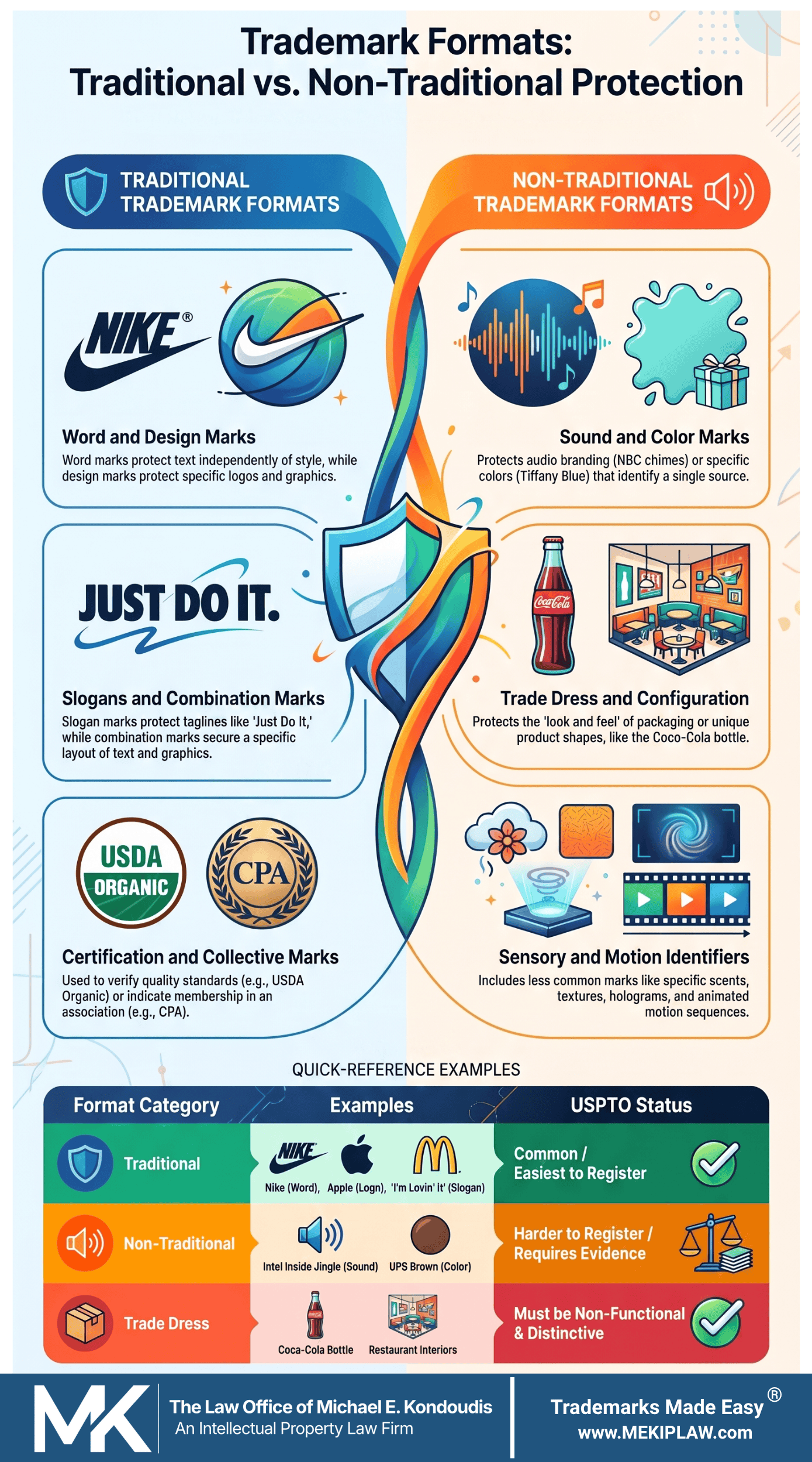
- Traditional formats (word marks, logos, slogans, combination marks, certification marks, and collective marks) are the most common and easiest to register.
- Non-traditional formats (sound, color, trade dress, motion, scent, and texture marks) are protectable but require stronger evidence of distinctiveness.
What Are Traditional Trademark Formats?
Traditional trademark formats are the most common and popular types of trademarks.
Word Marks. A word mark protects specific letters, words, or numbers independent of font, color, or stylization. Legal rights attach solely to the text. Classic examples include Nike, Apple, and Google.
Design / Logo Marks. A design mark (logo mark) protects unique visual elements, symbols, or graphic designs. Iconic examples include the Nike Swoosh, the Apple bitten-apple logo, and the McDonald’s Golden Arches.
Combination (Composite) Marks. A combination mark registers text and design elements together as a single unit. Protection is limited to the exact configuration shown. The Adidas name paired with its three-stripe design is a classic combination mark.
Slogan / Phrase Marks. A slogan mark protects short commercial phrases that function as source identifiers. Examples include Nike’s “Just Do It” and McDonald’s “I’m Lovin’ It.”
Certification Marks. A certification mark is owned by an organization that verifies third-party goods or services meet defined standards of quality, origin, or manufacturing. The owner does not use the mark on its own goods. Examples include the UL mark, Fair Trade Certified, and the USDA Organic seal.
Collective Marks. A collective mark is used by members of an association or cooperative to indicate membership. The “CPA” designation used by members of state accounting societies is a common collective mark.
What Are Non-Traditional Trademark Formats?
Sound Marks. A sound mark protects distinctive audio elements that consumers associate with a single source. Registration requires a clear acoustic description and evidence of use. Examples include the NBC chimes, the Intel Inside jingle, and the MGM lion’s roar.
Color Marks. A color mark grants exclusive rights to a specific color or color combination used as a source identifier. Color marks almost always require substantial proof of secondary meaning. Examples include Tiffany Blue, UPS Brown, and Owens-Corning Pink.
Trade Dress / Product Configuration. Trade dress protects the overall commercial look, feel, shape, packaging, or interior design of a product or service. The design must be non-functional and either inherently distinctive or have acquired distinctiveness. The Coca-Cola bottle shape is a classic example.
Less common non-traditional formats include motion marks, hologram marks, scent marks, and texture marks. These non-traditional formats require substantial evidence that the feature functions solely as a source identifier.
Types of Trademarks by Distinctiveness
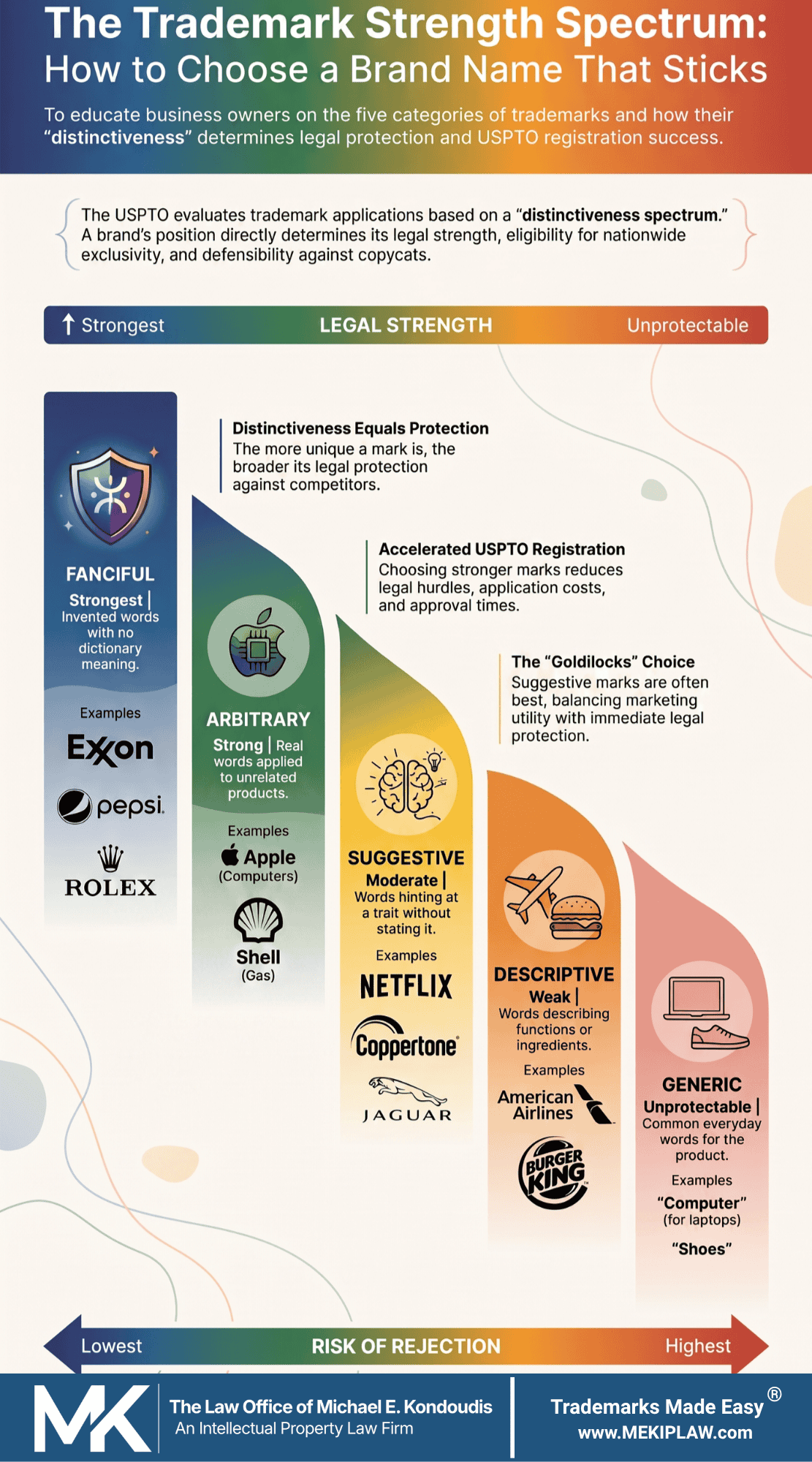
Trademarks are not equal. The USPTO evaluates distinctiveness along the Abercrombie distinctiveness spectrum (TMEP Section 1209.01)(Distinctiveness/Descriptiveness Continuum)). Position on this spectrum determines registration eligibility, legal strength, and protection against copycats.
Trademark Strength = Distinctiveness
Abercrombie Distinctiveness Spectrum Comparison
| Rank | Type | Legal Strength | Inherent Distinctiveness | USPTO Status | Examples |
|---|---|---|---|---|---|
| 1 | Fanciful | Strongest | Yes | Immediate Principal Register | Exxon, Pepsi, Rolex, Xerox, Kodak |
| 2 | Arbitrary | High | Yes | Immediate Principal Register | Apple (computers), Shell (gas), Camel, Dove |
| 3 | Suggestive | Moderate–Strong | Yes | Immediate Principal Register | Netflix, Coppertone, Jaguar, Holiday Inn |
| 4 | Descriptive | Weak | No | Requires secondary meaning (§2(f)) | American Airlines, Burger King, Sharp |
| 5 | Generic | Unprotectable | No (zero) | Permanent refusal – never registrable | “Computer,” “Shoes,” “Bookstore,” “Car Wash” |
Trademark Strength Infographic
Logos and design marks are evaluated on the same spectrum. A fanciful or arbitrary logo is far easier to register and enforce than a descriptive design.
For a deeper dive into protecting visual marks, see Are Logos Trademarked? YES! – How to Register Yours.
What Is A Fanciful Trademark?
A fanciful trademark (also called a coined mark) is an invented word with no prior dictionary meaning. (TMEP § 1209.01(a)) Fanciful trademarks sit at Tier 1 — the strongest position on the Abercrombie spectrum (15 U.S.C. § 1052).
What are the Core Traits of Fanciful Trademarks?
- Completely invented word with zero pre-existing meaning
- No contextual connection to the goods or services
- Qualifies for immediate registration on the Principal Register
- Receives the broadest enforcement protection from federal courts
- Rarely conflicts with foreign dictionary terms
What Are The Best Examples of Fanciful Trademarks?
- EXXON® is a classic fanciful trademark — a completely coined word invented solely to brand petroleum and energy products.
- ROLEX® is a fanciful trademark — an invented word created exclusively to identify luxury watches.
- KODAK® is a fanciful trademark — a neologism engineered solely to brand photographic cameras and film.
- PYREX® is a fanciful trademark — a coined term created specifically to market glass bakeware.
Fanciful marks face the lowest risk of descriptiveness refusal and deliver the strongest long-term exclusivity. In the music industry, the Rolling Stones tongue and lips logo and the Metallica logo are examples of fanciful trademarks that enjoy robust trademark protection.
What Is An Arbitrary Trademark
An arbitrary trademark is a real dictionary word applied to completely unrelated goods or services. (TMEP § 1209.01(a)). Arbitrary trademarks sit at Tier 2 on the Abercrombie spectrum and is inherently distinctive (15 U.S.C. § 1052).
What are the Core Traits of Arbitrary Trademarks?
- Uses an ordinary dictionary word
- Literal meaning has zero relationship to the product or service
- Qualifies for immediate Principal Register registration
- Requires marketing investment to teach consumers the brand association
- Receives broad exclusivity against competitors
What Are The Best Examples Of Arbitrary Trademarks?
- APPLE® is a classic arbitrary trademark — a standard edible fruit used as an identifier for consumer smartphones and computers.
- SHELL® is an arbitrary trademark — the protective outer layer of a marine organism applied as a brand for commercial gasoline.
- CAMEL® is an arbitrary trademark — a large desert mammal used as a brand identifier for tobacco products.
- DOVE® is an arbitrary trademark — a small white bird used as a brand mark for soap and chocolate.
What Is A Suggestive Trademark
A suggestive trademark hints at a quality, characteristic, or benefit of the product without directly describing it. (TMEP § 1209.01(a)). Suggestive Trademarks sit at Tier 3 and is inherently distinctive. Suggestive marks often deliver the best real-world balance of marketing utility and legal strength. (15 U.S.C. § 1052).
What is the Imagination Test for Suggestive Marks?
A consumer must use multi-step mental reasoning to connect the word to the product. This required leap of imagination is what separates suggestive marks from descriptive marks.
What are the Core Traits of Suggestive Trademarks?
- Uses a real word that alludes to a product trait
- Requires consumer imagination to understand the connection
- Qualifies for immediate Principal Register registration
- Ideal for startups and creators with limited marketing budgets
What Are The Best Examples of Suggestive Trademarks?
- NETFLIX® is a classic suggestive trademark — a combination of “net” and “flix” that hints at internet-based movie streaming without directly describing it.
- COPPERTONE® is a suggestive trademark — a name that alludes to the golden skin tone resulting from sunscreen use.
- JAGUAR® is a suggestive trademark — a name that evokes attributes of speed, agility, and power for automobiles.
- HOLIDAY INN® is a suggestive trademark — a name that evokes an aura of relaxation and a welcoming vacation environment.
What Is A Descriptive Trademark
A descriptive trademark directly describes a quality, characteristic, function, ingredient, or purpose of the goods or service (TMEP § 1209.01(b)). Descriptive Trademarks sit at Tier 4 and are not inherently distinctive. (15 U.S.C. § 1052).
What are the Core Traits of Descriptive Trademarks?
- Literal meaning has an immediate, clear relationship to the product
- Require zero consumer imagination to deduce the product
- Cannot register on the Principal Register without proof of secondary meaning
- Receives narrower protection even after registration
- Requires more enforcement effort
What is Secondary Meaning and Acquired Distinctiveness?
Secondary meaning exists when consumers no longer view the term as a product description but instead recognize it as a single commercial source. Section 2(f) of the Lanham Act (15 U.S.C. §1052(f)) permits registration only after secondary meaning is established.
In trademark practice, secondary meaning and acquired distinctiveness are used interchangeably — both describe the point at which consumers recognize a descriptive term as a single commercial source rather than a mere product description.
How Do You Prove Secondary Meaning?
To overcome a USPTO descriptiveness refusal under Section 2(f) of the Lanham Act, a trademark applicant must demonstrate acquired distinctiveness through four kinds of empirical evidence:
- Duration of use — typically five years of continuous and substantially exclusive use
- Advertising spend — high volume of advertising that promotes the mark
- Sales revenue and market penetration — extensive commercial success and consumer exposure
- Consumer surveys — direct evidence that the public associates the term with a single source
What Are The Best Examples of Descriptive Trademarks?
- AMERICAN AIRLINES® is a descriptive trademark — a name that directly describes an aviation transport operator based in America.
- CARTOON NETWORK® is a descriptive trademark — a name that directly describes a cable broadcasting network focused on cartoons.
- BURGER KING® is a descriptive trademark — a name that directly describes a fast-food establishment specializing in hamburgers.
- SHARP® is a descriptive trademark — a name that directly describes a primary performance feature of a television screen.
What Is A Generic Trademark? (Unprotectable)
A generic term is the common everyday name for a category of product or service. (TMEP § 1209.01(c)). Generic terms sit at Tier 5 — the bottom of the spectrum — and receive zero trademark protection.
What are the Core Traits of Generic Terms?
- Names the product category itself, not a source
- Never inherently distinctive
- Cannot be registered on the Principal or Supplemental Register
- Can never acquire distinctiveness
- Anyone may use the term freely
What is Genericide?
Genericide occurs when a once-protectable trademark becomes the common name for an entire product category through public use and failure to police the mark. Classic examples of genericide include ASPIRIN and ESCALATOR.
What Are The Best Examples Of Generic Terms?
- BOOKSTORE is a generic term — the common category name for retail establishments that sell books and therefore receives zero trademark protection.
- CAR WASH is a generic term — the common category name for automotive cleaning service providers and therefore cannot function as a trademark.
- ASPIRIN is a classic example of genericide — a former trademark that lost all exclusive rights after the public adopted it as the common name for over-the-counter pain relievers.
- ESCALATOR is a classic example of genericide — a former proprietary brand name that permanently lost trademark protection and became the generic category term for moving staircases.
Even creative misspellings usually fail if consumers still understand the term as the product category.
Why Don’t Generic Terms Receive Trademark Protection?
Generic terms are incapable of distinguishing one company’s goods from another’s because they name the category itself. The USPTO will refuse registration of generic terms outright. Even creative spellings (e.g., “Bookstorr” or “Kawr Wash”) or combinations usually fail if the term still functions as a generic descriptor in the minds of consumers.
Why Do The Strongest Trademarks Win?
Stronger trademarks (fanciful, arbitrary, and suggestive) register faster, cost less to enforce, deter competitors more effectively, and build higher long-term brand equity. Weak or descriptive marks face higher refusal rates, narrower protection, and greater rebranding risk.
Advantage 1: Easier and Faster Federal Registration. Fanciful, arbitrary, and suggestive marks are inherently distinctive. They normally register on the Principal Register without secondary-meaning evidence and face the lowest risk of distinctiveness refusals.
Advantage 2: Broader Legal Protection. Courts grant stronger marks a wider scope of protection against similar marks. Strong marks support more effective cease-and-desist letters and federal litigation under the likelihood-of-confusion analysis (DuPont factors).
Advantage 3: Higher Commercial Value. Strong trademarks are easier to license, sell, and defend. Investors and acquirers assign higher value to brands protected by inherently distinctive federal registrations.
Why Weak Trademarks Underperform
Descriptive trademarks trigger higher USPTO refusal rates and require expensive secondary-meaning evidence. Even after registration, they receive narrower protection. Generic terms offer no protection at all and leave the brand permanently exposed.
Bottom line: Choosing a strong mark will save you time and money
How Do I Choose a Strong Trademark? (5-Step Strategic Framework)
Choose the strongest available mark by: (1) avoiding descriptive and generic terms, (2) targeting suggestive or stronger names, (3) inventing a fanciful mark when possible, (4) conducting a proper clearance search, and (5) filing an intent-to-use or use-based application promptly to secure priority.
Use this five-step framework to select a trademark that maximizes USPTO registration speed, legal strength, and long-term brand equity while minimizing the risk of costly refusals or forced rebranding.
Step 1: Bypass the Descriptive Trap
Reject any name that merely describes a feature, quality, ingredient, or function. Descriptive marks create unnecessary legal risk from day one.
Step 2: Target the Suggestive Sweet Spot
When marketing budgets are limited, prefer a suggestive mark. Suggestive marks balance immediate consumer understanding with inherent distinctiveness and eligibility for the Principal Register
Step 3: Budget for Fanciful (Coined) or Arbitrary Names
Choose a completely invented (fanciful) or completely unrelated (arbitrary) name only when you can invest in teaching consumers the brand association. These marks offer the strongest legal protection.
Step 4: Execute a Comprehensive Clearance Search
Before buying domains or packaging, conduct a thorough search of the USPTO database, state registries, common-law uses, and major social platforms. A professional clearance opinion identifies conflicts early.
Step 5: Establish Federal Priority Early
File an Intent-to-Use (ITU) application as soon as the name is cleared. An ITU filing secures nationwide priority under the Lanham Act before competitors can file.
What Are Common Mistakes Entrepreneurs Make When Selecting Trademarks?
Most trademark problems start with poor name selection. The most common and costly mistakes include choosing descriptive or generic terms, skipping a professional clearance search, assuming a domain name creates trademark rights, and failing to understand the distinctiveness spectrum before filing.
- Choosing a descriptive name because “it explains what we do”
- Falling in love with a weak or generic name and underestimating future legal costs
- Skipping a professional trademark search and clearance opinion
- Assuming that a business-name registration or domain purchase creates trademark rights
- Under-investing in brand education for fanciful or arbitrary names
Key Takeaways for Entrepreneurs
The strongest trademarks are fanciful, arbitrary, and suggestive marks. Descriptive marks require secondary meaning. Generic terms are never protectable. Selecting a strong mark from the start dramatically improves registration success, enforcement power, and long-term brand value.
- The Abercrombie spectrum (generic → descriptive → suggestive → arbitrary → fanciful) directly controls registration speed and enforcement power.
- Suggestive trademarks usually deliver the best practical results for most businesses and creators.
- Inherently distinctive marks (fanciful, arbitrary, suggestive) reduce legal risk, improve enforcement options, and increase long-term brand equity.
- Descriptive and generic terms frequently produce USPTO refusals and leave the brand weakly protected or unprotected.
Frequently Asked Questions About The Types of Trademarks
This reference section provides immediate, direct answers to the most common legal questions regarding the 5 types of trademarks.
Q: What are the different types of trademarks?
Trademarks are classified in two main ways: by format (word, logo, slogan, sound, color, trade dress, etc.) and by distinctiveness (fanciful, arbitrary, suggestive, descriptive, and generic). Both systems determine how well a mark can be registered and enforced.
Q: What is the strongest type of trademark?
Fanciful trademarks are the strongest. These are completely invented words (such as Xerox, Kodak, or Exxon) with no prior meaning. They receive the broadest legal protection and are the easiest to register with the USPTO.
Q: What is the best type of trademark for a small business or startup?
Suggestive trademarks are usually the best choice for small businesses and startups. They hint at a product benefit without being descriptive, making them inherently distinctive, easier to market, and fully protectable without needing secondary meaning.
Q: Can I trademark a descriptive name?
Yes, but only if you can prove secondary meaning (acquired distinctiveness). Without evidence that consumers recognize the descriptive term as a brand, the USPTO will refuse registration on the Principal Register.
Q: Can generic terms be trademarked?
No. Generic terms (the common name for a product or service category) can never be registered or protected as trademarks. Examples include “computer” for laptops or “bookstore” for a book retailer.
Q: What is the difference between a fanciful and an arbitrary trademark?
A fanciful trademark is a made-up word with no prior meaning (Xerox). An arbitrary trademark is a real word used in an unrelated context (Apple for computers). Both are inherently distinctive and highly protectable.
Q: How long does it take to register a trademark with the USPTO?
The average time is 12 to 18 months for a straightforward application. Applications facing Office Actions, descriptiveness refusals, or oppositions often take longer.
Q: What is the Abercrombie spectrum?
The Abercrombie spectrum is the five-level scale the USPTO and courts use to measure trademark strength: fanciful (strongest), arbitrary, suggestive, descriptive, and generic (weakest/unprotectable).
Q: Do I need a trademark attorney to choose the right type of trademark?
While not legally required, working with an experienced trademark attorney significantly increases the chance of selecting a strong, registrable mark and avoiding costly refusals or future rebranding.
Q: What happens if my trademark becomes generic?
If a trademark becomes the common name for the product itself (genericide), it loses all trademark protection. Famous examples include Aspirin, Escalator, and Thermos.
Q: Can I register a sound, color, or scent as a trademark?
Yes, non-traditional marks such as sounds, colors, and scents can be registered, but they are much harder to protect. You must prove the feature is distinctive and functions as a source identifier, often requiring substantial evidence of secondary meaning.
About the Author and Why You Can Trust This Guide
About the Author and Trademark Expertise
The YNAT® Trademarking System and Core Principles
- Operational Efficiency: The Trademarks Made Easy® methodology utilizes streamlined legal processes designed to minimize time, financial cost, and administrative friction for trademark applicants.
- Proactive Communication: The Trademarks Made Easy® methodology guarantees clear, transparent, and predictive client communication at every stage of the USPTO application cycle.
- Sustainable Growth: The Trademarks Made Easy® methodology focuses on building long-term client relationships centered on sustainable brand protection and long-term business equity.
- Measurable Value: The Trademarks Made Easy® methodology prioritizes practical, results-driven legal strategies that deliver tangible business assets rather than unnecessary legal complexity or billable litigation.
87 ⭐⭐⭐⭐⭐ Reviews
Protect What You’ve Built — Take the Next Step
Business, product, and service names are trademarked every day. The real question is whether yours will be protected before someone else tries to claim or copy it.
If you’re ready to explore protecting your name — or you already have questions about an existing design, a potential conflict, international strategy, or maintaining an existing registration — I invite you to schedule a complimentary strategy consultation.
Trademarks Made Easy® isn’t just a slogan—it’s how we work.
Want To Make Sure Your Name is 100% Yours Forever?
Free Strategy Consultation With An Attorney
Simple Flat Fee Pricing • Free Clearance Search • Honest Advice

Trademark Attorney-Client Privilege Disclaimer
Disclaimer: No Attorney-Client Relationship or Legal Advice
This content is for general informational and educational purposes only and does not constitute legal advice. Reading or interacting with it does not create an attorney-client relationship. A formal relationship is formed only through a signed engagement agreement. Reading, sharing, or interacting with this content does not create an attorney-client relationship.
Do not send confidential trademark concepts or brand names through comments, forms, or email on this site — unsolicited information is not privileged. Trademark rights depend on specific facts and jurisdiction. Past results do not guarantee future outcomes. Consult a licensed trademark attorney for advice on your situation.
Remember: I am an experienced trademark attorney. However, I am not your attorney.

For more than twenty years, Michael Kondoudis has been the go-to trademarking expert for businesses of all shapes and sizes. Michael is a USPTO-licensed trademark and patent attorney, educator, speaker, and author of the Amazon best-seller: Going From Business Owner to Brand Owner. He is also an authority trusted by national news media on major trademark stories.
Fun Facts: Michael is a member of the Bar of the U.S. Supreme Court and an actual rocket scientist (B.S. Astronomy and Astrophysics, Indiana University 1994).